Introduction
You have the budget and the room. What you don't have is a reason to pick a side.
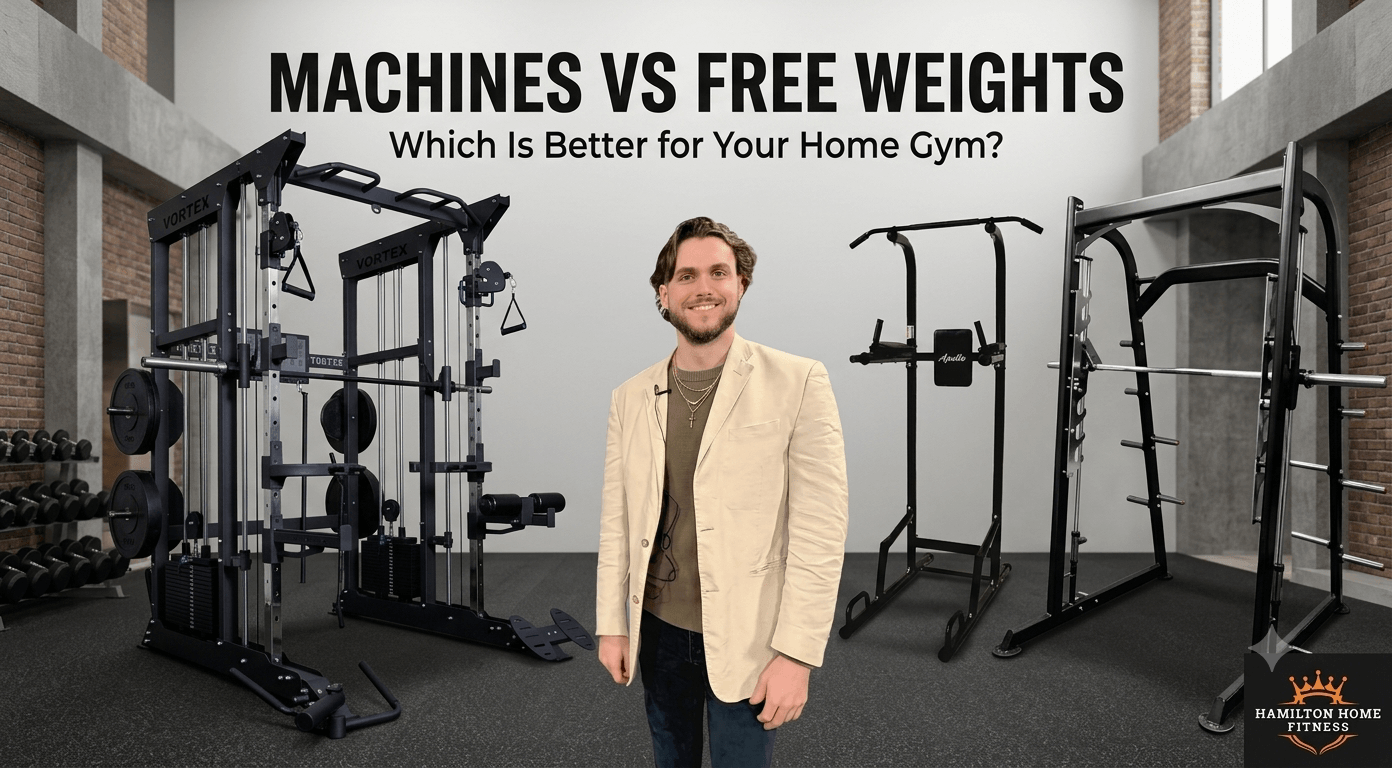
Most machine vs. free weight advice calls the machine the lesser choice and never says why. Machines win when you train alone and want to push hard without gambling on form. Free weights win when you want strength that holds up in unpredictable movement.
Both are true. The useful question isn't which is better — it's which one you buy first, and what comes second.
Machines vs Free Weights: What Each Trains
Machines fix the movement path so nearly all your effort goes into the target muscle. Free weights leave the path open, so you spend part of every rep controlling balance and position. That single difference explains almost everything else people argue about.
Pick up a pair of dumbbells for your first press, and you'll feel it—the small wobble at the bottom, one arm drifting before the other. That wobble is your stabilizer muscles working: the smaller muscles that hold a joint in place while the big ones move the load. On a chest press machine, the frame does that job for you.
Neither is a flaw. It's a trade. Stability you don't have to supply is effort you can spend on the muscle you came to train.
Guided machine | Free weight | |
Target-muscle loading | High—the path is fixed for you | Shared with balance work |
Balance and coordination | Minimal demand | Trained every rep |
Skill to start | Sit down and go | Weeks of practice |
Load progression | Pin or plate, small steps | Larger jumps, no ceiling |
Range of motion | Set by the frame | Set by your body |
Is the Not-Functional Claim True?
Mostly a myth, with a real kernel. Strength is specific: you improve most at the exact movement you practice. Train on machines, and you get strong on machines. Train with a barbell and you get strong with a barbell. Neither builds strength that stops existing outside its own pattern.
That's what controlled comparisons keep finding. Test a machine-trained lifter on machines, and they win. Test a barbell-trained lifter on the barbell, and they win. Compare general strength or muscle size, and the gap closes to nothing worth arguing about.
So where's the kernel of truth? Carry an awkward 60-pound box up a flight of stairs. Your grip fights the shape. Your torso corrects every time the load shifts. Nothing about that is guided. Free weights help with that correction, and machines don't.
Real advantage — just a narrower one than the claim suggests. Machines aren't a compromise on strength. They're a compromise on one specific skill.
Machine or Barbell Rack First?
Buy the machine first if you train alone, have limited experience, or share the space with people at different strength levels. Buy the rack first if you already know how to squat and press, and your goal is heavier barbell numbers. Most first-time buyers fit the first description.
Start With a Machine If
If nobody's home to spot you and you're still learning what a good rep feels like, a guided machine lets you train close to your limit without gambling on technique.
It also solves the household problem. A 200-pound lifter and a 130-pound one can share one stack and just move the pin.
The Body-Solid G1B multi-station gym is worth considering here—a 160 lb stack covering press, pulldown, row, leg, and core work in a 55" × 47" footprint, shipped free with an in-home lifetime warranty. It's residential-rated, so skip it for a shared studio floor.
Start With a Rack If
If you already squat and press with reasonable form, a power rack with safety pins gives you a higher ceiling for less money than any machine at that price.
Set the pins just below your working depth, and a failed rep lands on steel instead of your chest. That's what makes solo barbell work viable — not a spotter.
The cost is the learning curve. A rack rewards a technique you already have. It doesn't teach it.
Stack, Plate, and Cable Under Load
A weight stack changes load with a pin and holds tension evenly through the rep. A plate-loaded machine uses Olympic plates and feels closer to a barbell, with resistance that shifts through the range. A cable column lets you pull from any angle, which no fixed path allows.
Stacks are the fastest to use. Drop the pin, go. The catch is what the number means—pulley systems can change the load you actually feel against what's written on the plate, so a 160 lb stack rarely feels like 160 lb in your hands.
Plate-loaded machines feel heavier at the bottom and lighter at the top, the way a real lift does. You also have to load and strip plates between sets, which slows you down. Worth reading how selectorized and plate-loaded machines compare before you commit.
Cables are the outlier. Tension stays on through the whole rep, and you choose the angle rather than accepting the frame's.
Can Machines Alone Build Muscle?
Yes, for most home lifters. Muscle responds to hard, progressive effort more than to the tool delivering it, and controlled comparisons find no meaningful growth advantage either way when effort and volume match. The real limits on a machine-only setup are exercise variety and how far the stack goes.
Both are manageable. When a stack stops feeling heavy, slow the lowering phase, pause at the hardest point, or switch to one arm or one leg at a time. That buys you months.
Variety is the harder ceiling—and it's what cable columns add that fixed paths cannot. A chest press does one thing well. A cable does a dozen.
Running Both in One Weekly Plan
Put the free weight work first while you're fresh and your technique is sharp. Finish on machines, where you can push close to failure without form breaking down under fatigue. That order holds whether you run full body, upper/lower, or push/pull/legs.
A push day looks like this: barbell bench, then dumbbell shoulder press, then machine chest press and cable pressdowns to finish. Hard lifts while you're sharp and safe volume after that.
Rather not sequence two purchases at all? The Vortex VX1000 power rack with a functional trainer puts an Olympic rack, a Smith module, and dual cable columns in one frame, rated to 1,000 lb and shipped free. The trade is size—roughly 68.5" × 82.6" × "91.3"—so you need real ceiling height and a clear path to get it into the room.
FAQ
Is a home gym machine worth it?
Yes, if it removes a barrier you actually face—no spotter, limited technique, or shared use. Entry cost varies widely. A power tower in the low hundreds covers pulling and dips but won't load pressing, squatting, or hinging. Full multi-station gyms run into the low thousands.
Do I need a spotter for free weights at home?
Not if the rack is set up correctly. Safety pins and spotter arms set just below your working depth catch a failed rep. Machines remove the question entirely by fixing the bar path. Training heavy with neither is the genuinely risky option.
How much space does each option need?
Measure floor length and width, ceiling height, and standing clearance on every side you'll use before you shop. Racks and multi-station gyms commonly need seven to eight feet of ceiling. Then check those numbers against the product page. The space rules and full purchase order go deeper.
Are machines safer for sore knees, shoulders, or a bad back?
Often, because the fixed path and supported seating reduce how much you have to stabilize under load. That's general guidance, not a treatment plan. If you're working around pain or recovering from an injury, get clearance from a qualified professional before loading the movement.
Final Thought
Whichever you buy first, the second purchase is the one that covers what the first can't. Start on a machine and add a barbell once your technique is ready. Start with a rack and add cables when you want volume without form breaking down.
Taking the guided route? Browse home workout machines. On the barbell path, start in the free weights range. Still undecided—book a gym design consultation, and we'll sequence it around your room.
Hamilton Home Fitness is an authorized dealer shipping to all 50 states from Tennessee.