Introduction
You have a 200–400 sq ft garage or basement, you lift five days a week for hypertrophy, and you're stuck on one purchase: one pair of premium adjustables like Nuobell that replaces a full rack or a 5–70 lb rubber hex set on a saddle rack that takes the floor space but lasts decades. Both are honest choices, and the wrong one costs you either money or floor space you can't get back.
Here's the short answer before the details: Adjustable dumbbells win on space and cost per pound; fixed rubber hex sets win on durability, drop tolerance, and lifting feel. The right pick comes down to your floor plan and how you actually train.
This article compares the two across four axes that matter for a home gym—space, cost, durability, and lifting feel; gives a verdict by buyer type; and shows the numbers behind the call.
Quick Verdict and Comparison Table
Adjustable dumbbells like Nuobell win on space and cost per pound; fixed rubber hex sets win on durability, drop tolerance, and lifting feel—choose by floor space and how often you drop weights.
Factor | Nuobell Adjustable (5–80 lb pair) | BodyKore RB570 5–70 lb Rubber Hex Set with Rack |
Floor footprint | Under 2 sq ft on cradle stand | About 14 sq ft for rack + clearance |
Upfront cost | ~$745 per pair (manufacturer) | $2,399 for 14 pairs + 3-tier rack |
Cost per pound of capacity | ~$4.66 per lb (single pair) | ~$2.55 per lb (full set, 14 dedicated pairs) |
Durability | 2-year warranty; voided by drops | Decades of use; no moving parts |
Drop tolerance | Not drop-rated; mechanism can fail | Built to be dropped on protected flooring |
Lifting feel | Slightly longer handle; otherwise close to fixed | Native, balanced feel on every lift |
Weight change speed | ~2–3 seconds (twist handle) | Instant—pick up the next pair |
Weight range | 5–80 lb (or 5–100 lb on S 5100 model) | 5–70 lb in 5 lb increments, dedicated |
Best for | Solo lifter, limited space, controlled hypertrophy work | Dedicated training room, partner training, heavy or drop-prone lifts |
The table tells most of the story. The next four sections show the math, the trade-offs, and the disclosures behind each row—so you can see both options side-by-side in the dumbbells subcategory with the full picture in hand.
Space and Footprint in a Home Gym
A 5–70 lb rubber hex set with a 3-tier rack occupies roughly 14 square feet of dedicated floor area; a single Nuobell pair on its cradle stand occupies under 2 square feet—a 7× footprint difference before you add lift-out clearance.
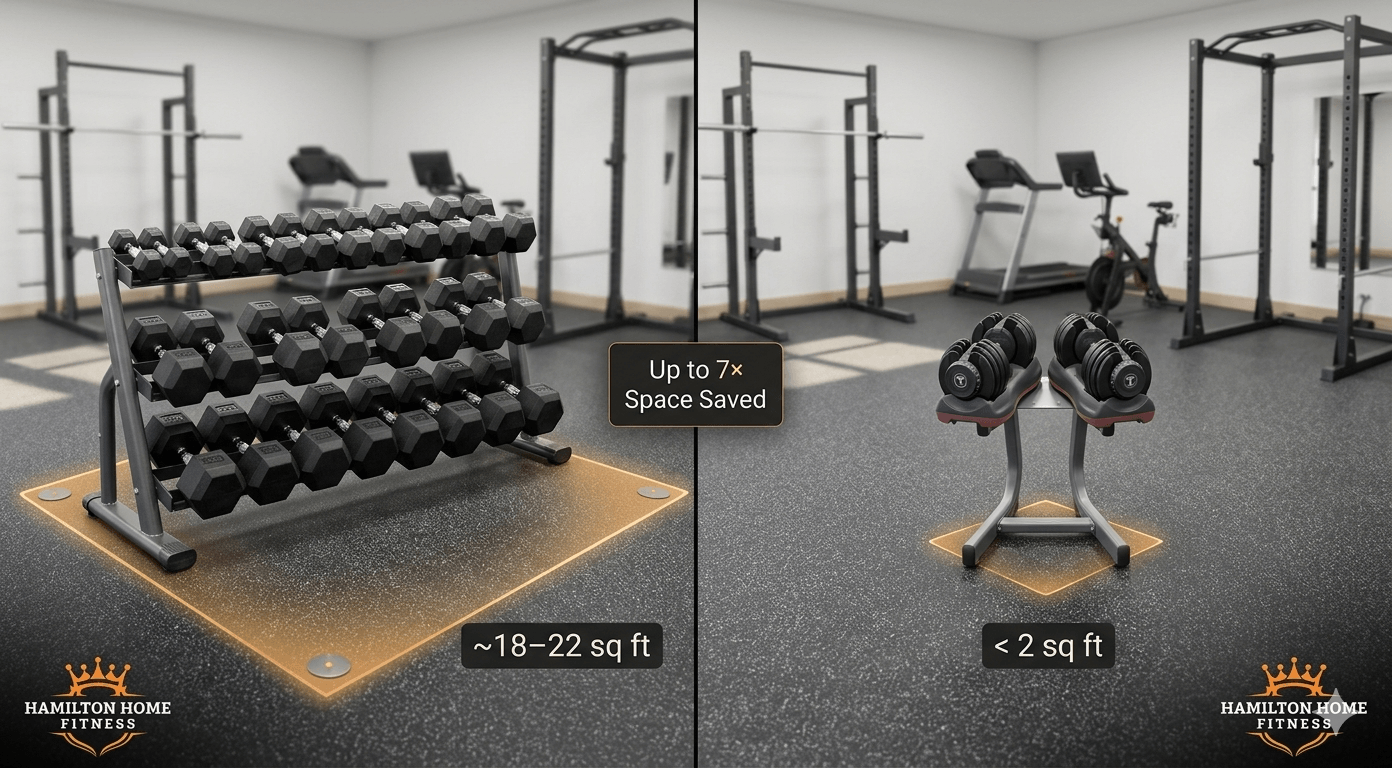
For a 200–400 sq ft garage or basement, that gap decides whether you also fit a bench, a rack, and a cardio piece or whether dumbbells eat the room.
Footprint of a 5–70 lb hex set with rack
The BodyKore RB570 3-tier rack measures 67" × 30" × 36", which works out to about 14 square feet of dedicated floor footprint—before any clearance.
Add the 24–36 inches of front clearance you need to grab and re-rack a 70 lb dumbbell safely without rotating your torso into the rack, and the real working footprint pushes closer to 18–22 sq ft. In a 240 sq ft single-car garage, that's roughly 8–9% of your total floor space gone before the bench, rack, or platform.
If that math fits your room, the BodyKore RB570 5–70 lb rubber hex set with rack gives you 14 dedicated pairs ready to grab. If it doesn't, the hex route is the wrong route — no rack rearrangement fixes a footprint problem.
Footprint of a single Nuobell pair
A Nuobell pair on its cradle measures roughly 17" × 7.5" per dumbbell, giving the full setup a footprint of under 2 square feet.
That's about 7× smaller than the racked hex set. In the same 240 sq ft garage, you reclaim 16–20 sq ft for a flat bench, a folding rack, or a rower—equipment that genuinely expands what you can train, not just what you can lift. For apartment lifters working in a spare bedroom or office, this is often the difference between a usable home gym and no gym at all.
Cost and Cost Per Pound Over Time
Per pound of lift capacity, a premium adjustable pair often lands close to a quality hex set with a rack—the upfront price gap is real, but the cost-per-pound gap usually isn't.
Here's the worked math using current published prices:
Setup | Upfront Price | Total Lb of Iron | Cost Per Lb |
Nuobell 5–80 lb pair (manufacturer price) | $745 | 160 lb (80 × 2) | ~$4.66 / lb |
BodyKore RB570 5–70 lb set + 3-tier rack | $2,399 | ~1,050 lb across 14 pairs | ~$2.28 / lb |
Nuobell S 5100 5–100 lb pair | ~$1,140 | 200 lb (100 × 2) | ~$5.70 / lb |
Read the table honestly. The racked hex set is cheaper per pound of iron—but you're paying for 14 dedicated pairs you'll rarely all use in a single session. The adjustable pair costs more per pound, but it's one pair doing the work of sixteen.
The "is Nuobell worth it?" question really comes down to whether you value one pair, always set to the exact weight you want, more than you value a full wall of weights, every pair instantly available. There's no universal answer—your training style decides.
A few hidden costs worth pricing in before you click buy:
Freight on the hex set. A 1,050 lb racked set ships LTL freight, often $150–$400 to a residential address depending on the state and liftgate requirements. Built into some retailer prices, added at checkout on others.
Replacement mechanism risk on adjustables. A dropped Nuobell mechanism isn't covered under warranty (more on this in the next section). Budget the replacement cost mentally before training to failure on heavy presses.
Resale value. Used rubber hex dumbbells hold roughly 60–80% of retail on the secondhand market for years. Adjustables with mechanism wear depreciate faster.
If the cost-per-pound math points you toward adjustables, the Nuobell adjustable dumbbells page shows current pricing on both the 5–50 lb and 5–80 lb versions for direct comparison against the racked hex setup above.
Durability and Drop Tolerance
Rubber hex dumbbells tolerate drops without complaint; premium adjustables like Nuobell carry 2–4 year warranties that are voided by drops, and reviewers have reported that dropped sets can damage the locking mechanism.
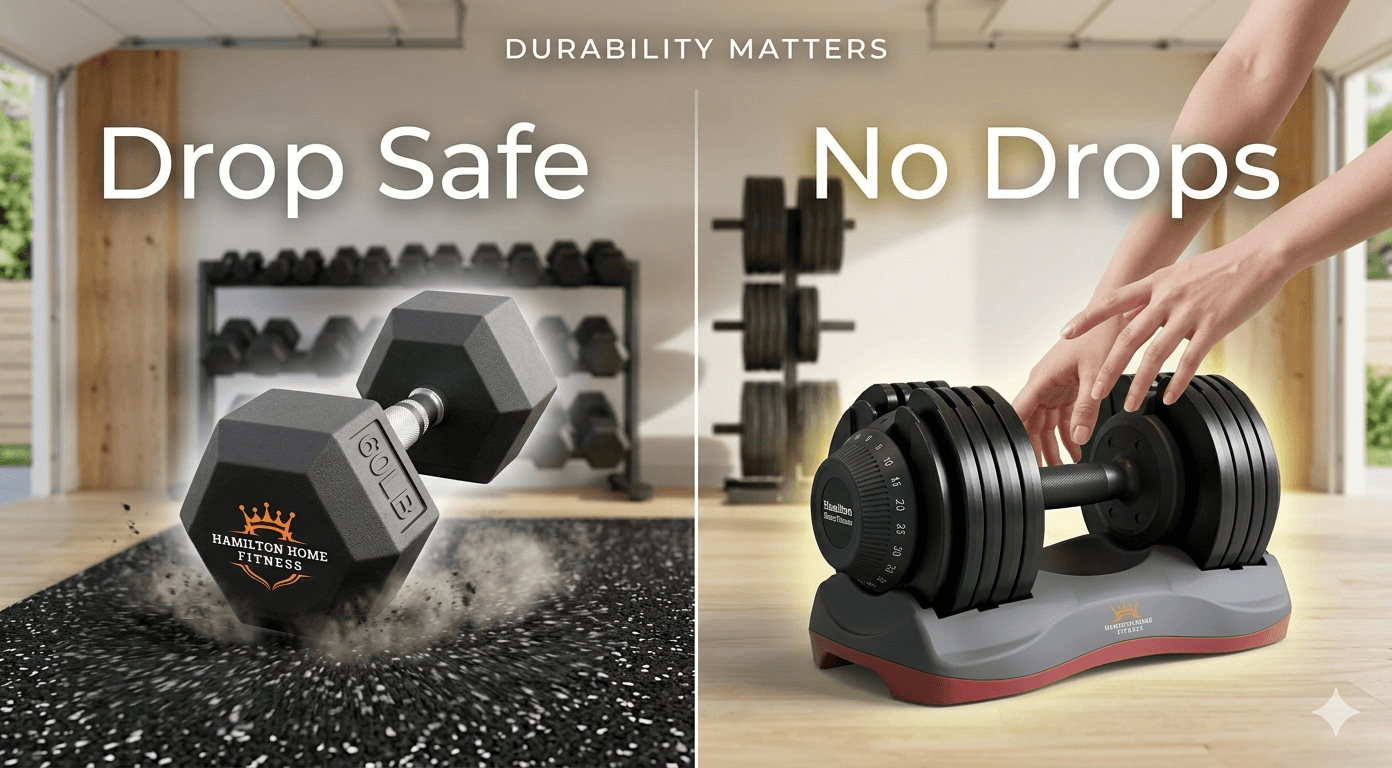
This is the trade-off most competitor articles soften to protect a sale. The honest version below saves you a $750–$1,140 mistake on day one.
Drop tolerance of rubber hex dumbbells
Rubber-coated hex dumbbells are built to be dropped — the hex shape prevents rolling, the rubber jacket absorbs impact, and the cast-iron core stays sealed inside the coating.
A 70 lb rubber hex landing on a rubber-floored garage from chest height is a non-event. No mechanism to break, no plastic to crack, no warranty to void. This is why commercial gyms have used rubber hex for decades on equipment that gets abused by thousands of users a year.
That said, even rubber hex shouldn't land on bare concrete. Repeated drops on hard floors eventually crack the rubber coating, dent the iron, and chip the floor. A horse stall mat or rubber gym flooring built to absorb impact protects both the dumbbell and the slab underneath. The dumbbell survives the drop; the floor decides whether the workout setup survives the year.
Drop risk for adjustable mechanisms
Premium adjustable dumbbells are not built to be dropped—Nuobell explicitly voids its warranty on drops, and reviewers have publicly reported that dropping 80–100 lb sets can damage the weight-selection mechanism and leave the adjustment feeling rough or imprecise from that point forward.
The common owner errors that wreck adjustable mechanisms:
Training to failure on heavy dumbbell bench press. When the last rep fails overhead, the dumbbell goes down hard. Nuobells don't survive that landing the way a rubber hex does.
Returning the dumbbell to the cradle aggressively. The cradle is designed for controlled placement, not a drop from waist height. Repeated slams degrade the locking mechanism faster than any other single habit.
Training drop sets on bare concrete or thin foam. Even an intentional set-down at 80 lb sends shock through plastic connectors that weren't engineered to absorb it.
The practical rule: if your hypertrophy work involves pressing close to true failure on heavy dumbbells, adjustables may not be a strong fit for your training style. If you stop sets with 2–3 reps in reserve and place dumbbells deliberately, premium adjustables can serve you for years.
Rubber hex vs urethane coating
Urethane is denser, more durable, and more expensive than rubber; rubber hex is the right pick for most home gyms, and urethane makes sense for high-traffic facilities.
A simple decision rule: under ~3 users per day or under 5 lifting sessions per week, rubber wins on value. Above that—multi-family gyms, small studios, and training facilities—urethane pays for itself by resisting odor, surface wear, and the slow degradation that rubber shows under constant commercial use.
For a solo home lifter, paying the urethane premium rarely returns its value. The rubber hex on a 5–70 lb set like the BodyKore RB570 holds up fine for decades of single-user training. Spend the savings on flooring, a better bench, or a heavier pair.
Lifting Feel for Hypertrophy and Strength
Fixed hex feels familiar and balanced for every lift; adjustables feel close to fixed for presses and rows but trade some natural feel for length, and drop sets are faster on dial/twist mechanisms than on plate-loaded sets.
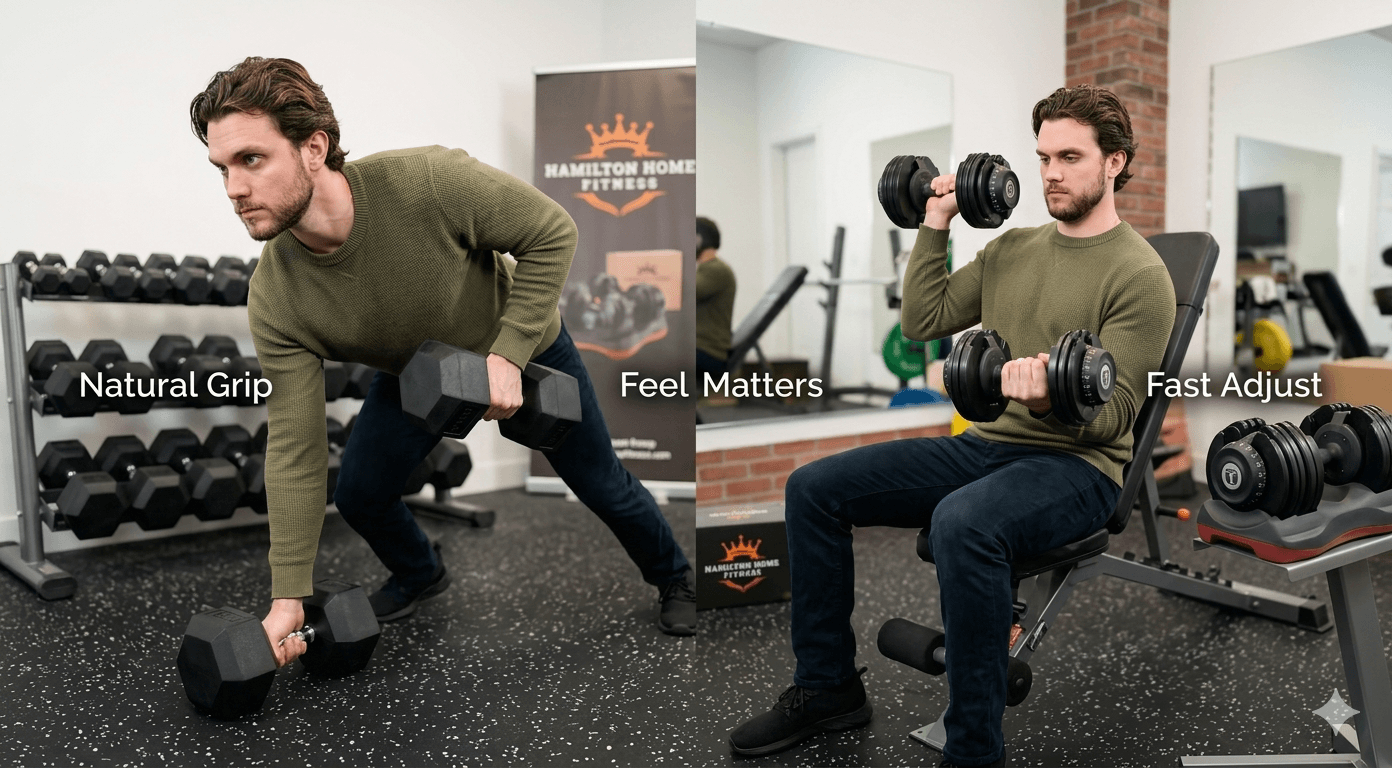
For a five-day hypertrophy program, feel isn't a luxury—it's what keeps you progressing on the same equipment for years instead of replacing it after a year of mild dissatisfaction.
Handle thickness, knurling, and grip
Nuobell uses a knurled steel handle close to commercial dumbbell diameter; rubber hex dumbbells typically run slightly thicker through the ergonomic contour and feel more "gym-like" for heavy rows and farmer carries.
The practical effect: at light weights, the difference is invisible. At heavier loads—60+ lb rows, 70+ lb shrugs, sustained loaded carries—the thicker contoured hex handle distributes pressure across the palm better than the straight steel of an adjustable. Grip fatigue shows up later in the set.
For smaller hands, the reverse can be true. A thinner Nuobell-style handle feels more controllable for high-rep curls and lateral raises than a thick rubber hex grip. There's no universal winner—match the handle to your hand size and your hardest lift.
Bench press, rows, curls feel
Bench press and rows feel almost identical between Nuobell and rubber hex up to mid-weight ranges; the longer Nuobell handle becomes noticeable at heavy bench setups, while curls feel natural on both.
Walking through the persona's 5-day push/pull/legs/upper/lower split, here's what changes and what doesn't:
Dumbbell bench press. Identical groove through 50 lb. At 70+ lb, the longer adjustable handle requires slightly wider hand placement at setup—the lift itself is unchanged, but the kick-up to start the set feels more deliberate.
Bent-over rows and chest-supported rows. Effectively identical. Both options pull the same way.
Hammer and bicep curls. Native feel on both. The adjustable's slight extra length disappears at curl-level loads.
Lateral raises and front raises. Adjustables can feel marginally end-heavy at low weights because the outer plates sit further from your hand—minor, but real if you're sensitive to it.
Goblet squats and Bulgarian split squats. Hex wins on comfort here. A single hex dumbbell tucks against the chest cleanly; a longer adjustable one presses awkwardly into the collarbones at heavier goblet loads.
RDLs and farmer carries. Hex wins on grip, as covered above.
Nothing on that list disqualifies adjustables from a serious hypertrophy program. It does mean adjustables are a slightly better fit for upper-body-dominant splits and a slightly worse fit for programs heavy on goblet-position lower-body work. For a deeper look at quick-change versus loadable mechanisms and how each one changes feel under the bar, the linked guide breaks it down by mechanism type.
Speed for drop sets and supersets
Yes, you can do drop sets with adjustables—Nuobell's twist-handle adjustment takes about 2–3 seconds, which is fast enough for most drop-set protocols. A fixed hex is still faster because no adjustment happens at all.
For a standard double drop (working weight → 70% → 50%), the 4–6 second total adjustment time on adjustables sits comfortably inside normal drop-set rest. For triple drops, mechanical-advantage drops, or back-to-back supersets with two different dumbbell weights, the math changes—and the workaround is simple: pre-stage a second pair or pre-set the adjustable to your lightest drop weight before the working set begins.
Plate-loaded adjustables like Ironmaster take 15–30 seconds per change and aren't suited to drop sets at all. If drop-set work is core to your program, twist-handle adjustables or fixed-hexes are the only two real options.
Weight Range and Progression
Most home hypertrophy lifters max out around 70–80 lb per hand within 2 years; choose a 5–80 lb adjustable or a 5–70 lb fixed set unless you're already pressing the 90s.
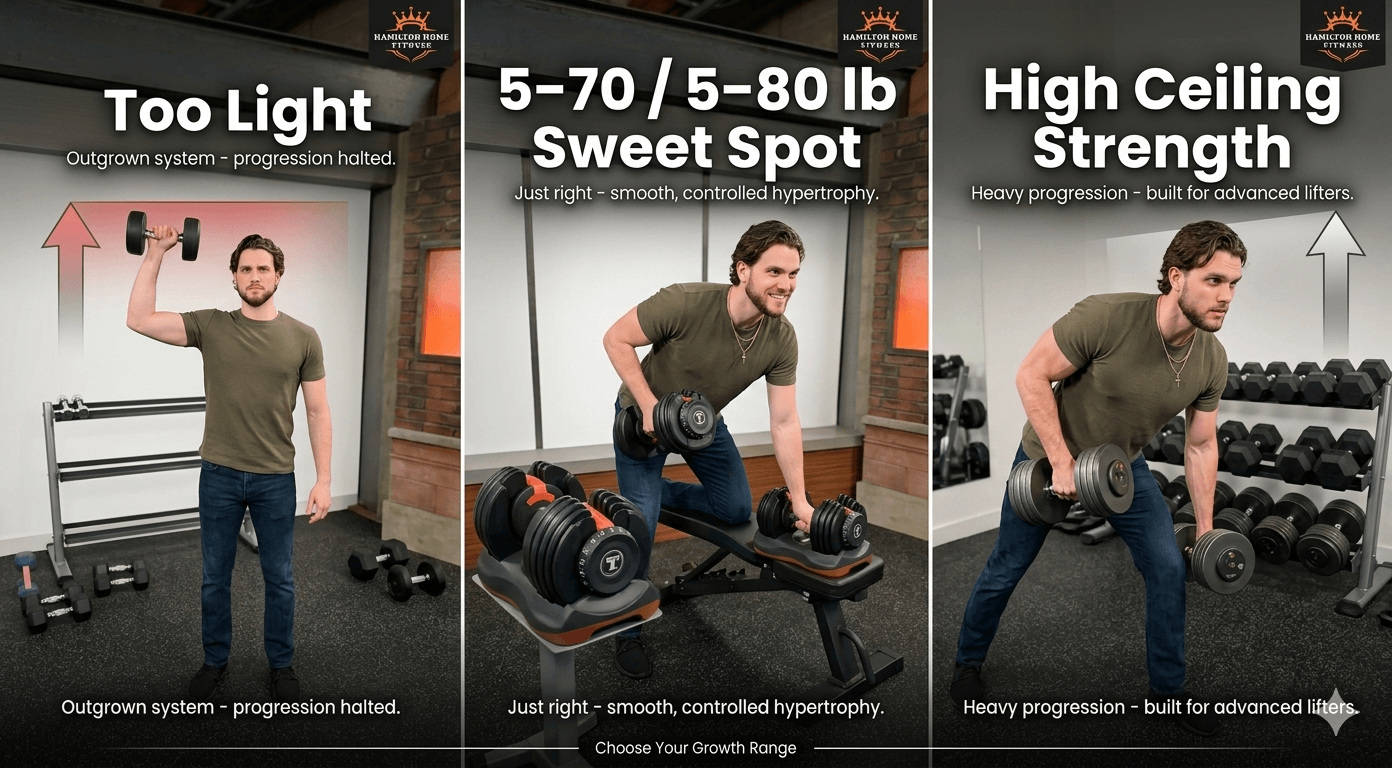
Buying too light means replacing the set in 12–18 months. Buying too heavy means paying for iron you'll never lift. The right range tracks your strongest lift, not your average one.
Heaviest adjustable dumbbells available
The heaviest mainstream adjustable dumbbell pair currently sold to consumers is the Nuobell S 5100 at 5–100 lb; Ironmaster Quick-Lock expands up to 165 lb with add-ons but adjusts more slowly.
Quick comparison of the realistic options at the top of the range:
Nuobell S 5100: 5–100 lb per hand, twist-handle adjustment in 2–3 seconds, around $1,140 per pair. Highest ceiling on a fast-adjust mechanism.
Nuobell 5–80 lb (standard). The sweet spot for most home lifters covers nearly all hypertrophy work without the S 5100 premium.
Ironmaster Quick-Lock. 5–75 lb base, expandable to 125 or 165 lb with add-on plates. A plate-loaded mechanism takes 15–30 seconds per change but tolerates abuse better.
Powerblock Elite USA 90: 5–50 lb base, expandable to 90 lb with two add-ons. Block shape is polarizing—try before you commit if you can.
For a five-day hypertrophy program, the Nuobell 5–80 lb covers the working range cleanly. The S 5100 is the call if you already bench press over 185 lb or expect to within the year. The Ironmaster route makes sense only if drop tolerance matters more to you than adjustment speed.
Hypertrophy weight needs at home
For hypertrophy at home, most lifters need 5–70 or 5–80 lb per hand—enough for working sets of 6–12 reps on dumbbell bench, rows, RDLs, and split squats through year 2 of training.
Typical working weights for an intermediate lifter on the big four dumbbell lifts:
Flat dumbbell bench press: 40–70 lb per hand for sets of 8–12
One-arm dumbbell row: 50–80 lb for sets of 8–12
Romanian deadlift: 50–80 lb per hand for sets of 8–12
Bulgarian split squat: 30–55 lb per hand for sets of 8–12
A 5–70 lb set or a 5–80 lb adjustable one covers all four with progressive overload. If your shoulder press is already over 50 lb per hand or your bench is over 70 lb per hand on day one, build in a year of headroom—go 5–80 lb, or step up to the S 5100.
The thing most buyers underestimate is how fast hypertrophy work eats weight. Hitting 12 clean reps on dumbbell bench and progressing 2.5–5 lb every couple of weeks moves you from 40 lb to 60 lb inside a year. If you're still deciding whether your current strength matches a 50, 70, or 80 lb ceiling, the weight-range guide for matching pounds to goals walks through the calibration in more detail.
Who Should Buy Which
Buy adjustables if you're space-limited, train alone, and never train to failure on heavy presses. Buy a fixed hex set if you have 15+ sq ft to dedicate, train with a partner, or routinely drop weights. Many serious lifters end up with both.
The three blocks below are decision filters, not preferences. If you fit the list, buy that option.
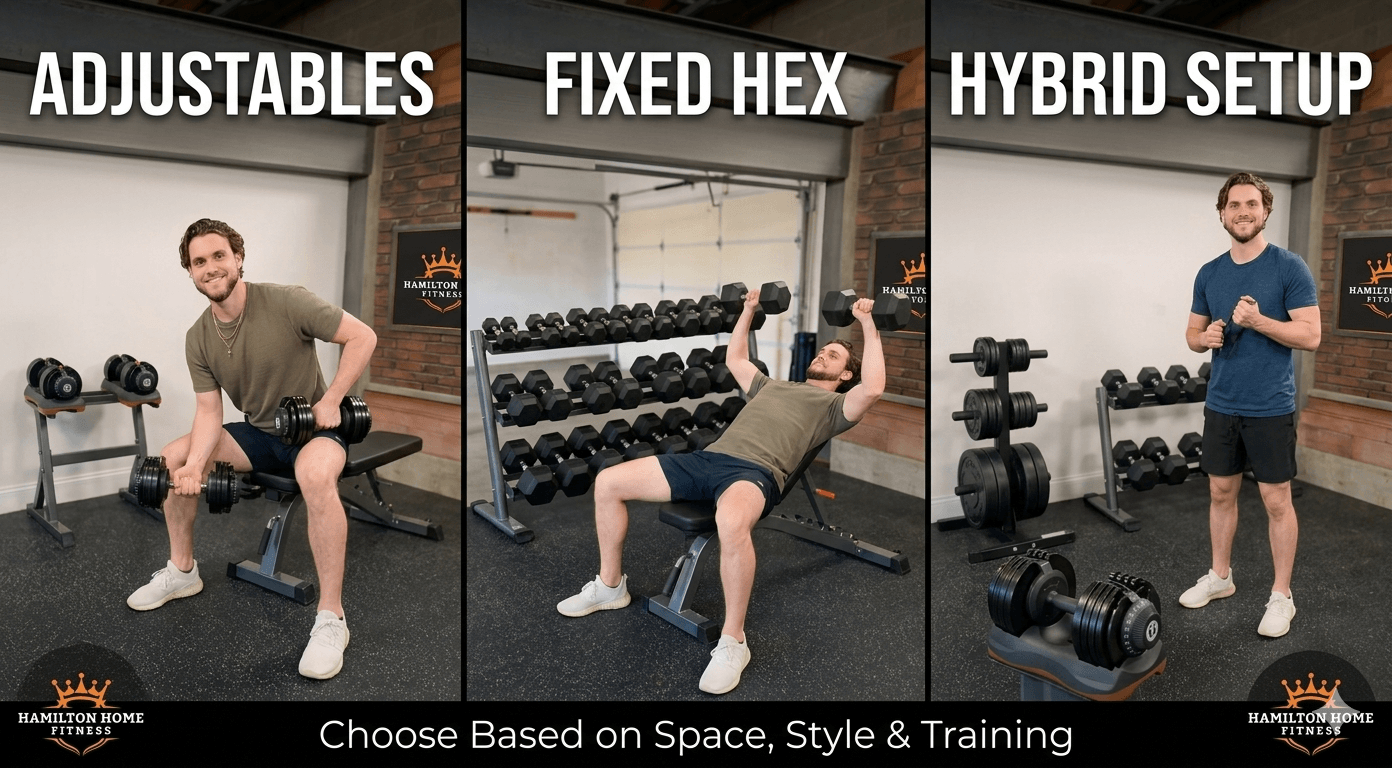
Choose adjustables if…
Choose adjustables if your training space is under 400 sq ft, you train alone, your heaviest dumbbell press is under 80 lb, and you value clean floor space over speed.
You train in a garage, basement, spare room, or apartment with limited floor area
You lift solo—no partner needing a different weight at the same time
Your hypertrophy program stops 2–3 reps shy of failure (not training to muscular failure on heavy presses)
You want floor space back for a bench, rack, rower, or open training area
You're comfortable with a 2-year warranty and disciplined handling
Choose fixed hex if…
Choose a fixed hex set if you have a dedicated training room, train with a partner, drop weights regularly, or want equipment that survives 20+ years of use with no moving parts to fail.
You have a dedicated gym room with 15+ sq ft of free floor area
You train with a partner who needs a different weight at the same time
Your program includes training to failure, drop sets on the floor, or aggressive set-downs
You want every pair instantly available—no 2-second adjustment between sets
You value buy-once durability over upfront savings
If a fixed set fits your space and training style but you want to mix-and-match brands or upgrade the storage, the matching dumbbell storage racks page covers 2-tier, 3-tier, vertical, and horizontal options that fit standard 5–70 lb and 5–100 lb pair runs.
When both make sense
Some home lifters buy a Nuobell pair for daily hypertrophy work and a few fixed hex pairs (often 25, 35, and 50 lb) for warm-ups, accessories, and movements where drop tolerance matters.
In 200 sq ft, a hybrid setup typically looks like this: one Nuobell pair on its cradle for working sets on bench, rows, RDLs, and curls, plus three fixed hex pairs on a compact A-frame rack for warm-ups, goblet squats, lunges, and any movement where you might need to bail safely. Total footprint runs around 6 sq ft — three times the Nuobell-only setup, but a third of the full racked hex set.
This is the path many serious home lifters land on after two or three years of training. If budget allows, it removes nearly every limitation of either option taken alone.
FAQ
How much floor space does a full 5–70 lb hex dumbbell set with a rack actually take?
About 14 sq ft of dedicated floor area for the rack alone (BodyKore RB570 rack: 67" × 30" × 36"), plus 2–3 ft of front clearance for safe lift-out and re-racking. A real working footprint lands closer to 18–22 sq ft.
How fast are adjustable dumbbells like Nuobell to change weight mid-set or in a drop set?
Nuobell adjusts in roughly 2–3 seconds with a twist of the handle, fast enough for standard drop sets. Plate-loaded adjustables like Ironmaster take 15–30 seconds per change and aren't suited to drop sets.
Can you drop adjustable dumbbells safely on rubber flooring?
No—even on rubber flooring, dropping a NuBell or similar selectorized adjustable weight typically voids the warranty and can damage the weight-selection mechanism. Rubber flooring protects the floor, not the dumbbell internals.
Do adjustable dumbbells feel awkward for chest press, rows, or curls compared to fixed hex?
Curls and rows feel nearly identical. Chest press feels slightly different because premium adjustables are longer than equivalent fixed hex dumbbells, which is noticeable at heavy setups but rarely affects the lift itself.
What is the real cost per pound difference between adjustable and fixed dumbbells over time?
A Nuobell 5–80 lb pair runs roughly $745 (manufacturer price), about $4.66 per pound of capacity. A 5–70 lb racked rubber hex set like the BodyKore RB570 runs around $2,399, about $2.28 per pound—but the hex set delivers 14 dedicated pairs versus one adjustable pair.
How long do the internal mechanisms of premium adjustable dumbbells typically last?
Premium adjustables like Nuobell are warrantied 2–4 years against defects under non-commercial use. With no drops and routine inspection of the locking mechanism, owner reports suggest 5+ years of reliable use is common, though exact lifespan varies by usage and is not guaranteed.
Final Thought
The trade-off comes down to two questions: how much floor space can you give up, and how often will weights actually hit the floor? Adjustable weights win on space and cost per pound; fixed rubber hexes win on durability, drop tolerance, and lifting feel. Many serious lifters end up running both—one Nuobell pair for daily hypertrophy work plus a few fixed pairs for warm-ups and drop-prone lifts.
If you already know which direction fits your gym, the Dumbbells subcategory has Nuobell and the BodyKore RB570 ready to compare side-by-side. If you'd rather hand the math to someone who builds home gyms for a living, book a free gym design consultation—the Hamilton Home Fitness team in Tennessee will match the right setup to your floor plan, lift selection, and budget and ship it anywhere in the USA.