Introduction
Picking the wrong floor is one of the most expensive mistakes in a gym build-out. Cracked tiles, damaged equipment, noise complaints from tenants below, and avoidable injuries usually trace back to flooring that was never matched to the actual training happening on top of it.
This page is for facility planners, gym owners, property managers, contractors, and anyone outfitting a luxury home gym who needs a floor that holds up. The right commercial gym flooring does three jobs at once — it protects users, protects equipment, and protects the building.
You'll see how to choose flooring by training zone — cardio, strength, free weight, turf, and rehab — plus thickness rules, installation guidance, noise control for apartment and hotel gyms, and realistic cost ranges. Hamilton Home Fitness supplies commercial gym flooring nationwide and pairs it with equipment packages and layout planning, so the whole build-out moves on one timeline.
What Commercial Gym Flooring Is and Why It Matters
Commercial gym flooring is high-density flooring — usually rubber, sometimes turf, vinyl, or urethane — engineered to absorb impact, reduce noise, resist heavy traffic, and protect the building's subfloor in fitness facilities. It's the layer that takes every dropped dumbbell, treadmill vibration, and sled push so the concrete underneath doesn't.
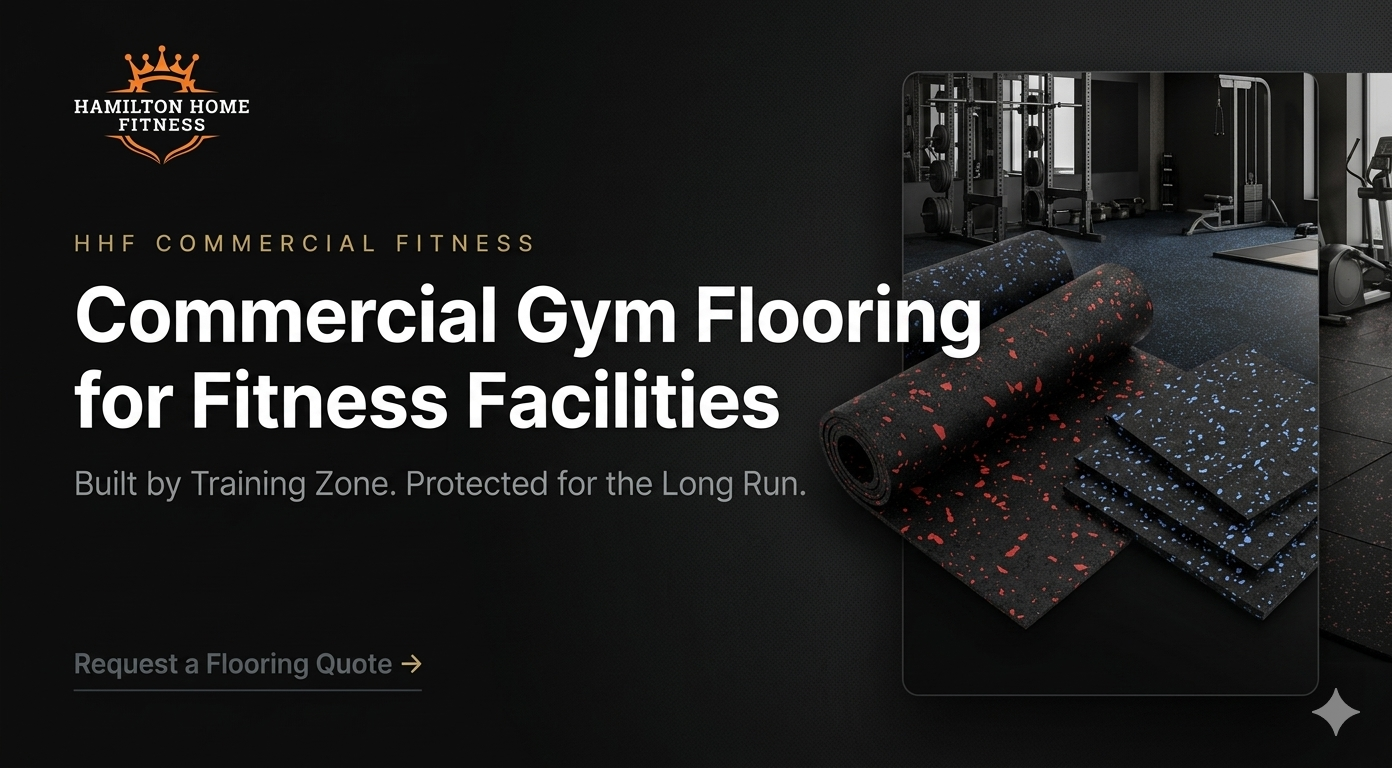
Most commercial facilities lean on rubber as the core surface. Rolled rubber covers large open floors with the fewest seams. Rubber tiles — interlocking or straight-edge — work well in irregular rooms and phased build-outs. Heavy-duty rubber mats handle spot protection under racks and platforms. Around those, indoor turf carries sled tracks and functional zones, vinyl or urethane suits group fitness studios, and high-density foam fits rehab corners and yoga rooms.
Commercial gym flooring does three protective jobs at once:
User safety. Slip resistance keeps athletes upright when surfaces get sweaty. Shock absorption reduces joint strain during high-impact work. Beveled edges and tight seams cut trip hazards.
Equipment longevity. Treadmills, plate-loaded machines, and racks live longer on stable, vibration-dampening floors. Dropped plates ricochet less. Frames stay true.
Building integrity. Concrete cracks, hardwood stains, tile shatters — all preventable with the right thickness and a proper moisture barrier underneath.
Commercial-grade is not the same as residential. A horse stall mat or a 6mm garage tile will fail fast in a facility logging hundreds of sessions a week. Commercial flooring uses denser materials — often vulcanized rubber rather than loosely bonded recycled crumb — with tighter thickness tolerances, lower off-gassing, and better wear ratings. EPDM-blended surfaces add color stability and UV resistance for windowed studios. Recycled rubber stays popular for sustainability and value, while virgin rubber lasts longer in punishing zones.
The decision isn't just "rubber or not." It's matching density, thickness, and format to what's actually happening on each square foot of the floor plan. A treadmill bank doesn't need the same surface as a deadlift platform. A boutique stretching studio doesn't need the same floor as a CrossFit drop zone. Buying one flooring spec for the entire facility either over-builds (and over-spends) on light-traffic areas or under-builds where it matters most.
That's why the rest of this page is organized by training zone — so the floor matches the work.
Commercial Gym Flooring by Training Zone
The right floor changes by zone. Cardio areas need quiet, stable surfaces. Strength zones need impact protection. Free-weight platforms need maximum thickness. Turf carries sleds and functional training. Rehab and stretching zones need cushioned, low-impact surfaces.
Buying one flooring spec for the whole facility is the most common build-out mistake. It either burns budget on light-traffic areas or leaves your highest-impact zones under-protected. Plan the floor in zones — match each zone to the equipment and the work happening on top of it.
Cardio Zone Flooring
Cardio zones do best with 8mm rolled rubber or 3/8-inch rubber tiles — thick enough to dampen vibration and protect the subfloor without making equipment unstable.
Treadmills, ellipticals, bikes, rowers, and steppers don't drop weight, but they create constant vibration and concentrated load under wheels and feet. The floor needs to absorb that vibration, resist sweat, and stay flat enough to keep machines stable and level.
Rolled rubber wins in most cardio rooms because fewer seams mean cleaner aesthetics and easier cleaning under heavy machine traffic. For apartment amenity gyms and hotel fitness rooms placed above occupied floors, add an acoustic underlayment — vibration travels further than people expect.
Avoid going too thick under cardio equipment. Mats over 1/2-inch can create instability under treadmill belts and cause uneven wear on rollers. Match the floor to the machines you'll actually run — and if you're still planning that side, choose the best commercial cardio equipment before locking your flooring spec, since machine footprints and weight ratings affect thickness decisions.
Strength Machine Zone Flooring
Selectorized and plate-loaded machine areas typically use 3/8-inch (8–10mm) rubber rolls or tiles — enough to absorb foot traffic and protect tile or concrete underneath.
Strength machines, cable stacks, smith machines, and leg presses carry heavy footprints, but drop risk is low. Members aren't slamming weight stacks into the floor. What you actually need is a surface that handles all-day foot traffic between stations, keeps machine bases stable, and cleans up easily.
This is the zone where teams over-spec most often. Installing 1/2-inch or thicker rubber under selectorized equipment usually wastes budget that should go into your free-weight zone. Save the heavy thickness for where weights actually drop.
Free Weight & Lifting Platform Zone
Free-weight and lifting platform zones need 1/2-inch to 1-inch rubber — heavy-duty mats, 1-inch tiles, or a built lifting platform — to absorb dropped weights and protect the building.
This is the highest-impact zone in any facility. Bumper plates, dumbbells, kettlebells, and barbell drops create force the rest of your floor isn't built for. Under-spec'ing here is the fastest way to crack concrete, damage equipment, and trigger noise complaints.
For dumbbell rows and rack zones, 1/2-inch heavy-duty rubber mats handle most workloads. For Olympic lifting, deadlifts, and consistent drop work, build a dedicated platform: a plywood core, thick rubber wings (3/4-inch to 1-inch), and a steel frame to hold it together. Olympic-rated 1-inch tiles work as an alternative when a built platform isn't an option.
Keep in mind: thicker rubber doesn't make weight drops silent. It absorbs impact and protects structure — noise still travels. Pair thickness with platform design and equipment placement.
Turf, Sled Tracks & Functional Training
Functional training zones use indoor turf — typically a 13–20mm pile turf strip — installed over a rubber underlayment to support sled pushes, agility drills, and dynamic movement.
Turf isn't decoration. It's a performance surface. Sled tracks, prowler lanes, and sprint strips need a specific pile height and backing to give athletes traction without snagging the sled. Short, dense polyethylene pile (around 15–20mm) prevents sleds from "digging in" and holds up to repeated use.
Most commercial installs use a 5-foot to 7-foot wide turf strip running 25–50 feet down the floor, often with inlaid yard markers or hash lines. Lay it over a rubber underlayment or shock pad — turf alone doesn't protect the subfloor or absorb impact for footwork drills.
For functional zones outside the sled lane, full-area turf works for kettlebell flows, battle ropes, and group training. Outdoor functional spaces need UV-resistant turf with proper drainage.
Rehab, Stretching & Group Fitness Zones
Rehab, stretching, and group fitness zones do best with thinner cushioned rubber, plyometric rolls, or high-density foam — soft enough for floor work but durable enough for daily group classes.
These zones serve different bodies and different work. PT clinics need surfaces that support floor exercises, balance work, and slow controlled movement. Yoga and stretching studios need warmth and cushion underfoot. Group fitness rooms need traction for jumping, lateral movement, and dance-based classes without the heavy thickness of a weight room.
Plyometric rubber rolls (around 3/8-inch, lower density than standard rubber) handle aerobics, dance fitness, and HIIT well. High-density EVA foam tiles fit yoga, martial arts, and rehab movement work. Vinyl roll flooring gives studios a polished look with built-in cushion for group classes.
Avoid using the same heavy-duty 1-inch rubber from your weight room here. It's too firm, too cold, and not what these activities need.
Rolls vs Tiles vs Mats: Choosing the Right Format
Rolled rubber gives the cleanest seamless look for large rooms. Interlocking tiles are easier to install and replace. Heavy-duty mats are best for spot protection under racks, platforms, and cardio machines. Most commercial facilities use a mix — rolls for the main floor, tiles for irregular zones, mats for the highest-impact spots.
Format isn't a style choice. It's a logistics, install, and lifecycle decision. Pick wrong and you'll either pay too much in labor or end up replacing damaged sections by tearing out a whole room.
Rolled Rubber Flooring
Rolled rubber flooring is the standard for mid-to-large commercial gyms — it covers wide areas with fewer seams and lower cost per square foot than tiles.
Rolls typically come 4 feet wide in custom-cut lengths up to 50–100 feet, so a wall-to-wall install in a large room can require only a handful of seams. Fewer seams mean fewer trip hazards, less dirt and moisture intrusion, and a more professional finish. Pricing usually runs $1.50–$5 per square foot for the material itself, which is why facilities covering 5,000+ square feet almost always default to rolls.
The trade-off is handling. Rolls are heavy — often 200–400 pounds each — and difficult to move without a team and dollies. Cuts need to be precise, especially around columns, doorways, and equipment footprints. Most large rolled installs benefit from professional installation with full-spread adhesive or perimeter double-sided tape.
Rolled rubber works best in cardio rooms, machine zones, group fitness studios, and any large open floor plan where seamless aesthetics matter. It's the wrong call for tight irregular rooms, phased build-outs, or any space where you'll need to swap a damaged section later.
Rubber Gym Tiles & Interlocking Tiles
Rubber gym tiles — interlocking or straight-edge — work best in small rooms, oddly shaped areas, and gyms that need easy spot replacement over time.
Interlocking tiles connect like puzzle pieces with no adhesive required, which makes them friendly to DIY installs, phased rollouts, and tenant-improvement projects where you can't glue down the floor. Straight-edge tiles install with adhesive for a more permanent finish. Both formats run roughly $3–$10 per square foot depending on thickness and quality.
The big advantage shows up at year three or four. When a section gets damaged — a dropped barbell tears a corner, a dragged rack scratches the surface — you replace one or two tiles instead of pulling up an entire roll. That alone can save thousands over the life of the floor.
Tiles are the right call for boutique studios, apartment amenity gyms, hotel fitness rooms, rehab clinics, and any facility planning future expansion. They're also faster than rolls when you're working around columns, jogs in the wall, or unusual room shapes.
Heavy-Duty Rubber Gym Mats & Platforms
Heavy-duty rubber mats (3/4-inch to 1-inch) are used for high-impact spots — under racks, dumbbell drops, and as the rubber base of a deadlift platform.
Mats are spot-protection tools, not whole-room solutions. A standard 4'x6' commercial mat under a power rack absorbs dropped weights, dampens noise, and protects the floor underneath your main flooring. A pair of mats under a dumbbell rack stops plates from cratering thinner rubber when they slip off the rack.
A built deadlift platform takes this further: a plywood core for spring and load distribution, two thick rubber mat "wings" where the plates land, and a steel frame holding everything in place. This setup absorbs heavy drops, protects the building, and keeps the lifter on a stable, predictable surface.
Heavy-duty mats are the right choice for free-weight zones, rack stations, drop zones, and any spot taking concentrated impact. They're the wrong choice for full-room coverage — too expensive per square foot, too heavy to handle, and too much overkill for cardio or machine areas.
Quick selection rule: Big open room → rolls. Irregular space or phased build → tiles. High-impact spot → mats or a built platform. Most commercial facilities combine all three. If you're still mapping the layout, request a flooring quote with your room dimensions and equipment list — the mix usually matters more than the material.
Thickness Guide: 8mm to 1 Inch
Most commercial gyms use 8mm or 3/8-inch rubber for general areas, 1/2-inch for free weight zones, and 3/4-inch to 1-inch for Olympic lifting and heavy-drop platforms. Thickness isn't about quality — it's about matching the floor to the impact happening on it.
Buying one thickness for the whole facility wastes money in light-traffic zones and leaves your drop zones under-protected. Plan thickness by zone, the same way you plan the equipment.
6–8mm — Light cardio, studios, group fitness, apartment and hotel amenity gyms. This is the entry point for commercial use. It handles foot traffic, light cardio equipment, group classes, and yoga or stretching work. It's not built for dropped weights. Common in boutique studios, multi-family clubhouse gyms, hotel fitness rooms, and corporate wellness spaces where heavy lifting isn't part of the program.
3/8" (≈10mm) — Standard commercial use: cardio banks, machines, light free weights. The most popular thickness in commercial fitness. It absorbs treadmill vibration, supports plate-loaded and selectorized machines, and handles light dumbbell work without issue. If you're building a general-purpose facility and unsure where to start, 3/8-inch rolls or tiles cover the majority of your floor plan.
1/2" (≈12mm) — Dumbbell areas, kettlebells, moderate barbell work. Step up to 1/2-inch for any zone where weights regularly meet the floor — dumbbell racks, kettlebell stations, bench press areas, and rows of squat racks used for moderate loads. This is the sweet spot for most strength zones in commercial gyms that aren't powerlifting or Olympic-focused.
3/4"–1" (≈19–25mm) — Olympic lifting, deadlift platforms, drop zones, CrossFit boxes. Reserved for the highest-impact spots. Olympic lifting, repeated deadlift drops, bumper plate work, and drop-from-overhead training all need this range. Use thick rubber mats, 1-inch tiles, or build a dedicated lifting platform. A facility with five rack stations doesn't need 1-inch flooring across the whole strength zone — only inside the drop zone footprint.
One decision rule worth memorizing: if you'll drop weights, go thicker than you think. The cost difference between 1/2-inch and 3/4-inch in a single platform footprint is small. The cost of replacing cracked concrete, a damaged subfloor, or buckled rolled rubber is not.
Budget reality. Thicker flooring costs significantly more per square foot — 3/4-inch and 1-inch options can run two to three times the price of 8mm. The smart play is zoning the building so you only buy thickness where it matters. A facility might run 8mm rolls across cardio and machine zones, 1/2-inch tiles in the dumbbell area, and a single 8'x8' platform of 1-inch rubber where the deadlifts happen. Same building, three thicknesses, right protection in every zone, no wasted budget.
Apartment and hotel gyms add one more wrinkle: thickness alone doesn't solve sound transmission to the floor below. The next section covers that stack-up.
Noise, Impact & Apartment / Hotel Gym Flooring
Yes, commercial gym flooring reduces noise. Thicker rubber (1/2-inch+), an acoustic underlayment, and avoiding direct subfloor contact can significantly cut impact and airborne sound transmission in apartment and hotel gyms — but no flooring fully eliminates the sound of heavy weight drops.
Noise complaints are the single biggest reason multi-family and hospitality fitness amenities get scaled back, redesigned, or shut down. Property managers who solve the noise problem upfront protect both their residents and their amenity investment.
Two types of noise to plan for.
Impact noise is the thud, vibration, and structural sound that travels through the floor when a weight drops, a foot lands, or a machine pounds. It's transmitted through the building structure itself. This is what wakes up the resident below.
Airborne noise is machine hum, music, voices, and treadmill belts. It travels through air and through walls. Thicker flooring helps less here — wall insulation, ceiling treatments, and equipment selection matter more.
The acoustic stack-up that actually works.
For apartment, hotel, and multi-family gyms placed above occupied space, the floor needs to be a system, not a single layer. A reliable stack from bottom to top:
Clean, level concrete subfloor with a moisture/vapor barrier
Acoustic underlayment — recycled rubber or specialty acoustic mat
Primary commercial rubber surface (8–10mm rolls or tiles for general areas)
Heavy-duty mats or a built platform under any free-weight zone
Isolation pads under cardio equipment, especially treadmills
This layered approach decouples the gym floor from the building structure so vibration has to pass through multiple density changes before reaching the unit below. Each density change absorbs energy.
Equipment placement matters as much as flooring.
Even a perfect acoustic stack won't fix bad zoning. Push heavy free-weight zones to the corners of the room, ideally over load-bearing walls. Keep cardio banks away from shared walls. Locate stretching, yoga, and rehab zones above bedrooms when possible — they create the least noise.
Honest expectations.
No commercial flooring fully silences dropped Olympic lifts. If your apartment gym needs to support serious lifting, plan for: a built lifting platform inside the drop zone, hours-of-operation rules that limit lifting to daytime, and clear member guidelines about dropping weights. Some facilities skip Olympic-style lifting entirely in residential settings — substituting trap bars, heavy machines, and controlled-descent equipment that delivers strength training without the impact.
Specific guidance by facility type.
Apartment amenity gyms: 8–10mm rubber with acoustic underlayment, no Olympic lifting zone, cardio away from shared walls.
Hotel fitness rooms: 8mm rubber, treadmill isolation pads, cushioned vinyl in any group fitness or yoga space.
Multi-family clubhouse gyms: Same as apartment, plus a small mat zone for dumbbell work — keep platform-style lifting out.
Corporate gyms above occupied floors: 1/2-inch in strength zones, full acoustic stack-up, no drop training during work hours.
Schools and rec centers: Less noise-sensitive, but still benefits from acoustic underlayment in upper-floor weight rooms.
The goal isn't a silent gym. It's a gym that doesn't generate complaints, doesn't damage the building, and delivers a real training experience to members and residents at the same time.
Installation, Subfloor Prep & Long-Term Care
Commercial gym flooring is installed over concrete or wood subfloors using loose-lay, double-sided tape, or full-spread adhesive — with a moisture barrier on concrete. Most projects run $3–$10 per square foot installed, and properly maintained rubber flooring lasts 10–15 years.
Three things determine whether your floor performs the way you planned: subfloor prep, install method, and ongoing care. Skip any of them and you'll be replacing rubber years before you should.
Installing Over Concrete & Other Subfloors
Yes, gym flooring installs over concrete — but concrete needs a moisture/vapor barrier, must be clean and level, and benefits from full-spread adhesive in high-traffic areas.
Concrete subfloors. Concrete looks dry but constantly releases moisture vapor from the ground up. Trap that moisture under dense rubber and you get mildew, adhesive breakdown, and rubber that delaminates within a year. The fix is a 6-mil polyethylene vapor barrier laid before the flooring. For confirmation before install, run an ASTM D4263 plastic-sheet test: tape a 2'x2' clear plastic square to the slab, wait 24–48 hours, and check for moisture droplets underneath. Droplets mean a barrier is mandatory.
Wood subfloors. Plywood and OSB need the opposite approach. A plastic vapor barrier traps ambient moisture against the wood and causes rot. Use a breathable barrier — kraft paper or a specialty underlayment — instead.
Subfloor prep checklist:
Slab clean, dry, and free of dust, debris, and old adhesive
Cracks filled and high spots ground flat — flooring telegraphs every imperfection underneath
Floor leveler applied where needed for slopes greater than 1/8" over 10 feet
Moisture/vapor barrier installed for concrete; breathable underlayment for wood
Acoustic underlayment added if the gym sits above occupied space
Install methods. Loose-lay works for heavy rubber rolls and tiles in tight wall-to-wall installs. Double-sided tape secures the perimeter and seams for semi-permanent installs. Full-spread adhesive is the most secure method for high-traffic commercial floors and the safest choice over concrete with any moisture risk. Add transition strips at doorways and zone changes, and a wall base around the perimeter for a finished commercial look.
Hamilton Home Fitness coordinates flooring installation alongside equipment delivery so your build-out moves on one timeline instead of three. Ask About Installation when you request your quote.
Cost & Budget Planning
Commercial gym flooring typically costs $1.50–$5 per square foot for rolls, $3–$10 per square foot for tiles, and $1–$5 per square foot for professional installation — full facility builds often run $45,000–$220,000.
What drives the price up:
Thickness. 1-inch rubber can cost two to three times the price of 8mm.
Material grade. Virgin and vulcanized rubber outlast recycled rubber but cost more upfront.
Custom branding. Inlaid logos and color matching add $2–$4 per square foot.
Subfloor prep. Leveling and moisture remediation add $1–$3 per square foot.
Installation complexity. Irregular rooms, columns, custom transitions, and platform builds raise labor cost.
Shipping. Rubber is heavy. Freight to remote regions or upper floors adds real cost.
The biggest budget mistake is buying one thickness across the entire facility. Zoning the floor — 8mm in cardio, 3/8-inch in machines, 1/2-inch in dumbbells, 1-inch only inside the platform footprint — typically cuts material cost 20–35% without sacrificing protection. Request a Flooring Quote with your room dimensions and equipment list to get a real per-zone breakdown.
Cleaning & Maintenance
Maintain rubber gym flooring by sweeping or vacuuming daily, damp-mopping with a rubber-safe neutral cleaner weekly, and avoiding harsh solvents or oil-based cleaners that break down the binder.
Daily: Sweep or vacuum to clear chalk, dust, and grit before they wear the surface. Weekly: Damp-mop with a neutral pH cleaner formulated for rubber sport flooring. Microfiber heads work better than string mops. Monthly: Inspect seams, edges, and high-impact zones for lifting, gaps, or wear. Re-secure tape or adhesive before damage spreads. Quarterly: Deep clean with a rubber-safe disinfectant, especially in shared facilities and rehab spaces.
Mistakes to avoid:
Bleach, ammonia, citrus solvents, and oil-based cleaners — they degrade rubber binders and void most warranties
Steam cleaners on glued-down rubber (heat softens adhesive)
Letting sweat puddle on tile seams overnight in apartment and hotel gyms
Dragging racks or benches across the floor instead of lifting them
Done right, commercial rubber flooring lasts 10–15 years in a busy facility. Done wrong, you'll be tearing it out at year five.
Build Your Commercial Gym with Hamilton Home Fitness
Hamilton Home Fitness — headquartered in Tennessee and serving facilities nationwide — pairs commercial gym flooring with equipment packages, layout planning, and installation coordination so your build-out moves on one timeline.
Most flooring suppliers stop at the rubber. Most equipment suppliers stop at the racks. Build-outs stall when the flooring crew shows up before the slab is prepped, the rolls arrive after the racks, or the deadlift platform footprint doesn't line up with the rack stations. Every one of those problems is solvable when flooring, equipment, and layout are sourced and scheduled together.
Who we work with. HHF Commercial Fitness supplies fitness facilities across the country — health clubs, boutique studios, hotel gyms, multi-family and apartment amenity spaces, school weight rooms, corporate wellness centers, rehab and physical therapy clinics, sports performance facilities, and luxury home gyms. Tennessee-based, with nationwide shipping and installation coordination. Authorized dealer for major commercial fitness brands.
What you can package together:
Commercial gym flooring sized and zoned to your room
Power racks, platforms, and free-weight stations with matching drop-zone protection
Cardio banks with appropriate flooring spec for treadmill and elliptical placement
Functional training turf strips and sled tracks
Layout planning that ties equipment footprints to flooring zones from day one
If you're outfitting a full facility, browse our Commercial Gym Equipment for Facilities & Gyms catalog to see how flooring fits into a complete equipment package. For cardio-heavy build-outs — hotel gyms, apartment amenity spaces, corporate wellness centers — start with Commercial Cardio Equipment for Fitness Facilities, since cardio footprints often dictate where flooring thickness changes happen.
Why source flooring with the equipment. A few reasons facility planners and contractors keep coming back:
One project timeline. Flooring, equipment, and installation get scheduled together instead of three separate vendor windows.
Layout-aware specifications. Drop zones, cardio banks, and turf strips get specified before order — not improvised after delivery.
Honest spec guidance. Thickness, format, and material recommended by zone, not by what we have to sell.
Design support. Book a Gym Design consultation to map flooring zones, equipment placement, and traffic flow before anything ships.
Take the next step.
Request a Flooring Quote — send room dimensions, ceiling clearance, equipment list, and subfloor type for a per-zone breakdown.
Add Flooring to Your Gym Package — bundle with equipment and ship on one timeline.
Book a Gym Design — get a layout plan that ties flooring zones to equipment footprints.
Ask About Installation — coordinate flooring install with equipment delivery and assembly.
Call 423-458-2453 or Shop Quality Fitness Gear and Equipment — Hamilton Home Fitness to start your build-out. Tennessee headquarters, nationwide service, every project specified for the work happening on the floor.
People Also Ask
What flooring is best for commercial gyms? Rubber flooring is the standard for commercial gyms — in rolls, tiles, or heavy-duty mats — with turf added for sled tracks and functional training zones. Rolls cover large open rooms with the fewest seams, tiles handle irregular spaces and phased builds, and mats protect high-impact spots under racks and platforms.
How thick should commercial gym flooring be? Most commercial gyms use 8mm or 3/8-inch rubber for general areas, 1/2-inch for free weight zones, and 3/4-inch to 1-inch for Olympic lifting and heavy-drop platforms. Zoning thickness by activity protects the building without overspending on light-traffic areas.
Is rolled rubber or rubber tile better? Rolled rubber is better for large seamless areas and lower cost per square foot. Rubber tiles are better for irregular rooms, phased projects, and easy spot replacement when sections wear out. Most commercial facilities use both — rolls for the main floor, tiles for tighter zones.
What flooring works best under free weights? Free-weight zones need 1/2-inch to 1-inch heavy-duty rubber — thick mats, 1-inch tiles, or a built lifting platform. Anything thinner risks cracked concrete, damaged plates, and noise complaints. The platform footprint matters more than covering the entire strength zone in thick rubber.
Do cardio machines need special flooring? Yes. Cardio banks need 8mm to 3/8-inch rubber to dampen vibration, protect the subfloor, and keep treadmills and ellipticals stable under daily use. Going too thick under cardio equipment can actually create instability, so match thickness to the machines, not the rest of the gym.
Can gym flooring reduce noise? Yes. Thicker rubber paired with an acoustic underlayment and isolation pads under cardio equipment cuts both impact and airborne noise — especially in apartment, hotel, and multi-floor settings. No flooring fully silences dropped Olympic lifts, so plan platform placement and operating hours alongside the floor itself.
Do you install commercial gym flooring? Hamilton Home Fitness coordinates commercial gym flooring installation alongside equipment delivery so your build-out moves on one timeline. Use the Ask About Installation option when you request your quote, and send your room dimensions, subfloor type, and equipment list for an accurate scope.
What flooring is best for apartment fitness centers? Apartment amenity gyms do best with 8–10mm rubber over an acoustic underlayment, plus dedicated mats under any free-weight zone. Cardio should sit away from shared walls, and Olympic-style drop lifting is usually skipped or replaced with controlled-descent equipment to limit complaints from units below.
What type of flooring do gyms use? Commercial gyms use rubber as the dominant surface — rolled, tiled, or in heavy-duty mats — with turf for functional and sled zones, vinyl or urethane for studios, and high-density foam for rehab and yoga areas. The mix depends on what training happens in each zone.
How much does commercial gym flooring cost? Commercial gym flooring typically runs $1.50–$5 per square foot for rolls, $3–$10 per square foot for tiles, and $1–$5 per square foot for professional installation. Full facility builds often land between $45,000 and $220,000, depending on size, thickness, customization, and subfloor prep.
Can you put gym flooring over concrete? Yes. Concrete is the most common subfloor for commercial gyms, but it needs a 6-mil polyethylene moisture barrier, a clean and level surface, and the right install method — loose-lay, double-sided tape, or full-spread adhesive — for the format you've chosen.
How do you maintain rubber gym flooring? Sweep or vacuum daily, damp-mop weekly with a rubber-safe neutral pH cleaner, and inspect seams monthly for lifting or wear. Avoid bleach, ammonia, citrus solvents, oil-based cleaners, and steam — they break down rubber binders and shorten the life of the floor.
What is the difference between gym mats and gym tiles? Gym mats are larger single pieces of thick rubber used for spot protection — under racks, platforms, and drop zones. Gym tiles are smaller modular pieces, interlocking or straight-edge, designed to cover full rooms and allow individual sections to be replaced when damaged.
Final Thoughts
The right commercial gym flooring does three jobs at once — it protects users, protects equipment, and protects the building. Get those three right and the floor disappears into the background, exactly where it belongs.
The smartest builds don't pick one flooring spec for the whole facility. They zone the floor by activity. 8mm in cardio, 3/8-inch in machines, 1/2-inch in dumbbell areas, 1-inch only inside the platform footprint, turf where the sleds run, cushioned rubber where rehab and stretching happen. Same building, right protection in every zone, no wasted budget.
Three decisions matter most: match thickness and format to the actual training in each zone, layer in acoustic underlayment for apartment, hotel, and multi-floor settings, and prep the subfloor properly before anything gets installed. Skip any one of them and the floor underperforms — sometimes within months.
When you're ready to move from planning to ordering, Hamilton Home Fitness can package commercial gym flooring with the equipment and layout in one project, on one timeline. Tennessee headquarters, nationwide shipping, installation coordination, and gym design consultations available before anything ships. Request a Flooring Quote with your room dimensions, equipment list, and subfloor type — and get a per-zone breakdown built around the work actually happening on your floor.