
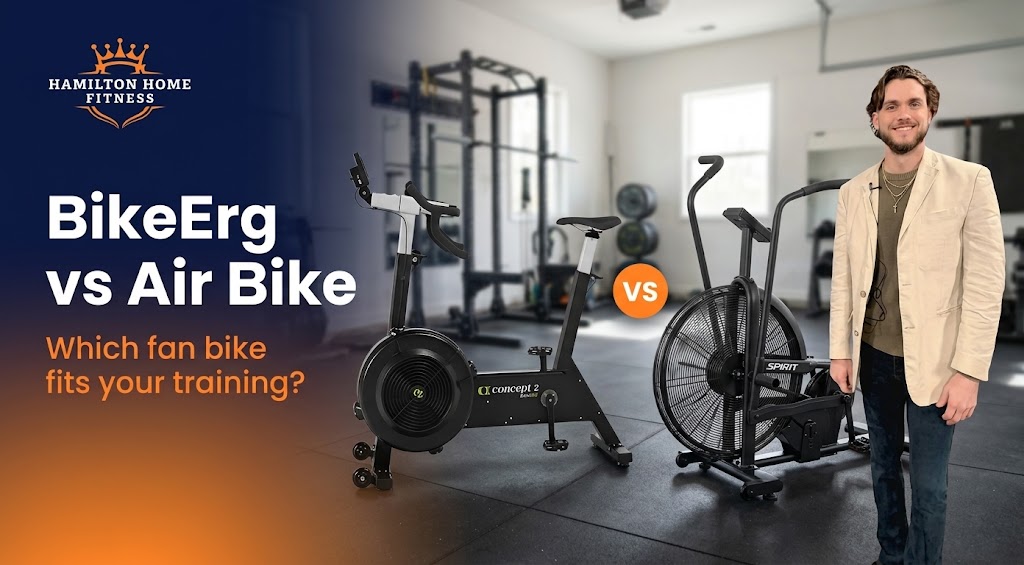
If you’ve ridden both at a gym, you know the split. The BikeErg feels like a road bike you can settle into, while the air bike’s moving arms can leave you gasping after a 30-second sprint. The short answer to BikeErg vs air bike: choose the Concept2 BikeErg for steady, legs-only riding with gearing and numbers you can compare. Choose an arm-driven air bike for short, full-body conditioning. Both use fan resistance, so the real differences are arm work, pacing and calorie counts that don’t convert.
How Is a BikeErg Different From an Air Bike?
The BikeErg is Concept2’s indoor bike, built around an air flywheel, a damper that works like gearing, a clutch that lets you coast, and bike-style handlebars that don’t move. An air bike, such as the Schwinn Airdyne, links push-pull handles to a large open fan, so your arms and legs drive it together.
It uses the same flywheel and PM5 monitor as the RowErg and SkiErg in the Concept2 erg lineup, so rides log alongside your rows and ski sessions.
Here is how they compare, with prices as listed on November 1, 2026.
| Feature | Concept2 BikeErg | Arm-driven air bike |
|---|---|---|
| Arms | Bike-style bars, no arm work | Push-pull handles |
| Resistance | Effort plus a 1 to 10 damper | Effort only on pure-air models |
| Easing off | Coast, or lower the damper | Slow down |
| Machine weight | 68 lb | About 108 to 169 lb (models below) |
| Price here | $1,100 | $600 to $2,575 |
| Built for | Steady rides, intervals, data | Short full-body intervals |
How Do Resistance and Pacing Compare?
On both bikes, a fan sets the load, and the curve is steep. Double your cadence and the power needed jumps roughly eightfold. The BikeErg adds a damper and a coasting clutch. A pure air bike leaves you one control, your own push and pull.
Treat the BikeErg’s damper as gearing, not a difficulty dial. Low settings feel light and spinny, while high settings feel like pushing a big gear. A higher number isn’t automatically a harder workout.
Why Is the Air Bike So Hard?
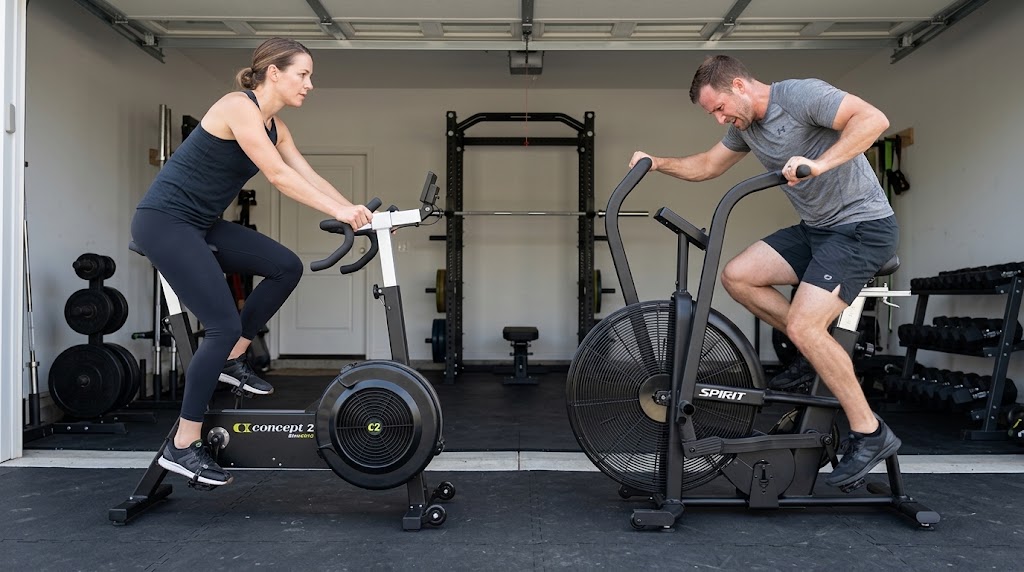
Three things stack up. The fan curve climbs fast, your arms add working muscle so heart rate and breathing spike sooner, and there’s no gear to drop into. On most dual-action bikes, the handles move whenever the pedals do, so the only relief is slowing down.
Going all-out from the first stroke drains you fast on that curve, so pick a cadence or watt number you can repeat every round, then hold it.
Which Is Easier to Pace on Long Rides?
The BikeErg. Set the damper once, settle into a cadence, and watch pace or watts on the PM5. When you ease off, the flywheel freewheels like a road bike, so zone 2 work, the easy conversational pace, feels natural.
Air bikes can hold a steady pace, but with your arms always working and no gears, long, easy seated rides aren’t their strength.
Want real gears on a legs-only fan bike? The STEPR CYCLE XL offers more than 100 virtual gears through a variable-pitch fan.
Which One Trains Your Upper Body?
The air bike. Its push-pull handles load your chest, back, shoulders and arms while your legs drive the pedals. The BikeErg trains your quads, glutes, hamstrings and calves, with your core bracing; its bars are for grip and fit, not pulling.
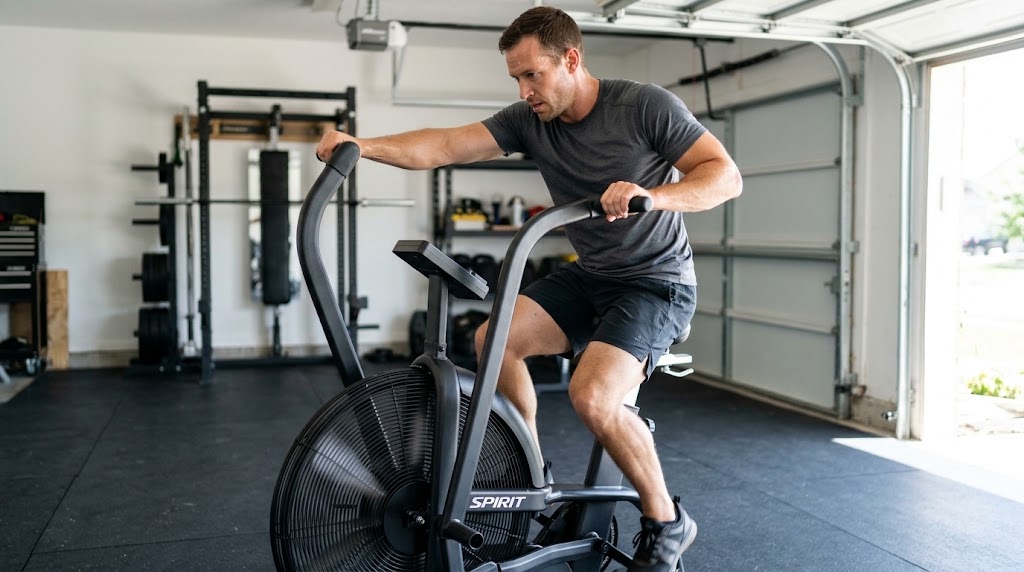
Pick the air bike if it’s your only conditioning machine or your workouts tax every limb. Pick the BikeErg if you already row, ski or train your upper body hard, ride outdoors, or want to spare a sore shoulder.
Coaching friends in a garage or running classes? Our guide to equipping a CrossFit box shows how many bikes to plan per class.
Why Don’t the Calorie Counts Match?
Each console turns your effort into calories with its own formula, so 20 calories on a BikeErg and 20 on an air bike are different amounts of work. Concept2’s monitor even bases its count on a 175-lb rider, whatever you weigh. Compare calories on the same machine, and use time and effort when a workout mixes machines.
How Do You Set Fair Calorie Targets?
Build your own conversion in one 20-minute session:
- Warm up the same way on each bike
- Ride 2 minutes at a hard effort, about 8 out of 10
- Note the calories, then rest fully
- Repeat on the other bike at the same effort
- Divide air bike calories by BikeErg calories
Scale workout targets by that ratio, and test at the intensity you train at, since the ratio shifts between easy riding and sprints.
Which Is Quieter and Easier to Fit at Home?
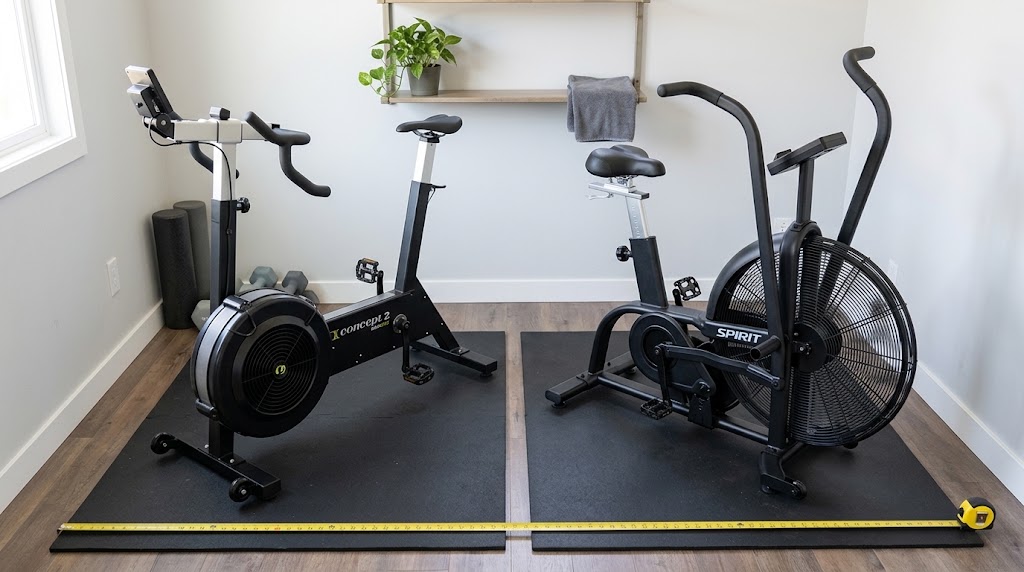
Neither is quiet at full effort, because both make wind noise that rises with speed. Footprints are close, near 4 feet by 2 feet, but the BikeErg is much lighter, and an air bike needs room for its swinging arms.
How Loud Are They?
Concept2 calls the BikeErg’s ride smooth and quiet, but any fan gets louder as you speed up. An air bike’s open fan also pushes air back at you. That’s welcome in a hot garage, and some models add a windscreen to block it.
If the bike will sit in a hot garage, Gym Space Guide explains how to cool a garage gym without AC, starting with how a fan actually cools a rider.
A rubber mat cuts vibration through the floor, but it won’t mute the whoosh. For late-night sprints behind shared walls, neither bike is a good neighbor.
How Much Floor Space Do They Need?
The BikeErg’s footprint is 48 by 24 inches, and Concept2 recommends 60 by 48 inches of clearance. It weighs 68 lb and rolls on wheels, but it doesn’t fold. Air bikes run from about 108 lb on the APE Air Bike to nearly 169 lb on the Renegade, and they need space in front and behind for the handles.
Standing sprints raise your head, too, so check our ceiling height and floor space guide before you pick a low basement.
Which Fan Bike Should You Buy?
Buy for the workout you’ll repeat most weeks, then check space and budget. You can compare every model in our air bike range, from a $600 starter to full-commercial builds.
When Is the BikeErg Worth It?
It’s worth $1,100 if you’ll ride steady sessions most weeks, such as zone 2 base work for HYROX or endurance racing. It also suits riders who want PM5 data to log, and households sharing one bike. Skip it if you want arm work or a bike that folds.
If that fits, the Concept 2 BikeErg ships with the PM5 and a device holder. Call us to confirm its rider weight rating for everyone who’ll use it.
Which Air Bike Fits Your Budget?
An air bike earns its place when short, whole-body intervals drive your training.
The APE Air Bike is a chain-drive model at $1,099.99 with online checkout. Its console pairs with an optional wireless heart rate band.
The Spirit Fitness AB950 Air Bike costs $2,049.99 and is built for full commercial use. Its 27-inch fan, 350-lb user rating and windscreen suit busy floors, and it ships free.
The Renegade Air Bike Unlimited Mag adds an 8-level magnetic dial to the fan for $2,575. Beginners can hold a set load, while stronger riders push past it.
Schwinn’s Airdyne AD6 ($699) and AD7 ($1,099) are handled by private invoice. The AD7 adds a 350-lb user rating (300 lb on the AD6), multi-grip handles, interval programs and a seat that slides fore and aft. Request a quote or call 423.458.2453.
FAQ
Are air bikes better than spin bikes?
For short, full-body conditioning, yes. For long seated rides and quiet apartments, a spin bike wins, and our magnetic vs friction spin bike guide covers that choice. The BikeErg sits between them: legs-only like a spin bike, with fan resistance like an air bike.
Do air bikes have adjustable resistance?
Most don’t. A pure air bike only gets harder as you pedal and push faster. Hybrids add control. The STEPR BIONIC BIKE XL uses a variable-pitch fan with 100+ levels, and the Renegade adds a magnetic dial.
Is an air bike good for your knees?
Usually, yes. It’s seated, impact-free and paced by you. Set the saddle so your knee stays slightly bent at the bottom of the stroke. If you’re managing a knee injury or ongoing pain, check with a doctor or physical therapist before hard intervals.
Final Thought
The BikeErg vs air bike choice comes down to the workout you’ll repeat. Pick the BikeErg for steady, legs-only riding you can pace and log, and pick an air bike when short, whole-body intervals are the goal. Then confirm the rider weight rating and footprint on the product page, or call 423.458.2453 and our Tennessee team will help you choose.