Introduction
You found a list. It named pregnancy, or a pacemaker, or the knee you had replaced—then told you to ask your doctor and stopped there.
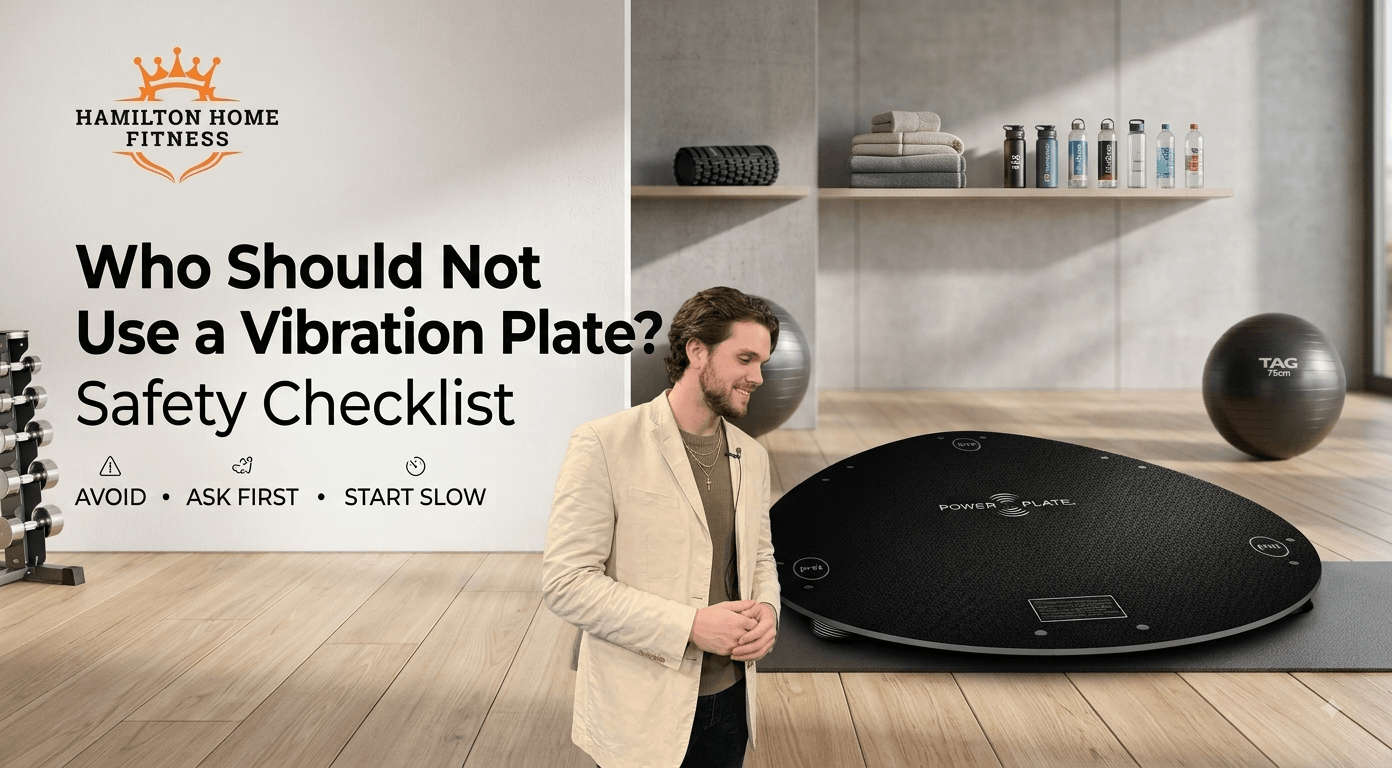
Here is what it left out. Who should not use a vibration plate splits three ways, not two: conditions that rule it out, conditions that need a clinician's sign-off, and conditions that only need a slower start.
This page explains what the guidance says and why. It cannot diagnose you. By the end you will know which group you are in and what to ask before you buy recovery and rehab equipment.
98 words against the 95-word plan, inside the §28 band of 80–110. Carries the hook, the primary keyword, the three-tier promise, the clinical boundary, and link 1 on its mapped descriptive anchor. One link, one paragraph.
Who a Vibration Plate Rules Out
Most healthy adults can use a vibration plate safely. A small group should not use one at all, and a larger group needs clearance first. Vibration plate contraindications cover three situations: conditions that rule it out, conditions needing clearance, and conditions needing only a slower start.
Most sources print all three as one list, so the guidance beside whole-body vibration machines reads harsher than it is.
Ruled out entirely. An active clot or clotting disorder is the clearest case—the concern is dislodging it. So do acute injury, an unhealed fracture, acute inflammation, an untreated retinal condition, and unstable heart disease.
Clearance first. A pacemaker or implanted device, pregnancy, recent surgery or joint replacement, epilepsy, advanced osteoporosis, a hernia, or kidney or gallstones. None is automatic; each needs a clinician who knows your history.
A slower start. Peripheral neuropathy, migraine, and unsteadiness rarely rule vibration out. They change how you begin: lowest setting, shortest session, something to hold.
Being ruled out does not end training. Lower-impact cardio options carry no vibration at all.
The other route is floor work, and stability balls train balance and core with no restrictions here.
Pacemakers and Implanted Devices
If you have a pacemaker or implanted defibrillator, get your cardiologist's approval before using a vibration plate. The reason is not electrical interference, which is what most sources claim. It is that many of these devices carry a motion sensor that can read a vibrating platform as exercise.
Many pacemakers are rate-adaptive, which means they raise your heart rate when they sense you moving. The sensor doing that reads vibration through the body and cannot reliably tell walking from a platform vibrating underfoot.
The same effect turns up during car journeys and aircraft turbulence. That makes it a documented mechanism, not a proven injury, and the evidence stays thin because vibration studies exclude pacemaker wearers rather than test them.
Ask your cardiologist two things: whether your device uses rate-adaptive pacing and how sensitively its sensor is set. Bring the platform's frequency and amplitude figures, not a brand name—ask us for the model's specifications. That answer is theirs, not ours.
Pregnancy, Surgery, and Healing Bone
Pregnancy, recent surgery, and healing bone are timing questions, not lifetime bars. Manufacturers advise against vibration plate use during pregnancy, and credible sources defer to your prenatal provider. For surgical cases the governing number is your surgeon's weight-bearing timeline, not a figure in a manual.
Pregnancy. Effectively every manufacturer prints a warning, and it is precautionary—nobody has run the trial that would settle it. Your obstetrician is the one to ask, and non-powered balance work carries none of the same questions.
Recent surgery. The six-month wait after a knee or hip replacement gets repeated everywhere, but it traces to vendor and clinic guidance, not a consensus body. Whether you can use a vibration plate after surgery, spinal included, is your orthopedic surgeon's call. Supervised clinical and rehab equipment fills it.
Healed bone is different. Small studies have found no adverse effect on orthopedic hardware, and some suggest loading helps bone bond to an implant. Healing fractures follow the same rule—a hip replaced eight years ago and one replaced last month get different answers.
Why Intensity Changes the Answer
"Vibration plate" covers machines that differ enormously in the force they deliver. Intensity comes from frequency and amplitude together, not either alone. A condition ruling out a high-magnitude platform may not rule out a gentle one, so the machine matters as much as the diagnosis.
Frequency is how many times a second the platform moves, in hertz. Amplitude is how far it travels. The MOVE's six preset levels span roughly thirty to forty hertz.
Laboratory measurement found some consumer platforms inside daily exposure limits and others past what is considered safe for one minute. Head transmission fell sharply with bent knees—hence the soft-knee instruction.
That range explains the osteoporosis confusion. Low-magnitude vibration is the version studied as a bone treatment; high-magnitude platforms are what advanced-osteoporosis warnings target. Reviews call the evidence thin; pooled results in postmenopausal women show bone density gains over longer protocols.
Many budget platforms publish neither. The Sunny Fitboard 4D lists modes and speed levels, not hertz or amplitude.
If a clinician says keep it low, you need a machine that publishes its numbers—compare the full Power Plate range.
What the First Sessions Feel Like
Mild itching or tingling in the legs, brief unsteadiness when you step off, and next-day muscle soreness are the whole body vibration side effects first-timers report most, and they usually settle within a few sessions. Headache, persistent dizziness, new joint pain, or any change in vision is different.
The tingling comes from circulation. Unsteadiness on stepping off is orthostatic hypotension, a brief blood pressure drop—stand still before you walk. Nausea usually means the setting was too high. Soreness behaves like any new stimulus, and foam rollers help if the first week bites.
The second list behaves differently: it does not settle with repetition. Persistent dizziness, headaches, new joint discomfort or low back pain, and anything visual—stop and ask.
Documented harm is rare and dose-linked. A small number of published cases describe retinal tears and bleeding in the eye after high-intensity sessions. Low back problems track long occupational exposure in drivers, not ten-minute home sessions.
How Long a Session Should Run
Most manufacturers put a session at ten to fifteen minutes, and several platforms build the limit in—the timer simply stops at nine minutes. Two to three sessions a week is the usual starting point.
Start on the lowest setting, keep your knees soft, and stand near something you can hold. Longer is not better: the exposure evidence runs the other way, so extend the weeks before you extend the minutes.
If balance is already a question, have someone with you for the first sessions.
What to Ask Before You Buy
Medical clearance for vibration therapy takes five minutes if you bring the machine's numbers rather than its brand name. Take three things: your condition, the platform's frequency and amplitude range, and how long you intend to stand on it.
Ask:
- Cardiologist: Does my device use rate-adaptive pacing?
- Cardiologist: How sensitively is its sensor set?
- Obstetrician: Is any vibration exposure a concern now?
- Surgeon: When am I cleared for full weight-bearing?
- Physician: Is there an intensity ceiling for me?
- Therapist: Should my first sessions be supervised?
Hamilton Home Fitness can supply the frequency and amplitude figures as an authorized dealer; the manual carries the user weight limit.
If supervision is advised, the clinic-grade Pro5 HP platform is what clinics run—overkill and over budget for one person at home.
Facilities specifying platforms for multiple users can book a gym design consultation.
FAQ
Is vibration training appropriate for older adults, and under what conditions?
Yes, for many, once a physician has cleared the conditions involved. The age-specific risk is the blood pressure drop in the minute after stepping off, when a fall is most likely. A MOVE stability bar gives you something to hold.
Should you wear shoes on a vibration plate?
Most manufacturers direct barefoot or thin-soled use. Thick cushioned soles absorb the signal before it reaches you and reduce grip. The deck is textured for that reason—bare feet or flat shoes hold it best.
Can children or teenagers use a vibration plate?
No, as a default. Manufacturers restrict these machines to adults, and no safety data exists for growing bodies. The gap is the reason, not evidence of harm—and not a gap worth testing on a child.
What should make you stop a session immediately?
Chest pain, palpitations, or a racing heartbeat that does not settle when you step off. Sit down and do not start another session until a clinician has seen you. These are emergency signals, not dose problems.
Final Thought
For most people the honest answer is a conversation, not a refusal—and it is a short conversation when you bring the machine's numbers to it.
If you are cleared, compare platforms on published specifications rather than price. If you are not, book the appointment first. The shipping and returns terms are worth reading before a purchase this size.