
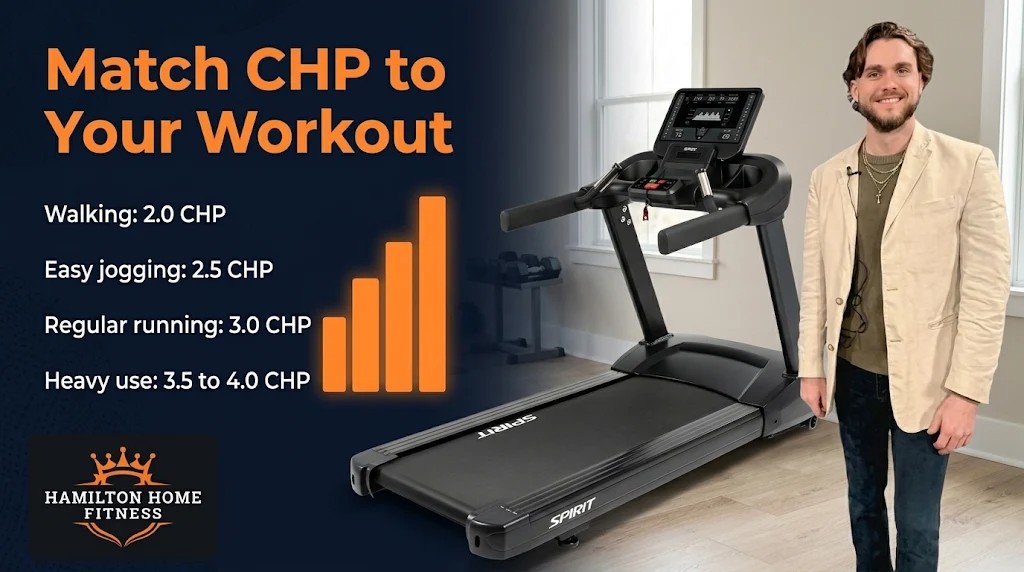
Most home treadmills need about 2.0 continuous horsepower (CHP) for walking and 3.0 CHP or more for regular running. The word that matters is continuous. Our product pages list motors four different ways: a peak figure, a test rating, a plain HP number, and a rating with a peak beside it. None of those four labels says CHP, the number that shows what a motor can hold for a full session.
This guide shows how to read each label, match CHP to your training, and choose between AC and DC before you check the outlet and the warranty.
What Does Treadmill Horsepower Measure?
Horsepower measures how much work a motor can do each second, and one horsepower equals 746 watts. A treadmill's rating describes what the motor is built to deliver at its limit, not what it pulls from your wall during a normal workout.
The arithmetic shows the gap. A 4.0 HP motor working flat out delivers roughly 3,000 watts. A standard 120-volt, 15-amp household circuit supplies at most 1,800 watts. So the rating is headroom, not draw, and a motor that runs well inside its rating works under less strain. Your weight, belt speed and incline decide how hard it works.
CHP vs Peak HP: What Do the Labels Mean?
CHP is the power a motor can hold for a whole workout. Peak HP is the most it can reach in a short burst, so it says little about a 45-minute run. Compare CHP with CHP, and treat any other label as a question to ask.
Label on the product page | Where we list it | How to read it |
2.0 Peak HP, brushless | Sunny Active 400 | Short-burst maximum, not a sustained rating |
3.0 hp (test rating) | BowFlex T6 | Measured in BowFlex's test setting; ask how it compares with CHP |
3.0 AC motor, 7.0 HP peak | Apollo IR-XG-V9 | Two figures; compare the non-peak one |
4.0HP DC motor | Spirit CT800 | Plain HP; ask whether it is continuous |
Peak. The Sunny Active 400 page says it directly: peak horsepower describes a short burst, not what a motor sustains hour after hour.
Test rating. The BowFlex T6 lists 3.0 hp as a test rating and tells shoppers to check how each brand measures horsepower before comparing numbers.
Two figures. The Apollo IR-XG-V9 page lists a 3.0 AC motor with a peak output of 7.0 horsepower. Compare the 3.0, not the 7.0.
How Much Horsepower Do You Need?
Match continuous horsepower to how you train: about 2.0 CHP for walking, 2.5 for walking with easy jogging, 3.0 or more for regular running, and 3.5 to 4.0 or more for daily heavy use. These are working minimums, not guarantees.
Use | Working minimum CHP |
Walking only | 2.0+ |
Walking plus easy jogging | 2.5+ |
Regular running at home | 3.0+ |
Daily heavy use, taller or heavier runners | 3.5 to 4.0+ |
Full commercial floor | 4.0+ AC |
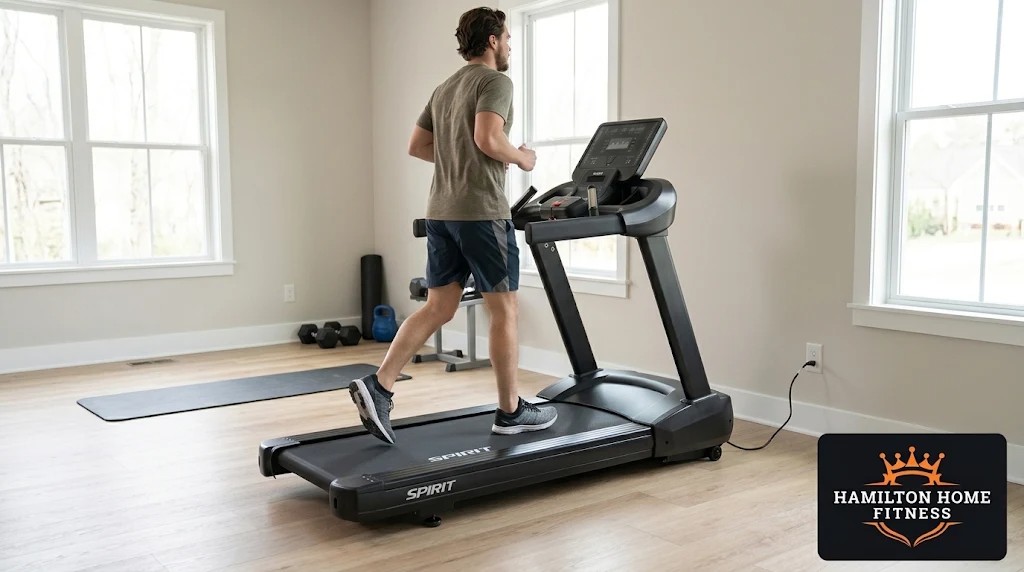
Some brand guides accept 1.5 CHP for walking. The tiers here follow the minimums in our comparison of curved manual and motorized treadmills, with a 2.5 step added for easy jogging.
Check the weight limit as well. Heavier users load the motor more, so move up a tier and confirm the maximum user weight: our commercial treadmill page lists the Spirit CT800 at 450 lb, while the BowFlex T6 page lists 325 lb. Treat two runners sharing one machine as daily heavy use. Compare motors and weight limits side by side in our treadmill collection.
Is 2.5 Horsepower Enough?
Yes for walking and easy jogging, if 2.5 is a continuous rating. For regular running it falls below the 3.0 CHP minimum above. If the 2.5 is a peak figure, the continuous rating is lower, so ask before you buy.
AC or DC: Which Motor Is Better?
Neither wins outright. DC motors are the common choice in home treadmills, tend to run quieter and typically use an ordinary plug. AC motors are the usual commercial choice because they handle continuous daily use without overheating, and the two Spirit AC models below need a 20-amp outlet.
Spirit shows the split. The Spirit CT800 pairs a 4.0 HP DC motor with a standard plug at $3,999.99 (prices as of November 2026).
The Spirit CT850 keeps the 4.0 HP figure but moves to a brushless AC drive and a 5-20P plug, at $4,999.99. Same horsepower, $1,000 more, and a different wall requirement.
The Spirit CT900 steps up to a 5.0 HP AC drive sold as full commercial, also on a 5-20P plug, at $6,999.99.
Ask one more question about any DC motor: brushed or brushless? A brushed motor uses carbon brushes that wear and need replacing. A brushless design has none. The Sunny Active 400 page lists a brushless motor.
Will Your Outlet Handle the Motor?
Check the plug before the horsepower. A NEMA 5-20P plug needs a 20-amp outlet and will not fit a standard 15-amp household receptacle, so a spare room may need a new circuit before a Spirit CT850 or CT900 can run there.
Give any motorized treadmill its own circuit where you can. The Sunny Active 400 page names a space heater or window air conditioner on the same circuit as the usual cause of a tripped breaker mid-workout.
No suitable outlet at all? Skip the motor. Non-electric cardio machines run on your own effort.
Planning a garage setup? Gym Space Guide shows how to add up the load on a garage circuit, and it lists a treadmill among the loads that can share one.
What Does a Motor Warranty Tell You?
A motor warranty shows how long the maker covers the motor and in which setting, such as home or commercial use. Labor is a separate term, and it is usually shorter, so read both numbers before you lean on the word lifetime.
The Horizon T101 covers the frame and motor for life, with one year on parts and one year on labor. A motor that fails in year three is covered, but the labor term has ended, so budget for the service visit.
Setting matters too. BowFlex covers the T6 for home use only, so a gym, office, school or apartment amenity room voids the warranty.
What About Gyms, Hotels and Offices?
Facilities choose by traffic. Dues-paying clubs need a full commercial AC drive, 4.0 CHP or more, on a 20-amp outlet. Hotel, apartment and office rooms can use a light-commercial DC model on a standard outlet, if the warranty names that type of site.
Spirit's light-commercial terms for the CT800 and CT850 cover non-dues sites, with 5 years on the motor. The CT900, sold for all facilities, carries 10 years on the motor. If members pay dues, confirm the terms cover you. Browse commercial treadmills or ask for a quote.
FAQ
How do my weight and workout days change the motor I need?
Move up one tier if you are heavy for the machine, train most days or share it. Then confirm the maximum user weight sits above your heaviest user.
Can a standard 15-amp outlet run a 4.0 HP treadmill?
Yes, if the plug is standard. Our pages list the Spirit CT800's 4.0 HP DC motor with a standard plug on a 120V/15A outlet. The rating is headroom, and the plug tells you the wall requirement.
Does a higher horsepower treadmill last longer?
Not by the number alone. A higher continuous rating gives the motor more headroom, but motor type, build quality and warranty terms also decide how long it lasts.
What if the product page lists no CHP?
Ask the seller for the continuous rating and how it was measured, or check the owner's manual. Call or text us at 423-458-2453 and ask.
Before You Order
- Is the number continuous, or a peak or test rating?
- Is the motor AC, or brushless DC?
- Does the plug match your outlet?
- Does the warranty name your type of use?
If a page leaves any of these out, use our contact page and tell us your room, outlet and heaviest user, and we will help narrow the list.