Introduction
You're at the size dropdown: 55, 65, or 75 cm. Pick wrong and the ball is a nuisance, not a tool.
Every stability ball size chart online sets the height cut-offs slightly differently, so the one you just read may not match the one printed on the box you're about to buy.
This guide gives you the chart, explains why they disagree, and shows you the seated test that settles it. All three diameters sit in our rehab and recovery equipment range.
Sizing for a rehab program, back pain, or pregnancy? Confirm the diameter with the clinician running your plan.
What Size Ball Fits Your Height?
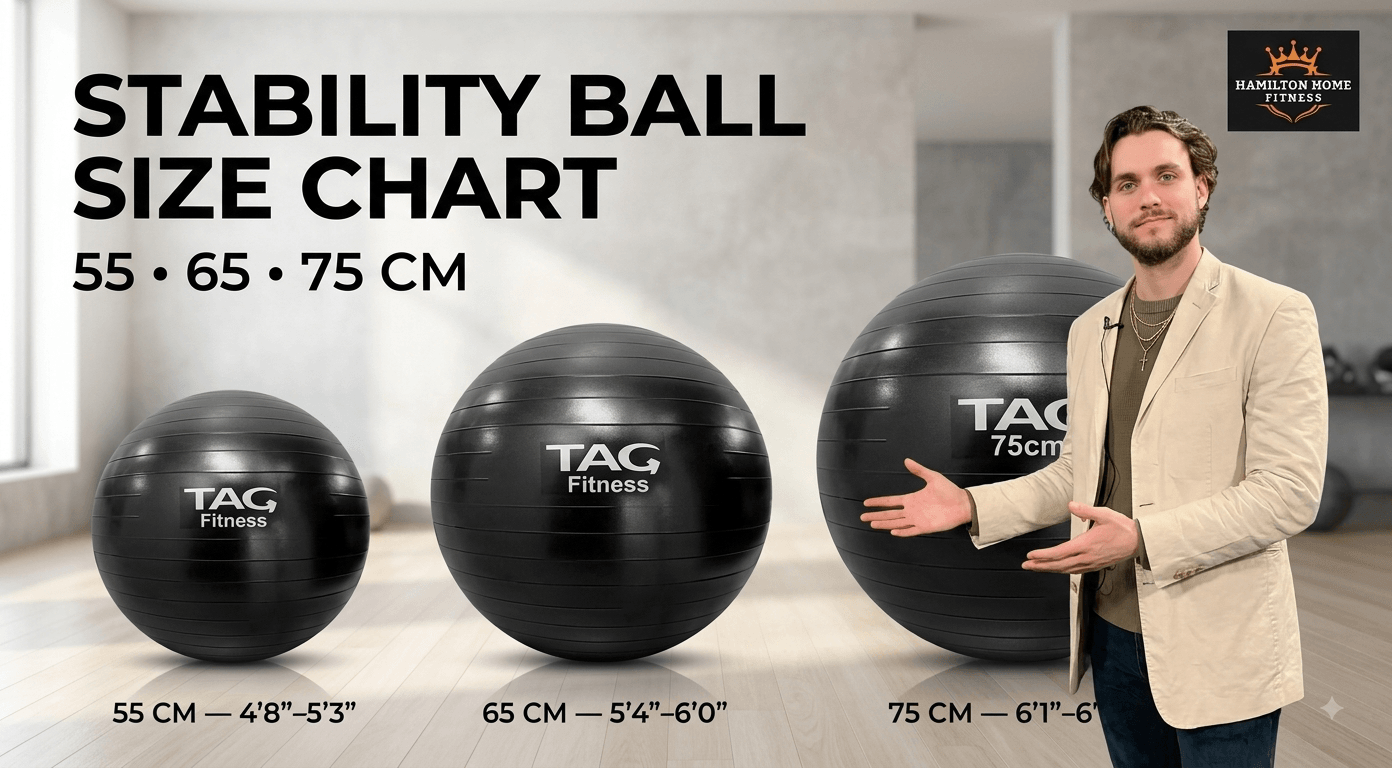
Most adults need a 65 cm ball. Under about 5'4", size down to 55 cm; over 6 feet, size up to 75 cm. Those cut-offs are not standard, though—published height ranges shift by up to four inches between brands, so check the chart for the ball you're actually buying.
Diameter | Height range | Who it suits |
55 cm | 4'8" – 5'3" | Shorter frames, tighter rooms |
65 cm | 5'4" – 6'0" | Most adults, the default pick |
75 cm | 6'1" – 6'7" | Tall lifters, long limbs, bridging |
We stock all three diameters: 55 cm at $19, 65 cm at $21, and 75 cm at $23 as of August 2026. That spread is small enough that the size decision costs almost nothing—you can compare the three TAG diameters before you commit.
Sizing an exercise ball by height gets you close, but not always to one answer. At 5'6" you'll be told 55 cm by some retailers and 65 cm by others, because the ranges above come from TAG Fitness and sit larger than several rivals.
On a boundary, or at the far end of a range, the chart alone can't settle it.
The Fit Test That Settles It
Sit on the fully inflated ball with both feet flat on the floor. Your hips should sit level with your knees or slightly above them, and your thighs should run roughly parallel to the ground. If your knees ride higher than your hips, the ball is too small.
Two versions of this test circulate, and they don't give the same answer.
The stricter one wants thighs exactly parallel and knees at 90 degrees. The other wants hips clearly above knee height. That second standard pushes you up a size, so knowing which one you're applying matters more than knowing the chart.
Use thighs-parallel for training. Use hips-above-knees for anything seated.
Already bought? Run the test the day the box arrives, not a month later. Inflate it fully first, since a soft ball fails the test for the wrong reason. Return windows are finite, and a ball that's been used on grit won't qualify.
Borderline either way—passing one version and failing the other—is common and worth a second opinion. Talk to our team before you order if you're stuck between two diameters.
How Weight and Leg Length Shift It
Two people the same height can need different diameters, because a heavier user compresses the ball further and a long-legged user sits higher on it than the chart assumes.
Picture two readers at 5'9". One weighs 160 lb with a short femur and passes the seated test cleanly on a 65 cm ball. The other weighs 240 lb with long legs, sinks a couple of inches further into the same ball, and ends up with knees above hips—a 75 cm ball fixes it.
Height is the starting variable, not the only one. If you sit heavy on the ball or your inseam runs long for your height, size up rather than trusting the row you landed on.
Sizing for a Desk vs. for Exercise
For desk use, take the larger of your two candidate sizes—seated posture wants hips clearly above knees. For exercise, take the smaller, where thighs run parallel. Keep desk sessions short: the evidence for ball sitting is weaker than the marketing suggests.
An open hip angle stops you from collapsing into your lower back over a long stretch, which is why desk use sizes up. Specifying seating for a whole floor? Planning a workplace wellness room covers the wider setup.
A bigger ball won't fix the setup on its own. Sitting all day calls for loaded movement more than a different seat, which is where resistance training gear earns its place.
For training, go the other way. Thigh parallel shortens your lever on rollouts and planks and keeps shoulder position cleaner under load.
Be realistic, though. Against a normal office chair, ball sitting produces more trunk movement—but also higher sustained lower-back muscle activity, measurable spinal compression inside an hour, and more reported discomfort. Short stints, not full days. Some manufacturers print that their balls are not intended for use as a chair.
How Inflation Changes Real Diameter
A ball only measures its printed diameter when it's fully inflated and stretched. An under-inflated 65 cm ball behaves like a smaller one, so it fails the seated test even though you bought the right size. Measuring is the only way to know.
The symptom shows up fastest under load. On Swiss ball hamstring curls, a soft ball rolls sideways instead of holding position, and your heels lose the surface entirely.
Measure it against a wall. Mark 65 cm on the wall, inflate until the top of the ball reaches your mark, and stop there—diameter and inflated height are the same number. The tape in the box is for exactly this.
New balls need stretching first. Fill to roughly 80% of the target, leave it a day, then top up.
Then repeat it. Every ball loses air across normal use, so a diameter that passed in March quietly shrinks by summer. Re-check monthly and keep the plug and pump somewhere you'll find them, alongside the foam rollers for the same corner.
Anti-Burst and Weight Ratings Decoded
"Burst-resistant" means the ball deflates slowly if punctured rather than bursting under you. It is not the same as puncture-proof. A weight capacity is usually a static rating—the load measured with the user sitting still, not bouncing, dropping onto it, or pressing a dumbbell.
Published capacities run from 300 lb to four figures, measured differently by each brand, so they don't compare across a shelf. Every figure we list is the manufacturer's—more about Hamilton Home Fitness.
Loading the ball is where the rating earns itself. A 1,000 lb static rating means it isn't the weak link under a supine press, which is why they hold up in what trainers stock in a studio. It says nothing about abrasion, though.
Check three things before you buy:
- Static rating, not bounce or drop
- Latex-free for shared floors
- Textured surface, not smooth
Grit, rough concrete, and pet claws shorten any ball's life, whatever the number. Latex-free matters on shared floors for the same reason it does with light bands for warm-ups.
Sizing for a Clinic or Studio
A shared space buys coverage, not a single size. Two diameters cover most adult populations, and three cover nearly all. At $19 to $23 a ball, the second and third sizes cost less than one member walking away from equipment that doesn't fit them.
Picture a studio with forty members between 5'1" and 6'3". A rack of 65 cm balls serves the middle well and leaves both ends compensating—the shorter members perched with knees up, the taller ones folded. Six balls across three sizes fixes it for under $130.
Storage and labeling decide whether that works in practice. An unlabelled ball gets grabbed by whoever reaches it first, so buy sizes that are visibly different or marked, and give each size its own spot rather than one shared pile. Balls store badly and roll worse, which matters more in a 400 sq ft studio than the purchase price does. The rest of the commercial fitness equipment range is worth planning alongside them.
One limit worth naming: these are fitness-grade balls in three diameters. A clinic needing a therapeutic size outside 55 to 75 cm won't find it here.
FAQ
What size ball do physical therapists use?
Clinics keep several diameters rather than one, commonly 45 through 75 cm. The choice follows the patient and the exercise, not height alone. A prescribed size overrides any chart, including this one. See outfitting a rehabilitation center.
How do I measure a stability ball to check its size?
Mark the target height on a wall and inflate until the top of the ball reaches it—the diameter and inflated height are the same measurement. A tape around the widest point, divided by 3.14, gives the same answer.
Should I get 65 cm or 75 cm if I'm right between them?
Take 75 cm for seated work and wide bridging. Take 65 cm for rollouts, planks, and pikes, where the shorter lever keeps your shoulders in a cleaner position. The use decides it, not your height.
Do stability balls come in 45 cm or 85 cm?
Yes—the industry range runs 45 to 85 cm in 10 cm steps. The three middle sizes cover almost every adult, which is why most retailers stock those. The outliers suit children and users above 6'7". Shipping and returns terms.
Final Thought
The chart narrows it, the seated test confirms it, and inflation decides whether the size you bought is the size you get. Pick your diameter—55, 65, or 75 cm—and order it. All three stability balls ship free, so a wrong guess costs you a return, not a purchase.