Introduction
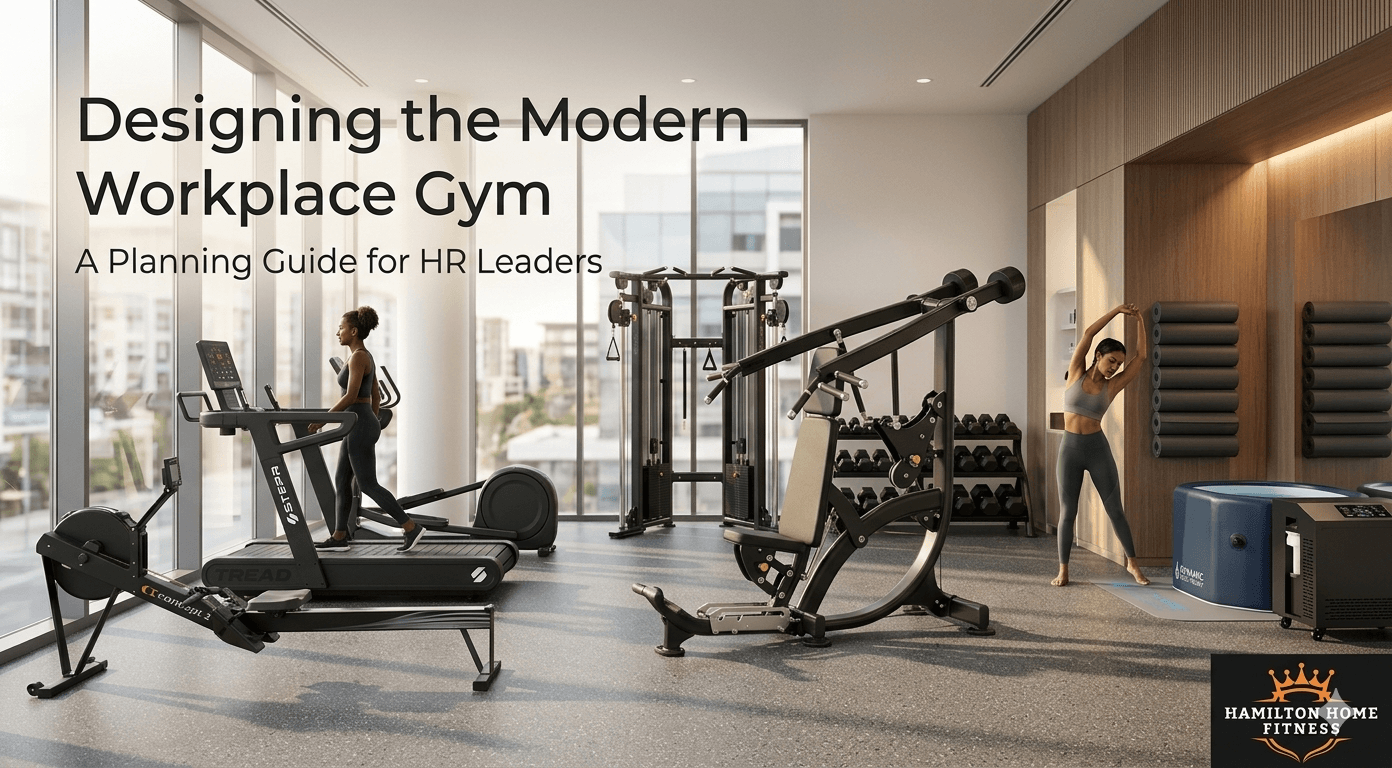
A corporate wellness gym works when the equipment mix is deliberate—low-impact cardio, beginner-friendly strength, and a real recovery zone, sized to the space and the workforce that will actually use it.
This guide is built for HR leaders, benefits managers, facilities managers, and workplace experience directors planning a new or refreshed on-site fitness center between 500 and 4,000 square feet. Most teams overspend on heavy free weights, underplan recovery and safety, and struggle to defend the ROI later.
You will leave with a clear, decision-ready plan: the right corporate wellness gym equipment for your space; a safety and maintenance framework HR and facilities can stand behind; and an ROI lens that holds up in a finance review. When you are ready to scope a quote or layout, the Hamilton Home Fitness commercial collection and our free corporate gym design consultation pair directly with the steps in this guide.
Corporate Wellness Gym Equipment Defined
Corporate wellness gym equipment is commercial-grade fitness gear specified for an employer-owned, on-site fitness center used by employees of mixed ages, abilities, and training experience — usually without a full-time trainer on the floor. It sits between home gym gear (too light for daily multi-user load) and high-performance club equipment (too complex and intimidating for general staff).
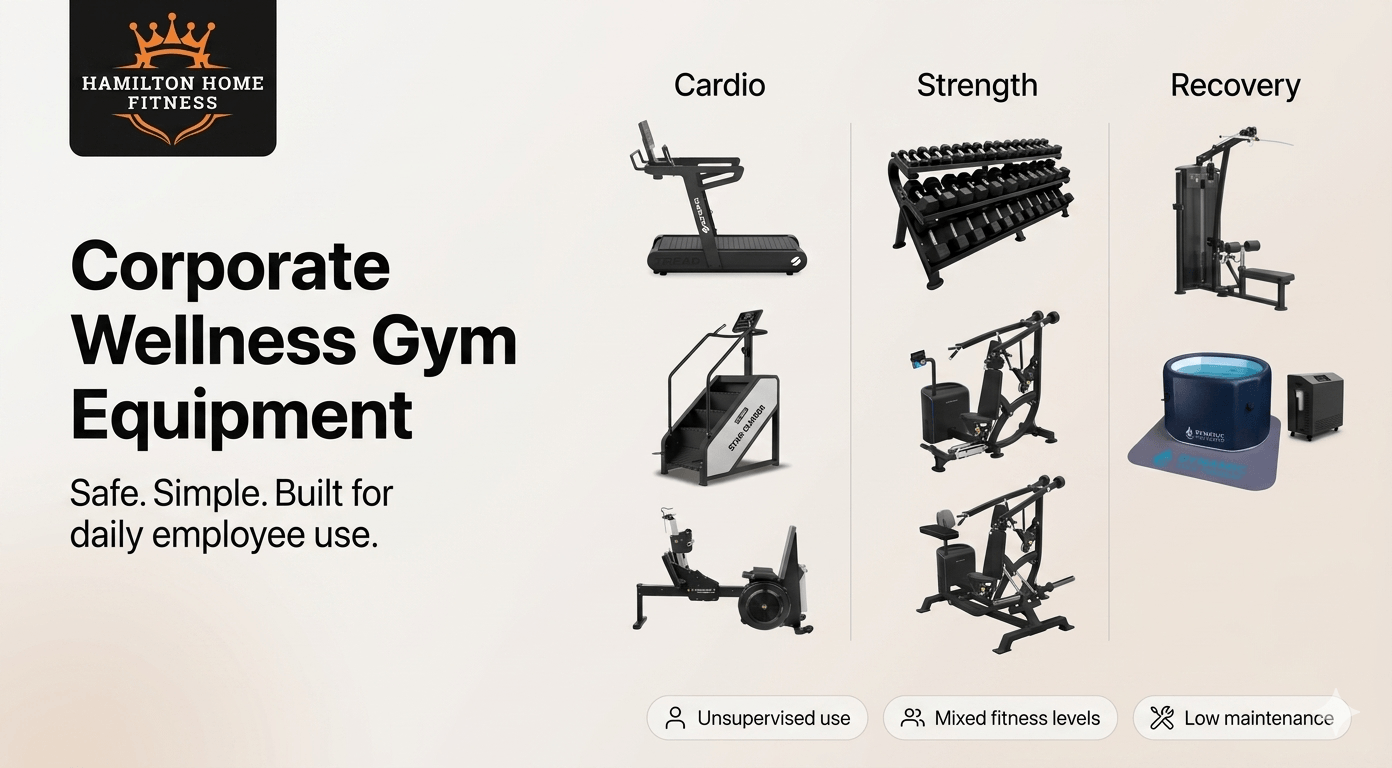
The category is defined by three equipment pillars and three planning constraints.
The three pillars
Cardio — low-impact, intuitive machines that suit deconditioned and sedentary employees.
Strength — guided-motion and selectorized machines paired with a small free-weight area for confident lifters.
Recovery and mobility — stretching, foam rolling, and optional sauna or cold therapy to drive participation beyond hard training.
The three constraints
Unsupervised use — equipment must be safe and intuitive enough for employees to use without on-floor coaching.
Mixed fitness levels — the same room must serve a first-time exerciser and a seasoned lifter without friction.
Low maintenance — commercial-grade build quality and a service plan that protects daily uptime with minimal facilities-team effort.
In short, corporate wellness gym equipment is not just smaller commercial gear or upgraded home gear. It is a deliberately scoped mix engineered for safety, simplicity, and sustained employee participation — the foundation every other planning decision in this guide is built on.
Right-Sizing Your On-Site Fitness Center
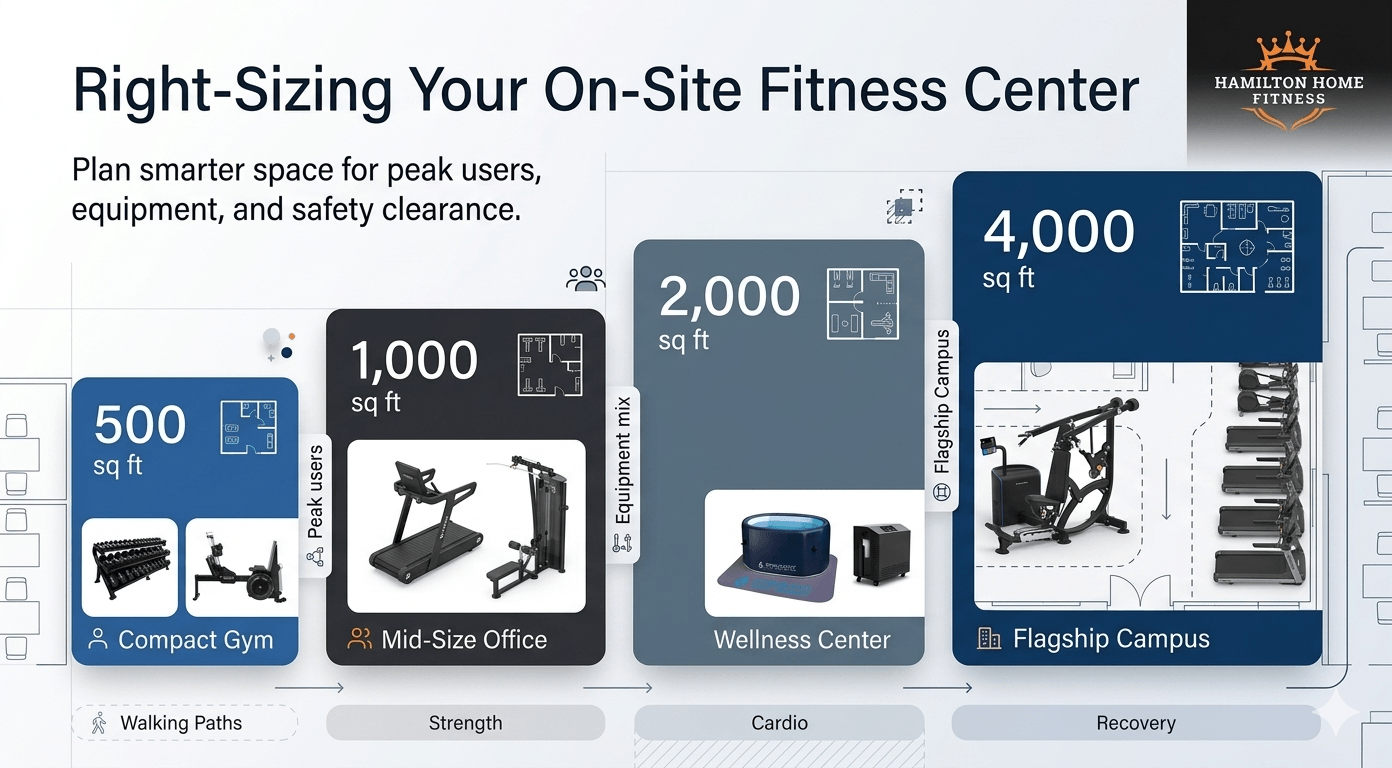
A practical starting rule is 10 to 20 square feet per active user at peak hour, with a minimum of 500 square feet for any functional setup. The exact number depends on the equipment mix, the percentage of employees who will actually use the gym at lunch, and whether you plan to host group fitness or biometric screening events on the floor.
Three variables drive the final footprint:
Concurrent peak users, not total headcount. Most corporate gyms see 3–8% of on-site employees during the busiest hours (typically 11:30 a.m.–1:00 p.m. or 4:30–6:00 p.m.).
Equipment mix. Cardio and selectorized strength have predictable footprints; free-weight zones, functional rigs, and group fitness areas need extra care.
Safety clearance. Plan roughly 24–36 inches of clear space around each machine and clear walking paths to meet accessibility expectations.
Square footage by headcount band
Most mid-to-large US employers can serve their on-site gym needs with one of four space tiers: 500, 1,000, 2,000, or 4,000 square feet. The table below maps each tier to a realistic employer profile and the concurrent users it can comfortably support.
Space Tier | Typical On-Site Headcount | Concurrent Peak Users | Best Fit |
500 sq ft | 50–150 employees | 3–6 | Compact fitness room, satellite office, or pilot program |
1,000 sq ft | 150–400 employees | 6–12 | Standard mid-size HQ or regional office |
2,000 sq ft | 400–1,000 employees | 12–25 | Full wellness center with group fitness corner |
4,000 sq ft | 1,000+ employees | 25–50 | Flagship HQ, corporate campus, or executive-grade facility |
A few planning notes that often get missed:
Ceiling height matters. Aim for at least 9 feet clear and 10–12 feet if you plan to include functional rigs, pull-up stations, or jump-based training.
Plumbing access. Even a basic gym benefits from a nearby restroom or shower. A 2,000+ sq ft facility usually needs dedicated locker rooms in the plan.
Flooring and load. Strength and free-weight zones need rubber flooring and a floor load rating that supports the heaviest planned equipment plus users.
Start smaller, leave room to grow. It is easier to add a second cardio row or a functional rig later than to retrofit ventilation, flooring, or power.
These tiers feed directly into the equipment mix and package recommendations later in this guide—once you have a defensible square-footage target, every downstream decision gets simpler.
Best Equipment Mix for an Office Gym
A workable starting mix for most corporate gyms is roughly 40% cardio, 40% strength, and 20% recovery and mobility, measured by floor space rather than machine count. This ratio assumes an unsupervised facility serving a mixed-ability workforce—adjust slightly toward strength for a younger, more active employee base and slightly toward cardio and recovery for a sedentary or older population.
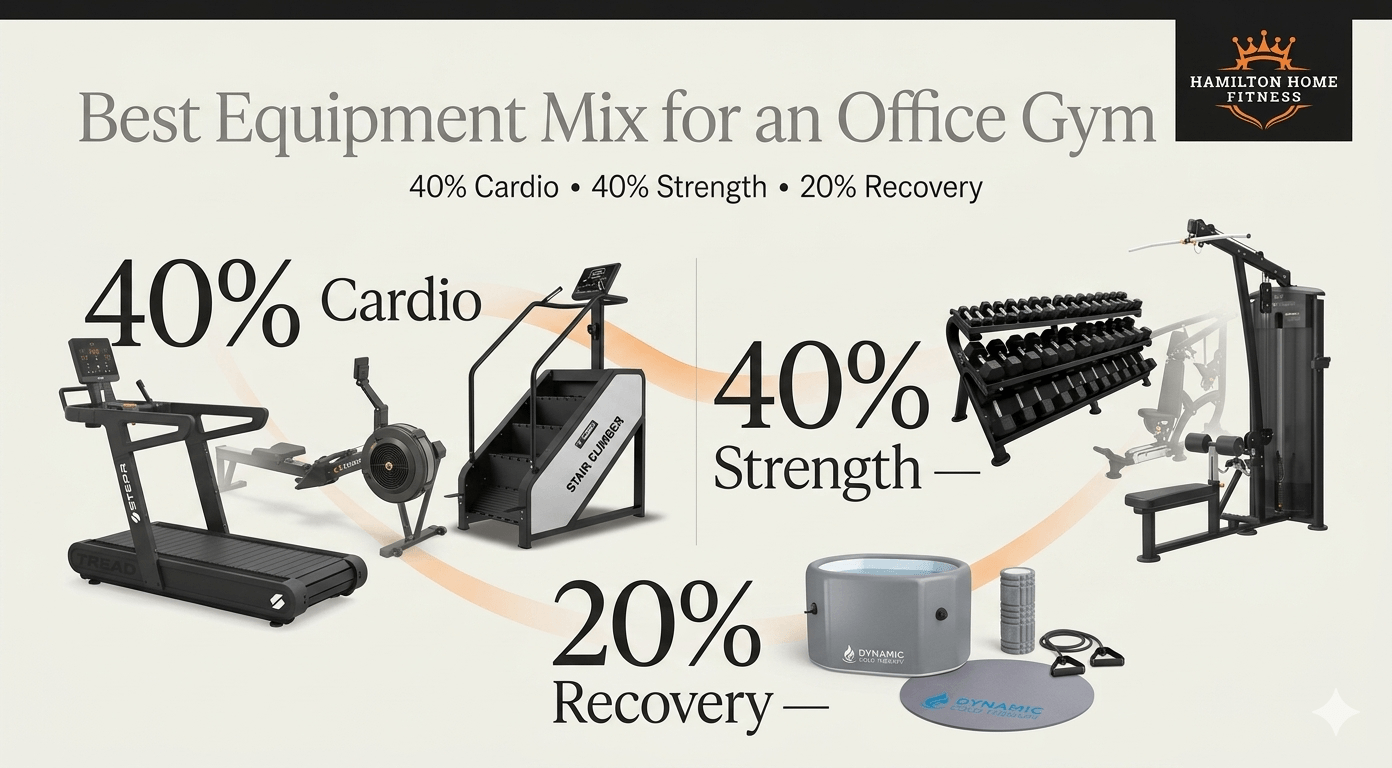
Three rules govern the mix:
Bias toward intuitive, guided-motion equipment. Anything that takes more than 60 seconds to figure out without a trainer is a risk.
Avoid duplicating intensity. One quality rower beats two budget rowers; one functional trainer beats three single-purpose machines.
Reserve real space for recovery. Recovery zones drive participation from employees who will never touch a barbell—and that is where wellness ROI quietly compounds.
Cardio choices for low-impact use
For an unsupervised office gym, prioritize low-impact cardio that is quiet, intuitive, and forgiving to deconditioned users. Most employees walk in at lunch, not before a race—the equipment should match that reality.
The strongest cardio categories for a workplace gym:
Walking pads and under-desk treadmills — quiet, compact, ideal for shorter sessions and hybrid setups near sit-stand desks.
Full-size commercial treadmills—the highest-demand machine in almost every corporate gym; specify cushioned decks and step-off safety features.
Recumbent and upright bikes — low-impact, low-skill, and welcoming for first-time users and seniors.
Ellipticals — joint-friendly cross-training option that suits employees recovering from minor injuries.
Indoor rowers — full-body conditioning in a small footprint; pair with brief on-machine instructions to keep technique safe.
Browse commercial cardio equipment built for daily use when you are ready to shortlist; cardio from Spirit Fitness, Concept2 commercial rowers, and STEPR are common category-fitting choices.
Strength picks for unsupervised use
Selectorized strength machines, one functional trainer, and a small free weight set cover full-body needs while keeping unsupervised risk low. Pin-loaded selectorized stations guide movement paths, simplify resistance changes, and remove most of the technique risk that comes with heavy barbell work.
A defensible starter strength list:
Selectorized stations—chest press, lat pulldown, seated row, leg press, leg curl, and shoulder press cover full-body training without complexity.
One functional trainer or dual-cable system — the single most versatile piece in a corporate gym; supports beginners and advanced lifters in one footprint.
Adjustable dumbbells (5–50 lb range) — replace a rack of fixed dumbbells, save floor space, and serve a wide skill range.
One adjustable bench—flat, incline, and decline coverage in a single unit.
Light kettlebells and a technique bar — optional, useful for group fitness and beginner barbell work.
A smith machine is worth considering when you want a safer squat and bench option without on-site coaching. A heavy free-weight platform with bumper plates is usually a poor fit for an unsupervised gym—the injury and equipment-damage risk rarely justifies it.
Shortlist commercial weightlifting machines and a commercial free weight selection for these categories.
Recovery and mobility zone
A small recovery zone with mats, foam rollers, and optional sauna or cold therapy can lift gym usage measurably by giving non-lifters a reason to walk in. It is also the lowest-cost square footage in the gym.
Build the zone in three layers:
Core layer — yoga mats, foam rollers, lacrosse balls, resistance bands, and a stretching corner with one or two stability balls or BOSU trainers.
Engagement layer — a percussion massager, a massage chair, or a TRX/suspension trainer station for active recovery.
Premium layer (optional)—infrared sauna or a single cold plunge unit, usually planned only in 2,000+ sq ft facilities.
Source the layers from stretching and mobility equipment, yoga and mat-based recovery gear, commercial sauna options, and dynamic cold therapy and cold plunge units—selecting only what fits the space tier and budget.
Serving beginners and lifters together
A workplace gym serves both groups when guided-motion machines anchor the layout and a small free-weight area is added with clear signage. Beginners gravitate to the predictable, low-skill machines first; experienced lifters use the free-weight area without needing an open platform or heavy bumper drops.
Practical rules for shared use:
Place selectorized machines in the most visible, well-lit area—visibility lowers the intimidation barrier for first-time users.
Tuck the free-weight area into a side zone, not the center of the room.
Pick wide-range adjustable dumbbells over a long fixed rack—they serve a 5 lb beginner and a 50 lb regular without taking 20 feet of wall.
Add a technique bar (~15 lb) alongside a standard barbell so newer lifters can learn movement patterns at a lower load.
Post one clear "how to use this machine" card per station — the single highest-impact safety upgrade for an unsupervised gym.
For employees returning from injury or working with mobility limitations, pair the layout with rehab and accessible fitness equipment so the gym remains usable across the full employee population—not just the already-fit minority.
Corporate Gym Packages by Square Footage
Equipment lists scale predictably from a compact fitness room to a full HQ gym—these four tiers cover most US employers. Each package below uses the 40% cardio / 40% strength / 20% recovery mix as a baseline, adjusted for what realistically fits the footprint.
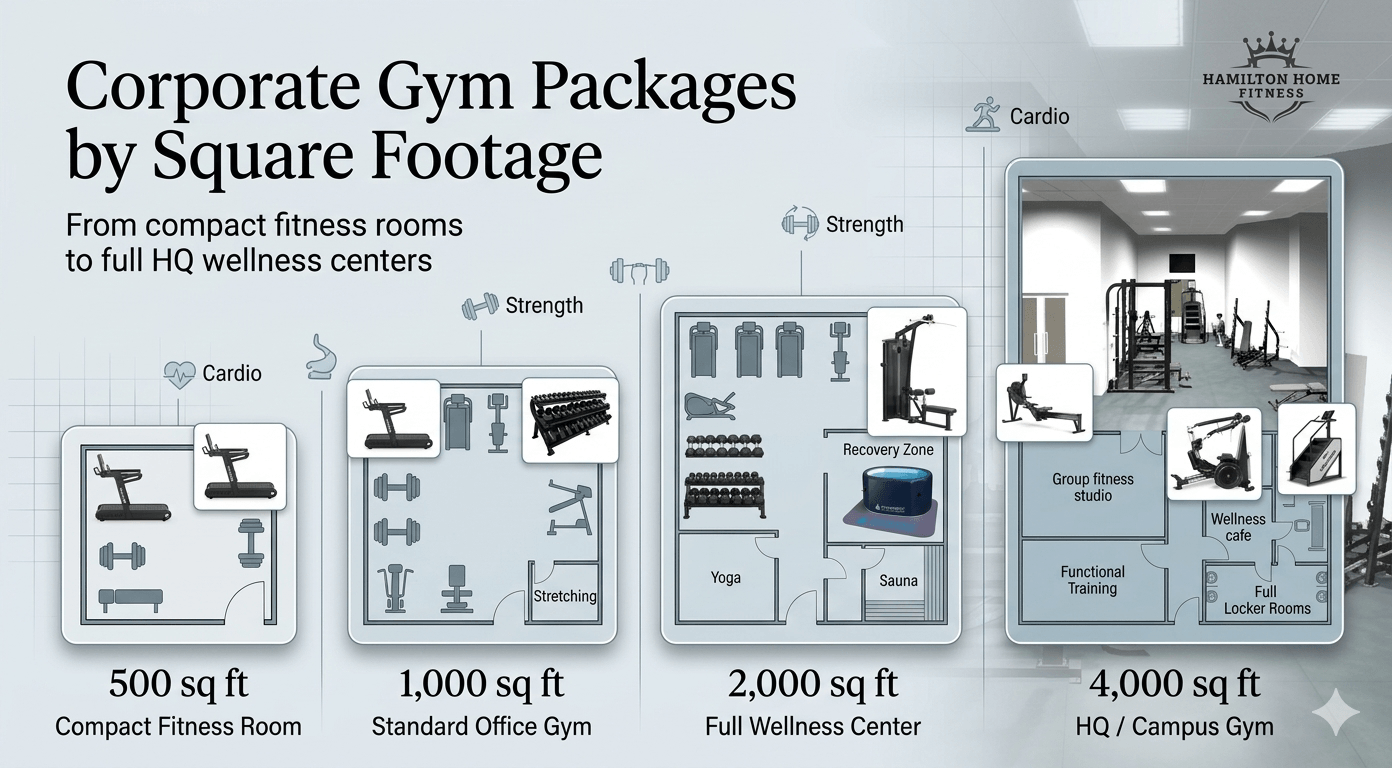
Use these as planning sketches, not final quotes. The exact machines, brands, and clearances should be confirmed against your floor plan and ventilation.
Tier | Cardio | Strength | Recovery | Best Fit |
500 sq ft | 3 machines | 1 functional trainer + light free weights | Mobility corner | 50–150 employees |
1,000 sq ft | 5–6 machines | 3–4 selectorized + free weights | Defined recovery zone | 150–400 employees |
2,000 sq ft | 8–10 machines | Full selectorized line + free-weight area | Recovery zone + group fitness | 400–1,000 employees |
4,000 sq ft | Multiple cardio rows | Full-strength floor | Sauna or cold therapy + studio | 1,000+ employees |
500 sq ft compact fitness room
A 500 sq ft layout typically fits three cardio machines, one functional trainer, an adjustable bench, and a small mobility corner. This is the minimum viable corporate gym — useful for satellite offices, pilot programs, or single-floor HQs testing employee demand before scaling.
Sample equipment list:
1 commercial treadmill
1 recumbent or upright bike
1 indoor rower or elliptical
1 functional trainer (the single most versatile strength piece)
1 adjustable bench
1 set of adjustable dumbbells (5–50 lb)
Mobility corner: 2 yoga mats, 2 foam rollers, resistance bands, 1 stability ball
A functional fitness rig system is the highest-leverage piece in this tier—it replaces three or four single-purpose machines and serves beginners through advanced users in the same footprint.
1,000 sq ft standard office gym
A 1,000 sq ft gym supports five to six cardio pieces, three to four selectorized strength machines, and a defined recovery zone. This is the most common corporate footprint and the sweet spot for most mid-size HQs and regional offices.
Sample equipment list:
2 commercial treadmills
1 elliptical
1 upright or recumbent bike
1 indoor rower
1 walking pad (optional, for hybrid-desk integration)
Selectorized: chest press, lat pulldown, seated row, leg press
1 functional trainer or cable column
1 adjustable bench + 1 set of adjustable dumbbells
Recovery zone: mats, foam rollers, resistance bands, percussion massager, 1 TRX station
This tier is where group participation begins to outpace solo use, so leave a 10×10 foot clear area for occasional stretching or bodyweight classes.
2,000 sq ft full wellness center
A 2,000 sq ft wellness center adds a small group fitness area, broader strength variety, and a proper recovery zone. Employers in this tier can support lunchtime yoga, lunchtime HIIT, and on-site biometric screening events without rearranging the floor.
Sample equipment list:
3–4 commercial treadmills
2 ellipticals or bikes (mix of upright and recumbent)
1–2 indoor rowers
1 stair climber (optional)
Full selectorized line: chest press, lat pulldown, seated row, leg press, leg curl, shoulder press, abdominal
1 smith machine
1 functional trainer
Free-weight area: adjustable dumbbells, light kettlebells, technique bar, 1–2 adjustable benches, 1 power rack
Recovery zone: stretching corner, foam rollers, mats, percussion massager, 1 massage chair
Group fitness corner: 8–12 mats, light kettlebells, resistance bands
Mid-tier strength categories from Body-Solid strength systems and TAG Fitness racks and benches are typical category-fit choices at this size.
4,000 sq ft HQ or campus gym
A 4,000 sq ft HQ or campus gym supports a full strength floor, multiple cardio rows, group fitness, and optional sauna or cold therapy. This is destination-grade—the facility that recruiting and retention teams reference in benefits materials.
Sample equipment list:
5–8 commercial treadmills
3–4 ellipticals
3–4 bikes (upright, recumbent, smart bike)
2–3 indoor rowers
1–2 stair climbers
Full selectorized line (8–10 stations covering all major movement patterns)
1–2 smith machines
2 functional trainers or a dual-cable system
Free-weight area: adjustable dumbbells, fixed dumbbells, kettlebells, technique bar, multiple benches, 1–2 power racks
Recovery zone: dedicated stretching area, percussion massagers, 1 massage chair, optional infrared sauna and cold plunge unit
Dedicated group fitness studio (~400–600 sq ft) with mirrors, mats, light kettlebells, resistance bands, mobility tools
At this tier, locker rooms, towel service, and shower facilities usually become part of the brief. A 4,000 sq ft facility is also where a written floor plan stops being optional—book a free corporate gym design consultation to get a 2D or 3D layout, a written quote, and confirmation of ceiling height, ventilation, and load requirements before procurement.
Safety, Compliance, and Insurance Setup
A safe, unsupervised corporate gym is built on five layers: equipment safety design, signage, emergency response gear, a liability waiver, and the right insurance coverage. Miss any one of them, and the rest lose their value.
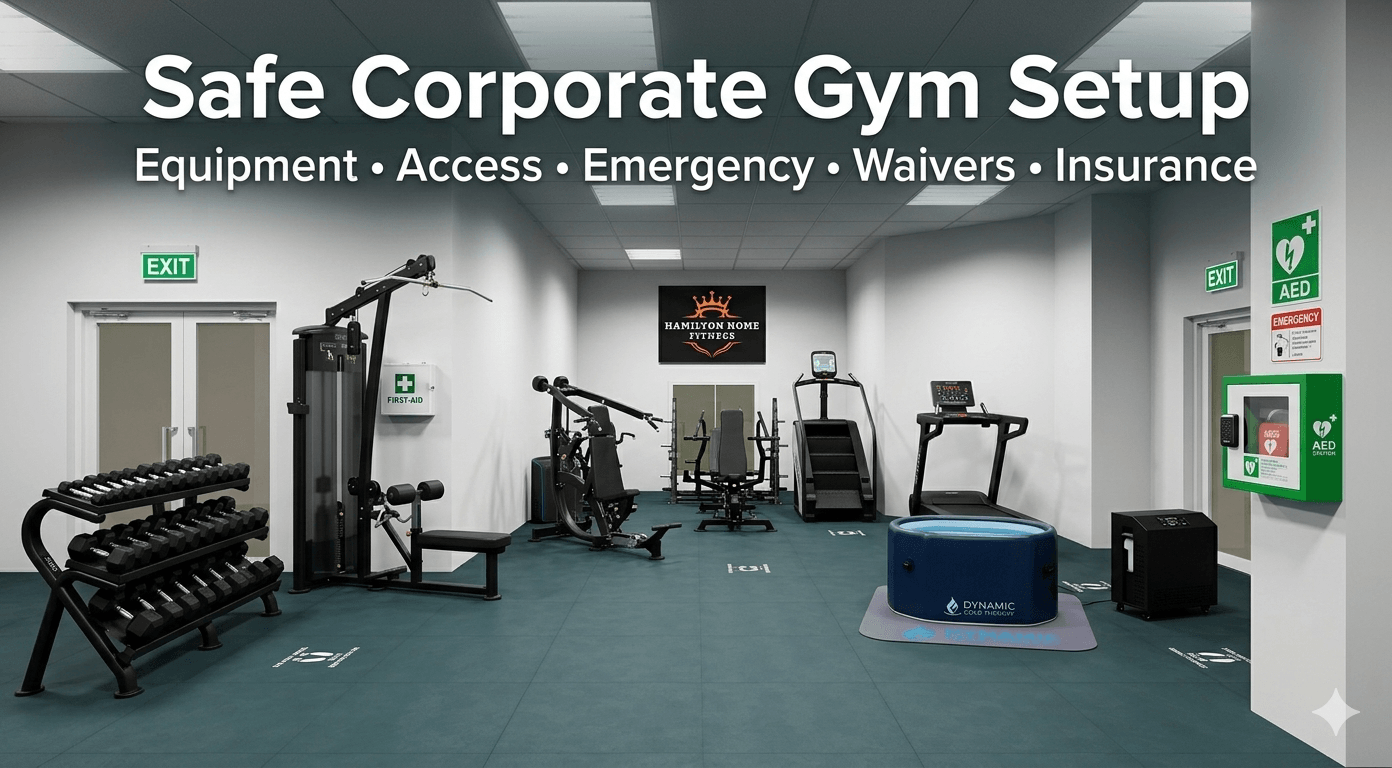
This section walks through the practical setup. Important YMYL note: The legal, accessibility, and insurance specifics below vary by state, carrier, and facility type. Treat this as a planning checklist for HR and facilities—final waiver language, accessibility compliance, and insurance terms should be reviewed by a qualified attorney and your commercial insurance broker.
The unsupervised gym safety checklist:
Equipment with guided motion, low-skill controls, and visible safety stops where applicable
Posted use rules at the entrance and equipment-specific instruction cards at each station
A wall-mounted AED with clear signage and a documented emergency response procedure
Signed liability waiver on file for every employee user before keycard access is granted
Keycard or badge access with usage logging
Adequate lighting, ventilation, and unobstructed pathways
A documented incident reporting process tied to HR and facilities
ADA and OSHA touchpoints
Plan for ADA-compliant pathways, accessible machines, and basic OSHA-aligned facility safety from day one. Retrofitting accessibility after installation is expensive; planning it in upfront costs almost nothing.
Practical touchpoints for a US corporate gym:
Accessible path of travel from the building entry through the locker room, restroom, and gym floor
Door widths that meet ADA clear-opening requirements
At least one accessible machine in each major category (cardio, strength, recovery)—recumbent bikes, low-step treadmills, and selectorized machines with swing-away seats are typical fits
Clear floor space at the front of accessible equipment so a user can transfer or approach safely
OSHA-aligned facility safety: marked emergency exits, working egress lighting, proper electrical load for cardio equipment, clear walking paths, and slip-resistant flooring in wet zones
Indoor air quality and ventilation appropriate for an exercise space — important for both safety and participation
Equipment from a rehab and accessible fitness equipment category fits well here for the accessible-machine layer.
Waivers, signage, and emergency gear
Every unsupervised gym should have a signed liability waiver, posted use rules, equipment-specific signage, an AED, and a clear emergency contact—all visible before a user gets to the first machine.
The on-wall and on-floor essentials:
Liability waiver signed by each employee user before access; renewed annually
Posted rules of use at the entrance: hours, age restrictions if applicable, dress code, supervision policy, food and drink rules
Per-machine instruction cards showing correct setup, basic technique, and what to do if a malfunction occurs
AED in a visible, unlocked cabinet with a posted "in case of emergency" card listing security, facilities, and 911
First-aid kit stocked and inspected monthly
Emergency stop, safety pins, or spotter arms present and functional on relevant strength equipment
Mirror placement that supports form awareness without creating tripping or visibility hazards
Keycard or badge access with usage logs—these protect the employer and feed ROI measurement later
Younger employees and contractors are sometimes overlooked. Confirm with legal counsel whether waivers and access rules need to differ for interns, contractors, family members, or after-hours visitors.
Gym insurance for employers
Most US employers cover an on-site gym through general liability and premises liability, often paired with a recreational facility endorsement or a named amendment to the commercial policy. Specifics vary widely by carrier and state, so confirm with the company's broker before installation.
Questions to bring to your insurance broker:
Does the commercial general liability policy cover employee injury inside an employer-owned gym, or is a rider required?
Is a recreational facility endorsement or named-premises amendment needed?
How does workers' compensation treat injuries that occur on-site but during non-work activity?
Are there carrier-required safety conditions (AED on site, posted rules, signed waivers, supervised vs. unsupervised classification) that affect coverage or premium?
Does the policy require specific equipment maintenance records or vendor certifications to remain in force?
Are family members, contractors, or guests covered, and what waiver or registration is needed for each?
The answers shape the equipment specification and the maintenance plan covered in the next section. They also affect whether the on-site gym is classified as a perk, a benefit, or a recreational facility — a distinction that can matter for both insurance and tax treatment.
Maintenance Plan and Total Cost of Use
A working maintenance plan combines daily wipe-down, monthly inspection, quarterly preventive service, and annual deep service—most large suppliers can quote a contract for the last three. Equipment that runs 10 to 14 hours a day under mixed users fails faster than a home gym; planning maintenance up front protects uptime, safety, and capital.
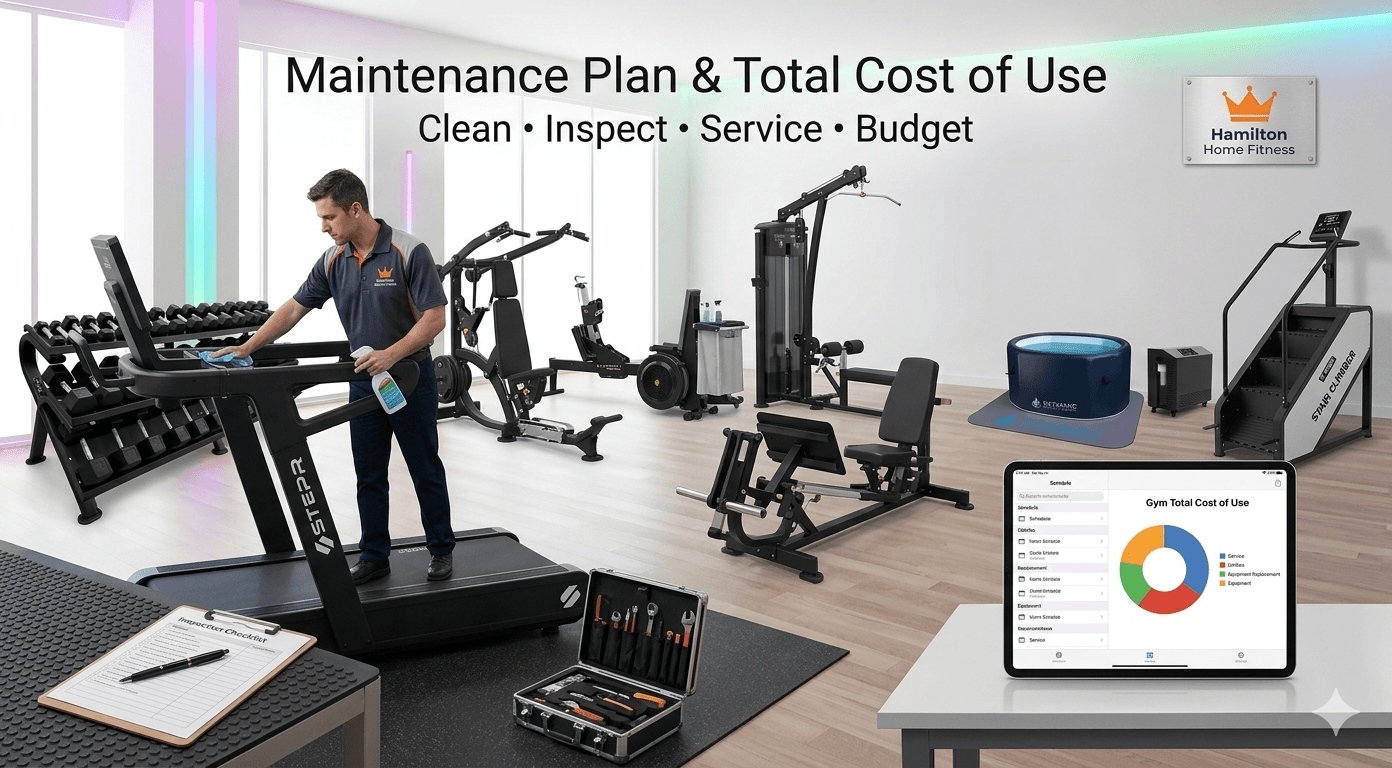
Skipping the plan is where most corporate gyms quietly fail. A treadmill belt that goes unserviced for 18 months is no longer a covered piece of equipment under most warranties, and an out-of-service machine is a participation killer that takes weeks of momentum with it.
Preventive maintenance schedule
Schedule daily cleaning, monthly self-inspection, quarterly preventive service, and annual deep service for each machine. The frequency table below is a defensible starting point for HR and facilities to operationalize.
Frequency | Who | Scope |
Daily | Cleaning crew or first-shift facilities | Wipe down all touch surfaces, check for visible damage, restock sanitizing wipes and paper towels |
Weekly | Facilities | Vacuum under and behind cardio equipment, check cable connections, verify AED status, confirm all stations are functional |
Monthly | Facilities lead | Inspect cables, pulleys, upholstery, bolts, and safety stops; lubricate treadmill belts per manufacturer specs; and log any issues |
Quarterly | Certified service technician | Belt tension, deck wear, motor and console diagnostics, cable replacement as needed, alignment and calibration |
Annually | Certified service technician | Full preventive service, deep inspection, upholstery replacement if worn, firmware updates, written condition report |
A few operational notes that protect the plan:
Document everything. A written maintenance log is often required by insurance carriers and is essential evidence if an injury claim is filed.
Keep a tag-out process. Any machine flagged as unsafe goes out of service immediately with a visible "do not use" sign and a logged ticket.
Pre-stock common consumables — treadmill lubricant, manufacturer-spec cleaning solution, replacement upholstery covers, and a spare set of cable attachments.
Confirm the service network. Before purchase, ask the supplier about technician availability in your state and typical response time; nationwide coverage matters for multi-site employers.
For employers planning across multiple US locations, confirm service scope and response targets in writing during the design phase — a free corporate gym design consultation is the right place to document those expectations alongside the equipment quote and floor plan.
Total cost of ownership math
Total cost of ownership (TCO) for a corporate gym is the equipment capex plus installation, annual maintenance, insurance allocation, and minor consumables. Framing the spend this way moves the conversation with finance from "How much does the equipment cost?" to "what does the facility cost to run per year?"
A simple TCO formula HR can take to finance:
TCO (Year 1) = Equipment + Installation + Flooring & Buildout + First-Year Maintenance + Insurance Delta + Consumables
TCO (Years 2+) = Maintenance Contract + Insurance Delta + Consumables + Periodic Replacement Reserve
The line items in plain language:
Equipment capex — the bulk of Year 1 spend; this is the only line that may qualify for accelerated tax treatment (covered in the ROI section).
Installation — delivery, white-glove placement, anchoring, and final commissioning.
Flooring and buildout—rubber flooring, mirrors, signage, electrical, and ventilation upgrades; often underestimated in early budgets.
First-year maintenance — usually rolled into the supplier contract or covered by initial warranty.
Insurance delta — the incremental premium added to the commercial policy for the recreational facility; confirm with the broker.
Consumables — wipes, paper towels, lubricant, replacement cables, upholstery.
Replacement reserve—set aside roughly 7–10% of equipment capex per year so cardio (the first to wear out) can be refreshed on a 5–7 year cycle without a fresh capital request.
Three planning rules that keep TCO predictable:
Buy commercial grade once. Residential equipment placed in a commercial setting typically voids the warranty the day it is installed and fails within months—every dollar saved is borrowed against early replacement.
Bundle the maintenance contract at purchase. Service contracts negotiated at the quote stage are almost always cheaper than reactive service calls.
Standardize across sites if you have them. Multi-site employers gain real savings on training, spare parts, and service contracts by limiting the number of brands and models specified across locations.
These numbers feed directly into the ROI framework in the next section—the more honestly TCO is captured up front, the more defensible the ROI case becomes later.
Measuring ROI of an On-Site Gym
Corporate gym ROI is measured across four lenses: healthcare cost trend, absenteeism, retention and engagement, and tax treatment of the capital expense. No single number tells the full story, and any supplier offering a guaranteed multiple is overpromising.
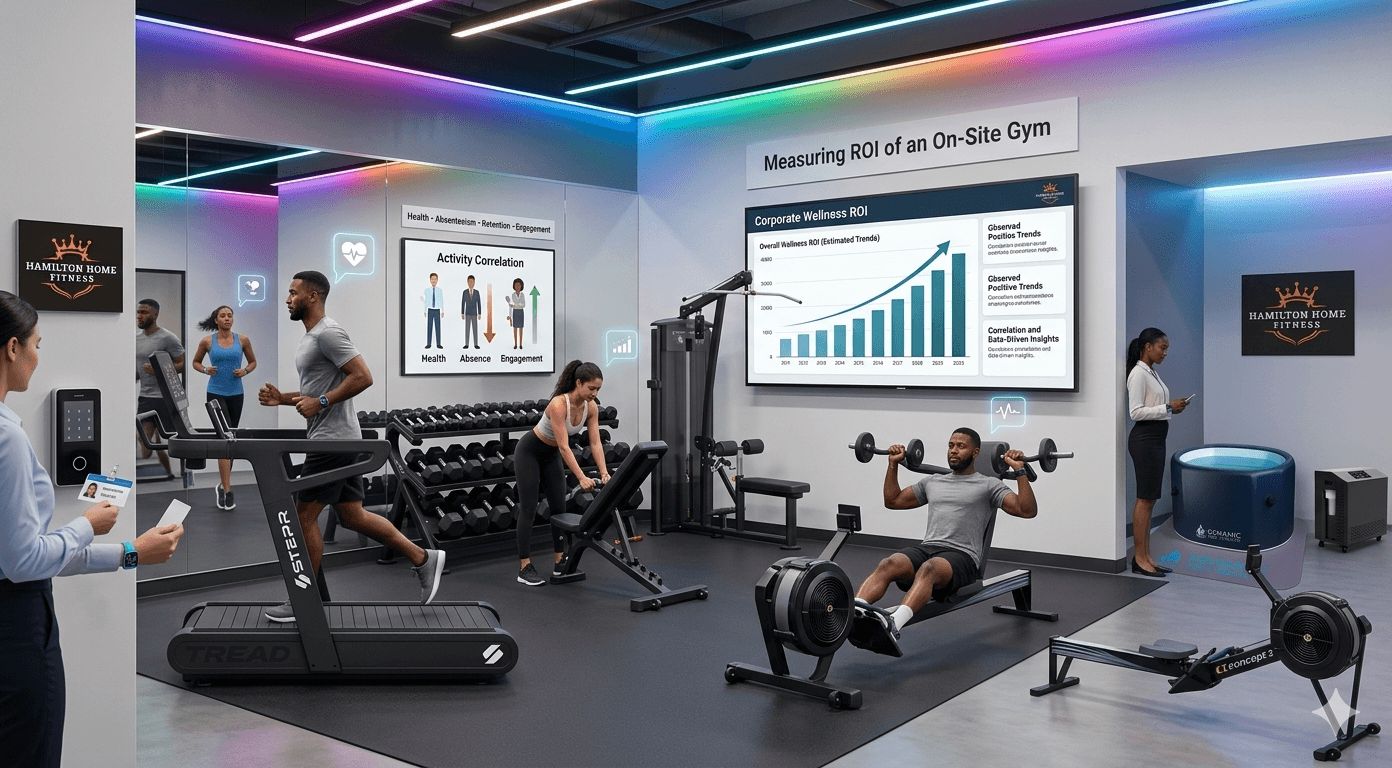
Important YMYL note: The ranges, tax references, and study findings discussed below come from published research and current US tax frameworks, but actual outcomes vary widely by program design, participation rate, and workforce profile. Treat the framework as directional; confirm tax treatment with a qualified CPA, and verify healthcare assumptions with your benefits broker.
A defensible ROI model includes the following:
Inputs: total facility cost (from the TCO formula in the prior section), program costs, and time horizon (most employers measure over a 3–5-year window)
Outputs: healthcare claims trend, absentee days, voluntary turnover rate, engagement scores, and gym utilization
Attribution: a clear method for separating gym impact from broader wellness program effects (challenges, EAP, biometric screening, mental health benefits)
Healthcare costs and absenteeism
Peer-reviewed and industry studies have reported reductions in absenteeism and medical spend among employers with strong wellness programs, but results vary widely by program design. The widely cited figure—roughly $3.27 in medical cost savings and $2.73 in absenteeism savings per dollar spent on wellness programs—comes from a 2010 Health Affairs meta-analysis by Baicker, Cutler, and Song; later research (including 2019 RAND and JAMA studies) has shown more modest or mixed results.
What this means for HR in practice:
Use ranges, not point estimates. Frame healthcare cost reduction as "Studies have shown reductions in the range of X–Y%" rather than promising a fixed figure.
Track baseline first. Measure healthcare claims trends, absentee days, and biometric screening averages for 12 months before the gym opens so you have a real comparison.
Separate program from facility. A gym alone rarely moves healthcare costs; pair it with biometric screening, a wellness platform, an EAP, and clear participation incentives.
Watch presenteeism. Reduced presenteeism—employees physically at work but cognitively impaired by stress, pain, or fatigue—is often a larger ROI driver than absenteeism but is harder to measure. Engagement surveys and self-reported energy metrics are the typical proxies.
The strongest ROI case usually comes from employers who deploy the gym as one component of a coordinated wellness strategy, not as a standalone amenity.
Retention, engagement, and tax angle
Beyond healthcare, an on-site gym supports retention and talent attraction and may qualify for Section 179 expensing of the equipment under current US tax rules.
The non-healthcare ROI lenses are
Retention — calculate the cost-per-lost-employee (typically estimated at 50–200% of annual salary, depending on role and industry source) and model the impact of even a 1–2 percentage point improvement in voluntary turnover among gym-using employees.
Talent attraction — track whether the on-site gym appears in offer-letter acceptance feedback and recruiter conversion data. For roles competing with hybrid or remote employers, a real facility can be the differentiator that pulls people into the office.
Engagement — include gym-related items in the next engagement or pulse survey and track scores over a multi-year window.
Tax treatment — Section 179 allows qualifying US businesses to expense the full cost of qualifying equipment in the year of purchase, up to annual limits set by the IRS. Limits and qualifying-property definitions change each tax year, and employer-provided fitness facility treatment has specific rules under IRC Section 132(j). Confirm eligibility, current-year limits, and treatment of any employee-paid usage with a qualified CPA before relying on this in the business case.
For ROI purposes, the tax angle is rarely the headline, but it often shifts the Year 1 net cost meaningfully — enough to change the payback period in the finance model.
Usage tracking and wearables
Track ROI inputs with keycard access logs, simple usage analytics, and optional wearable integrations through the company's wellness platform. Without usage data, ROI is a story; with it, ROI is a defensible business case.
A practical measurement stack:
Keycard or badge entry logs — the foundation; gives you unique users, visit frequency, peak hours, and underused time slots
Equipment-level usage analytics — many commercial cardio consoles report aggregated session data that can be exported to facilities or wellness platforms
Wearable integrations — voluntary, opt-in connections through Apple Health, Fitbit, Garmin, or Whoop via the corporate wellness app for step, activity, and sleep trends
Step challenges and group events — easy participation drivers that also generate measurable engagement data
Survey overlays — quarterly pulse questions on stress, energy, and benefit satisfaction that connect facility use to perceived value
A few measurement rules that keep the data trustworthy:
Anonymize and aggregate—individual usage data should not flow to managers or to anyone outside HR and the wellness platform.
Document the participation goal — most successful corporate gyms aim for 20–40% of on-site employees as monthly active users by Year 2.
Report quarterly, not constantly — give the program time to compound before drawing conclusions.
Tied together, these inputs turn the ROI conversation from "We think the gym helps" into a quarterly report with usage curves, attribution logic, and a clear cost picture—exactly the format finance and leadership respond to.
FAQ
Do corporate gyms reduce healthcare costs for employers?
Strong wellness programs that include on-site fitness have been associated with reduced absenteeism and lower medical claims in published US research, including the often-cited 2010 Health Affairs meta-analysis. Results vary significantly by program design, participation rate, and workforce profile. Treat reported ROI multiples as directional benchmarks, not guarantees, and pair the gym with biometric screening, an EAP, and a wellness platform for the strongest effect.
Are corporate gym investments tax deductible?
Most on-site gym equipment purchases qualify as a business expense, and qualifying equipment may be eligible for Section 179 expensing or standard depreciation under current US tax rules. Employer-provided athletic facilities also have specific treatment under IRC Section 132(j). Limits, eligibility, and the rules around employee-paid usage change each tax year — confirm current-year treatment with a qualified CPA before including the savings in your business case.
How many employees justify an on-site gym?
Most employers see clear participation and ROI when on-site headcount reaches roughly 150–250 employees per facility. Smaller offices can still succeed with a 500 sq ft compact fitness room, a walking-pad and stretching corner near sit-stand desks, or a wellness stipend that funds nearby gym memberships until headcount supports a dedicated build-out.
Which US companies have well-known on-site gyms?
Several large US employers are widely recognized for substantial on-site fitness facilities, including Google, Microsoft, Nike, SAS Institute, and Chesapeake Energy. Facility scope, access policies, and amenities change over time as real estate footprints evolve — treat these as illustrative benchmarks rather than current-state endorsements, and verify specifics directly if you are building a competitive benefits comparison.
What insurance is required for an in-office gym?
US employers typically cover an on-site gym through general liability and premises liability, often paired with a recreational facility endorsement or named-premises amendment. Requirements vary by carrier, state, and whether the facility is classified as supervised or unsupervised. Confirm coverage, required safety conditions (AED, posted rules, signed waivers), and any maintenance-record requirements with the company's commercial insurance broker and counsel before opening the gym.
Final Thought
A successful corporate wellness gym is not the biggest room or the most expensive equipment — it is a deliberate mix of low-impact cardio, beginner-friendly strength, and a real recovery zone, sized to the space and the workforce that will actually walk in. Layer safety, a written maintenance plan, and an honest ROI framework on top, and you have a facility that holds up under scrutiny from leadership, finance, and your insurance broker.
For HR, benefits, facilities, and workplace experience leaders, the work now is straightforward: lock the square footage, choose the equipment mix that fits your headcount band, document the safety stack, and build the TCO and ROI model before you sign a quote.
When you are ready to move from planning to procurement, three next steps make the path easier:
Browse the Hamilton Home Fitness commercial collection to shortlist the cardio, strength, and recovery categories that match your space tier
Book a free corporate gym design consultation for a written quote and a 2D or 3D floor plan built around your headcount, footprint, and wellness goals
Contact the Hamilton Home Fitness team directly if you need brand-specific guidance, multi-site coordination, or nationwide installation support from our Tennessee headquarters
Build the plan once, build it right, and the on-site gym becomes one of the most defensible line items in your wellness program — and one of the most visible ways your company shows employees their health is part of the job.