Introduction
You feel it on the last two reps—elbows peeling off the pad, shoulders starting to help. Most preacher curl mistakes trace back to one of two things: how you're lifting or a bench that doesn't fit your arm length.
Stalled progress and sore elbows can come from either, and they need different fixes. Here's what actually costs you reps, how to set seat height and pad angle, which bar to use, and which equipment fits you.
Five Mistakes That Ruin Preacher Curls
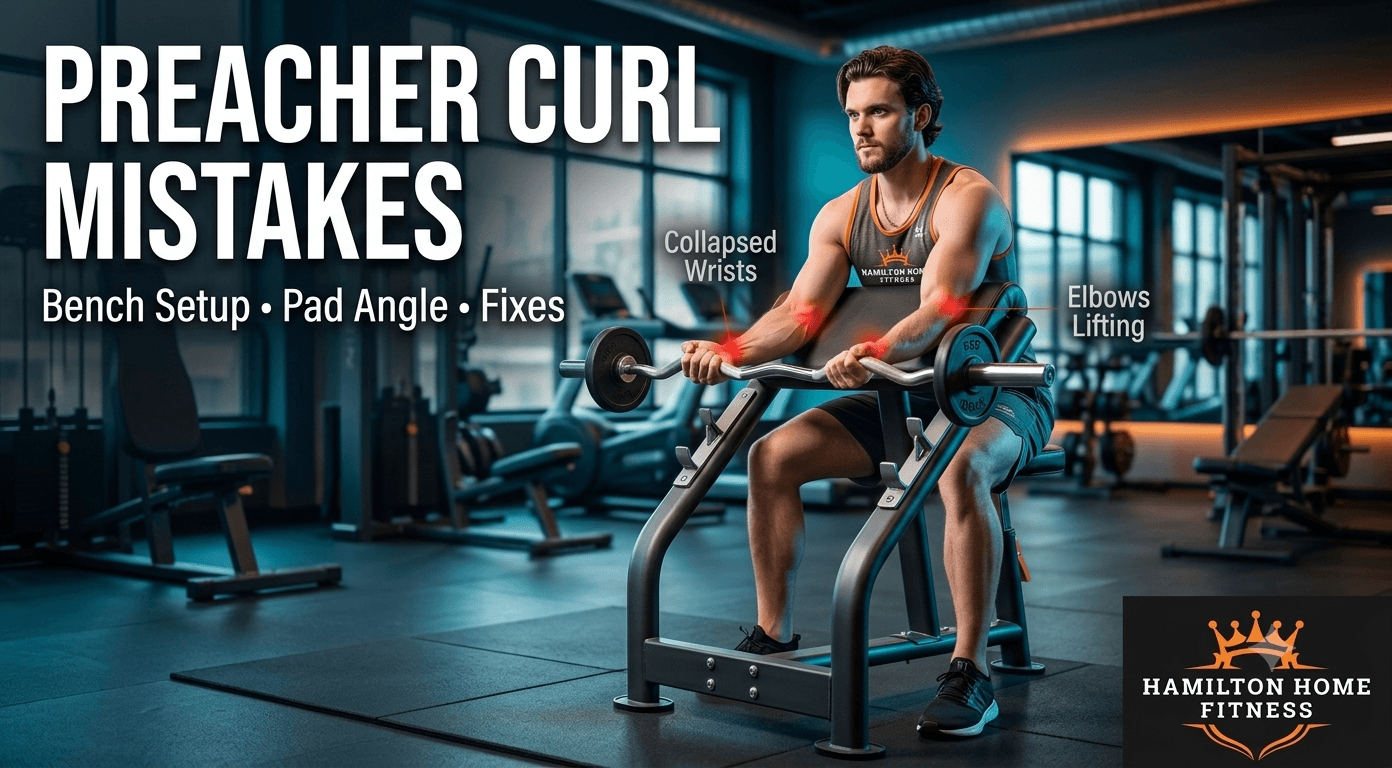
Five faults cost most lifters their preacher curls: elbows drifting off the pad, a load too heavy to move strictly, a bottom cut short, wrists that collapse backward, and a seat height fighting your arm length. The first four are technique. The last one is fit—and no cue fixes it.
Elbows drift off the pad. Your upper arms slide up as you curl, and your shoulders quietly take over the top half of the rep. Technique.
The load is too heavy to reverse. Your hips lift off the seat on the last two reps because the bar won't come out of the bottom any other way. Technique.
The bottom gets cut short. You stop the lowering a few inches early, skipping the stretched position that makes this exercise worth doing. Technique.
Your wrists fold backward. The bar rolls toward your fingers, your forearms light up, and your inner elbow starts complaining before your biceps do. Technique.
The seat height fights your arm length. You're either leaning forward to reach the pad or shrugging up to meet the bar—every rep, from the first one. Fit.
That last distinction matters more than the list itself. Technique faults respond to lighter weight and better attention. A fit fault doesn't. Keep reading and you'll know which one you have.
Why Your Elbows Lift Off the Pad
Your elbows lift for one of two reasons: the load has passed what your biceps can move through in the hardest part of the rep, or your seat sits too low relative to the pad, so your shoulders shrug up to reach the bar.
Run the check mid-set. If your upper arms stay planted for the first six reps and lift only on the last two, it's a load—drop the weight until you can reverse the bar out of the bottom without your hips helping. If they lift on rep one, it's setup, and no cue will fix it; raise the seat until your armpits meet the top edge of the pad. A commercial preacher bench with an adjustable seat lets you fix the second problem directly, and a single-piece heavy-gauge frame keeps the bench from rocking under a hard set.
Setting Seat Height and Pad Angle
Set the seat so your armpits sit flush against the top edge of the pad with your torso upright and both feet flat on the floor. You should not lean forward to reach the pad, and you should not shrug your shoulders up to meet the bar. Then set arm-pad height so your whole upper arm makes contact, from elbow to armpit.
Four steps, in order:
Sit down and place both upper arms on the pad with your torso upright.
Raise or lower the seat until your armpits touch the top edge without leaning.
Check that your elbows sit fully on the pad, not hanging off the low end.
Unrack the bar and lower it once. If your shoulders rise, the seat is still too low.
A seat set too low forces your shoulders up on every rep and pulls your elbows forward off the pad. A seat set too high tips you over the pad, so your chest carries weight your arms should be holding.
The Armpit-Flush Test
Sit down, place both upper arms on the pad, and check one thing: are your armpits touching the top edge without you leaning forward or lifting your shoulders?
If yes, the height is right. If you're reaching, raise the seat. If you're shrugging, raise it further. This works on any bench, including gym equipment you've never touched before, and it takes about four seconds.
Why Pad Angle Numbers Mislead
You will see preacher pads listed at 30°, 45°, and even 60°—and those numbers are not measuring the same thing. Manufacturers measure from different reference planes, so two pads that look almost identical in person can carry very different figures on paper. The Body-Solid GPCB329B publishes its arm pad at 30°, while other makers publish 45° for a comparable slope.
So don't shop by the angle number. Shop by whether the seat and arm pad both adjust, because that's what lets a bench fit your arm length rather than the other way around.
EZ Bar, Straight Bar, or Dumbbells?
An EZ bar's angled grip lets your wrists sit semi-supinated—partway between palms-up and neutral—which most lifters tolerate better under a load. A straight bar forces full supination and exposes wrist and inner-elbow discomfort. Dumbbells let each arm work independently and let you set your own wrist angle.
Pick by condition, not by ranking. If your inner elbow complains on straight-bar sets, the EZ bar is the first change to make—how EZ and straight bars differ comes down to that grip angle and your natural carrying angle. If one arm consistently lags, single-arm dumbbell preacher curls let you train the weak side without the strong side covering for it. If neither applies, use whichever bar loads cleanly.
Will Your Bar Fit the Catches?
Before you buy, check the bar catch spacing against the bar you already own—some specialty bars don't seat cleanly on every bench. Rack-mounted and attachment-style pads publish their own rack widths and height settings, and owners of Olympic-length or fixed curl bars sometimes find the bar won't rest securely. Check bar catch spacing with our team before ordering rather than after the freight arrives.
Fixing a Bottom Position That Hurts
The stretch at the bottom is the reason this exercise works, so cutting it removes the benefit. But there's a difference between reaching end range under control and dropping into a passive hang with a load you can't reverse. Lower under tension, pause without relaxing, and curl back out.
That distinction settles the lockout argument. Straightening the arm isn't the problem — going slack at the bottom is. Keep the biceps loaded through the deepest position, and the tendon won't be taking the load cold.
For weight, use one test: if you can't reverse the bar out of the bottom without your elbows lifting or your hips coming up off the seat, it's too heavy. That's a more useful ceiling than any percentage, because it measures the exact position where preacher curls are hardest. Most lifters find they need noticeably less here than in standing curls, which is normal—the pad removed the momentum they were borrowing.
Slow the lowering before you add weight. A controlled three-second negative gives you more usable stimulus than a heavier bar you drop into the stretch.
One limit worth stating plainly: sharp or persistent elbow pain isn't a form problem to train through. If it keeps showing up after you've fixed setup and load, see a qualified medical or rehab professional.
Bench, Machine, or Attachment?
Choose a standalone bench if you already own a bar and want strict isolation in a small footprint. Choose a curl machine if a shared floor needs guided resistance and fast setup between users. Choose an attachment if you want to add arm work to a frame you already have.
Standalone bench. The simplest route, and the one most home lifters want. You supply the bar, so the cost stays low and the footprint stays small. Preacher curl benches range from adjustable residential models to commercial builds like the BodyKore G257 Preacher Curl. The limitation: you're still racking and loading a bar every set.
Curl machine. Built-in resistance means no bar handling and faster changeovers, which matters on a busy floor. Plate-loaded and selectorized curl machines suit studios, clubs, and corporate rooms. The limitation: larger footprint and higher cost than a bench.
Attachment. The space-saver and the one with a real catch. Attachments are frame-specific—York's Pro Series arm curl attachment connects to York Pro Series benches, not to any bench you own. Confirm your frame before ordering.
FAQ
Are preacher curls better than regular curls?
Neither is better outright—they load the biceps differently. The preacher position removes momentum and makes the stretched bottom the hardest part of the rep, while standing curls let you move more total weight. Most lifters benefit from running both.
Do preacher curls build the biceps' peak?
Peak height is largely set by muscle belly length and tendon insertion, which training doesn't change. Preacher curls build biceps size well, but the arms-forward position shortens the long head—so they aren't the strongest choice for long-head emphasis specifically.
Can spider curls replace preacher curls?
No — their resistance profiles are opposite. Preacher curls are hardest near the stretched bottom; spider curls are hardest at the fully contracted top. They complement each other rather than substitute.
Can I do preacher curls on an adjustable bench?
Yes, with limits. Set the backrest to a steep incline, kneel or stand behind it, and use dumbbells—bar clearance is the usual problem on a narrower pad. Expect a less stable elbow position than a dedicated pad.
Final Thought
Technique faults and fit faults look identical from the outside and need different fixes. One check settles on you: armpits flush against the top of the pad, torso upright, and elbows planted from rep one.
If your bench can't get you there, compare the three formats on our curl bench page—and confirm your bar seats in the catches before ordering.