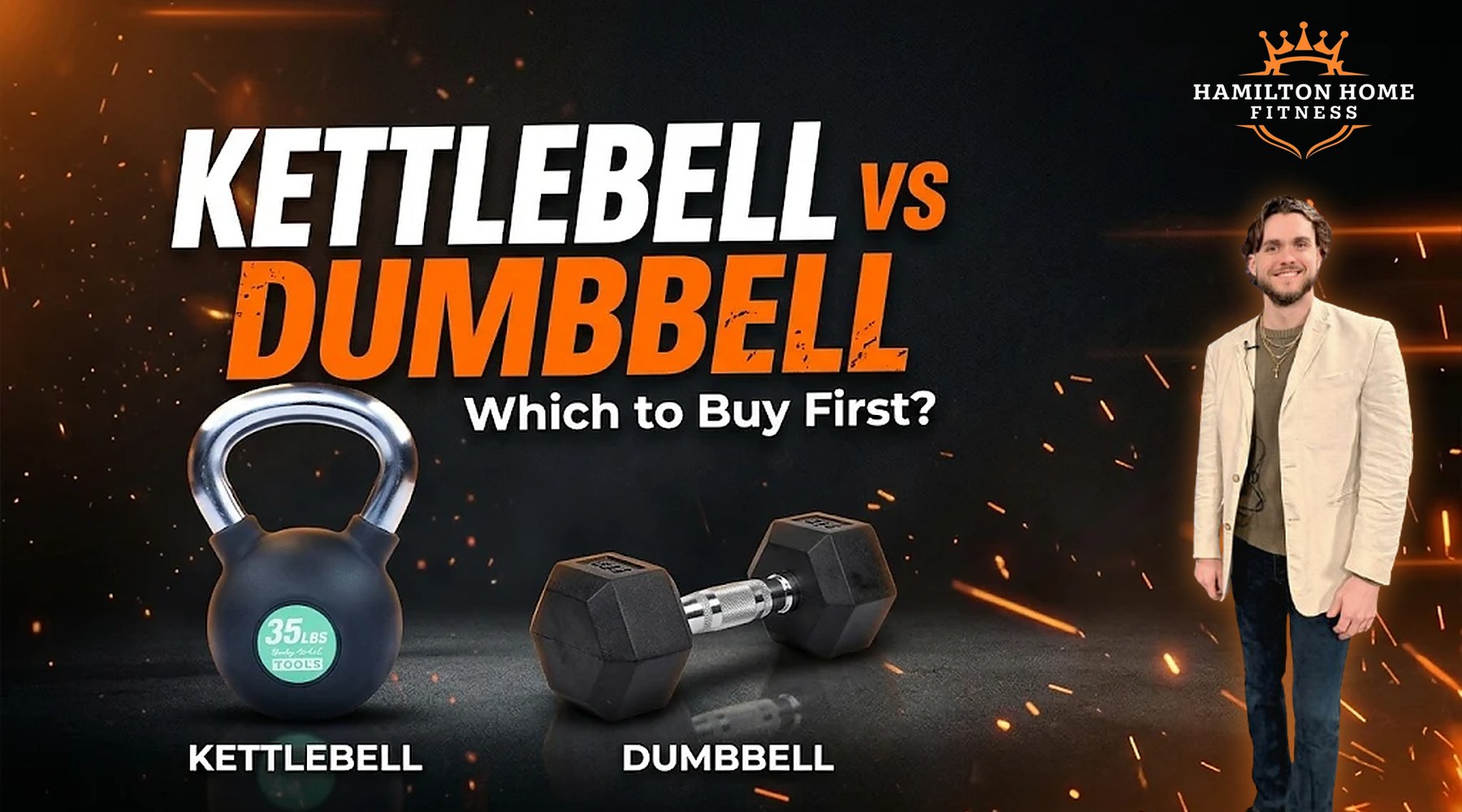
You have room and budget for one kind of hand weight. Kettlebell workouts look like a complete plan, yet you worry about missing presses, rows, and curls later.
Kettlebell vs dumbbell comes down to where the load sits in your hand. Dumbbells balance the weight on both sides of the grip, so presses, rows, and curls feel simple and progress in small steps. Kettlebells hang the weight below the handle, which suits swings, carries, and conditioning.
If you lean toward bells, our guide on how to choose kettlebells covers handles, coatings, and starting weights.
Kettlebell vs Dumbbell at a Glance
Choose dumbbells if you want simple loading, presses, rows, curls, and small weight jumps for muscle building. Choose a kettlebell if you want swings, carries, and conditioning from very little floor space. Both build strength, but dumbbells are easier to learn, while kettlebells reward a solid hip hinge.
Factor | Kettlebell | Dumbbell |
Where the load sits | Below and in front of the handle | Centered on both sides of the grip |
Lifts it suits | Swings, cleans, snatches, carries | Presses, rows, curls, raises, flyes |
Usual weight jumps | 4 kg in kilogram sizing, 5 lb in pound sizing | 5 lb in most fixed sets |
Learning curve | Ballistic lifts need careful practice | Most lifts feel familiar on day one |
Floor space | One or two bells fit in a corner | A full set needs a rack |
How the Offset Handle Changes the Load
A kettlebell's center of mass sits several inches below and in front of your hand, so the bell pulls away from your wrist as it moves. That lever trains grip, shoulder stability, and core bracing harder than a dumbbell, whose weight stays centered in your palm.
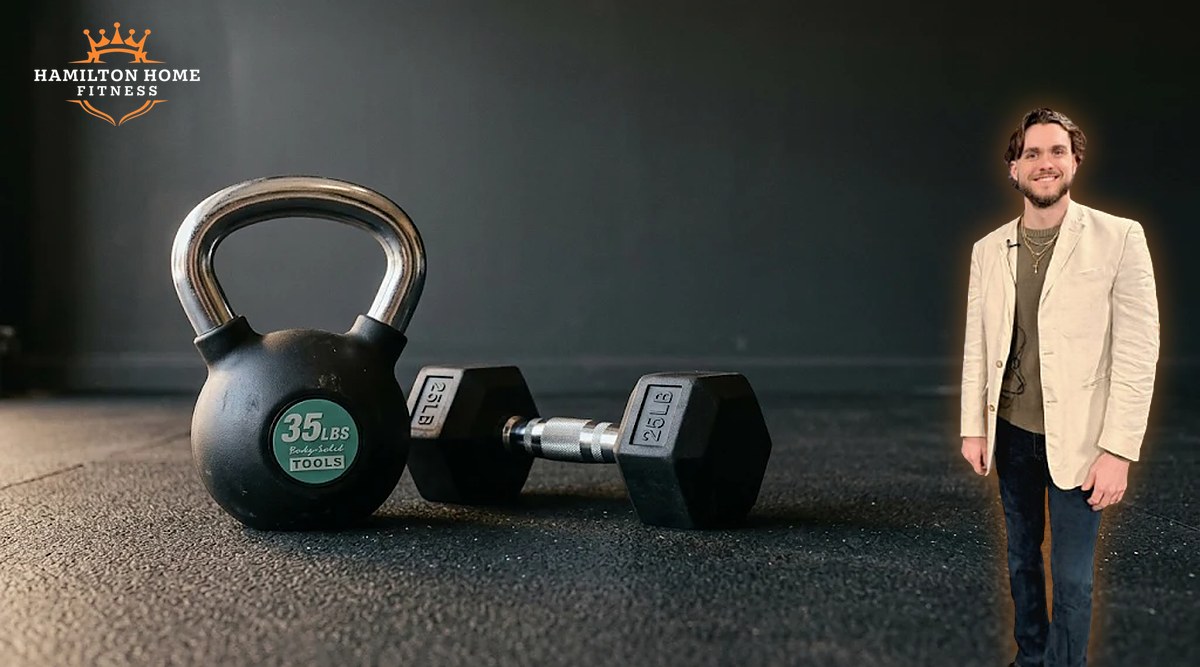
The offset is what makes swings work. The bell hangs between your legs, then your hips drive it forward while your arms only guide it.
Why Do Kettlebells Feel Heavier?
Kettlebells feel heavier because the load sits farther from your grip, which raises the leverage your forearm and shoulder must resist. Thick handles add grip demand too. A 16 kg bell and a 35 lb dumbbell weigh about the same, yet the bell usually feels harder to press.
Bell build matters as well. Cast iron bells grow larger as they get heavier, while competition bells keep one size at every weight. Our comparison of cast iron vs competition kettlebells explains which shape suits home training.
Muscle or Conditioning: Which Tool Wins?
Dumbbells usually win for building muscle, because small weight jumps and isolation lifts make progressive overload easy to track. Kettlebells usually win for conditioning, because swings, cleans, and snatches raise your heart rate while loading the glutes, hamstrings, and back. Either tool builds strength when the weight keeps rising.
Can You Build Muscle With Just Kettlebells?
Yes, especially in your first year, through goblet squats, presses, rows, and swings taken close to failure. Progress stalls sooner, though, because each bell size is a big jump. Most lifters eventually add a heavier bell, a matching pair, or dumbbells.
If arm and chest size is your main goal, our dumbbell workout guide shows how to organize presses, rows, and curls at home.
Are Swings Better for Fat Loss?
Swings are a strong conditioning choice, because they pair hard hip work with steady breathing demand and no jumping. Fat loss still depends mostly on diet and total weekly activity. A dumbbell circuit with short rests can work just as well.
Which Lifts Feel Better With Each Tool?
Kettlebells feel better for ballistic hip-hinge lifts, front-loaded squats, and carries, where the offset load helps. Dumbbells feel better for presses, rows, curls, raises, and flyes, where a balanced load and a level handle matter. Goblet squats and Romanian deadlifts work well with either tool.
These lifts suit a kettlebell's shape:
Two-hand and one-arm swings.
Cleans and snatches.
Turkish get-ups.
Rack and suitcase carries.
Halos and windmills.
Dumbbells take over when you want to isolate one muscle or press from a bench. Their handles stay level, so the load never drags your wrist backward. These lifts suit a pair of dumbbells:
Flat and incline bench presses.
Seated or standing shoulder presses.
One-arm and chest-supported rows.
Curls, lateral raises, and flyes.
Learn the hip hinge before you swing anything heavy. Your hips should drive the bell while your back stays flat. If you have back pain or a past injury, check with a physical therapist before starting ballistic lifts.
How Do Weight Jumps Compare?
Dumbbell sets usually climb in 5 lb steps, and many adjustable dumbbells offer smaller jumps at lighter settings. Kettlebells sized in kilograms often climb 4 kg at a time, about 9 lb, which can stall presses. Pound-sized bells narrow the gap, and some lines move in 5 lb steps.
Our rubber-padded kilogram bells run from 4 kg to 48 kg in 4 kg steps. Moving from 16 kg to 20 kg is a 25 percent jump, which is large for a press. Traditional sizing uses the pood, and one pood matches the classic 16 kg bell.
Fixed dumbbell sets add a pair every 5 lb, so overload stays gradual. Our guide to dumbbell set weight range shows how far a set should run for your goals.
Which Should You Buy First?
Buy dumbbells first if your main goal is muscle, you press and row on a bench, or you want the easiest learning curve. Buy a kettlebell first if conditioning matters most, floor space is tight, or you enjoy swings and carries. Many home lifters end up owning both.
For a lifter training alone in a spare room, one adjustable dumbbell pair covers a lot of ground. Our breakdown of adjustable vs fixed dumbbells helps you weigh dial speed, durability, and price.
Can Kettlebells Replace Dumbbells?
Partly. Kettlebells can replace dumbbells for squats, hinges, carries, rows, and many presses. They are a poor swap for bench presses, curls, lateral raises, and flyes, where the bell rests awkwardly on the forearm.
If those lifts matter to you, plan on dumbbells. Our adjustable dumbbells save floor space when a full rack will not fit.
How Big Should a Starter Set Be?
One or two kettlebells make a useful start: a moderate bell for presses and squats, plus a heavier bell for swings and deadlifts. For dumbbells, three to five pairs, or one adjustable pair, cover most beginner programs. Add weight only when your top weight stops challenging you.
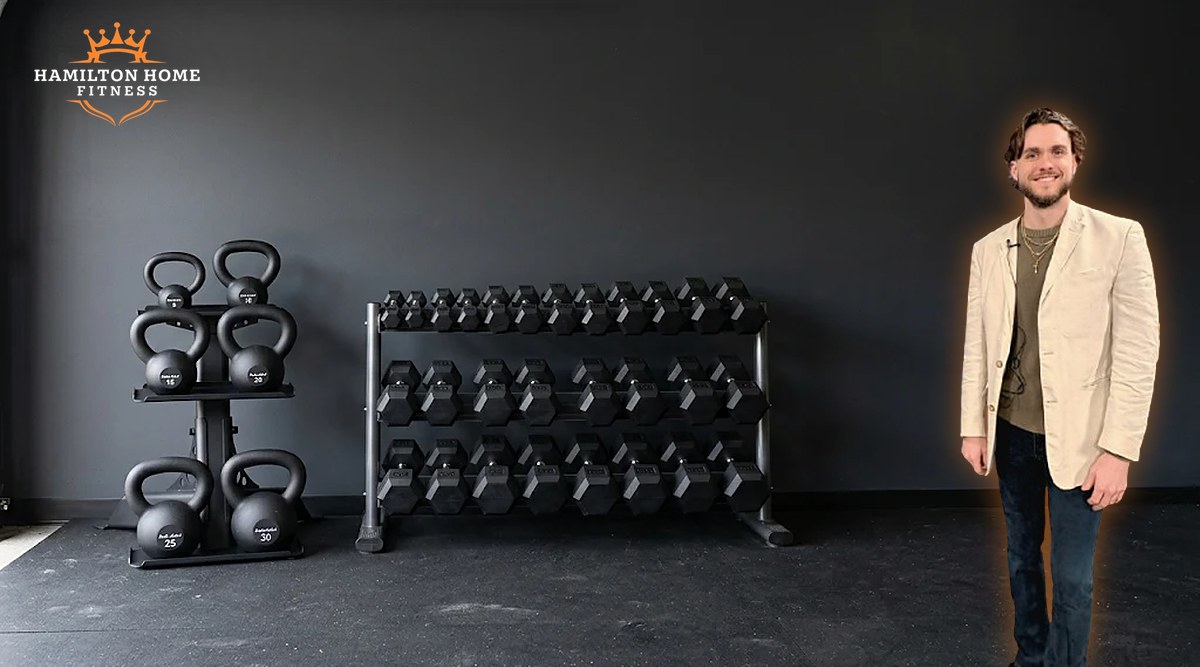
The Body-Solid KBRS105PACK kettlebell set pairs six powder-coat bells from 5 to 30 lb with a rack for $407, as of November 2026. It suits beginners and couples who want light bells for presses. It is the wrong choice for strong lifters, since 30 lb is light for swings.
Stronger lifters can buy single bells. The Body-Solid KBZ rubber-coated kettlebells run from 5 to 80 lb in 5 lb steps, from $15 for the 5 lb size as of November 2026. The coating protects floors, but skip it if you want one bell size at every weight.
The BodyKore RB570 rubber hex dumbbell set gives 14 pairs from 5 to 70 lb on a heavy-duty rack for $2,399, as of November 2026. It fits a garage gym shared by two people. It is the wrong choice for a small apartment, because the rack needs a long wall.
If space is tight, the BowFlex SelectTech 840 adjustable kettlebell dials six weights from 8 to 40 lb for $149, as of November 2026. It suits apartment lifters who want swings and goblet squats from one footprint. Skip it if you drop weights, since adjustable parts need gentler handling than solid iron.
Prefer ready-made bundles? Compare our kettlebell and dumbbell sets that include storage.
Still deciding what to buy first? Compare our hex and adjustable dumbbells, ask for a free 3D design of your home gym, or call or text 423-458-2453 and we will help you plan.
FAQ
Is it better to work out with kettlebells or dumbbells?
Neither is better for everyone. Dumbbells suit muscle-focused plans and bench work, while kettlebells suit conditioning and hip power.
Are kettlebells good for beginners?
Yes, for slow lifts like goblet squats, deadlifts, and carries. Swings, cleans, and snatches take practice, so start light and consider a session with a qualified coach.
Can you do kettlebell swings with a dumbbell?
Yes, by holding one end of a dumbbell with both hands. It works for light conditioning, but the long shape makes heavy swings harder to control.
How do you store kettlebells and dumbbells together?
A rack with flip platforms keeps both off the floor. The Body-Solid GDKR100B rack holds dumbbells or kettlebells for $315, as of November 2026, which suits a mixed collection. If you own only two bells, a rubber mat works fine.
Final Thought
Match the tool to the training you will repeat: dumbbells for muscle and bench work, a kettlebell for swings and conditioning in a small space. Add the other one when your program asks for it. When you're ready, browse our kettlebells by weight and finish.