Introduction
Three kettlebell guides, three different starting weights. One says 8 kg (18 lb). The next says 16 kg (35 lb). A third splits the difference and never explains why.
The numbers aren't random. Those guides are quietly answering different questions, and none of them say so.
The weight you can swing is not the weight you can press overhead. Most charts pick one lift, size it, and leave you to guess about the other.
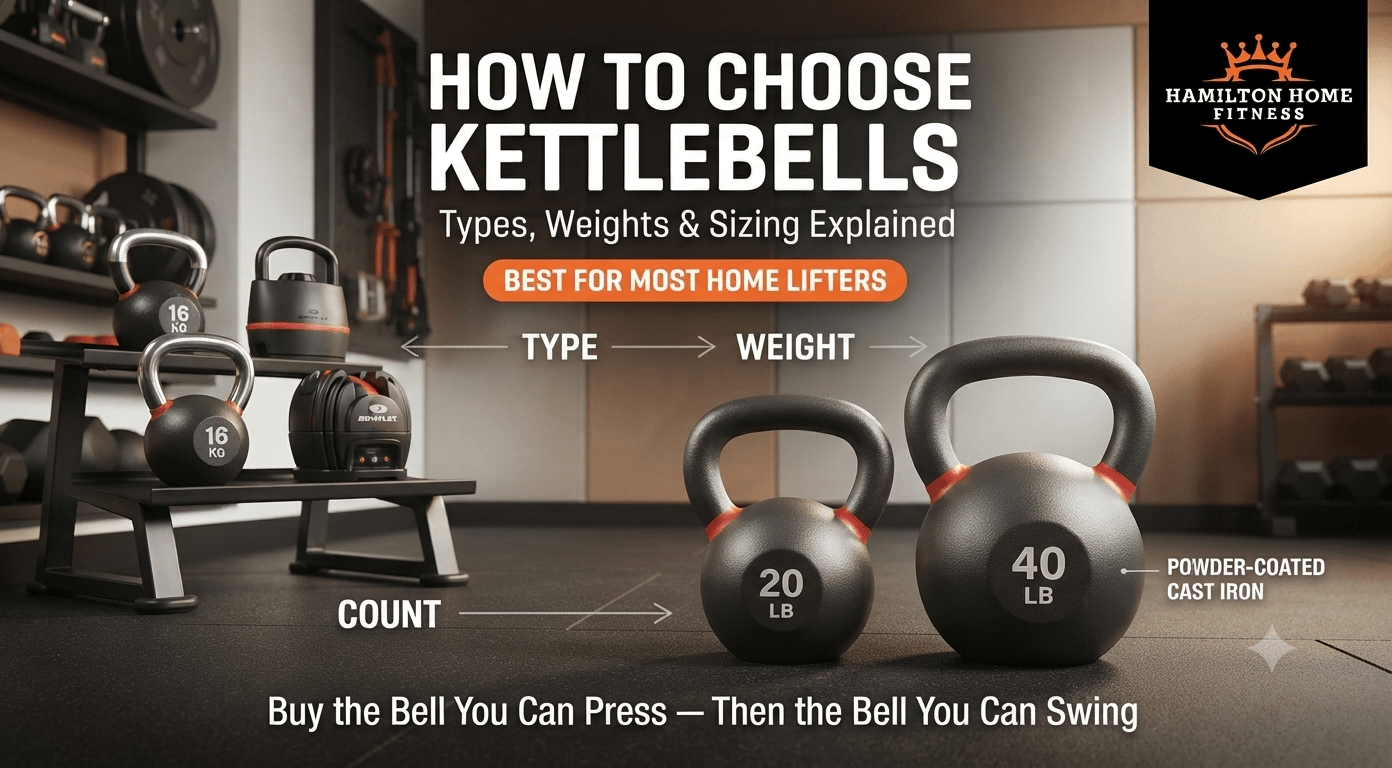
Here's how to choose kettlebells in the order the decision actually happens: type, then weight, then how many.
Cast Iron, Competition, or Adjustable?
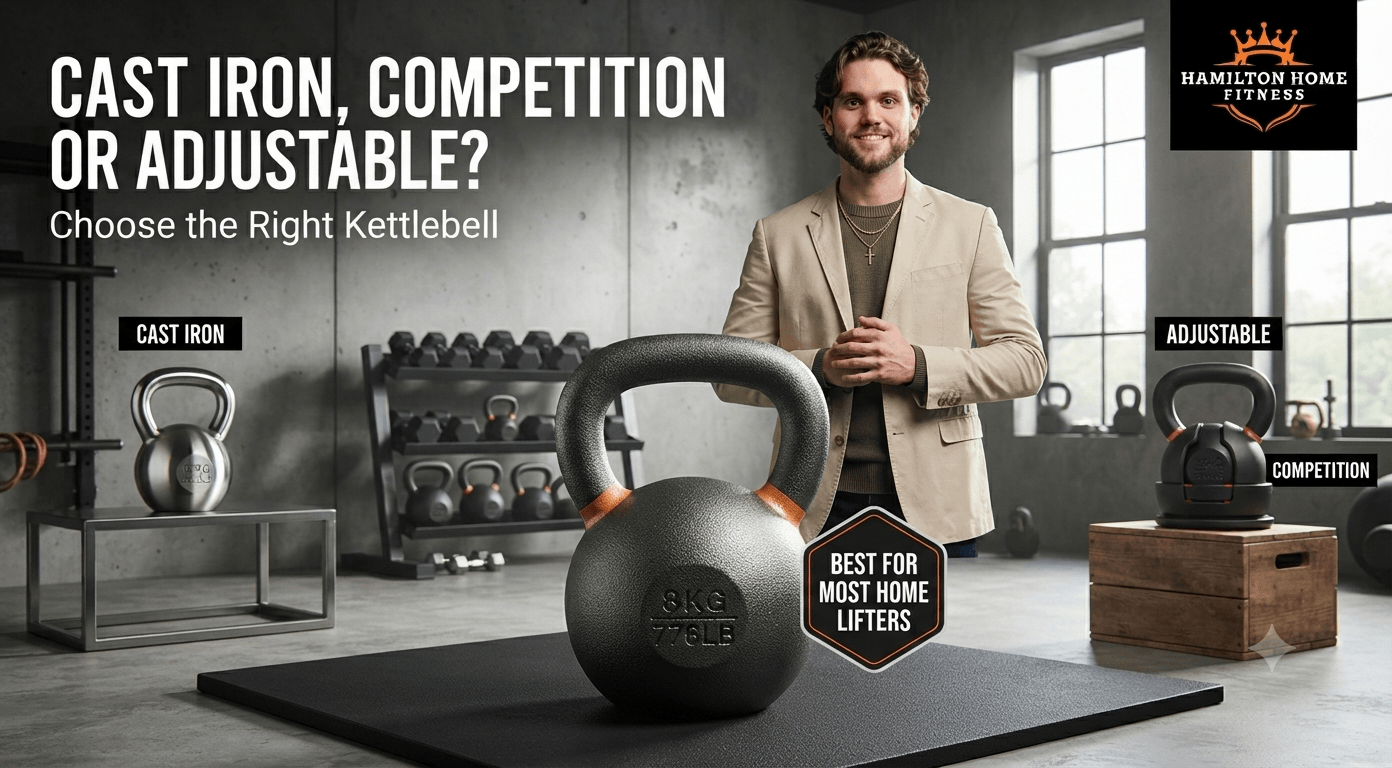
Choose cast iron if you train two-hand swings, goblet squats, and get-ups—that covers most home lifters. Choose competition steel only if you train sport lifts like the snatch, jerk, or long cycle. Choose adjustable only when floor space, not progression, is your binding constraint.
Type | Best For | Where It Falls Short |
Cast iron | Two-hand swings, goblet squats, get-ups, general strength | The handle and bell grow with weight, so the feel shifts every time you load up |
Competition steel | Snatch, jerk, long cycle, high-rep single-arm sets | It costs more, and the narrow window pinches larger hands on two-hand swings |
Adjustable | Small spaces and short weight ranges | One bell, a hard load ceiling, and no matched pair for double work |
Cast iron is the default for a reason. The wider window fits both hands on a swing, and the V-shaped horns let the bell sit against your chest in a goblet squat without fighting your wrists. If you don't already know you need something else, this is the something else you don't need.
Competition bells are built for a narrow job. Every weight shares the same outer dimensions, so a 12 kg (26 lb) and a 32 kg (70 lb) rest on your forearm in the same place—which matters enormously across a ten-minute set and barely at all across three sets of eight. Hamilton Home Fitness doesn't stock them. If you're weighing that decision seriously, we've written a full cast iron vs. competition comparison that goes deeper than this page needs to.
Adjustable is a space decision, not a training one. More on that shortly.
For most people reading this, the honest answer is a powder-coated cast iron kettlebell—textured enough to hold chalk, cheap enough to buy twice, and forgiving of the fact that you don't yet know what you'll want in a year.
What Weight Kettlebell Should You Buy?
There is no single beginner weight, because swings and get-ups need different loads. Most men start near 16 kg (35 lb) for two-hand swings and 8–12 kg (18–26 lb) for presses and get-ups. Most women start near 8–12 kg for swings and 4–8 kg (9–18 lb) for grinds.
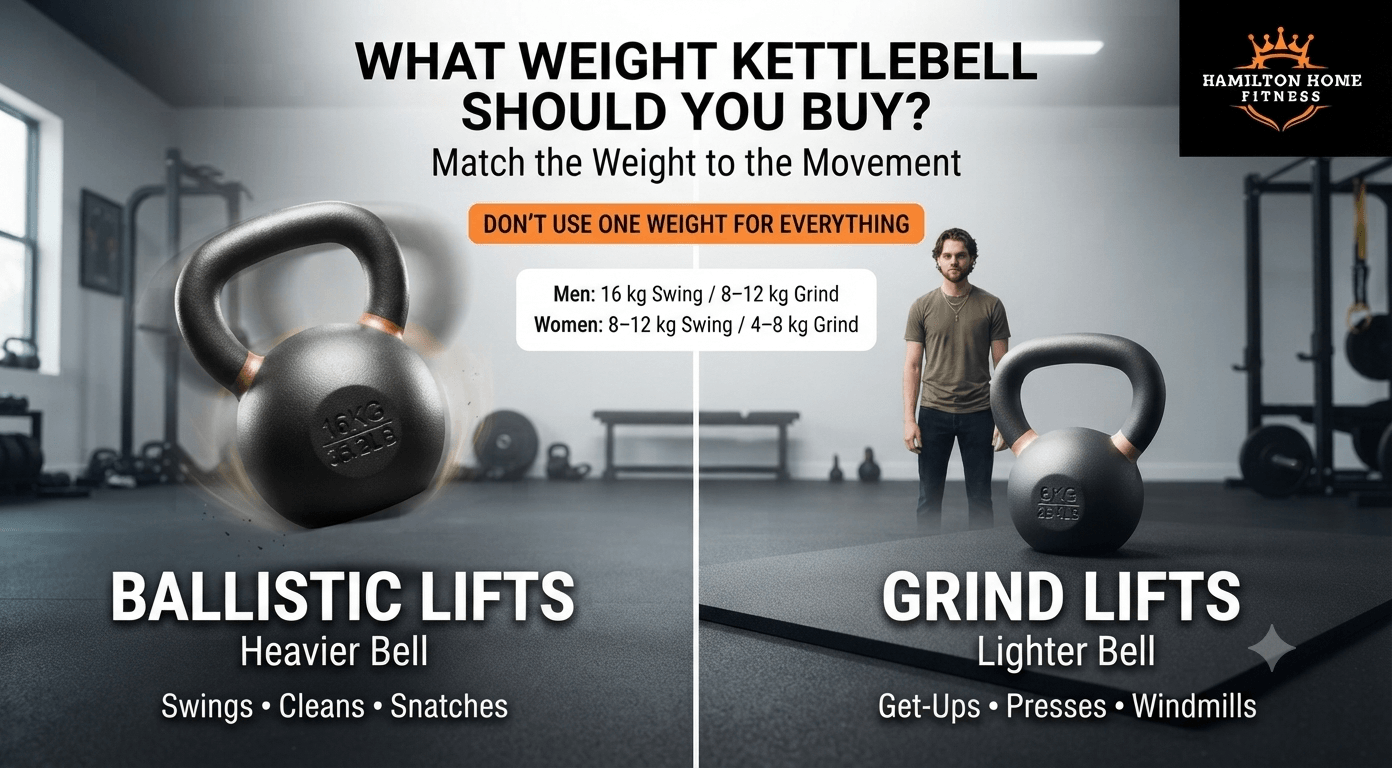
Two words explain the whole table below. Ballistic lifts are fast and hip-driven—swings, cleans, and snatches. Grinds are slow and controlled—get-ups, overhead presses, and windmills. Your hips are far stronger than your shoulders, so the two need different bells.
Ballistic lifts (swings, cleans, snatches) | Grind lifts (get-ups, presses, windmills) | |
Women | 8–12 kg (18–26 lb) | 4–8 kg (9–18 lb) |
Men | 16–20 kg (35–44 lb) | 8–12 kg (18–26 lb) |
Seniors and rehab | 4–8 kg (9–18 lb) | 4 kg (9 lb) |
Seniors, and anyone loading after an injury, should start at the bottom of that range and work with a coach or clinician before adding weight. Kettlebell ballistics are unforgiving of a rushed hinge.
Why Beginner Weight Charts Disagree
The charts disagree because they are quietly answering different questions.
One guide sizes the swing and prints 16 kg. Other sizes for the get-up and prints are 8 kg. Both are correct. Neither says which lift it means, so you're left staring at a 100% gap with no way to resolve it.
Once you know that, the contradiction disappears — and averaging the two numbers becomes the worst possible move. A 12 kg bell is too light to swing well and too heavy to press cleanly. You end up with one bell that does neither job properly.
How to Size a Bell You Cannot Test
If you own no kettlebell, size your first bell with a dumbbell you can already press.
Find the heaviest dumbbell you can press overhead for 8–10 controlled reps—same speed on the last rep as the first. That weight is roughly your grind bell. Round down to the nearest kettlebell size.
For two-hand swings, double it as a starting point. That's a starting point, not a rule: swings are hip-driven, and most people can hinge more than they can press, but the ratio moves with your training history. Round down again if you're between sizes.
Buying light and outgrowing it costs you one bell. Buying heavy and learning the hinge badly costs you months.
Is an Adjustable Kettlebell Worth It?
An adjustable kettlebell earns its place when floor space is your binding constraint and your training tops out around 40 lb (18 kg). It stops earning its place the moment you need a heavier bell, or two bells at once for double work.
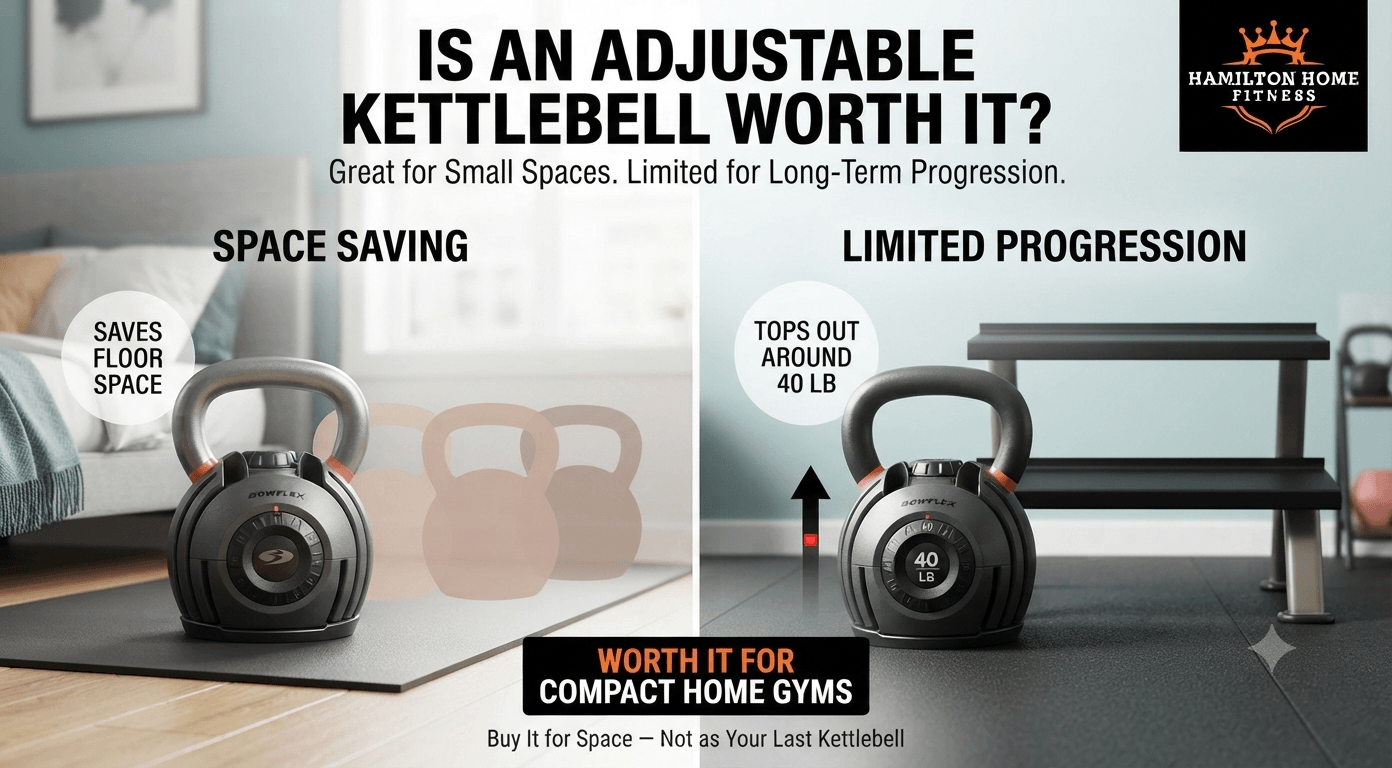
That's the whole verdict. If you're training in a bedroom corner or a shared flat, one bell that covers six loads is worth real money. If you're in a garage with a spare square meter, it isn't fixed; bells will outlast you and cost less per pound.
Where an Adjustable Runs Out
Look at the weight steps before you look at the price.
Take the BowFlex SelectTech 840, which dials to 8, 12, 20, 25, 35, and 40 lb. Six settings, one bell, a 40.5 lb loaded weight, and a footprint of roughly 8.8″ × 7.0″ × 12.5″. It's a residential product, and for a home lift inside that range, it does exactly what it promises.
Now read those numbers as a progression rather than a spec sheet. Two things show up.
The jump from 12 lb to 20 lb skips 8 lb of nothing. That's a wide gap at the light end, and it lands squarely where a beginner's second bell usually sits—you go from comfortable to a step you're not ready for, with no rung between.
The 40 lb ceiling is the harder limit. A man swinging 16 kg (35 lb) on day one is already one setting from the top, and swing progressions typically head toward 24 kg (53 lb) and beyond. You'd outgrow the bell in the lift you bought it for.
And one adjustable is one bell. Front-rack squats, double presses, alternating swings — none of it works with a single unit. Double-bell work needs a matched pair, which means buying the adjustable twice.
Buy it for the space it saves. Don't buy it expecting it to be your last kettlebell.
Which Kettlebell Coating Fits Your Space?
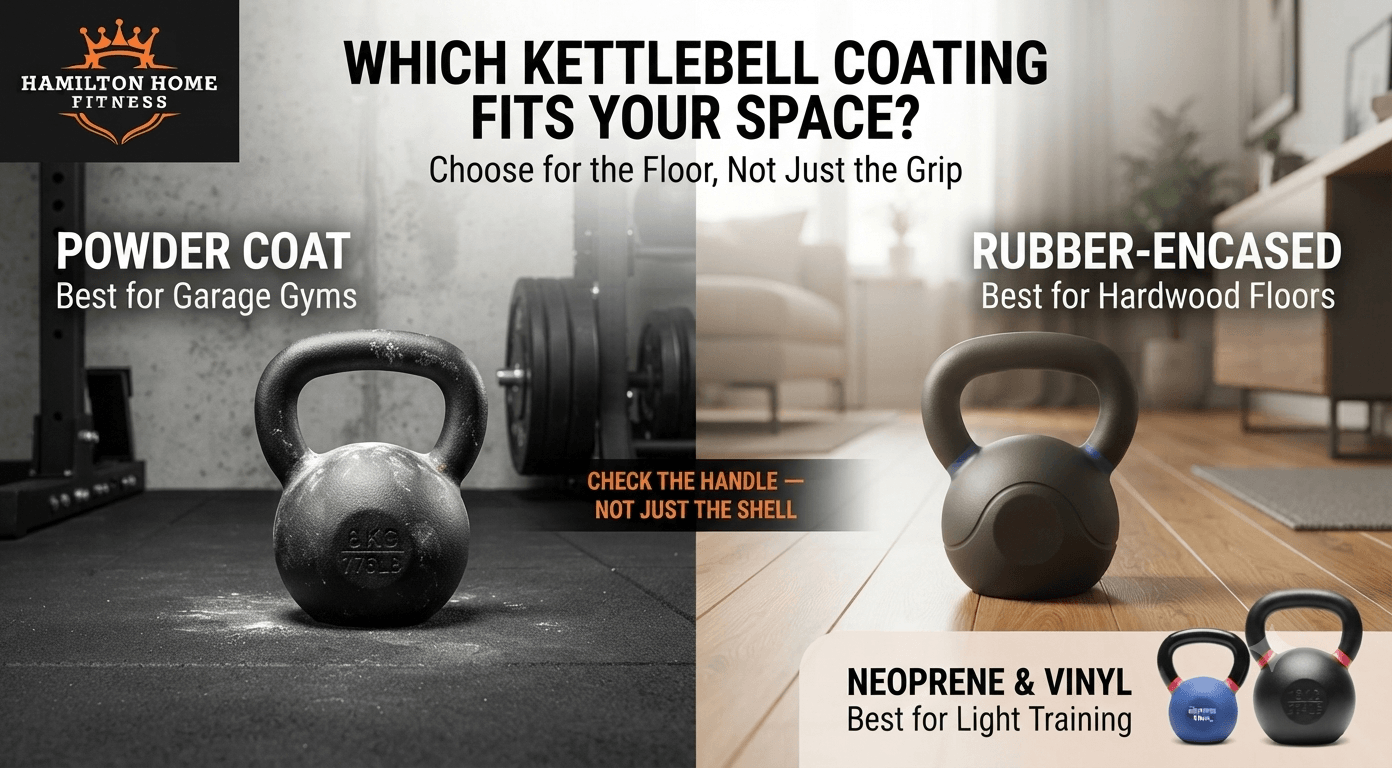
Coating is mostly a floor decision, not a grip decision. Powder-coated cast iron grips best and holds chalk, but it is loud and unforgiving on hardwood. Rubber-encased, neoprene, and vinyl bells set down quietly and protect floors, at some cost to the bare-steel feel.
Ask where the bell lands, not how it feels in your hand.
On a garage slab or over rubber matting, powder coat wins. The textured surface holds chalk, grips a sweaty palm, and takes a bump without complaint. That's the standard hardstyle setup, and there's little reason to deviate.
In a second-floor flat, powder coat is the wrong buy. Set a 16 kg (35 lb) bell down on a floorboard, and your downstairs neighbor hears it. Do it forty times in a session and you'll hear from them. A rubber-encased kettlebell lands quietly and won't dent the boards—worth the slightly softer handle feel.
Neoprene and vinyl sit at the light end, generally under 25 lb (11 kg). They're comfortable, floor-friendly, and fine for lighter grind work and rehab loading. They're not built for heavy swings.
One caveat worth knowing: coated bells vary in how the handle is finished. Some keep a bare or chrome handle even when the bell is encased, which gives you floor protection without losing your grip. Check the handle, not the shell.
How Many Kettlebells Do You Actually Need?
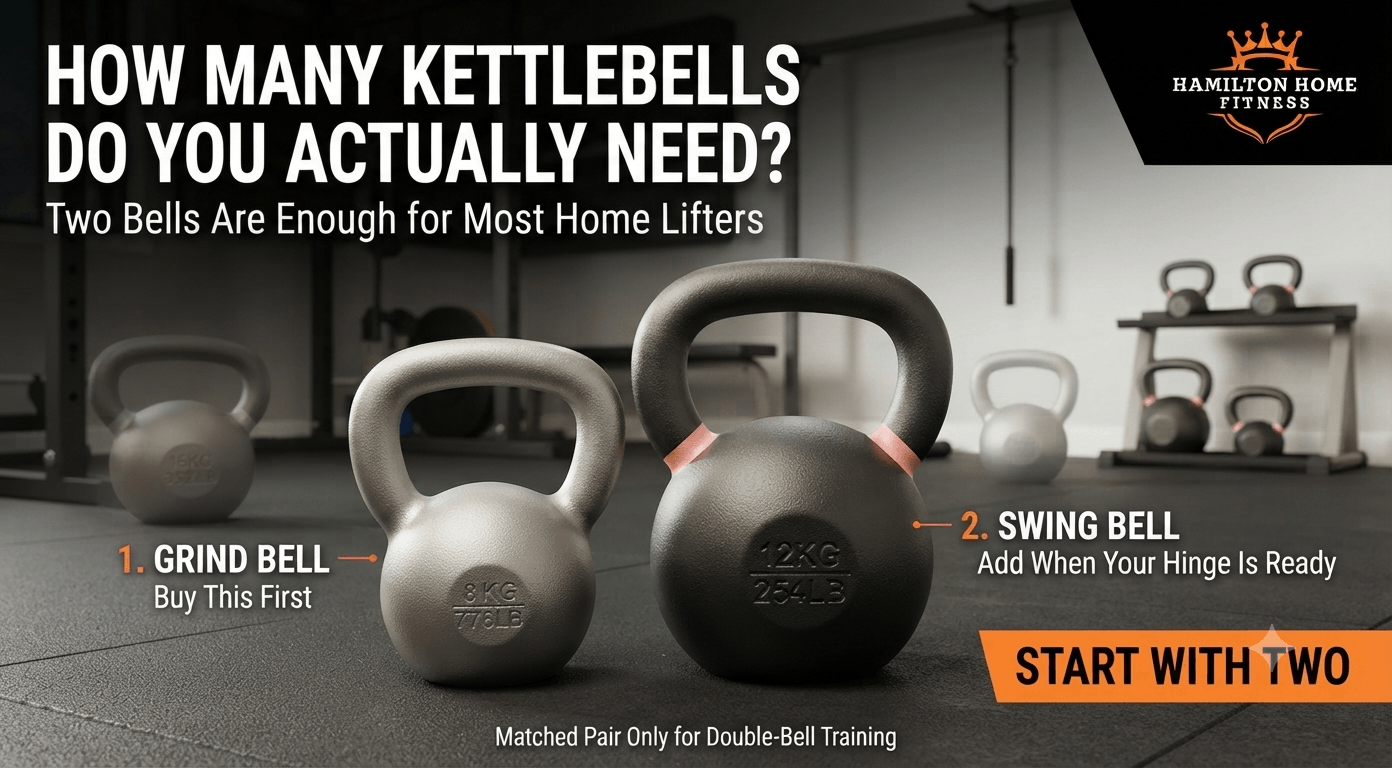
Most home lifters need two bells, not one. Swings carry roughly double what presses and get-ups can handle, and a single bell cannot serve both well. A third bell matters once you outgrow the first swing weight. Double-bell work needs a matched pair.
Studios and facilities are sized by class capacity, not by one lifter—if that's you, book a gym design consultation rather than working from a starter pair.
Buy This First, Then This
Buy the grindbell first—it's the one you can actually learn on.
Grind the bell. Your press and get-up weights. Light enough to drill the hinge, the rack, and the lockout without fighting the load.
Swing bell. Roughly double the grind bell, added once your hinge is solid—usually a few weeks in, not on day one.
Storage, at three bells. Two bells lie fine on the floor. Three start rolling. A two-tier kettlebell rack is the point where the ladder stops being cluttered.
Matched pair. Only when double work—front-rack squats, double presses—is a real commitment, not a maybe.
Most people never get past step two, and that's fine. Two bells, trained properly, will take you a long way.
Kettlebell vs. Dumbbell: Which First?
Neither is better—they load differently. Dumbbells are balanced and easy to progress in with small jumps, which makes them a stronger tool for building size. Kettlebells sit offset from the handle, which makes them better for swings, carries, grip, and conditioning.
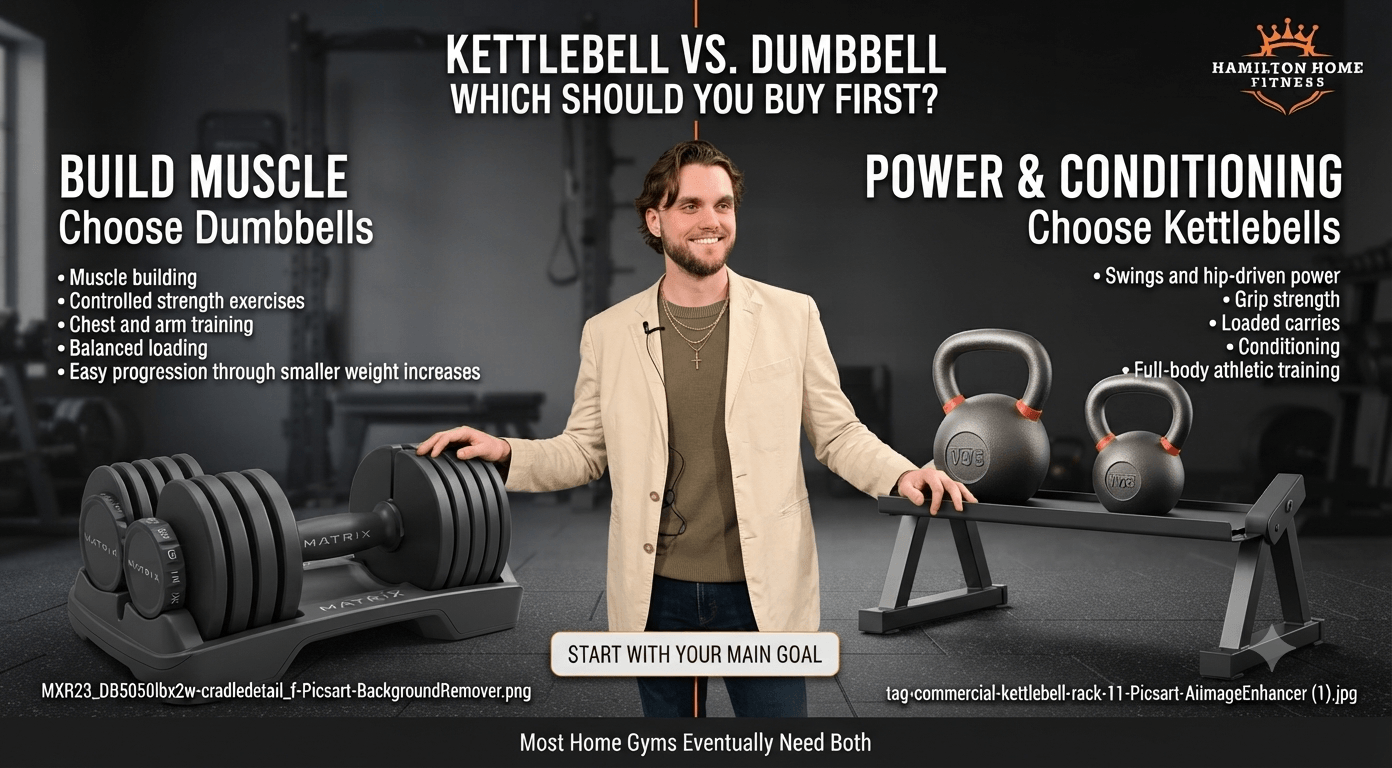
So be honest about the goal. If you want bigger arms and a bigger chest, the dumbbell range is the more efficient buy, and no amount of swinging changes that. If you want a hinge, a grip, and a heart rate—buy the kettlebell.
Most home gyms end up with both. Start with whichever one matches the goal you'd actually name out loud.
FAQ
Is 16 kg too heavy to start with kettlebells?
It depends on the lift. For two-hand swings, 16 kg (35 lb) is a standard starting weight for many men and isn't too heavy. For a get-up or an overhead press, it usually is.
What weight kettlebell do most people use?
The most common single bells are 16 kg (35 lb) for men and 8 kg (18 lb) for women, because both suit two-hand swings—the lift most beginners learn first. Press weight will be lighter.
How heavy should a kettlebell be for swings?
Swings are hip-driven, so they carry more load than presses. Most men start at 16 kg (35 lb) and most women at 8–12 kg (18–26 lb), then move up one bell size at a time.
Can kettlebells build muscle?
Yes. Presses, squats, rows, and heavy swings build muscle when the load increases over time. Dumbbells are still easier to progress in small increments, so they stay the more efficient tool if size is the only goal.
Why are competition kettlebells all the same size?
Sport lifters perform long single-arm sets, so the bell must rest in the same spot on the forearm at every weight. Uniform dimensions let technique carry over as the load increases.
Does handle diameter matter for swings and cleans?
Yes. A thicker handle drains grip faster on high-rep sets, and a narrow window can pinch the pinky fingers on two-hand swings. If your hands are large, check window width before you check the weight.
Final Thought
Type, then weight, then count. That's the order the decision actually happens in, and most people get it backwards—they shop for a bell before they know which lift they're buying it for.
The rule underneath all of it is simple: buy the bell you can press, then buy the bell you can swing. Everything else follows from those two.
You now know what you're looking for, which is what makes a product page useful instead of overwhelming. When you're ready, compare kettlebells by type, weight, and coating—cast iron, rubber-encased, neoprene, vinyl, and adjustable—shipped nationwide from Tennessee.