Introduction
If you already own a cast iron kettlebell or two, the question isn't whether kettlebells work. It's whether the competition steel is worth the price jump and whether the handle, sizing, and finish differences will actually help your training or just look good on the shelf.
This guide compares cast iron vs. competition kettlebells across the four things that actually matter: handle thickness, sizing across weights, finish, and training use case. You'll see the real millimeter differences, why competition bells stay the same size from 8 kg to 48 kg, how powder coat and e-coat affect grip, and which bell type fits which lift.
By the end, you'll know whether to stay with cast iron, add competition steel, or run a hybrid setup—and where to source what you decide on.
Cast Iron vs Competition: Quick Answer
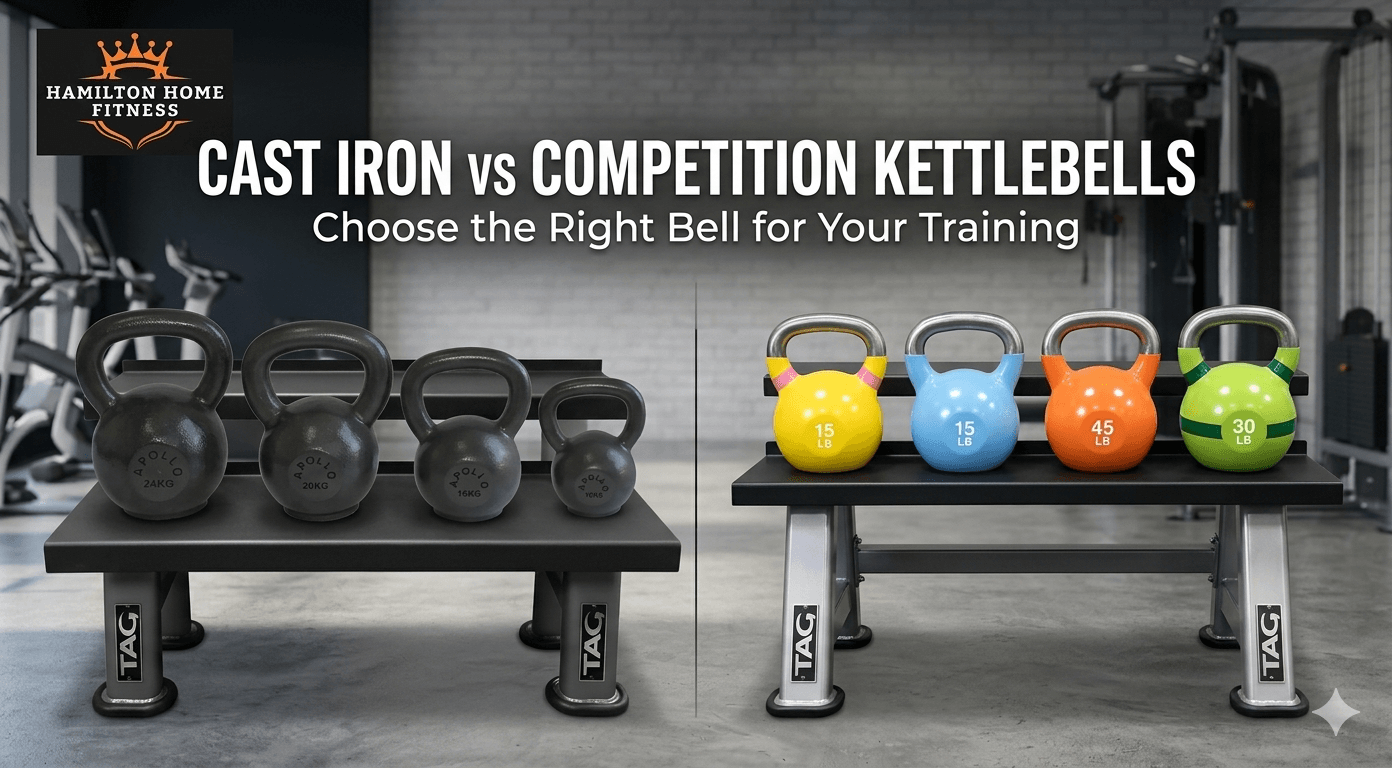
Cast iron kettlebells grow in size as weight increases and suit two-hand swings, Turkish get-ups, and general strength work. Competition kettlebells stay the same size across every weight, use a uniform 33 mm or 35 mm handle, and suit single-arm sport lifts like the snatch, jerk, and long cycle.
Feature | Cast Iron Kettlebell | Competition Kettlebell |
Material | Cast iron | Steel (single-cast or gravity-cast) |
Handle diameter | Varies by weight, roughly 30–38mm+ | Uniform 33mm or 35mm |
Bell size across weights | Grows as weight increases | Identical from ~8kg to 48kg |
Color coding | Optional band on horn | Full-bell color per federation standard |
Best for | Two-hand swings, get-ups, goblet work, strength | Snatch, clean, jerk, long cycle, high-rep sport |
Price band | Lower | Higher |
Handle Thickness and Grip Feel
Competition kettlebell handles use a standardized 33 mm or 35 mm diameter across every weight. Cast iron handles vary by brand and weight class, commonly running from about 30mm on lighter bells to 38mm or more on heavier ones.
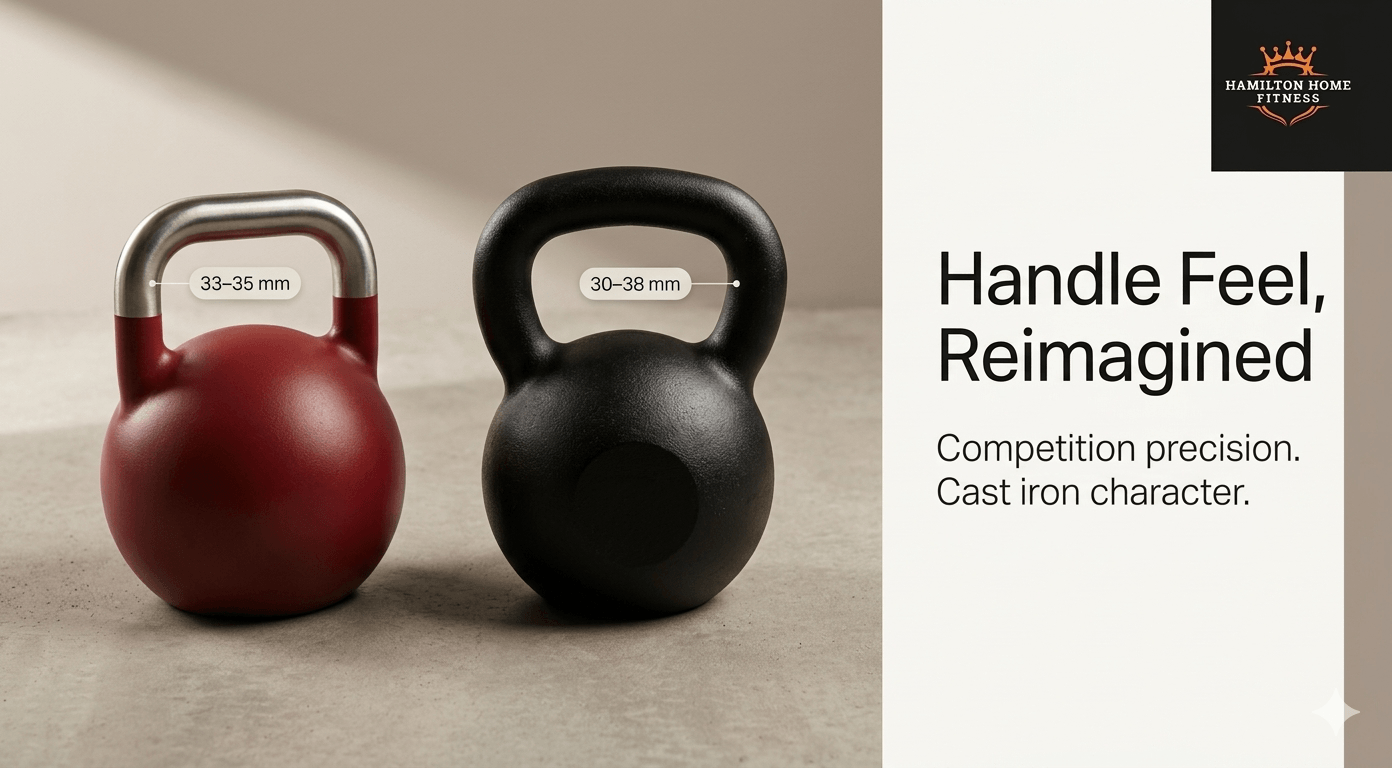
That difference shapes four real outcomes:
Single-arm grip endurance. A thinner, uniform handle reduces forearm fatigue on long snatch and jerk sets.
Two-hand swing comfort. A wider cast-iron window gives both hands room without pinching pinky fingers.
Overhead lockout pressure. A thicker handle spreads load across more palm surface on heavy presses.
Small-hand control. Smaller hands generally grip a 33mm handle more securely than a 38mm cast iron handle on heavier bells.
Standard Diameters and What They Feel Like
The international competition standard is 33mm or 35mm, with 35mm required by IUKL for senior international events and 33mm common for lifters with smaller hands or higher-rep sport sets.
Cast iron sits across a wider band. Light bells (4–8kg) often run around 30mm. Mid-weight bells (16–24 kg) cluster around 35–36 mm. Heavy bells (28kg and up) commonly hit 38mm or thicker depending on the brand. Two 16 kg bells from different brands can feel meaningfully different in the hand even though their weights are identical.
Hardstyle vs Sport Handle Differences
Hardstyle cast iron kettlebells generally have thicker, more variable handles that build grip strength under load, while sport-style competition bells use thinner, uniform handles tuned for long single-arm sets.
Neither is universally "better." Hardstyle training treats grip as a deliberate adaptation target — a thicker handle on a heavy swing or get-up forces the hand and forearm to work harder. Sport training treats grip as a limiter to manage, so the thinner uniform handle lets the lifter hold position for five or ten minutes of continuous reps without the hand failing before the cardiovascular system does.
Two-Hand Swings and Pinky-Finger Fits
Two-hand swings tend to favor cast iron because the wider window gives both hands space; on a competition bell, the corners can pinch pinky fingers, especially on lighter weights.
The fix for a competition bell is either a slightly wider stance and angled grip or accepting that two-hand swings will feel cramped on bells under about 16 kg. If two-hand swings are a regular part of your program and your hands are on the larger side, cast iron is the more comfortable buy.
Sizing: Uniform vs Weight-Based
Competition kettlebells share the same external dimensions across every weight from roughly 8 kg to 48 kg. Cast iron kettlebells grow in both bell diameter and handle thickness as the weight increases.
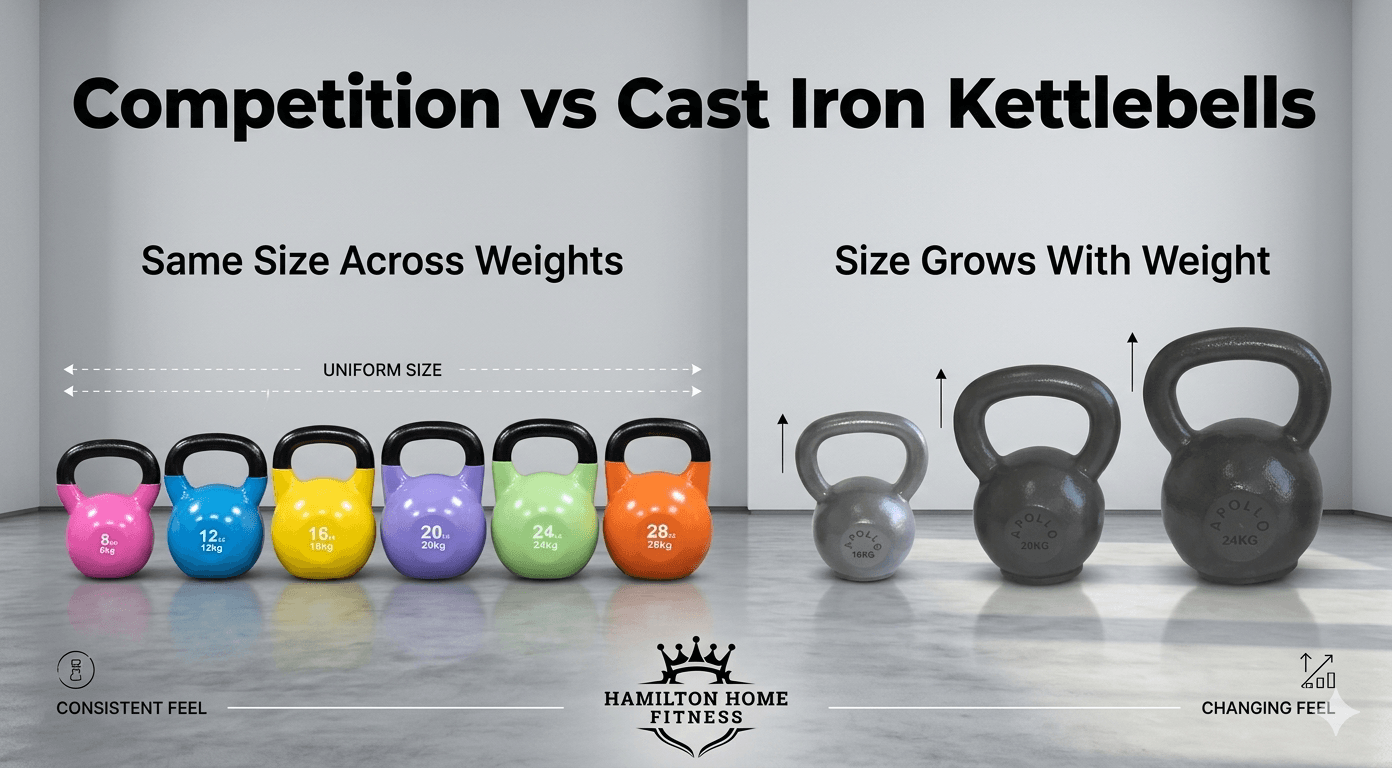
For the lifter, that means a competition 12 kg and a competition 32 kg sit on the forearm in the same spot, with the same hand insertion and the same balance feel. A 12 kg cast iron bell and a 32 kg cast iron bell sit differently—the heavier bell rides lower, fills more of the forearm, and shifts the rack contact point. Technique adjusts every time the weight changes.
Why Competition Bells Stay the Same Size
Competition kettlebells use single-cast or gravity-cast steel construction with a hollow core or controlled filler so that the shell stays identical across weight classes.
The lighter bells are mostly empty inside. The heavier bells are denser inside. Older filler designs used materials like sawdust or ball bearings to make weight, which could rattle or shift over time. Newer single-cast and dual-cast methods produce a sealed hollow shell with no welds, which keeps the balance stable and eliminates internal noise.
Color Coding and Federation Standards
Competition kettlebell colors follow federation conventions—IUKL, IKFF, and GSU each publish color codes—though exact shades for some weights vary between governing bodies.
The widely followed pattern runs roughly 8 kg pink, 12 kg blue, 16 kg yellow, 20 kg purple, 24 kg green, 28 kg orange, and 32 kg red, with in-between weights (10, 14, 18, 22, and 26) taking the color of the weight 2 kg below and having black bands. Cast iron kettlebells generally stay one color across the line, with some brands adding a colored band around the horn to mark weight. If you train across brands or federations, expect minor color variation at the same weight class.
Finish and Coating Comparison
Powder coat gives a textured surface that holds chalk well and grips bare hands; e-coat is smoother and easier to clean; competition bells often use bare or pitted steel that absorbs chalk fastest; rubber and vinyl shells protect floors but reduce direct steel feel.
Finish | Texture | Chalk Behavior | Best For |
Powder coat | Textured matte | Holds chalk longest, grips bare hands | Hardstyle, garage gyms, lifters who chalk |
E-coat | Smooth semi-gloss | Accepts chalk, wipes clean fast | Shared studios, chalk-free training |
Bare or pitted steel | Raw, slightly porous | Absorbs chalk fastest | Sport lifters, high-rep single-arm work |
Rubber or vinyl shell | Smooth coated body, separate handle | The handle behaves like the underlying steel | Floor protection, multi-use training rooms |
Powder Coat for Chalk and Hand Skin
Powder coat creates a fine-textured surface that holds chalk evenly and gives a secure grip even without it, which is why most hardstyle cast iron kettlebells ship with it.
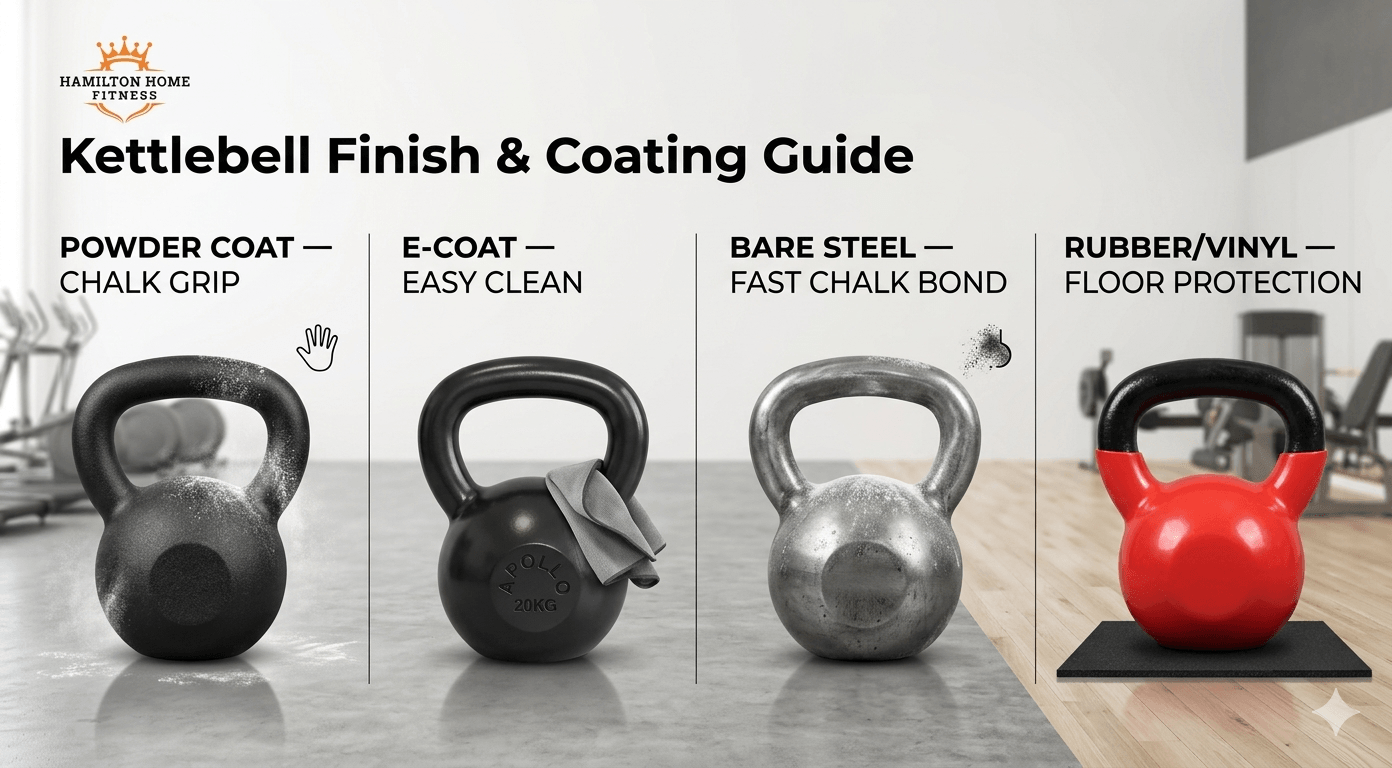
That texture is also why powder coating is harder on hands. New lifters often develop calluses faster on powder-coated bells than on smoother finishes, and overly aggressive coats can tear callused hands during high-rep work. If you train hardstyle volume and care about hand condition, look for a powder coat that is textured but not gritty and pair it with chalk applied sparingly rather than coated thickly. The Tag Fitness powder-coated cast iron kettlebell is one example of a textured-coat option built for that balance.
E-Coat for Easier Cleaning
E-coat applies paint electrostatically, producing a thinner, semi-gloss surface that still accepts chalk but wipes clean faster than powder coat.
The tradeoff is grip without chalk. E-coat is smoother than powder coat, so dry, sweaty hands can slip more on heavy, single-arm work. Lifters who can't or won't use chalk often prefer powder coat. Lifters in shared spaces, climate-controlled gyms, or homes with strict cleanliness needs often prefer e-coat. Both protect against rust well when maintained.
Bare Steel, Rubber, and Vinyl Alternatives
Competition bells often use bare or lightly pitted steel that absorbs chalk fastest; rubber-encased kettlebells trade some bare-steel feel for floor protection and a polished look.
Bare steel handles on competition bells are intentionally untreated. The slight porosity helps chalk bond to the metal, which is what sports lifters want for ten-minute sets. The downside is rust if the bell is stored damp.
Rubber and vinyl shells sit at the other end of the spectrum. The shell protects floors and softens the sound when a bell is set down, and a smooth chrome or coated handle keeps the grip refined. A rubber-encased kettlebell with a smooth chrome handle is a fit for buyers who want the cleaner look and floor-friendly profile of a coated bell without giving up handle quality.
Training Use Case by Lift
Cast iron suits two-hand swings, goblet squats, Turkish get-ups, halos, and general strength work. Competition steel suits the snatch, clean, jerk, long cycle, push press, and any high-rep, single-arm work where uniform rack contact matters.
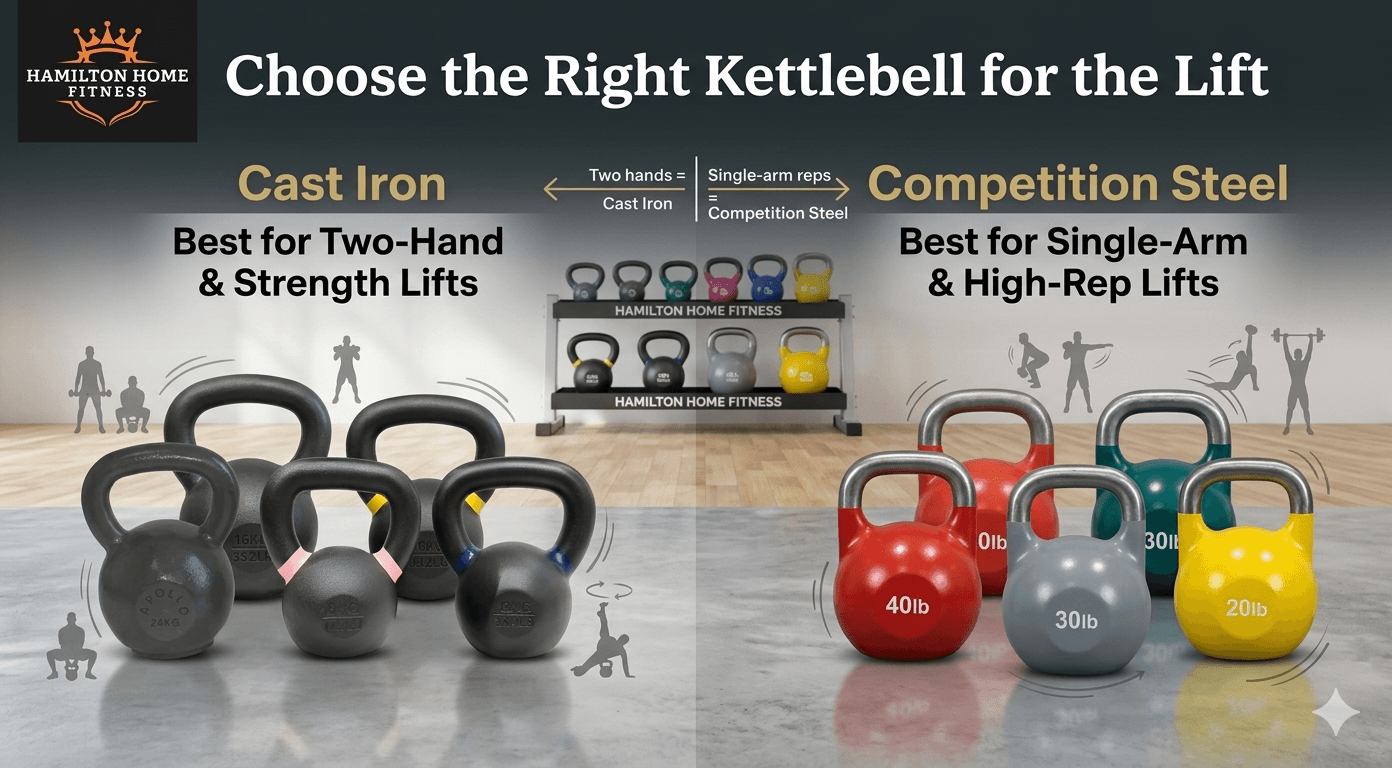
A simple decision rule: if the lift uses two hands or rotates the bell around the body, cast iron is the more comfortable tool. If the lift is single-arm, overhead, or measured in minutes rather than reps, competition steel earns the price gap.
Two-Hand Swings, Goblet Squats, and Get-Ups
Cast iron's wider window, V-shaped horn geometry, and growing bell size make it the more comfortable pick for two-hand swings, goblet squats, and Turkish get-ups.
The V-shaped horn lets the bell rest naturally in the goblet hold against the chest, where a competition U-shaped horn feels flat and less secure. On the get-up, the growing bell size of cast iron means the heavier bell still sits comfortably in the heel of the palm, with the forearm at a stable angle for the press, roll, and stand. Halos and windmills follow the same pattern — the horn geometry guides the bell around the head and hip more naturally than a uniform competition profile does.
Snatch, Jerk, Long Cycle, and Rack Position
Competition kettlebells reduce forearm bruising and stabilize the rack position because the bell rests in the same spot regardless of weight—a meaningful benefit for high-rep snatch, jerk, and long-cycle work.
On cast iron, the rack contact point shifts every time the weight changes. A 16 kg sits higher on the forearm than a 24 kg, which sits higher than a 32 kg. For occasional reps, that's manageable. For a ten-minute-long cycle set, every shift in contact point is a new pressure spot and a new place for skin to break down. Competition steel solves that by holding the same rack contact across the entire weight ladder, so the lifter trains rack position once and keeps it as they progress. The same logic applies to snatch lockouts and jerk dips—the bell behaves identically at every weight, so technique transfers directly.
Durability, Drops, and Flooring
Steel competition kettlebells tend to take repeated drops better than cast iron, which can chip or crack. On concrete, neither option is safe long-term; rubber flooring or a rubber-based kettlebell pad extends the life of both.
Cast iron is hard but brittle. A clean drop on rubber is usually fine. A drop on concrete, an edge landing, or a bell-on-bell collision can chip the coating, crack the bell, or in rare cases fracture a horn. Steel is more forgiving on impact because it deforms slightly before failing, which is why competition bells handle the drop-heavy nature of sport training better.
Neither bell is built to be dropped. Cast iron coatings will chip with repeated drops regardless of surface, and competitive steel finishes will scuff. The difference is structural integrity, not cosmetic protection.
Storage That Protects the Investment
A dedicated kettlebell rack keeps bells off the floor, prevents accidental rolls, and groups weights in the order you actually train.
A rack also protects the floor where the bells would otherwise live, keeps coatings from rubbing against each other in storage, and makes set selection faster during a session. For a home gym with three to eight bells, a 2-tier kettlebell rack designed for organized storage is enough. For larger collections or commercial floors, a 3-tier or modular rack handles the additional load.
How to Choose: A Decision Framework
Choose cast iron if you mainly train two-hand swings, get-ups, goblet work, and general strength. Choose competition steel if you train for sport lifts or want one consistent handle and rack position across every weight. Run a hybrid setup if you train both.
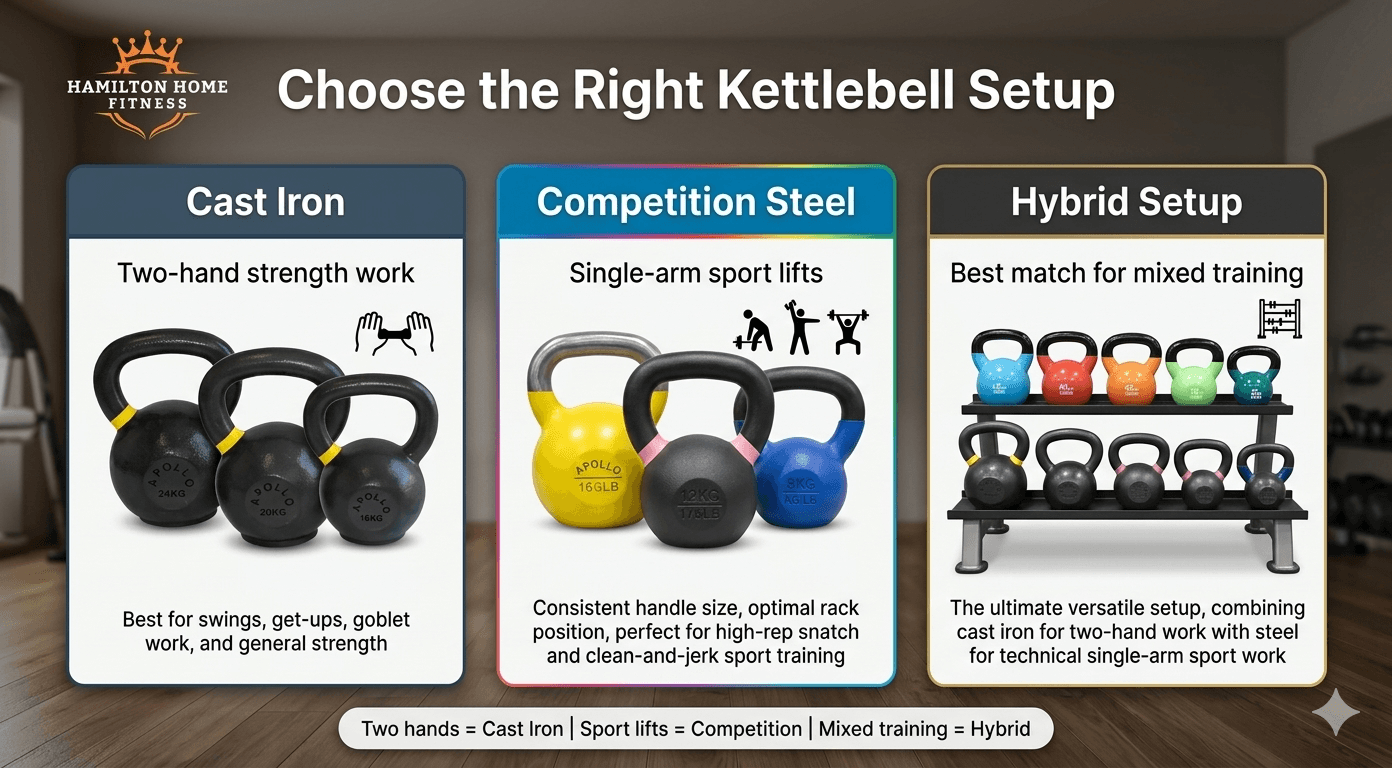
The honest middle path for most intermediate lifters is the hybrid. Keep cast iron in the weights you use for swings and get-ups; add competition steel in the weights you use for snatch, jerk, and long cycle. The cost is higher than picking one side, but the training match is closer to what you actually do.
Decision Checklist for an Intermediate Lifter
Run through these five questions before buying.
What's the dominant lift in my program? Two-hand and rotational work points to cast iron. Single-arm and sport work points to competitive steel.
How big are my hands? Larger hands fit cast iron windows better at lighter weights. Smaller hands grip 33mm handles more securely under load.
Do I chalk? If yes, powder-coated or bare steel holds chalk best. If not, e-coat or rubber-encased may suit you better.
How will I store and drop the bells? Rubber flooring or a rubber base bell is worth the small premium if drops happen.
Am I buying one bell or building a ladder? A single bell can be cast iron without overthinking it. A ladder of four or more bells is where uniform competition sizing starts to earn its price.
If you answered "single-arm sport," "smaller hands," "chalk," "rubber floors," and "building a ladder," competition steel is the stronger fit. If you answered the opposite across the board, cast iron is the better buy. Mixed answers point to a hybrid. You can browse the kettlebell collection at Hamilton Home Fitness to see the cast iron and rubber-encased options available, with weights from 4kg through 48kg.
When to Get Help Planning the Set
If you're outfitting a full home gym, commercial floor, or weight rack, planning the weight progression once is cheaper than buying twice.
The common mistakes are buying a single mid-weight bell and outgrowing it in a month, buying matched pairs at the wrong weight gap (8 kg jump when a 4 kg jump would have served better), or buying bells without the storage to keep them organized. A short conversation with someone who plans gym layouts often catches all three. You can book a gym design consultation if you want help mapping the weight ladder and storage to your space and goal before placing the order.
FAQ
What is the actual handle diameter difference between cast iron and competition kettlebells in millimeters?
Competition kettlebells use a standardized 33 mm or 35 mm handle across all weights. Cast iron handles vary by brand and weight class, typically 30mm to 38mm or more. At matched 16 kg weights, the difference between a cast iron and a competition handle can be as small as 1 mm.
Why are competition kettlebells all the same size regardless of weight?
Competition bells are designed for sport lifters who perform long single-arm sets. Uniform external dimensions mean the bell sits in the same rack position on the forearm at every weight, so technique transfers as the lifter loads up.
Which kettlebell type is better for two-hand swings versus jerks and snatches?
Cast iron suits two-hand swings because the wider window fits both hands without pinching. Competition steel suits jerks and snatches because uniform sizing stabilizes the rack position and reduces forearm bruising during high-rep work.
Do competition kettlebells hurt the forearm and rack position less than cast iron?
For most lifters, yes. The bell rests in the same spot regardless of weight, which reduces the forearm pressure points that change every time a cast-iron rack gets heavier.
Is a powder coat or e-coat finish best for chalk grip and hand skin?
Powder coat holds chalk longer and grips bare hands better thanks to its textured surface. E-coat is smoother, cleans faster, and is preferable for shared spaces or lifters who train without chalk. Both protect against rust.
Which kettlebell type holds up better when dropped on concrete or rubber flooring?
Steel competition kettlebells generally absorb drops better than cast iron, which can chip or crack. Neither holds up indefinitely on bare concrete. Rubber flooring or a rubber-based kettlebell pad extends the life of both.
Why are competition kettlebells more expensive than cast iron?
Competition kettlebells are typically single-cast or gravity-cast from steel with tighter weight tolerances and uniform external dimensions, which costs more to produce than basic cast iron pours.
Can a beginner start with a competition kettlebell?
Yes, especially for sport-style training. Beginners with small hands often find the 33mm handle easier to control. The tradeoff is a higher cost and a tighter window for two-hand swings.
Are colored competition kettlebells regulated?
Major sport federations (IUKL, IKFF, GSU) publish color standards, but exact shades for some weights vary between governing bodies. Manufacturers generally follow the IUKL pattern.
Do hardstyle kettlebells have a thicker handle than sport kettlebells?
Generally yes. Hardstyle cast iron handles run thicker and grow with weight to build grip; sport competition handles stay thin and uniform for high-rep single-arm sets.
Which brand do GS sport athletes prefer?
Preference varies by federation, region, and event, so no single brand dominates. Athletes generally choose bells certified to IUKL, IKFF, or GSU standards and stay with one brand for consistent feel through a training cycle.
Final Thoughts
Cast iron and competition kettlebells aren't ranked against each other — they're built for different jobs. Cast iron earns its place for two-hand swings, get-ups, goblet work, and general strength. Competition steel earns its place for snatch, jerk, long cycle, and any single-arm work where rack position has to stay identical from 12 kg to 32 kg. Hybrid setups serve lifters who do both.
Match the bell to the lift, match the finish to your chalk habits, and match the storage to the collection—and the buying decision stops feeling like a gamble.
When you're ready to build out the setup, the full Free Weights department at Hamilton Home Fitness covers kettlebells, racks, and the rest of the strength equipment to put around them, with Tennessee-based support and nationwide shipping.