Introduction
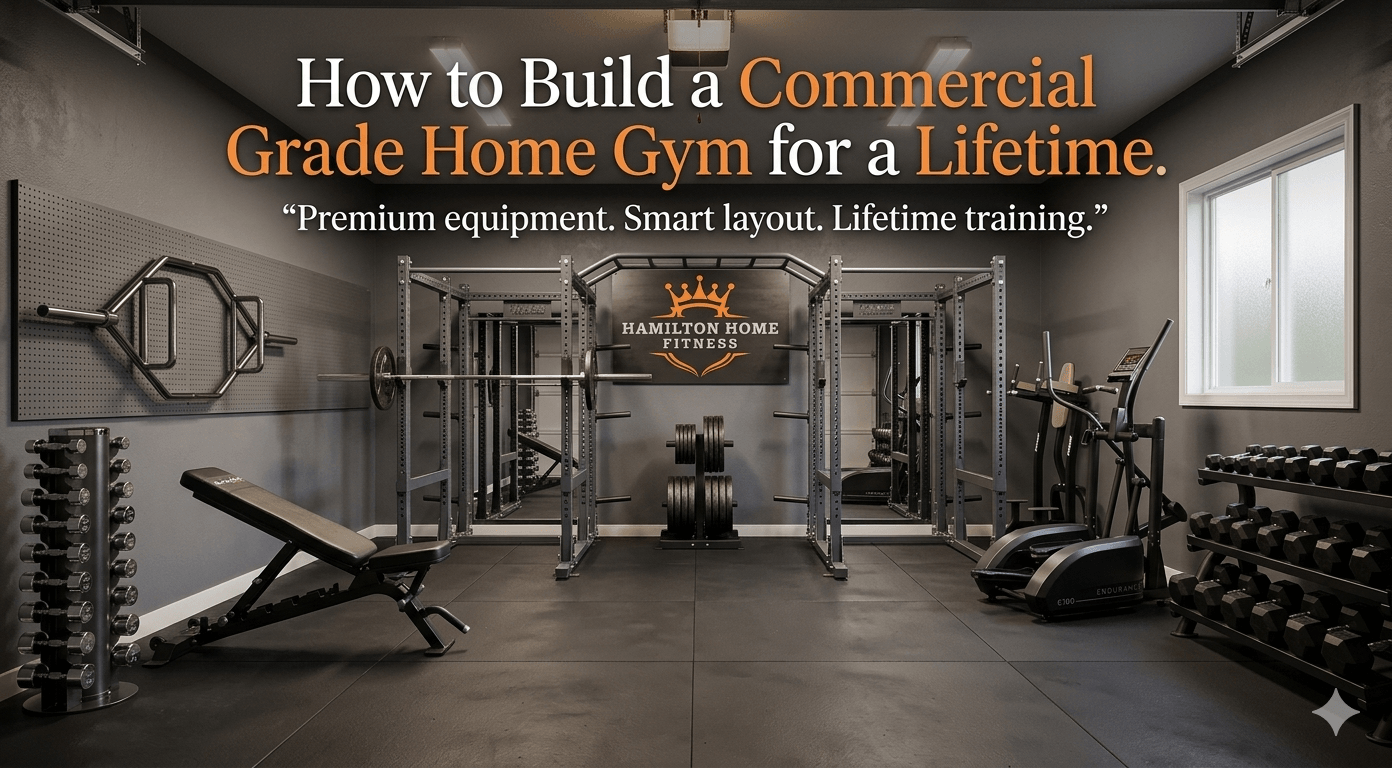
You already train four to six days a week, you already own the basics, and you know residential gear will not survive the next fifteen years of that schedule. This guide is for the build that does.
A commercial-grade home gym is a permanent garage or basement setup anchored by 11-gauge steel strength equipment, motor-rated cardio, and brands stocked through authorized US dealers—sized for 15–20 years of daily loading, not a season of motivation.
What you will get here: the three-tier framework so you can self-classify, space and ceiling rules sized to a garage or basement, the equipment list at commercial spec, a brand shortlist worth your budget, and a phased plan that spreads $5,000–$25,000 across 12–24 months without buying twice.
If you are scoping a starter or residential-tier build instead, the starter-level home gym build guide covers that lane. This one stays on the commercial grade.
What Commercial-Grade Really Means
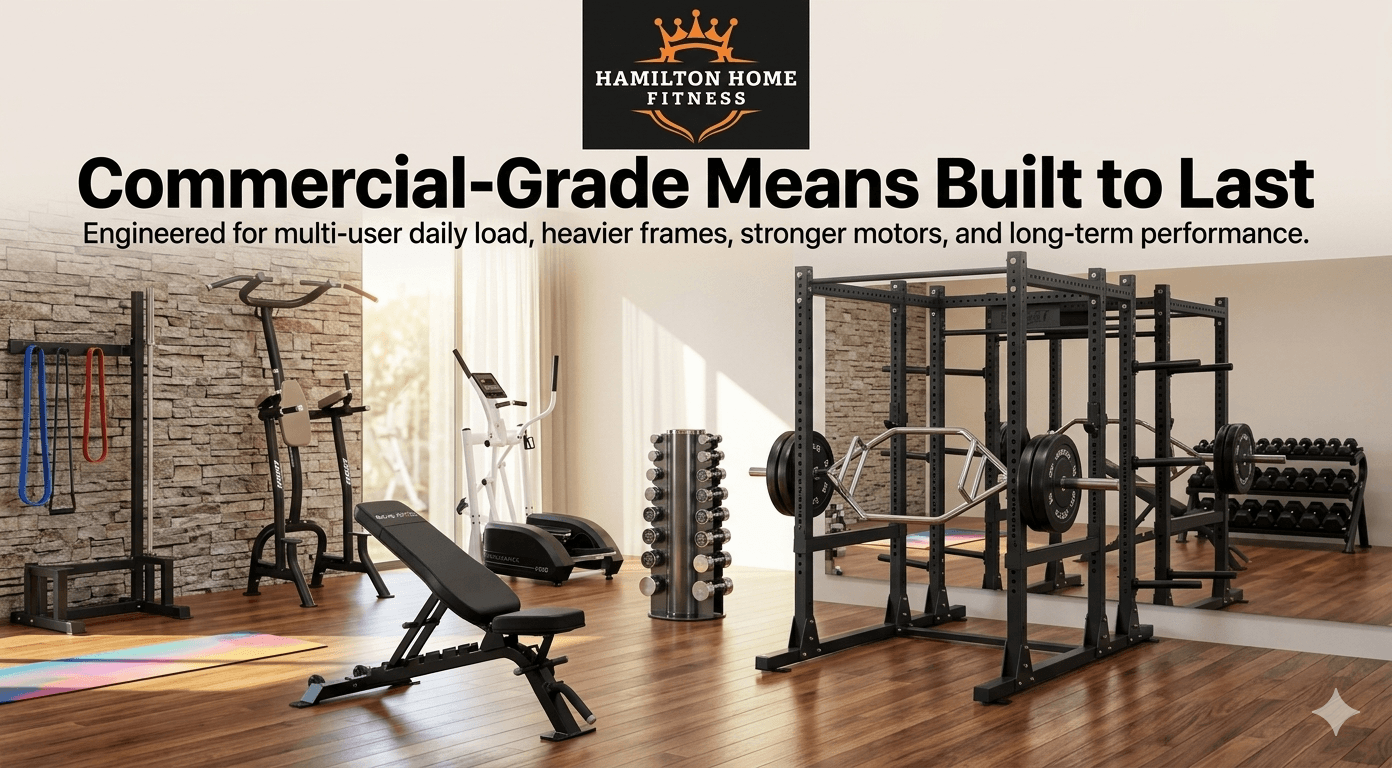
Commercial-grade gym equipment is engineered for hours of multi-user daily load — heavier-gauge steel, larger motors, continuous-duty ratings, and warranties that survive the kind of weekly volume that would void a residential warranty in the same household.
Residential vs light vs full commercial
Three tiers cover almost everything sold: residential for single-household use; light commercial for moderate daily use in studios or upscale homes; and full commercial built for continuous all-day loads. The spec gap between them is wider than the price gap suggests.
Tier | Daily Use | Typical Frame | Treadmill Motor | Warranty Stance | Best Fit |
Residential | 1–2 hours, single household | 12–14 ga. steel | Peak-rated DC | Voided by multi-user / facility use | Casual home use |
Light commercial | 4–6 hours, low traffic | 11-gauge steel | Continuous-duty 2.5–3.0 HP | Covers small studios, hotels, apartment gyms | Serious home builds, small facilities |
Full commercial | 8–16+ hours, high traffic | 7–11 gauge steel | Continuous-duty 3.0–5.0 HP AC | Covers public, multi-user facilities | Health clubs and demanding home gyms |
For a lifetime home build, light commercial is the floor and full commercial is the ceiling—both clear the 15–20-year horizon. Residential does not. For the full spec-by-spec breakdown, see how commercial and residential gym equipment actually differ.
Why home gyms now use commercial gear
Four to six sessions a week by one or two adults will outcycle a residential warranty in three to five years. The math is unforgiving: residential gear typically lasts 3–7 years under serious use, while commercial-grade strength equipment commonly runs 15–20 years with basic maintenance, and commercial cardio runs 8–12 years.
Translated to cost per year, a $1,500 residential rack replaced twice in a decade costs more than a $2,500 commercial-grade rack that outlasts the build. The sticker price is the wrong lens for a permanent setup. Cost per year over the planned lifespan is the right one—and it is what justifies every spec decision in the sections that follow.
Plan Your Garage or Basement Space
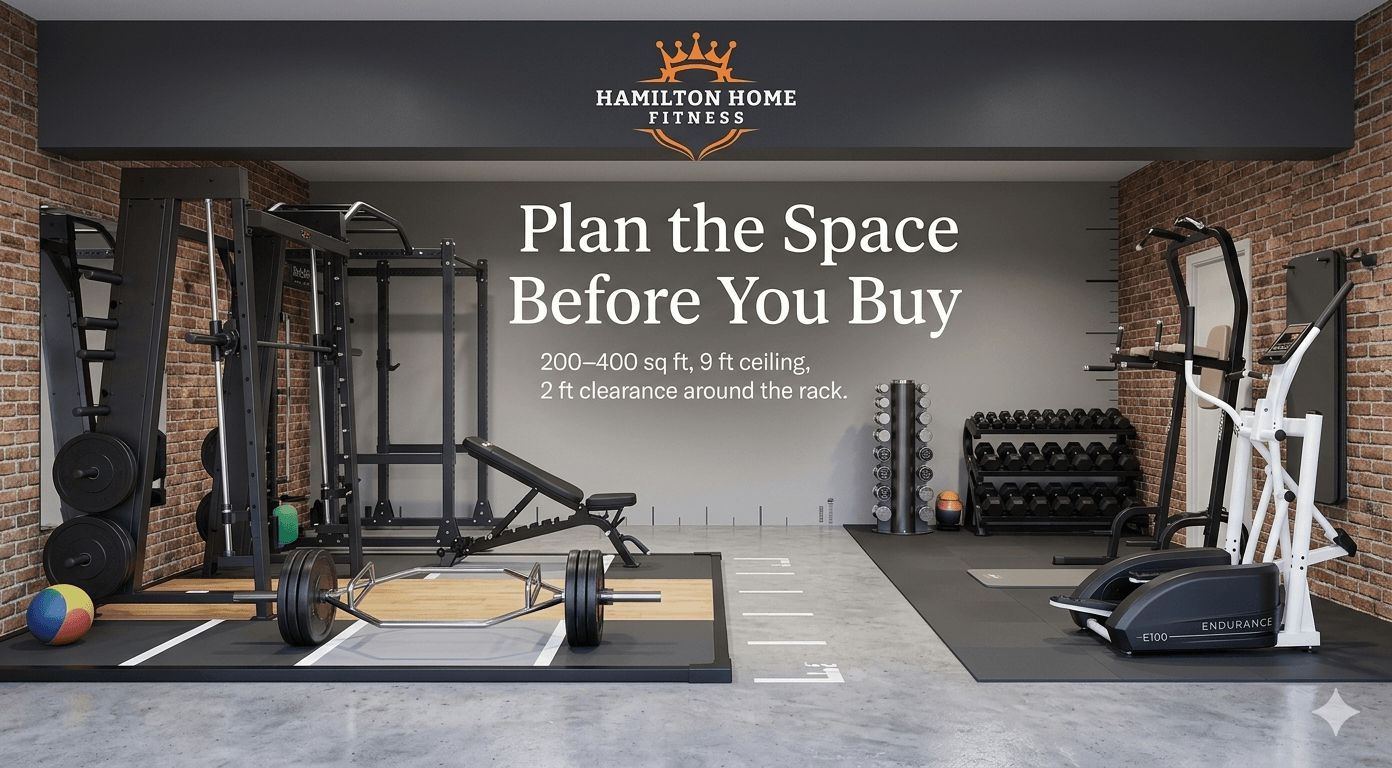
A commercial-grade home gym needs roughly 200–400 sq ft of usable floor for full strength plus cardio, at least 9 ft of ceiling for overhead pressing and pull-ups, and 2 ft of clearance on every side of the rack. Measure before you spec anything.
Minimum square footage by training
Strength-only builds work in 100–150 sq ft; full strength plus a cardio piece needs 200–300 sq ft; a multi-zone commercial-grade build needs 300+ sq ft of usable floor. Measure the usable area, not the room total—subtract space taken by water heaters, support columns, swinging doors, and any zone the car still uses.
Training Style | Floor Space | What Fits |
Strength-only | 100–150 sq ft | Full rack, bar, plates, adjustable bench |
Strength + one cardio piece | 200–300 sq ft | Rack, platform, dumbbells, rower or air bike |
Multi-zone commercial-grade | 300–500+ sq ft | Rack, platform, dumbbells, cardio, functional trainer |
Couples or family-shared build | 400+ sq ft | Above plus second loading station or duplicate dumbbells |
Ceiling clearance you actually need
Overhead pressing needs about 9 ft of ceiling for most adults; pull-ups need 9–10 ft; Olympic lifts overhead need 10+ ft. Measure to the lowest point in the room—beams, ductwork, and garage door tracks routinely require 6–12 inches cut off the number you assumed.
Movement | Minimum Ceiling | Note |
Floor work, dumbbells | 7.5 ft | Almost any room works |
Squat inside a short rack | 8 ft | Use a 78–80 in upright |
Standing overhead press | 9 ft | Add inches if you're over 6 ft |
Pull-ups, full hang | 9–10 ft | The bar needs 10–18 inches above it |
Olympic lifts overhead | 10+ ft | Snatch and jerk demand the most |
Under 8 ft, a wall-mount folding rack or a Smith machine keeps the build alive without the ceiling fight.
2-car garage layout that works
The best 2-car garage layout puts the rack against the long wall, the platform inline, cardio opposite, and storage vertical—preserving 2 ft of clearance around every loading station.
Picture a 20×20 ft footprint with one bay dedicated to training. The full power rack sits centered on the long wall, with an 8×8 ft deadlift platform extending out from it along the same wall. Plate trees and a dumbbell rack run vertically against the short wall behind the rack, keeping the floor clear. A rower, air bike, or treadmill takes the opposite long wall, leaving a center walking lane and a clean lifting lane in front of the rack. The second bay still parks a car or stores everything else the garage already holds.
The mistake most builders make: centering the rack in the room. Push it against a wall to free the floor for movement and to keep loading clearance on the open side.
Basement-specific planning
Basements work for commercial-grade builds when the ceiling clears 8 ft and humidity stays below 60 percent; under 8 ft, switch to a wall-mount folding rack and seated overhead variations.
Decision rule by ceiling height:
Under 8 ft: Wall-mount folding rack or short freestanding rack. Drop the standing overhead press; use a seated dumbbell or landmine press. Skip pull-ups in the rack—use a doorway or wall-mount bar in a taller hallway.
8–9 ft: Short power rack (78–80 in upright). Pull-ups work with a slight knee bend. The overhead press is fine for most adults under 6 ft tall.
9+ ft: Full commercial-grade build with no compromise — full-height rack, standing press, full-hang pull-ups, even rings if the joists support them.
Two basement realities to handle before the rack ships: First, seal the concrete floor before laying rubber—trapped moisture under mats causes mold and accelerates rust on plates and the bar. Second, sound carries upward through basement ceilings more than downward through garages, so layered rubber under the rack and controlled lowering of the bar matter more than they do in a detached garage.
Flooring, Electrical, and Climate
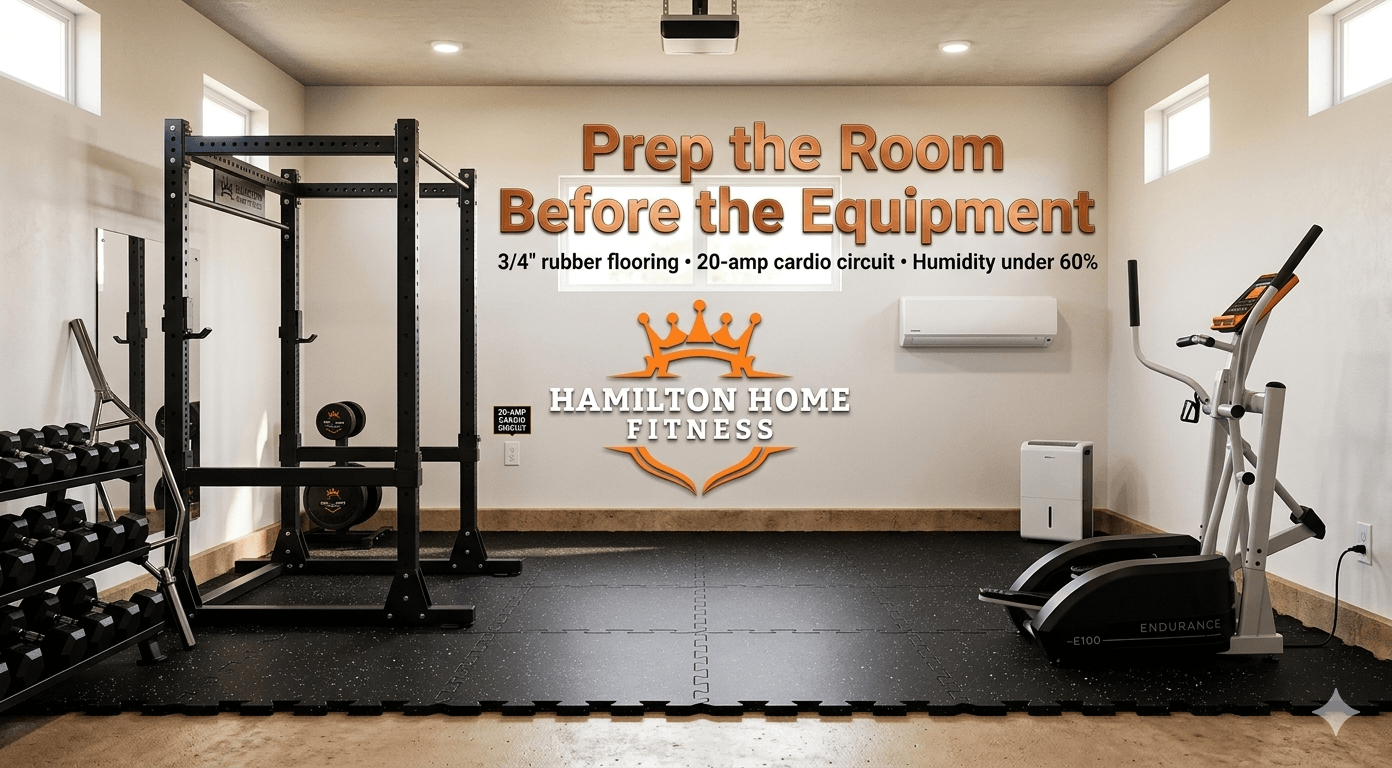
Lay 3/4-inch rubber or stall mats under the rack, run a dedicated 20-amp circuit on a NEMA 5-20R outlet for commercial cardio, and hold humidity under 60 percent year-round. These three prep steps protect a multi-thousand-dollar build over the 15–20-year horizon—and every one of them is harder to retrofit around loaded equipment than to handle on an empty floor.
Floors that survive heavy plates
3/4-inch horse stall mats handle the heaviest free-weight loads cheapest; 8–10 mm rubber tiles look cleaner in finished basements; and a plywood-rubber platform under the bar absorbs deadlift drops better than either alone.
Option | Cost Tier | Use Case | Drawback |
Horse stall mats (3/4 in.) | Low | Garage, heavy free-weight zones | Heavy, off-gas smell for first weeks |
Rubber gym tiles (8–10 mm) | Medium | Finished basement, mixed-use room | Cost per sq ft is 2–3x stall mats |
Plywood-rubber platform | Low–Medium | Under the bar for deadlift drops | DIY assembly takes a defined footprint |
Foam tiles | Very low | Yoga and bodyweight zones only | Compresses and tears under a loaded rack |
A lifetime build typically uses two layers: stall mats or rubber tiles wall-to-wall in the lifting zone, plus a dedicated platform under the bar where the heaviest drops happen.
Electrical for commercial cardio
Most commercial-grade treadmills and high-end rowers need a dedicated 20-amp circuit on a NEMA 5-20R outlet to avoid breaker trips and protect the motor electronics. A standard 15-amp bedroom circuit cannot handle a 2,500-watt peak draw from a 3.0–5.0 HP continuous-duty motor without nuisance trips and long-term electronics damage.
Wire it before the card ships out.
Dedicated 20-amp circuit for any motorized cardio piece — treadmill, motorized stair climber, or screen-equipped rower.
NEMA 5-20R outlet at the cardio location. The cost to install is typically $150–$300 with a licensed electrician.
Surge protection on the cardio circuit. A single power event will brick a commercial console.
At least two general outlets near the rack for fans, a sound system, and chargers. Extension cords across the lifting floor are a tripping hazard and a sign the wiring was skipped.
Plan the outlet positions on a sketch before the rack and cardio arrive. Moving an outlet after equipment is in place is far harder than running the line into an empty room.
Humidity, airflow, rust prevention
Hold relative humidity under 60 percent year-round to protect barnacles, cable systems, and bench upholstery. Mold thresholds and steel corrosion both accelerate above that line, and they are bigger issues in the Southeast US — including most of Tennessee — than buyers expect.
Match the climate plan to the region:
Humid Southeast (Tennessee, Gulf, Mid-Atlantic): A 50–70 pint dehumidifier handles most garages and basements year-round. Add a vent fan or window fan for active airflow during sessions.
Mixed climates (Midwest, Mid-Atlantic, Northeast): A 50-pint dehumidifier through summer, plus garage door insulation panels to cut both summer heat soak and winter chill. A mini split is the long-term answer if the space is used year-round.
Dry climates (Mountain West, Southwest): Humidity is rarely the threat—heat is. Add a ceiling fan, an evaporative cooler, or a mini split. Dust filtration matters more here than dehumidification.
Two cheap habits that extend bar and cable life regardless of climate: wipe the knurl after sweaty sessions and keep chalk away from cables and consoles. Neither costs anything. Both add years.
Equipment Built for a Lifetime
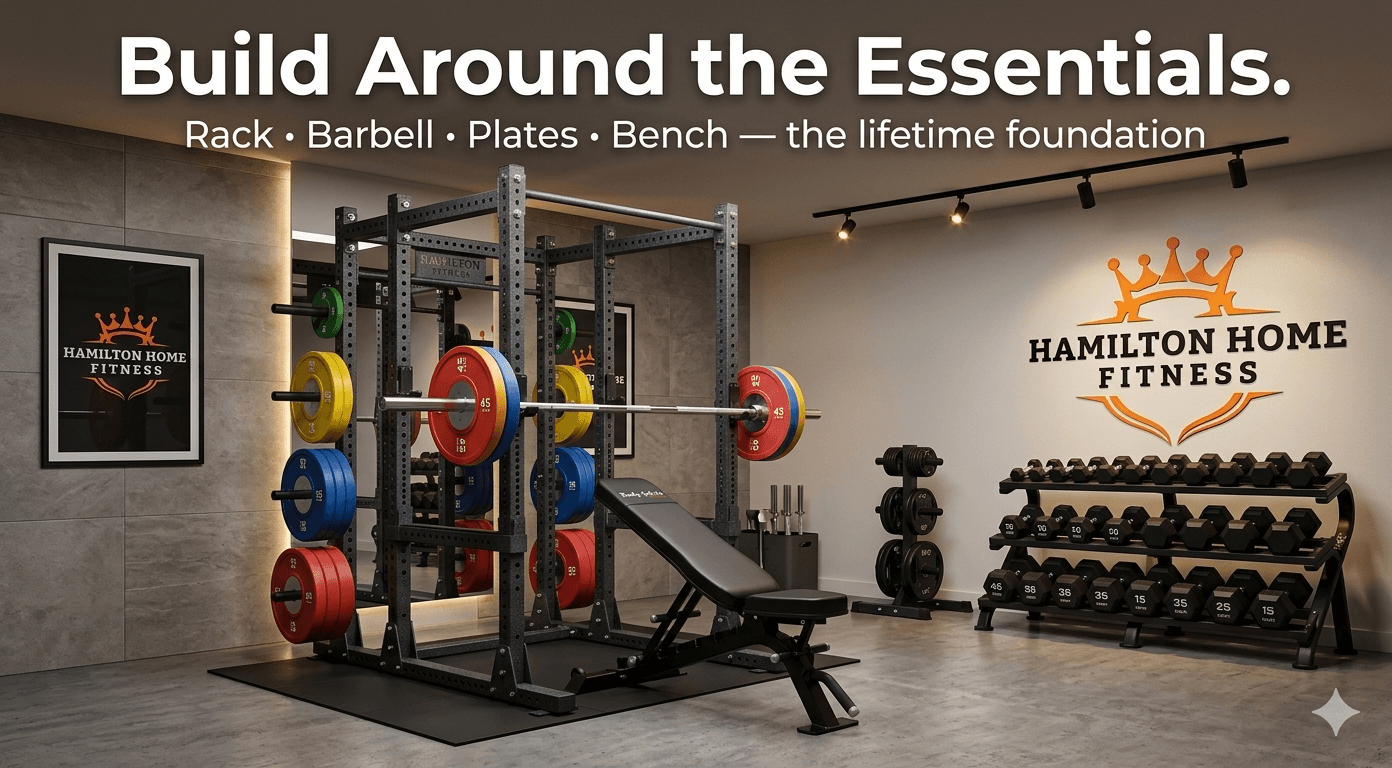
The non-negotiable commercial-grade stack is a 3×3-inch 11-gauge power rack rated for 1,000+ lb, an Olympic barbell rated for daily loading, calibrated or commercial plates, and a heavy-frame adjustable bench. Everything else is a layer on top of these four — and skipping the spec on any one of them is what turns a 15-year build into a 5-year regret.
The rack: anchor of the build
For a lifetime build, look for 3×3-inch, 11-gauge steel uprights with a 1,000+ lb rated capacity, full-length safety arms or pin pipes, and bolted hardware sized to 5/8-inch or 1-inch.
Verify these specs:
Steel gauge: 11-gauge is the commercial floor; 7-gauge is full commercial. Avoid anything 12-gauge or thinner for a permanent build.
Upright dimension: 3×3 inches is the long-term standard. It carries the load, holds attachment compatibility across major brands, and resists flex under dynamic movements.
Rackable capacity: 1,000 lb minimum. Most lifters will never approach this; the headroom is what keeps the rack stable under daily use.
Safeties: Full-length spotter arms, pin-pipes, or strap safeties rated for the same load as the frame. No safety arms means no solo training under heavy weight—non-negotiable.
Hardware: 5/8-inch bolts at minimum and 1 inch on premium racks. Westside hole spacing through the bench zone is worth the upgrade if you press heavily.
Anchor option: Even a heavy freestanding rack benefits from being bolted into concrete if the build includes kipping pull-ups, muscle-ups, or any modular rig extension.
Style by space: full power cage in a 9+ ft garage, half rack or short cage in a basement with 8–9 ft ceilings, and wall-mount folding rack under 8 ft. Compare verified commercial tier options in the commercial power racks and cages collection.
Bars, plates, and dumbbells for life
A daily-loaded bar should have 190,000+ PSI tensile strength with a finish suited to the room's humidity. Plates should match the lifts you actually do; commercial-grade dumbbells use heavy hex or urethane heads, not painted iron.
Bars by training style:
General strength + hybrid: A 20 kg / 28.5 mm dual-marked Olympic bar handles squats, benches, presses, and Olympic variants well enough for almost every home lifter.
Powerlifting priority: A 29 mm power bar with aggressive knurl and stiff whip improves squat and bench stability.
Olympic lifting priority: A 28 mm Olympic bar with needle bearings spins fast enough for the clean and snatch.
Specialty: Trap bar for deadlifts and carries; safety squat bar for shoulder-friendly squats; multi-grip bar for pressing variations.
Plates by drop tolerance:
Bumper plates if you will drop the bar from overhead or hang it. Competition bumpers hold tighter diameter and width tolerances.
Iron or urethane plates if you do not drop the bar. Urethane survives the room better and is quieter on the rack.
Calibrated plates if precise loading matters — typically powerlifting-focused builds.
Dumbbells by space:
Rubber or urethane hex if floor space allows a full rack from 5 to 100 lb. Urethane lasts longer and holds shape under daily use.
Adjustable dumbbells if space is the real constraint. A dial-style adjustable pair replaces 15+ fixed pairs in roughly 4 sq ft.
Browse barbells, plates, and dumbbells in the commercial-grade free weights and barbells collection to compare formats against the specs above.
Benches that hold up under pressing
A commercial-grade adjustable bench uses an 11-gauge frame, a wide pad, ladder-style backrest adjustment with no slop, and a weight capacity of 1,000 lb or higher.
Verify before ordering:
Frame gauge and weight capacity — 11-gauge with 1,000+ lb capacity. Anything lower flexes under heavy pressing and feels unstable.
Pad density and width—dense closed-cell foam, 10–12 inches wide for shoulder support without restricting the arch.
Adjustment mechanism—ladder-style with discrete locking positions beats pop-in systems that develop play over years.
Footprint and stability—wider base, no rocking under heavy unilateral work, and no gap between seat and back pad in the flat position.
Flat-to-decline range—most commercial-grade adjustable benches drop to flat cleanly and include decline; cheaper benches sit slightly inclined at the "flat" position.
A skipped bench upgrade is one of the most common reasons home lifters buy twice. The pad collapses, the backrest develops play, or the frame flexes—usually inside three years on residential-tier benches. Shop the heavy-frame adjustable benches category to apply this spec checklist against real options.
Add-ons that earn their footprint
Add only the cross-functional pieces that unlock new training: kettlebells, a sled, plyo boxes, slam balls, and a rope before any single-purpose strength machine.
Decision rule by training goal:
Hybrid or general strength + conditioning: Kettlebells (one heavy, one moderate), a sled or prowler, a single plyo box, and a battle rope.
Athletic or sport-specific prep: Sled, sandbags, medicine balls, plyo boxes at multiple heights, a vertical rope, or a climbing rope.
CrossFit-style or constantly varied: wall ball, slam balls, plyo box, kettlebells, jump rope, and a rower or air bike (covered in the cardio section).
Powerlifting or Olympic only: Most cross-functional aids gather dust. Skip them and put the budget into bar, plate, and platform quality.
The trap to avoid: single-purpose strength machines (preacher curl, dedicated leg curl, machine-only chest press) before the rack and free weights are at a commercial tier. Most movements those machines train can be covered in the rack with the right bar or attachment at a fraction of the footprint. Source kettlebells, sleds, plyo boxes, and ropes from the cross-training equipment for hybrid builds collection.
Cardio That Survives Daily Use
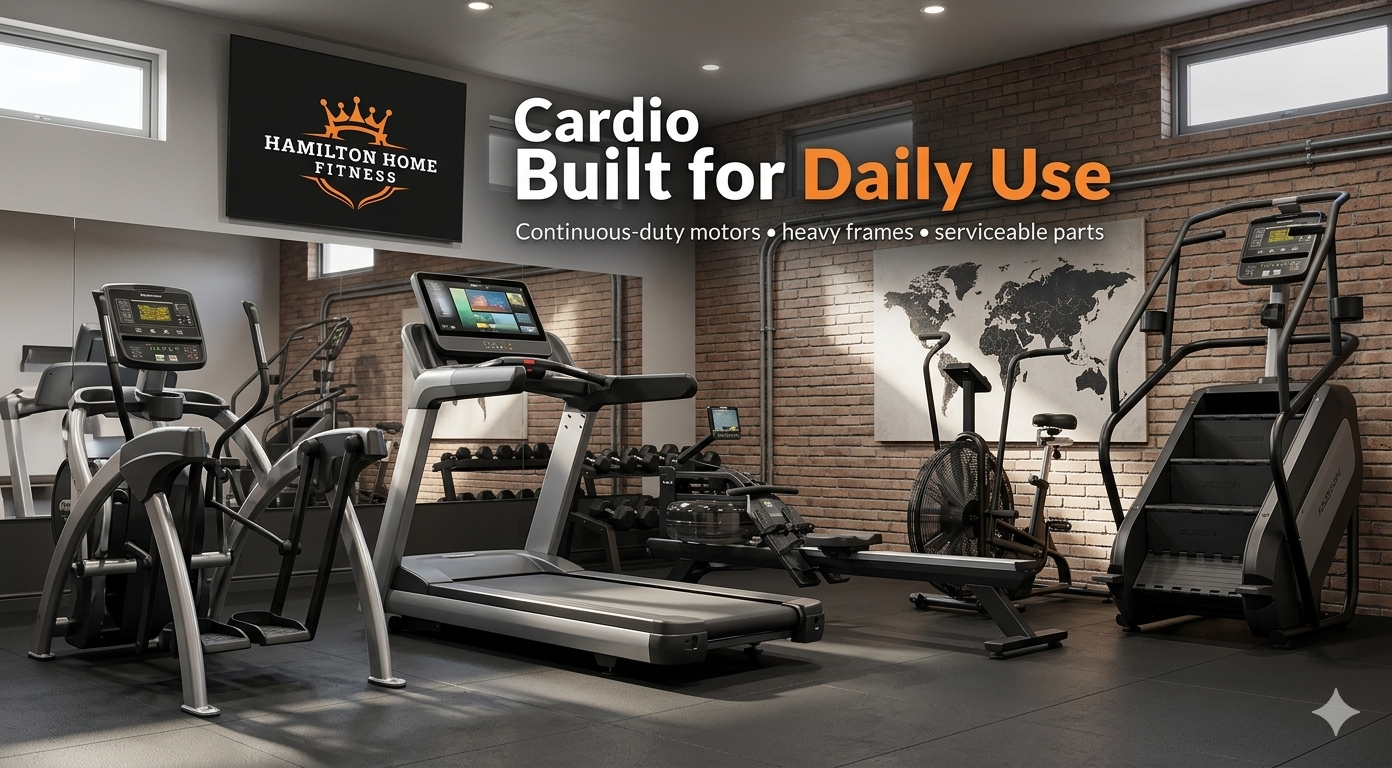
For daily running, a commercial treadmill with a 3.0–5.0 HP continuous-duty motor and an 11-gauge frame outlasts residential models by three to five times; for full-body conditioning, a Concept 2 rower remains the most service-friendly choice in the category. Cardio is where residential builds fail first—the motor, the belt, the console, or the bearings give out long before the strength side of the gym shows wear.
Commercial vs residential cardio
Commercial treadmills run continuous-duty AC motors and 11-gauge frames built for daily, multi-user loads; residential treadmills use peak-rated DC motors that burn out under sustained running.
Piece | Residential Spec | Commercial Spec | Daily-Use Verdict |
Treadmill | Peak-rated 2.0–3.0 HP DC motor, 12–14 ga frame | Continuous-duty 3.0–5.0 HP AC motor, 11 ga frame | Commercial only for daily running; residential fits walking |
Rower | Plastic-shroud air or magnetic, light frame | Steel-frame air or water. Concept 2 is the category standard | Concept 2 holds value and parts availability better than any alternative |
Air bike | Light steel frame, chain drive, plastic shroud | Heavy steel frame, belt drive, sealed bearings | A commercial belt drive runs quieter and needs less maintenance |
Stepper / stair climber | Light residential — fails fast under daily use | Continuous-duty motor, commercial frame (e.g., STEPR) | Commercial only—residential steppers are short-life pieces |
Indoor cycle | Belt or chain, plastic flywheel housing | Steel flywheel, magnetic resistance, commercial bearings | The commercial cycle survives daily use; residential is fine for 3x/week |
Three practical rules for cardio at the commercial tier. First, motor horsepower is meaningless without the duty cycle—"peak HP" residential ratings inflate the number; continuous-duty AC ratings tell the truth. Second, the rower with the deepest service network in the US is the Concept2, which keeps the build serviceable a decade from now. Third, screens and proprietary software date faster than the frame underneath them—prioritize the mechanical build and treat the console as a wear part.
Match the cardio piece to the actual habit, not the trendiest format. A treadmill earns its keep for daily walkers and runners. A rower or erg bike earns it for interval training and conditioning. A stair climber earns it for low-impact volume. Browse motor- and frame-rated options in the commercial cardio equipment collection before locking the piece in.
Brands Real Commercial Gyms Trust
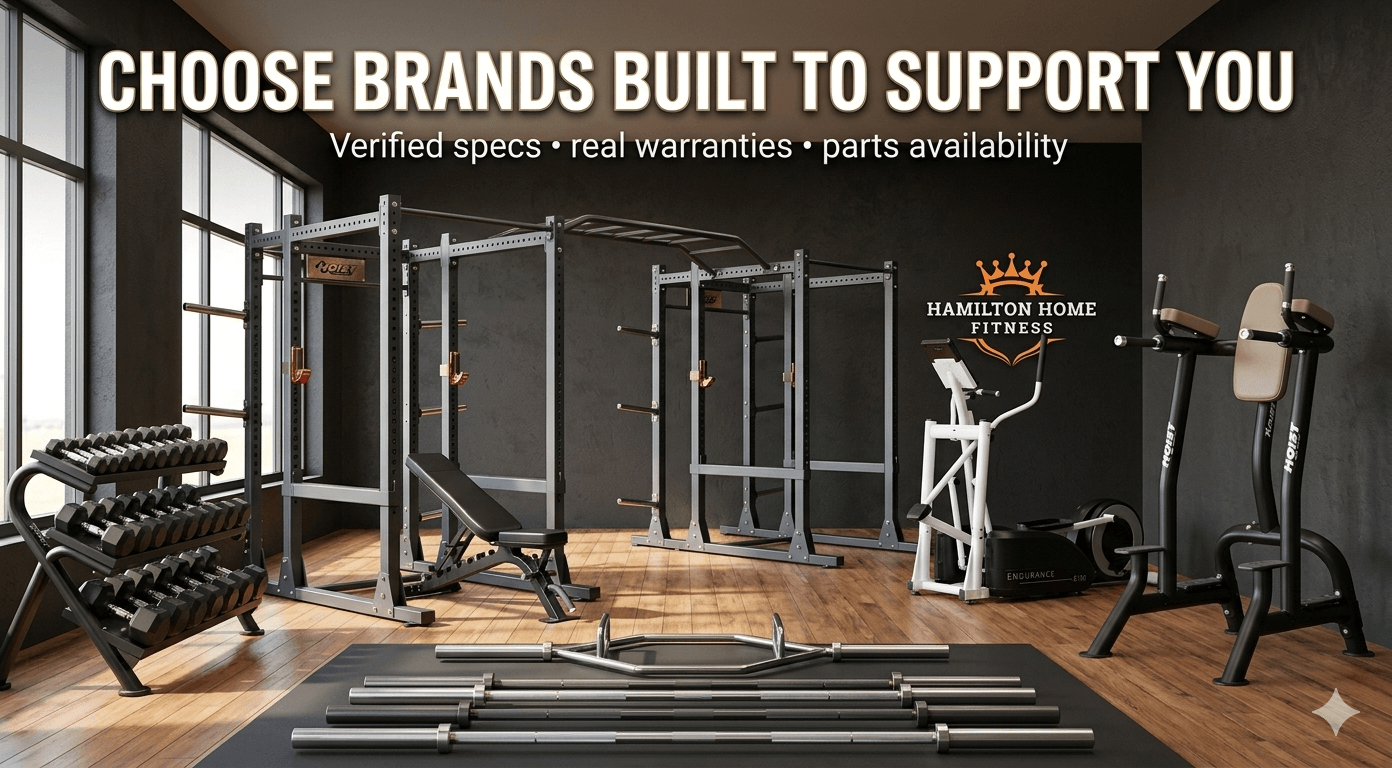
Brands worth a lifetime build are those with a named country of manufacture, a lifetime structural warranty, real parts availability through an authorized US dealer, and verifiable tier classification. The brand decision matters more than the model decision — parts, warranty support, and resale all flow from it.
How to verify a commercial-tier brand
Verify a commercial-tier brand on four points: steel gauge published on the spec page, named country of manufacture, multi-year or lifetime frame warranty, and parts stocked through an authorized US dealer.
Steel gauge published on the spec page. Commercial-tier brands state 11-gauge or 7-gauge plainly. If the spec is hidden or vague, treat the brand as residential regardless of its marketing.
Named country of manufacture. Stated clearly is a confidence signal. "Imported" or "manufactured overseas" with no country usually correlates with thinner steel and inconsistent quality control.
Frame warranty length. Lifetime on the frame, multi-year on moving parts, and at least a year on upholstery. Anything shorter signals the manufacturer's own confidence level.
Parts availability through an authorized US dealer. Authorized dealers stock replacement J-hooks, safety arms, cable parts, console boards, and bench pads. Marketplace sellers and dropshippers do not — and that gap shows up in year four or five when something needs replacing.
The anti-signal: marketplace-only brands with no manufacturer relationship, vague country of origin, and a warranty that quietly excludes the way you actually train. These are the brands that get replaced twice in the 15-year window. A vetted list of tier-correct manufacturers lives in the Hamilton Home Fitness commercial collection.
Brands worth shortlisting
Body-Solid fits the bridge between high-end residential and light commercial — a strong choice for racks, Smith machines, and functional trainers in a serious home build where one or two adults train heavily. The frames are heavier than residential-tier competitors, and the parts network through authorized dealers is reliable.
York Barbell anchors the bar-and-plate side of a lifetime build. The brand has been making barbells and plates for nearly a century, and the catalog covers Olympic bars, power bars, specialty bars, plates, and accessories at specs that survive daily loading.
TAG Fitness racks and strength gear sit at the commercial tier line for racks, half racks, half racks with Smith, plate-loaded strength, and free weights. The price-to-spec ratio is competitive against bigger-name commercial brands, and free shipping through authorized dealers reduces the all-in cost.
Spirit Fitness is worth shortlisting when cardio is the centerpiece. The brand covers residential, light commercial, and full commercial treadmills, ellipticals, and bikes, and the light commercial line is widely used in hotels, apartment gyms, and demanding home builds.
BodyKore carries plate-loaded strength and selectorized machines built for institutional and commercial environments—relevant for buyers adding a leg press, lat pulldown, or selectorized stack to the build.
Hoist Fitness is a full-commercial selectorized strength manufacturer used in health clubs and high-end facilities. Worth considering when the build includes a selectorized stack or a multi-station and the goal is a health club feel at home.
True Fitness and Matrix Fitness are full-commercial cardio brands found in chain gyms and health clubs. Both make sense when the cardio piece will see daily, multi-user use and console quality matters as much as motor specs.
Watson Gym Equipment is a heritage UK manufacturer known for old-school strength machines—relevant for serious lifters who want plate-loaded machines built to outlast the gym they sit in.
Concept 2 is the rower most commercial facilities actually run, and the parts and service network in the US is the deepest in the category. It is the single safest cardio pick for a 15–20-year build.
None of these are "the best." Each fits a specific role, and a strong commercial-grade build picks the right brand per piece rather than chasing one house brand across the whole room.
Budget, Phases, and Lifetime ROI
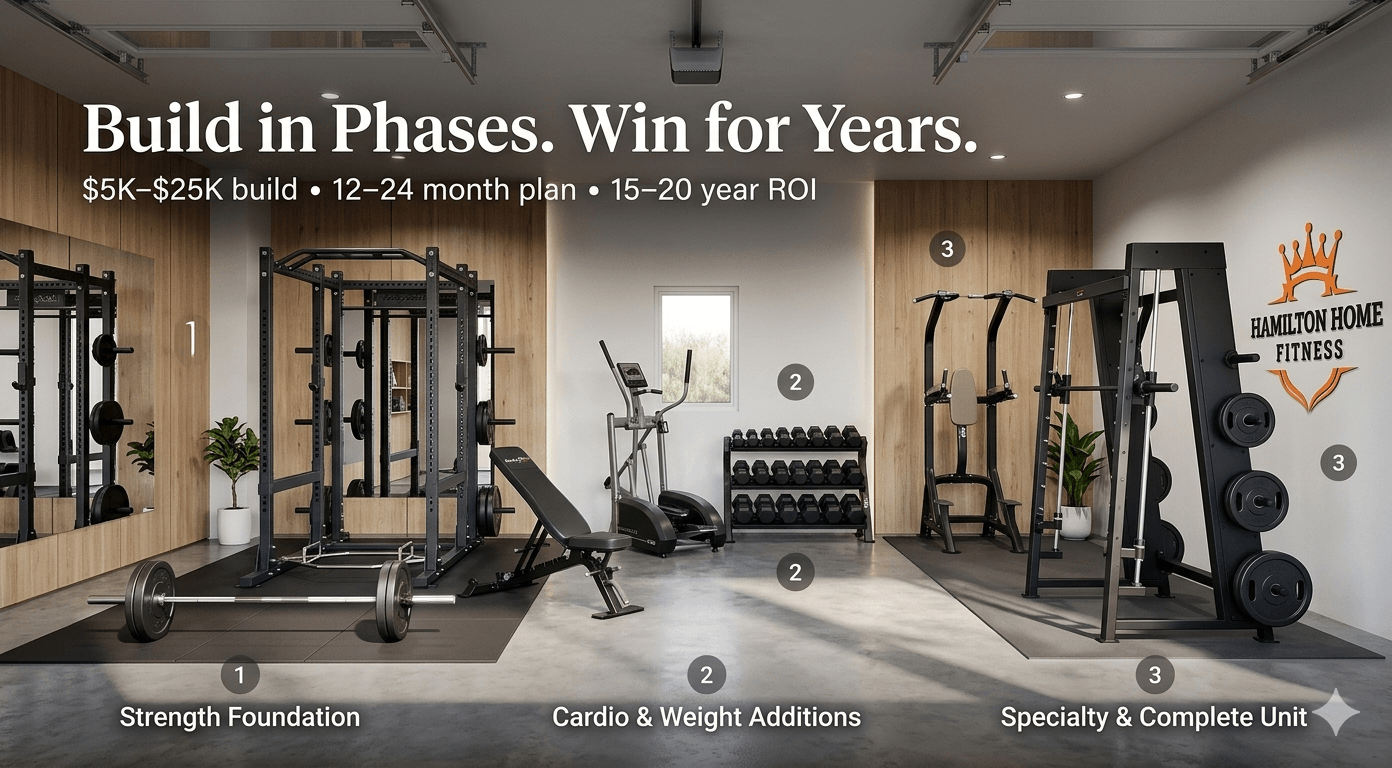
A commercial-grade home gym typically runs $5,000–$25,000 depending on the cardio scope, ships best in two or three phases over 12–24 months, and drops to roughly $300–$1,200 per year of ownership when amortized across a 15–20-year lifespan. The math gets defensible once the build is treated as a 15-year asset instead of a single-shot purchase.
Complete package vs piece-by-piece
A complete package saves 5–15 percent and ships faster; piece by piece lets the buyer pick the highest tier per category and protects the resale value of each unit.
Route | Speed | Cost | Upgrade Flexibility | Resale |
Complete package | One shipment, one install window | 5–15% bundle savings | Locked to the package mix | Sells as a set or splits cleanly by brand |
All-in-one functional trainer | One install, single footprint | Mid-range: consolidates several pieces | Locked to the unit's design | Resale tied to brand reputation |
Piece-by-piece | Spread across phases | Higher headline cost, better tier per item | Maximum—upgrade any piece independently | Each piece resells on its own market |
Three practical signals for the route choice. A complete package fits buyers who want a defined date the gym is finished and are willing to accept the bundle's tier mix. An all-in-one functional trainer fits tight footprints and multi-user households where two adults train simultaneously—the all-in-one home workout machines category covers this lane. "Piece by piece" fits the locked persona best: a 30–55-year-old lifter who wants the highest tier per category and is willing to wait for it.
Phasing a build over 12 to 24 months
A commercial-grade build phases cleanly across three stages: strength foundation first, cardio and dumbbells second, and a functional trainer or specialty add-on third. Phased builds spread the cost, give the room time to reveal what it actually needs next, and avoid the trap of buying gear that gathers dust.
Phase | What Ships | Approximate Band | Trigger to Move Forward |
1 — Strength foundation | Rack, bar, plates, adjustable bench, flooring, platform | $3,000–$7,000 | Training is consistent for 8+ weeks; the rack is the most-used piece in the room |
2 — Cardio and dumbbells | One commercial-grade cardio piece, rubber hex or adjustable dumbbells, or a dumbbell rack | $2,000–$6,000 | Conditioning sessions are being skipped because the cardio piece is missing |
3 — Functional or specialty add | Functional trainer, plate-loaded leg press or lat pulldown, storage system | $2,000–$10,000+ | A specific lift or movement has been on the wish list for 60+ days |
Two cheap habits make phasing work. First, write the phase trigger down before Phase 1 ships—"I will buy cardio when I have skipped conditioning twice because the equipment is not in the room." "Second, treat each phase budget as a ceiling, not a target—coming in under budget on Phase 1 means a heavier bar or a better bench, not an unrelated impulse buy.
Cost per year vs gym membership
A $10,000 commercial-grade build amortizes to roughly $500–$667 per year across 15–20 years—typically below the annual cost of a serious commercial membership and substantially below the cost of a boutique or specialty gym.
A working example. A $12,000 build at the commercial tier—full power rack, Olympic bar, 400 lb of plates, adjustable bench, commercial treadmill, adjustable dumbbells, functional trainer, flooring, and dehumidifier—amortizes to $600–$800 per year across a 15–20-year lifespan, before resale value at the end of the window. The same lifter on a $90/month full-service membership spends $1,080 per year, every year, indefinitely. Break-even on the build typically lands somewhere between year four and year seven, depending on the cardioscope.
What a home build does not replace. A garage or basement gym does not give you a pool, a sauna, group classes, the social environment of a CrossFit box, or basketball courts. If those amenities are part of the actual training week, the membership has real value the home build cannot match—and a hybrid setup (a commercial-grade home gym plus a smaller specialty membership for the pool or classes) is often the honest answer. For a strength, conditioning, and most cardio routine, the home build wins on cost per year, and the gap widens with every additional year past break-even.
FAQ
Is commercial gym equipment worth it for home use?
For lifters training four or more days a week who want a 15–20-year build, yes. The upfront cost is higher, but commercial-grade gear typically lands at a lower cost per year than replacing residential equipment twice in the same window—and the spec headroom means the gym feels solid every session, not just the first year.
How long does commercial home gym equipment last?
Commercial-grade strength equipment commonly lasts 15–20 years with basic maintenance, and commercial cardio commonly lasts 8–12 years under daily home use. Residential gear under the same load typically lasts 3–7 years. Maintenance, humidity control, and authorized-dealer parts availability are what protect the long end of those ranges.
Can a garage gym replace a commercial gym membership?
For strength, conditioning, and most cardio, a well-spec'd commercial-grade garage gym replaces the training side of a membership. It does not replace pool access, group classes, saunas, basketball courts, or the social environment of a box or studio. If those amenities are part of the weekly routine, a hybrid setup — home build plus a smaller specialty membership — is usually the honest answer.
What ceiling height do I really need?
Nine feet is the practical minimum for standing overhead pressing and pull-ups for an average-height adult; 10+ feet is needed for Olympic lifts overhead. Under 8 feet, the build still works with a wall-mount folding rack and seated overhead variations. Measure to the lowest point in the room—beams, ducts, and garage door tracks routinely cut several inches off the assumed height.
Do I need to bolt a commercial-grade rack into the concrete?
Most 11-gauge, 1,000+ lb rated full-power racks are stable without bolting because of their weight and footprint. Bolting is recommended for kipping pull-ups, muscle-ups, dynamic ring work, and any wall-mount or modular rig. If the build will ever include those movements, plan the anchor holes before the rack is set in place.
Final Thought
You now have the framework most commercial-grade buyers spend weeks assembling on their own: the three-tier definition, garage and basement space rules, a commercial-spec equipment list, a brand shortlist by role, and a phased budget sized to a 15–20-year horizon. That is enough to start scoping the build with confidence — and enough to stop second-guessing every product page you open.
If the layout, brand mix, or phasing still feels like a lot to coordinate alone, book a complimentary gym design consultation with Hamilton Home Fitness. We size the rack to your ceiling, match the cardio to your training, and quote a build across verified brands like Body-Solid, York Barbell, TAG Fitness, Spirit Fitness, and Concept 2—shipped nationwide from Tennessee through authorized US dealers. One conversation usually saves more than it costs.