
Introduction
You have two or three ellipticals open in tabs. Every spec sheet names the front, rear, or center drive, and none says what that changes in a spare room or basement.
So a front-drive vs. rear-drive elliptical choice often backfires: the machine feels wrong for the taller partner, eats the room, or squeaks a few months in.
The drive position is simply where the flywheel sits. It nudges posture and frame length. How a machine feels, fits, and ages depends on stride length, step-up height, and whether the pedals run on rails or go trackless.
The decision table at the end matches each layout to your room and household.
Where Does the Flywheel Sit on Each Type?
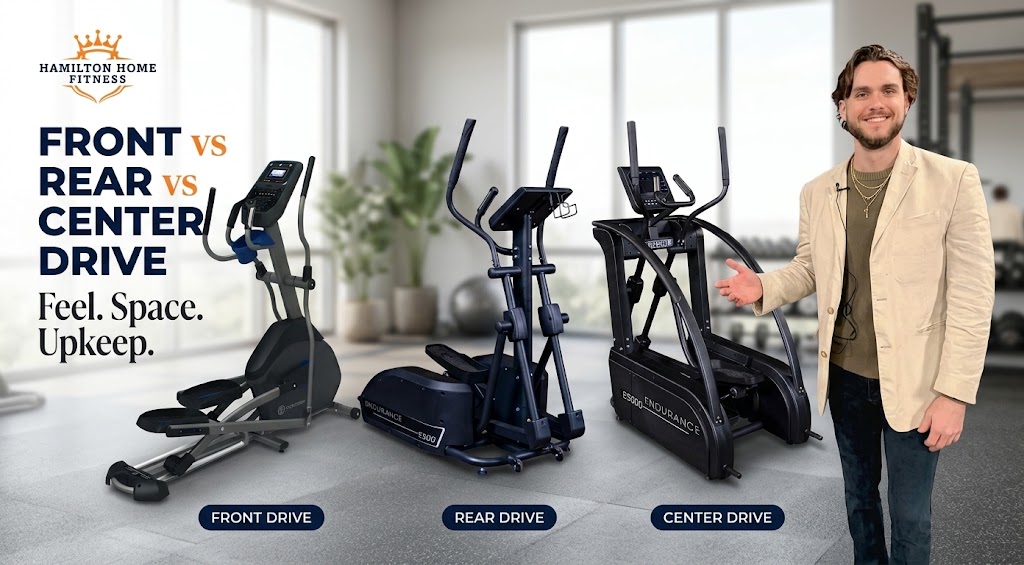
The difference between front- and rear-drive elliptical layouts is where the flywheel sits. That’s the weighted wheel that keeps each stride smooth. Front drive puts it ahead of you, rear drive behind your heels, and center drive beside or beneath your feet. The pedal arms turn its crank, so its position sets how the pedal path tilts.
[Image: side-view diagram of the three flywheel positions. Alt text: front, rear, and center drive elliptical flywheel positions compared
Front Drive: Flywheel Ahead of You
A front drive elliptical, or front wheel elliptical machine, keeps its flywheel under the console. Each pedal’s back end rolls on a rail or incline ramp, so power incline appears most often here.
The front-drive Horizon 7.0 AE adds 20 power incline levels and a 20-inch stride for $999.00 (October 27, 2026). It’s built for hill work, but it runs 76 inches long, doesn’t fold, and stops at 325 lb.
Rear Drive: Flywheel Behind Your Heels
A rear drive elliptical, or rear flywheel elliptical, houses its flywheel in a cover behind your heels. A short ramp or the handlebar linkage guides the front of each pedal.
If a listing doesn’t name the layout, and many don’t, check the side photo: a flywheel cover at floor level behind the pedals means rear drive.
Center Drive: Cranks Beside Your Feet
A center drive elliptical mounts its cranks beside or beneath your feet, so no flywheel housing stretches the frame front or back.
The Endurance E100 center drive measures 48 by 30 inches and costs $1,699.00 (October 27, 2026) with a 5-year in-home warranty. It suits a spare room where length is the limit. The listing caps users at 275 lb and gives no stride length, so tall users should ask first.
How Does Each Drive Type Feel to Use?
Front drive tends to tip you slightly forward into a climb-like path. Center drive keeps you most upright, and rear drive usually gives a flatter glide. Buying guides still argue over which feels flatter, because stride length, pedal spacing, and ramp angle shape the motion more than flywheel position does.
Upright Stance and Step-Up Height
Center drive machines usually keep you most upright and closest to the floor. The center-drive Endurance E300 lists an 8-inch step-up height, the first step from floor to pedal. The front-drive Horizon 7.0 AE lists 10.75 inches, and its power incline raises the pedals further.
That lower first step helps anyone who finds a high step awkward. It also saves basement headroom, since every inch of step-up lifts your head too. Before you order, work out the headroom your tallest user needs.
Fitting a Taller Partner
For a couple of different heights, stride length matters more than drive layout, and an adjustable stride settles it. The adjustable 18-to-24-inch stride on the Spirit CE850 changes electronically from the handlebar.
Partners of 5-foot-4 and 6-foot-2? Size the stride for the taller one first. If that feels longer than the shorter one, adjustable beats a compromise length. Our Ellipticals page lists starting strides by height.
It’s a front-drive machine at $3,999.99 (October 27, 2026), and it needs an outlet. It suits a big height gap, not a budget under about $2,000.
Which Drive Layout Needs the Least Floor?
Center drive is the reliably short layout, because no flywheel housing sticks out at either end. Front drive isn’t automatically compact: the Horizon 7.0 AE runs 76 inches long. Machines much shorter than 50 inches usually get there by cutting the stride.
Listed specs as of October 27, 2026:
Model | Drive layout | Length (in) | Stride (in) |
Endurance E100 | Center | 48 | Not listed |
Endurance E300 | Center | 50 | 21 |
York Aspire | Not listed | About 48 | 12 |
Best Fitness BFCT1R | Not listed | 45 | 13 |
Horizon 7.0 AE | Front | 76 | 20 |
Read length and stride together, and use the Endurance E300, a 21-inch stride in a 50-inch frame, as your benchmark. Under about 50 inches, check the stride before the price.
Rear drive frames tend to run long because the flywheel housing sits behind the pedals, so measure before you shortlist one.
Self-powered models make their own console power from your stride, so ellipticals that run without an outlet can sit anywhere the floor works.
Which Design Is Quietest and Lowest Upkeep?
Noise and upkeep follow how the pedals move, not where the flywheel sits. That squeak a few months after delivery usually starts where moving parts rub. Rail machines have more rubbing surfaces than trackless suspension designs. Magnetic resistance runs quietly on all three layouts.
Rail-and-Roller Machines
If the pedals ride on rollers along rails, those rails need regular cleaning: grit on the track often causes squeaks and uneven roller wear. Your manual sets the timing for basic elliptical maintenance:
Wipe the rails and rollers clean
Find where the noise starts: front, rear, or pedal
Tighten the frame bolts
Level the feet on a firm mat
Grease only where the manual says
The dual-rail Spirit XE795 pairs sealed roller bearings with self-generating power for $2,699.99 (October 27, 2026). It fits a buyer happy to wipe a rail, not one who wants zero upkeep.
Trackless Suspension Machines
A trackless suspension elliptical hangs the pedals from linkage arms with bearings at the joints, so there’s no rail to clean and fewer surfaces rub together.
The trackless Spirit CES880 adds a 22-inch stride and a 400 lb limit for $5,399.99 (October 27, 2026). It suits heavier users and shared homes, not a first budget under about $2,000.
Matrix’s E30 and E50 also use suspension designs, listed from $3,599.00 to $6,299.00 depending on console (October 27, 2026). Both sell by invoice, not online checkout; here’s how Matrix private-invoice orders work.
Which Drive Type Should You Choose?
In the front drive vs. rear drive elliptical debate, neither wins overall. Choose center drive when room length is tight and you want an upright stance. Choose front drive for incline at a home price, and rear drive when you have the length and prefer a flatter glide.
Front drive | Rear drive | Center drive | |
Stride feel | Climb-like, slight lean | Flatter glide | Most upright |
Length | 76 in (Horizon 7.0 AE) | Often long | 48–50 in (Endurance) |
Step-up | 10.75 in (Horizon 7.0 AE) | Varies by model | 8 in (Endurance E300) |
Upkeep check | Rails or trackless? | Rails or trackless? | Rails or trackless? |
Best room and household | Incline on a budget | Long rooms, flat-glide fans | Short rooms, shared homes |
Think twice if | Upright matters most. | Room length is tight. | The budget is tight. |
Then check each listing in order:
Compare length with stride
Check the step-up height
Look for rails or trackless
The best front, rear, or center drive elliptical is whichever fits your room and both users, not the one with the right label.
Ascent and HIIT trainers, like the Matrix A30 and A50, Spirit XS895 and BowFlex Max Trainer M9, move differently and sit outside this comparison.
Compare ellipticals by price and brand, then confirm the drive layout on each listing before you order. If it isn’t named, check the side photo or ask us.
FAQ
Which elliptical is most like running?
One with a long stride, about 20 inches or more for taller users, on a fairly flat path. Drive layout matters less. No elliptical copies running’s impact, which is the point.
How long do ellipticals last?
No fixed number: build, use, and upkeep decide it. Gyms often plan on roughly 7 to 10 years for commercial machines. Warranties show parts wear first: the Horizon 7.0 AE covers its frame for life, parts for 3 years.
Why do many gym-grade ellipticals use a rear or center drive layout?
Some do, but layout doesn’t make a machine gym grade; frame, flywheel, and daily-use rating do. Our commercial Spirit range includes a front-drive CE850 with a 30 lb flywheel and a trackless CES880. See commercial-grade ellipticals and what sets them apart.
Is a center-drive elliptical better than a rear drive?
For a short room or an upright stance, usually yes; for a flat, long glide with length to spare, rear drive may suit better. A center drive also tends to cost more than an entry front drive.
Final Thought
The drive label only says where the flywheel sits. Length read against stride, step-up height, and rails versus trackless to decide the fit for your room and household.
Before you order, ask us to confirm a model’s drive layout whenever a listing leaves it out. For a Matrix or Horizon sold by private invoice, call 423-458-2453 for a quote.