
- PACIFIC FIBRE
Authorized:











Battle Ropes
Battle Ropes for Home Conditioning
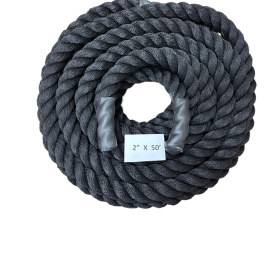
A battle rope is a thick, heavy rope that you loop around a fixed anchor and whip into waves, slams and circles. These battle ropes suit home gyms and garages. Pick length by the open lane you have, and thickness by how long you can hold the grip.
| Quick fact | Details |
|---|---|
| Also called | Fitness, workout, exercise and training ropes |
| Brands we carry | TAG Fitness, York, Body-Solid, Pacific Fibre |
| Thickness | 1.5 and 2 inch |
| Lengths | 20, 30, 40 and 50 ft |
| Rope materials | Poly Dacron blends and poly-twine |
| Free shipping | TAG Fitness and Body-Solid ropes |
How Long Should a Battle Rope Be?
What size battle rope should I get? Match length to your open lane. The rope loops around the anchor, so half its length reaches toward you. A common rule of thumb is half the length plus about 5 ft of standing room.
| Rope length | Lane to plan | Listed from |
|---|---|---|
| 20 ft | About 15 ft | TAG Fitness |
| 30 ft | About 20 ft | TAG Fitness, Body-Solid, Pacific Fibre |
| 40 ft | About 25 ft | TAG Fitness, Body-Solid, Pacific Fibre |
| 50 ft | About 30 ft | TAG Fitness, Body-Solid, Pacific Fibre |
Choose the longest rope your lane allows: longer ropes give slower, rolling waves, and shorter ones are easier to store. The York Battle Rope listing gives a Poly Dacron, three-strand build but no length or thickness, so confirm its size with us before you order.
1.5 Inch or 2 Inch: Which Rope Fits Your Grip?
Thickness sets how hard the rope is to hold. A 1.5-inch rope is lighter and easier on the hands, while a 2-inch rope is heavier and harder to grip. Choose 1.5 inch if your hands tire before your shoulders, and 2 inch once 1.5 feels light.
| Compare | TAG Fitness Battle Rope | Body-Solid BSTBR Fitness Ropes | Pacific Fibre Battle Ropes |
|---|---|---|---|
| Build | PolyDacron blend, UV resistant | Poly-twine, black finish | Dense lay, flattening-resistant core |
| Ends | Heat shrink boots | Wrapped ends | Heat-sealed ends |
| Sizes | 1.5 and 2 inch, 20 to 50 ft | 1.5 inch, 30 to 50 ft; 2 inch, 30 and 40 ft | 1.5 and 2 inch, 30 to 50 ft |
| Also listed | 1,500 lb average breaking strength | Black hides dirt | Custom lengths and colors offered |
The TAG Fitness Battle Rope has the widest range, with eight length and thickness options. The Body-Solid fitness ropes start at 30 ft.
What Should You Check Before You Buy?
Five checks cover the decision:
- ✅ A length that fits your open lane
- ✅ A thickness you can grip for a full round
- ✅ Ends that resist fraying
- ✅ A UV-resistant blend if you train outside
- ✅ A solid anchor point before the rope arrives
A bolted-down power rack upright is a common home anchor, because it is fixed and rigid.
Under the working zone, rubber flooring protects both the rope and the floor.
Never loop a battle rope around anything loose, wobbly or unrated, because a rope whipped hard against a weak anchor can pull it free.
What Pairs Well With Battle Ropes?
Ropes work as finishers after lifting or between other conditioning stations. A plyo box adds jumps to the same circuit.
Workout sleds add loaded pushes on days you want legs and no grip.
Battle Rope Questions
Are battle ropes worth it?
Yes, if you have a clear lane and a solid anchor, because those two decide whether you will use it. A rope adds conditioning and grip work to lifting rather than replacing it. Our functional training guide shows how much space each tool needs.
Are battle ropes good cardio?
Yes, as short interval rounds: waves and slams raise your heart rate fast, and pace sets the difficulty. Start with short rounds and full rests. With a heart, shoulder or wrist condition, check with a clinician first.
Can battle ropes be left outside?
Use them outside, but do not leave them out: Body-Solid lists indoor and outdoor use, TAG describes its blend as UV resistant, and Pacific Fibre offers indoor and outdoor sheathing. Still, coil a rope and store it dry between sessions; that is care advice, not a manufacturer rule.
Where can I buy battle ropes?
Here. We ship from Tennessee to all 50 states, and working, undamaged equipment can be returned within 30 days of purchase in its original packaging (a restocking fee and return shipping apply).
Get Help Choosing a Rope
Equipping a studio or team room? See our ropes for gyms and teams.
For help matching a rope to your lane and anchor, call or text 423-458-2453, or browse Hamilton Home Fitness.
Secure Payments