










Functional Trainers


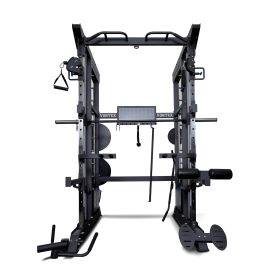
Commercial Functional Trainers Built to Last
A commercial functional trainer is the most versatile strength machine you can put on a gym floor—one footprint, hundreds of cable-driven exercises, and the daily durability your members, athletes, or clients demand. The collection at Hamilton Home Fitness brings together pro-grade dual-cable systems from trusted American and global manufacturers, configured for high-traffic gyms, training studios, athletic programs, corporate wellness rooms, and serious home setups across all 50 states.
If you want one machine that replaces a wall of single-purpose stations and still feels smooth on rep ten thousand, you are in the right category.
Why a Commercial Functional Trainer Wins
It delivers more training value per square foot than almost any other piece of strength equipment. Where a chest press, low row, lat pulldown, and cable crossover would normally eat 200+ square feet, one commercial functional trainer covers all of it with room left over.
The dual adjustable pulleys let users push, pull, rotate, lunge, press, and stabilize through real-world movement patterns — the same patterns that build athletic strength, support rehab progressions, and protect long-term joint health. What is a commercial functional trainer? It is a freestanding cable machine with two independently adjustable pulley columns, a selectorized or plate-loaded weight stack on each side, and accessory compatibility for handles, ropes, bars, and ankle straps.
Members get unlimited exercise variety. Owners get one durable asset they are not replacing in three years.
What Makes a Trainer Truly Commercial
A residential cable machine is built for one person and a handful of sets a week. A true commercial functional trainer is built for back-to-back use under heavier loads, often twelve hours a day. The difference shows up in the frame steel, the pulley bearings, the cable rating, and the warranty behind it.
Look for these markers on every spec sheet:
- 11-gauge steel uprights, typically 3" x 3", with bolt-through construction
- Aircraft-grade or equivalent steel cables rated well above stack capacity
- Sealed ball-bearing aluminum pulleys instead of plastic bushings
- Chrome-plated guide rods that resist pitting, rust, and carriage stutter
- Selectorized weight stacks in 5–10 lb increments with safety shrouds
- Universal carabiner attachment points for any commercial accessory
- Warranties that explicitly cover frame, parts, and cables under commercial use
These are the components that separate equipment built to outlast your lease from gear that wears out by year two.
How to Choose the Right Trainer
Match the machine to your space, your traffic, and the way your members actually train. Three decisions drive most of the buying choice.
Pulley Ratio: 1:1 vs 2:1
The cable ratio decides how the weight feels and how far the cable travels. On a 1:1 system, 100 lb on the stack feels close to 100 lb at the handle—direct, heavy, and ideal for rows, presses, and pulldown-style movement. On a 2:1 system, that same 100 lb feels closer to 50 lb at the handle, but the cable travels twice as far—smoother, faster, and better for cable flies, rotational core work, sprint starts, and rehab-style progressions.
What is the difference between a 1:1 and a 2:1 cable ratio? A 1:1 ratio gives full felt resistance with shorter cable travel; a 2:1 ratio halves the felt resistance but doubles cable length and smoothness. Some premium commercial units offer both ratios on one frame — the best of both worlds for mixed-use facilities.
Single Stack or Dual Stack
A dual-stack functional trainer lets two users train at the same time and supports true bilateral cable work with independent loading on each arm. Single-stack units are more compact and budget-friendly, but they limit partner training and certain split-load exercises.
Do I need a single or dual weight stack? For any commercial floor, hotel gym, training studio, athletic facility, or busy household with multiple lifters, choose dual. For a tight single-user space, a single stack still delivers serious value.
Weight Capacity and Footprint
Stack sizes range from dual 150 lb at the entry level to dual 220 lb and beyond for elite facilities. How much weight does a commercial functional trainer have? Most commercial-grade units carry 150 to 220 lb per stack, with some adding optional upgrades. Pair that number with the cable ratio—a 220 lb stack at 2:1 delivers 110 lb of felt resistance—to confirm the machine will actually challenge your strongest users.
Footprints typically run 4–6 feet wide and 4–8 feet deep, and most need 8–9 feet of ceiling clearance. Always measure twice before you buy.
Key Selection Criteria
✅ 11-gauge commercial steel frame
✅ Dual independently adjustable pulley columns
✅ Sealed ball-bearing aluminum pulleys
✅ Aircraft-grade steel cables, rated for daily use
✅ Selectorized stacks in 5–10 lb increments
✅ 20+ pulley height positions per column
✅ Chrome-plated guide rods for smooth glide
✅ Integrated multi-grip pull-up bar
✅ Universal accessory carabiner points
✅ Protective weight stack shrouds
✅ Commercial-rated frame and parts warranty
✅ Compact footprint under 30 sq ft where possible
Built for Every Training Space
Whatever the room looks like, there is a configuration that fits. Functional trainers are uniquely flexible—vertical footprint, freestanding base, and no anchored attachments needed.
- Commercial gyms and health clubs — dual 220 lb stacks, dual ratios, full accessory packages
- Hotel and corporate wellness rooms — quieter machines with safety shrouds and clean lines
- Personal training studios — dual cables for partner sessions and small-group work
- Athletic and sports performance facilities — 2:1 ratios for speed and rotational work
- Rehab and physical therapy clinics — smooth cables, small weight jumps, low-impact loading
- Garage and luxury home gyms — compact pro-grade units that replace a full station lineup
How much space does a functional trainer need? Plan for roughly a 7 x 7 foot training zone around the machine so users can lunge, walk out, and run cable lines through a full range of motion. A ceiling of 8 feet works for most units; verify the spec sheet before installing in a finished basement. If your build needs a larger cable footprint with pull-up stations, monkey bars, and attachment points, our commercial functional fitness rigs and heavy-duty commercial power racks and cages pair perfectly alongside.
Trusted Brands on Our Floor
Hamilton Home Fitness curates only manufacturers that build for real commercial duty—no white-labeled imports, no fake commercial badges. The lineup includes selectorized cable systems and all-in-one functional trainer rigs from names recognized across the industry, from heavy-duty US-built strength brands like Body Solid and Hoist to our own HHF Commercial Fitness line built to the same commercial standard. Every machine in this category has been selected for build quality, parts availability, warranty integrity, and long-term resale value. Browse the wider commercial gym equipment catalog for complementary strength and cardio pieces.
Is a functional trainer worth it? For any serious facility, yes—one commercial unit replaces a chest press, low row, lat pulldown, cable crossover, and triceps station and outlives most of them.
Setup, Service, and Shipping
Every order ships from authorized US distribution with freight handling appropriate for commercial weight. Tennessee-based service means real humans answer the phone, real specs get verified before checkout, and real installation guidance is available before your machine arrives. For larger facility builds, the team can design your full-strength floor around the trainer footprint and traffic flow—a service most online sellers do not offer at all.
Ready to Outfit Your Gym?
Choose the commercial functional trainer that matches your stack capacity, ratio preference, and floor plan — and place your order today. Your members, your clients, or your own training will feel the difference on the first rep. For configuration help, brand comparison, or a full facility consultation, contact the Hamilton Home Fitness team directly. Shop the collection now and lock in pricing on the equipment built to carry your gym for the next decade.
Secure Payments