Introduction
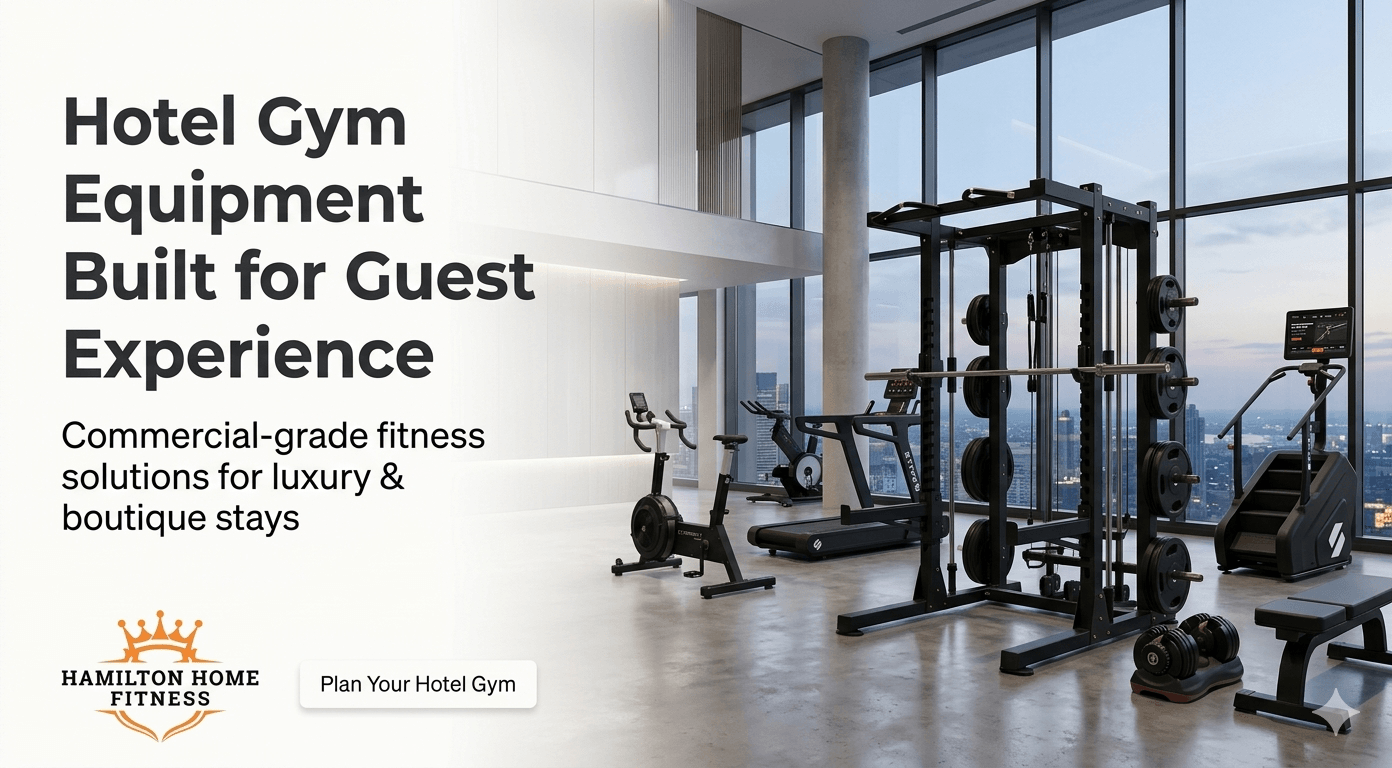
The best hotel gym equipment is hospitality grade—built for continuous-duty use, sized for limited footprints, easy to maintain, and intuitive enough for unsupervised guests at any hour.
If you're a hotel GM, asset manager, developer, or franchisee opening, renovating, or upgrading a fitness amenity, you're balancing brand standards, a 300 to 2,000 sq ft footprint, guest review pressure, and an ADR that depends on getting wellness right.
This guide walks through equipment categories, sizing tiers, property-type guidance, brand-standard considerations, the business case, and how to evaluate a supplier—so you can move from comparison to a confident quote.
Hamilton Home Fitness supplies commercial-grade hotel fitness equipment and offers a hotel gym design consultation for properties across the USA, shipping nationwide from Tennessee.
Why Hotel Gym Equipment Must Be Commercial
Hotel gym equipment must be commercial-grade because hospitality use far exceeds the duty cycle, frame load, and warranty terms residential machines are built for. A home treadmill is engineered for one user a few hours a week in a controlled environment. A hotel treadmill needs to handle dozens of unsupervised guests, run for hours a day, and stay safe and operable across the full PIP cycle.
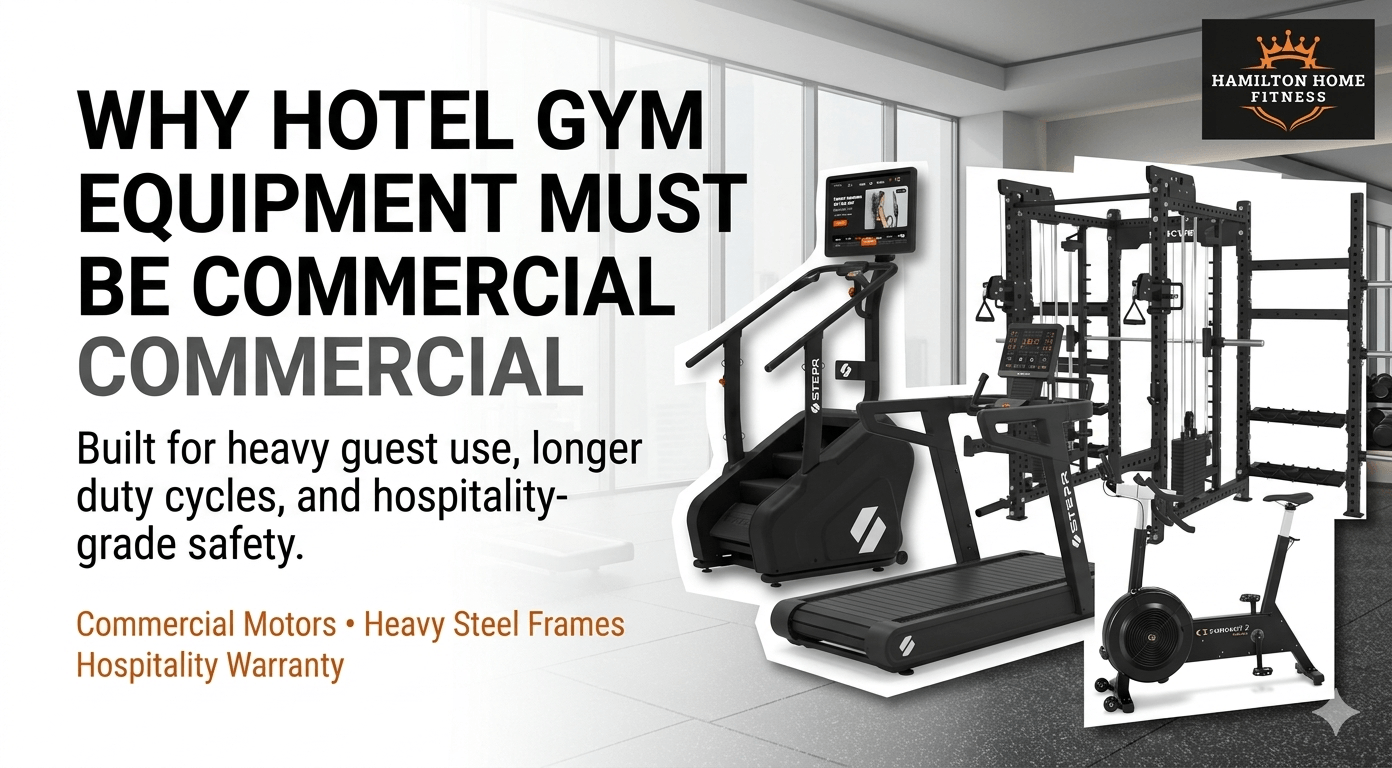
The cost of getting this wrong is real. Out-of-order machines drag down review scores, generate complaints to the front desk, and quietly cost you bookings. The two specs that decide whether a machine can survive a hotel—motor rating and frame construction—are also where most buyers get misled by a polished price tag.
Continuous-Duty Motors vs Residential Rated
Continuous-duty motors are designed to run for hours at full load, while residential motors are rated only for short bursts.
That single distinction is the most important line on a hotel cardiot quote. Residential treadmills are often marketed with a "peak HP" number—a figure that describes what the motor can output for a moment, not what it can sustain. Commercial hotel treadmills are rated in continuous horsepower (CHP), commonly 3.0 CHP and up, with 4.0 CHP common on heavier units, meaning the motor is built to deliver that output hour after hour without overheating.
Drop a residential treadmill into a 100-room hotel, and the math turns ugly quickly. Even at modest usage, the motor sees more runtime in a few weeks than it would in years of home use. The deck wears, the belt slips, and the warranty almost always excludes commercial settings—meaning the repair is on you. A single failed machine can sit "Out of Order" for weeks while parts ship, and that sign is the first thing a guest photographs.
When comparing quotes, look past the headline horsepower and check three things: the rating type (continuous duty, not peak); warranty language that specifically permits hospitality use; and electrical certifications, such as UL, on the drive assembly. If a salesperson can't answer those three cleanly, you're looking at the wrong category of machine. Browse commercial cardio equipment for hotels to see what hospitality-rated specs actually look like side by side.
Frame Steel, Warranty, and Liability
Commercial frames use heavier-gauge steel and carry warranties written for hospitality use; residential gear typically does not.
Strength equipment follows the same logic as cardio. A hotel multi-gym, rack, or bench needs to handle a wide range of body sizes, novice users who don't always load weights correctly, and round-the-clock access—for the full life of the PIP cycle. That durability starts at the frame. Commercial frames commonly use 11- or 12-gauge steel (lower gauge means thicker steel), heavier welds, and bolted joints rather than stamped ones. Residential frames cut weight and cost in the same places that fail first under hotel traffic.
The warranty turns this into a liability question, not just a maintenance one. Most residential warranties contain a clause excluding commercial, hospitality, or multi-user environments. If a guest is injured on equipment that explicitly was not warranted for hotel use, your insurer and your brand's risk team will both ask why it was installed. The decision rule is simple: if the warranty document does not permit hospitality use in writing, the equipment does not belong in your gym — regardless of how the showroom photo looks.
That is why the brand list matters. Hospitality-rated manufacturers — including STEPR, Spirit Fitness, Tag Fitness, Body-Solid, BodyKore, Hoist, and Concept 2 — publish commercial warranty terms because their products are engineered for that load. Hamilton Home Fitness carries these lines under one roof, and you can sort the full commercial-grade fitness equipment catalog by category as you build a shortlist.
Core Equipment Categories for Hotel Gyms
A complete hotel gym covers four categories: cardio, strength, free weights, and recovery—sized and selected for unsupervised guest use. Get this mix right, and you cover what most arriving guests actually want, regardless of fitness level.
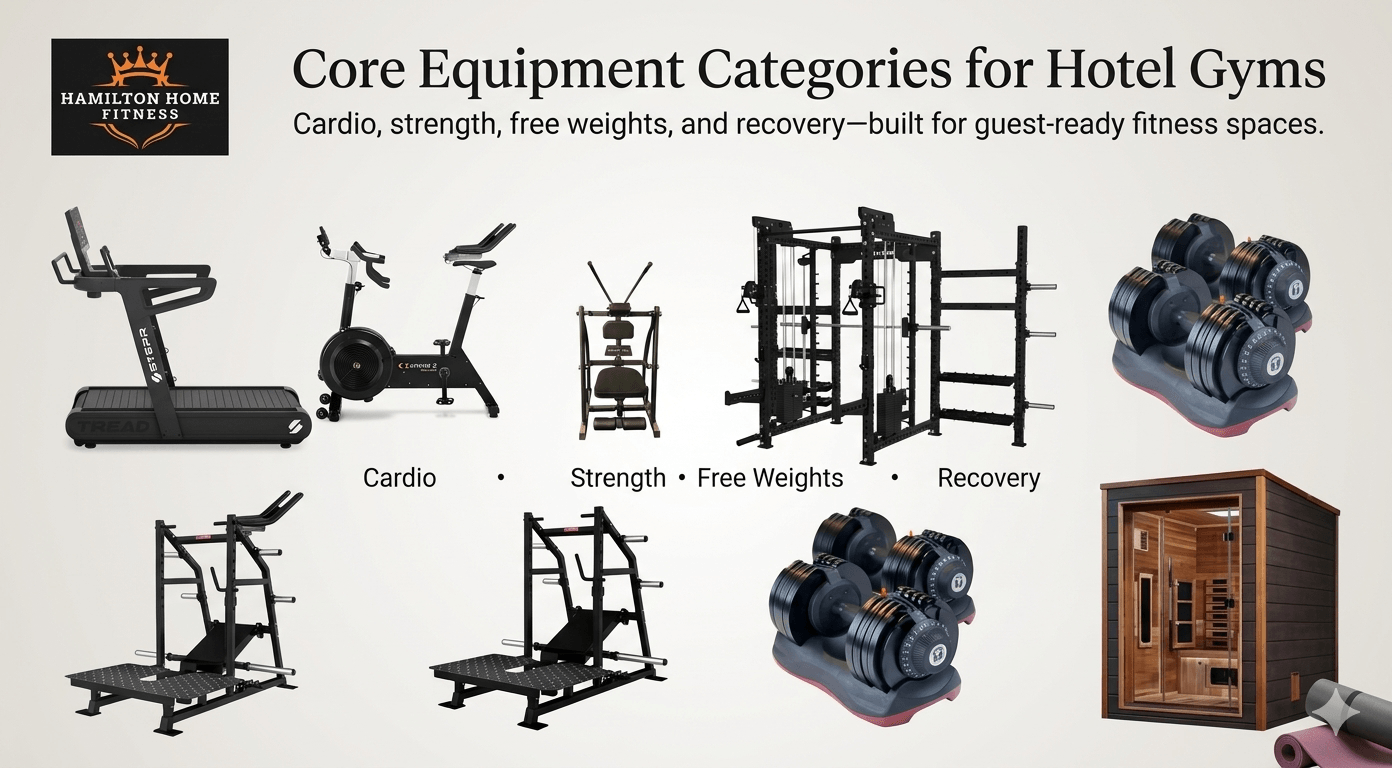
The four categories scale up and down with footprint. A 300 sq ft boutique gym picks one item from each; a 2,000 sq ft resort fitness center deepens every category. The sizing section that follows shows how to combine them by square foot.
Cardio: Treadmill, Bike, Elliptical, Rower
The cardio core is one or two treadmills, an upright or recumbent bike, an elliptical, and a rower.
Cardio is the equipment guests use first and photograph most often, and it generates the most maintenance calls. Every piece needs a commercial duty cycle rating, quiet operation, and an enclosed drive system that holds up under round-the-clock use. Bluetooth and app-connected consoles are now an expectation for most travelers, not a luxury.
A practical cardio mix by property size:
Compact (300 sq ft): 1 treadmill + 1 upright or recumbent bike
Standard (500 sq ft): 2 treadmills + 1 bike + 1 elliptical
Mid-size (1,000 sq ft): 2 treadmills + 1 bike + 1 elliptical + 1 indoor rower
Resort (2,000 sq ft): 3–4 treadmills + 2 bikes + 2 ellipticals + 1 rower + 1 stair climber
Indoor rowers and stair climbers are the two pieces that distinguish a serious hotel gym from a basic one. Concept 2 indoor rowers are widely used in hospitality because they run quietly, take heavy daily use, and need almost no maintenance. STEPR stair climbers work as a signature piece in luxury and resort properties where guests expect club-style options.
Strength: Multi-Gym and Functional Trainer
Most hotel gyms get more value from a single functional trainer or compact multi-gym than from several single-station machines.
Selectorized strength comes in three formats, and the right one depends on footprint and how many guests need to use it at once.
Multi-gym (selectorized): Smallest footprint with the widest exercise range; usually 1 to 4 weight stacks. Best for compact and standard hotel gyms, and easy to use without instruction.
Cable column (dual-adjustable pulley): Mid-footprint, mid-versatility, and especially good for stretching and rehab-style movement. Pairs well with a multi-gym in larger spaces.
Functional trainer: Mid-to-large footprint with near-unlimited exercise variety through handles, ropes, and bars. The best single-piece strength solution for a modern hotel gym.
Selectorized machines are safer than open free-weight racks in unsupervised settings because guests cannot drop loaded plates on themselves. Failure points are usually cables and pins — both quick swaps for a service technician. Browse commercial strength training machines for selectorized options, or look at functional fitness rigs for higher-capacity setups. Body-Solid and BodyKore both produce hospitality-rated lines that hold up across PIP cycles.
Free Weights, Dumbbells, and Kettlebells
For most hotels, a 5–50 lb rubber-hex dumbbell set or a single pair of adjustable dumbbells plus a small kettlebell range is enough.
Free weights are simple, but they're where unsupervised hotels have to make safety-conscious choices. Rubber-hex dumbbells are quieter on the floor, less damaging when dropped, and easier on the surrounding equipment. Adjustable dumbbells save serious floor space in compact gyms — a single pair replaces six to fifteen fixed pairs.
Typical free-weight ranges by property size:
Compact (300 sq ft): 1 pair of NÜOBELL adjustable dumbbells + 1 adjustable bench
Standard (500 sq ft): 5–50 lb hospitality dumbbell set in 5 lb increments + 1 commercial weight bench + small kettlebell set
Mid-size (1,000 sq ft): 5–75 lb dumbbell set + 2 benches (flat and adjustable) + full kettlebell range
Resort (2,000 sq ft): 5–100 lb dumbbell set + 3 benches + kettlebells + medicine balls
Avoid Olympic barbells and bumper plates in unsupervised hotel gyms unless you have signage, video, and clean sightlines. Outside a personal-training context, they create more risk than they justify.
Stretching, Yoga, and Recovery Tools
A stretching corner with yoga mats, foam rollers, and a stretching station costs little and often shows up in positive guest reviews.
Recovery is among the highest-ROI additions in a hotel gym. The essentials cost almost nothing, and they signal wellness to the exact guest segment that drives strong reviews on TripAdvisor, Booking.com, and Google. Travelers stretching after a flight, foam-rolling before a meeting, or doing a quick yoga session in the corner—those are the moments that show up in five-star feedback.
The essentials are short:
4–6 hotel yoga mats
2–4 foam rollers (smooth and textured)
A wall-mounted or freestanding stretching station
Basic resistance bands
A clear floor zone with sightlines away from the cardio bank
Upgrades for resort and luxury properties move into spa-adjacent territory: a commercial sauna for traditional or infrared recovery, cold plunge and recovery equipment for the wellness-traveler segment, and a small Pilates or yoga studio when footprint allows. These can lift the ADR signal in a market where guests increasingly search for recovery alongside the room itself.
Hotel Gym Sizing: 300 to 2,000 Sq Ft
A typical hotel fitness center needs roughly 50 sq ft per machine, with most properties landing between 500 and 1,000 sq ft. As a planning rule, the hospitality industry generally suggests allocating around 350 sq ft per 200 rooms and then adjusting up for brand standard, guest profile, and competitive set.
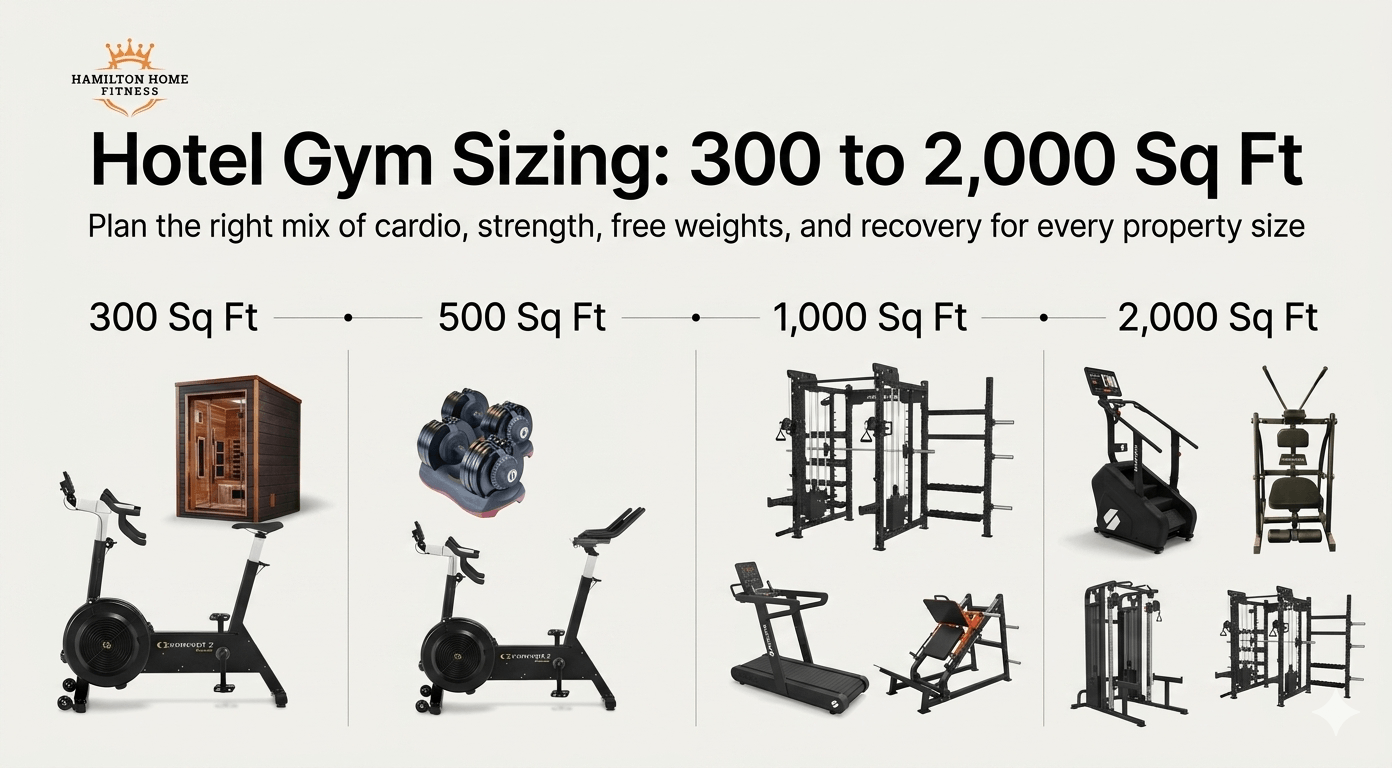
The four tiers below cover the realistic range. The same footprint can work for different property types depending on guest mix — a 1,000 sq ft floor in an urban business hotel does different work than the same footprint in a leisure resort.
Tier | Sq Ft | Typical Property | Cardio | Strength | Free Weights | Recovery |
Compact | 300 | Boutique, condo-hotel, large vacation rental | 2 pieces | 1 multi-gym or functional trainer | Adjustable dumbbells + bench | Mats + rollers |
Standard | 500 | Business, select-service, mid-scale | 4 pieces | 1 functional trainer | 5–50 lb dumbbell set + bench | Stretching corner |
Mid-size | 1,000 | Upscale, urban, all-suite | 5–6 pieces | 1–2 strength stations | 5–75 lb set + 2 benches | Dedicated stretching zone |
Resort | 2,000 | Resort, casino, luxury | 8–10 pieces | Full strength zone | 5–100 lb set + 3 benches | Recovery room or studio |
Compact Hotel Gym: 300 sq ft
At 300 sq ft, prioritize one treadmill, one bike, a functional trainer or compact multi-gym, and a dumbbell set.
This is the working footprint for boutique hotels, condo-hotels, all-suite properties, and large vacation rentals where space is at a premium and every square foot has to earn its keep. The mix has to be tight and intentional.
A workable 300 sq ft package:
1 commercial treadmill
1 upright or recumbent bike
1 compact functional trainer or single-stack multi-gym
1 pair of adjustable dumbbells (replaces a full rack)
1 adjustable bench
4 yoga mats, 2 foam rollers, and a small mirror panel
The trade-off at this size is depth. Guests get a full workout, but only one person at a time can use the strength station, and there's no room for a stretching zone separate from the cardio bank. That's why intuitive, multi-use pieces win here — a functional trainer replaces five single-station machines, and a single pair of adjustable dumbbells replaces a full fixed-weight rack.
Standard Hotel Gym: 500 sq ft
A 500 sq ft hotel gym typically fits 2 treadmills, 1 bike, 1 elliptical, a functional trainer, a fixed dumbbell set, and a bench.
This is the most common tier across business hotels, select-service properties, and mid-scale brands. It's also the footprint most PIP cycles target because it satisfies brand-standard expectations without consuming meeting room space.
A workable 500 sq ft package:
2 commercial treadmills
1 upright or recumbent bike
1 elliptical
1 functional trainer
5–50 lb rubber-hex dumbbell set in 5 lb increments
1 adjustable bench
A small stretching corner with mats, foam rollers, and a stretching station
The bottleneck at 500 sq ft is peak-hour capacity. During the 6–9 a.m. business window, a single treadmill creates a queue, which is why two is the baseline at this size. If your comp set runs two cardio machines, three becomes a quiet differentiator without adding much footprint.
Mid-Size Fitness Center: 1,000 sq ft
At 1,000 sq ft, you can add a stair climber or indoor rower, more strength stations, and a dedicated stretching zone.
This is the sweet spot for upscale hotels, urban full-service properties, and all-suite formats catering to longer stays. The footprint stops feeling like a converted meeting room and starts feeling like a real fitness center, which is when ADR and review-score effects begin to compound.
A workable 1,000 sq ft package:
2 commercial treadmills
1 upright or recumbent bike
1 elliptical
1 indoor rower
1 stair climber (optional but high-impact)
1 functional trainer
1 selectorized multi-gym or cable column
5–75 lb dumbbell set with flat and adjustable benches
Small kettlebell range
A dedicated stretching and yoga zone separated from cardio
At this size, layout matters as much as equipment. Group cardio along one wall to centralize ventilation and AV, place strength against the opposite wall with mirrors behind, and keep the stretching zone in a quiet corner away from machine noise. Sightlines should be open in every direction so unattended guests can see and be seen.
Resort Fitness Center: 2,000 sq ft
At 2,000 sq ft, a resort fitness center can deliver a near-club experience with cardio, strength, free weights, recovery, and a studio or recovery zone.
This is the destination-grade tier—resorts, casino hotels, luxury urban flagships, and properties competing on wellness as part of the booking decision. The goal shifts from "satisfy guest expectations" to "differentiate the property in a wellness-conscious market."
A workable 2,000 sq ft package:
3–4 commercial treadmills
2 bikes (mix of upright and recumbent)
2 ellipticals
1 indoor rower
1 stair climber
1 functional trainer plus 1 cable column
2–3 selectorized strength stations or a functional rig
5–100 lb dumbbell set with 3 benches (flat, adjustable, incline)
Full kettlebell range, medicine balls, plyo box, suspension trainer
A dedicated recovery zone or a small studio for pilates equipment for hotels, yoga, or stretching
Optional sauna, infrared cabin, or cold plunge for the wellness-traveler segment
At this size, the floor plan should be zoned: a cardio bank, a strength zone, a free-weight area, a functional/stretching area, and a separate recovery or studio room. Zoning protects the experience—strength users aren't interrupted by cardio noise, and recovery feels intentional rather than tacked on. This is also the tier where smart equipment integration—Bluetooth, app sync, and in-console entertainment—starts to influence brand perception and the photos guests post to OTAs.
Equipment by Property Type and Brand
The right equipment depends on the guest profile and brand requirements—luxury, boutique, and resort properties each need a different mix. Footprint sets what is possible; property type and brand standard set what is expected.
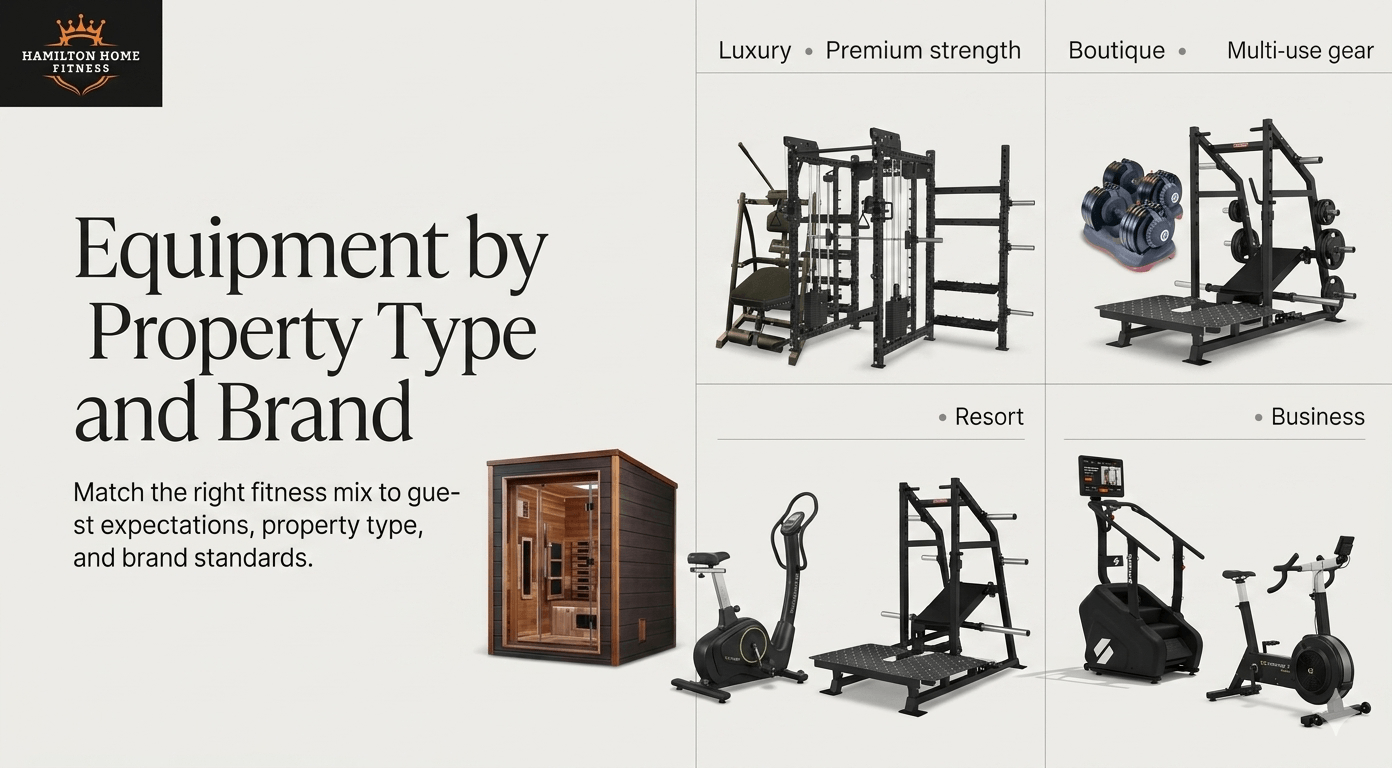
Two properties with identical 1,000 sq ft floors can land in very different places. A luxury urban flagship needs a signature finish and integrated entertainment; an airport hotel of the same size needs the cardio bank emphasized and the strength zone simplified. The sections below show what changes by property type and how to think about brand-standard requirements without specifying outdated ones.
Luxury Hotels and 5-Star Properties
Luxury hotel gyms emphasize premium finishes, integrated entertainment, and signature pieces like a stair climber or top-tier rower.
A 5-star guest is rarely a casual user. The typical workout is intentional—for a business traveler before a meeting, a wellness-focused leisure guest after a spa, or an athlete maintaining a routine on the road. They have worked out at Equinox, Soho House, and private clubs at home, and that is the bar your equipment is measured against.
What separates a luxury hotel gym from a standard one?
Cardio with integrated screens, native Bluetooth, and app sync to wearables
A signature piece guests notice — typically a stair climber, a high-end indoor rower, or a recovery-focused machine
Premium finishes: brushed metal, leather upholstery, or matte-black frames rather than basic black plastic
Clean visual design with mirrors, lighting that flatters rather than fluoresces, and quality flooring
A real recovery offering—stretching, sauna, or cold plunge in adjacent space
The scenario to design for is the corporate traveler checking in at 9 p.m. after a long flight. If they walk into the gym in the morning and see worn belts, mismatched dumbbells, or a single treadmill against a beige wall, the room rate does not match the experience — and that mismatch is exactly what shows up in reviews.
Boutique, All-Suite, and Condo-Hotel Gyms
Boutique and all-suite gyms prioritize compact, multi-use equipment that looks good on Instagram and works without staff.
Boutique guests are usually paying for design and curation, not scale. They notice what is in the room, how it looks in morning light, and how it photographs. A condo-hotel guest is often staying for a week or more and treats the gym as a substitute for their home routine. Both segments are unforgiving when the equipment looks generic or feels rented.
The scenario to design for is a boutique property in a converted historic building—400 sq ft of available space, exposed brick, a single window, and no room for a full cardio bank. The win here is curation: one beautifully specced functional trainer, a compact treadmill with a quiet drive, a pair of adjustable dumbbells, and a stretching corner with mirrors and quality mats. Less equipment, better equipment, and intentional layout.
For all-suite and condo-hotel formats catering to longer stays, add a rower or stair climber if the footprint allows. Extended-stay guests cycle through workouts and notice variety more than transient guests do. Photography matters here as much as engineering — the gym will end up on the OTA listing, and a clean two-photo composition often does more for bookings than a third treadmill.
Resort, Casino, Airport, and Business Hotels
Resorts need variety and recovery; casino hotels need 24/7 capacity; airport hotels need fast in-and-out efficiency; and business hotels need quick, effective sessions.
The mix changes meaningfully by property type:
Resorts lean into recovery and variety. Multi-day guests want to switch modalities—treadmill one day, rower the next, and yoga the third. Add a stretching studio, sauna, or Pilates corner if the footprint allows. The wellness traveler is the higher-spend segment.
Casino hotels see round-the-clock traffic with surges at unusual hours. Equipment durability matters more than variety, and the cardio bank carries the load. Plan for higher maintenance frequency than a typical hotel of the same size.
Airport hotels serve short stays and tight windows. The cardio bank is everything—guests want a 30-minute session between flights. Strength can be minimal; recovery is rarely used.
Business hotels see concentrated 6–9 a.m. demand. Cardio capacity matters most, with simple, intuitive strength that does not require explanation. The peak-hour queue is what guests remember.
For each property type, defending the equipment mix to ownership is easier when you tie the spec to guest behavior rather than to what looks impressive on a spec sheet.
Brand Standards: Marriott to Choice
Major brands publish fitness amenity standards through PIP and brand-standard manuals—these change, so always verify current requirements with your brand contact before specifying equipment.
Marriott, Hilton, IHG, Hyatt, Wyndham, Choice, and Best Western each maintain their own fitness amenity requirements that vary by sub-brand, market segment, and PIP cycle. A select-service brand has different minimums than a full-service or luxury brand in the same family. These documents are also revised periodically—the spec your property was held to during the last PIP may not match what your asset manager receives today.
The decision rule is simple: do not specify equipment from memory, from a competitor's gym, or from a generic vendor's "Marriott package" claim. The best practice is to:
Pull the current fitness amenity section of your brand-standard manual directly from your franchise portal.
Confirm any open items with your brand contact or your property's brand-standards representative.
Cross-check the spec against the most recent PIP scope letter your asset manager received.
Bring that confirmed list to your equipment supplier and ask them to map it to specific commercial models.
A trustworthy supplier should be willing to work from your brand's confirmed spec rather than pushing a stock "Hilton package" or "Marriott package" they invented internally. If a sales conversation starts with "this is what every Hyatt installs" before you have shared your specific brand-standard document, treat that as a flag.
This section deliberately avoids quoting specific brand-standard line items because those specs are proprietary, change frequently, and would be irresponsible to publish here. The cost of guessing is a failed PIP audit and a respec mid-project—far more expensive than the half-day it takes to verify the requirements up front.
Unattended Gym Design and Compliance
Unattended hotel gyms need machines that are safe and intuitive, plus a layout that meets ADA and OSHA expectations and a 24/7 access system that protects guests and the property. Equipment selection is half the buildout. The other half is the environment and the systems that let guests use it safely without staff in the room.
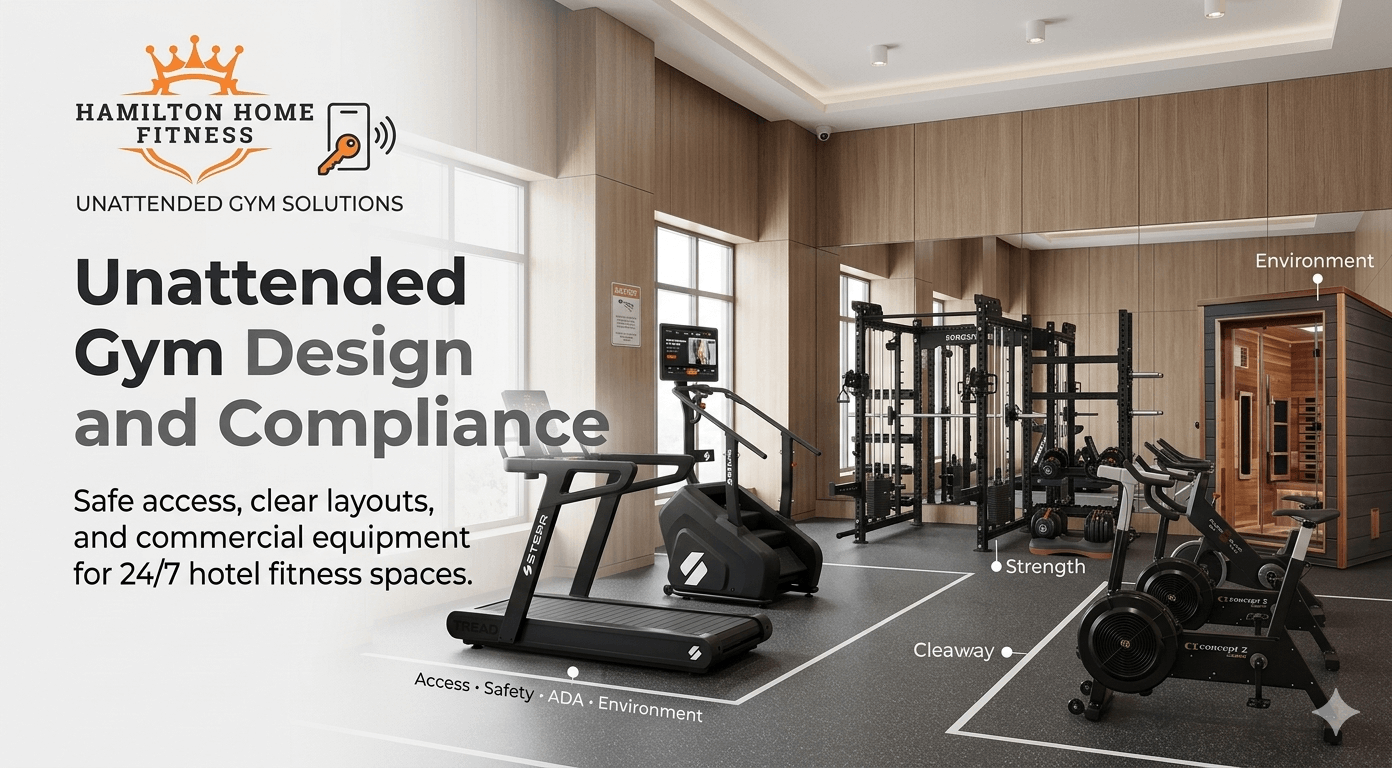
The three areas below — access, compliance, and environment — are where most hotels either polish or fail their fitness amenity. Get these right, and the equipment lasts longer, complaints drop, and the room performs the way the brand standard promised.
24/7 Access, Keycard, and Signage
Keycard or room-key access plus clear signage on hours, emergency contacts, and equipment use are standard for unattended hotel gyms.
Access systems do two jobs at once: they let guests work out when they want, and they create an audit trail if something goes wrong. Most modern hotels integrate the gym door reader with the same RFID system used for guest rooms, which keeps the experience seamless and limits liability exposure to verified guests.
A working unattended gym access and signage checklist:
RFID or keycard reader on the gym door tied to the PMS or access system
Posted hours of operation (with 24/7 noted if applicable) at eye level by the door
Emergency contact number for the front desk visible from anywhere in the room
Clearly posted age policy (typically 16+ unattended, 14–15 with an adult—confirm with your insurer)
"No outside food, glass, or drinks other than water" signage
Equipment-use signage near machines that require non-obvious setup (functional trainer, multi-gym)
A visible AED location and instructions, where the property carries one
Hand-sanitizer station and equipment-wipe dispenser near the entrance
A panic button or in-room phone tied to the front desk
The age policy line is the one most hotels under-document. Brand standards and most insurers expect this to be posted, not just enforced verbally. The same is true of the AED location — if you have one on property, the gym signage should point to it.
ADA, OSHA, and Insurance Basics
Hotel gyms in the USA must consider ADA accessibility, OSHA standards where staff interact with the space, and insurance terms that assume unsupervised guest use.
This is the section to read with your legal and insurance teams in hand. The notes below describe the general landscape—they do not replace qualified counsel, your specific brand-standard requirements, or the terms of your own property's insurance policy. Verify everything before you build.
ADA accessibility. Public-accommodation hotel gyms generally fall under Title III of the Americans with Disabilities Act, which has implications for entry width, equipment clearance, routes of travel, and at least one piece of accessible cardio equipment in many cases. The 2010 ADA Standards for Accessible Design are the controlling document, and how they apply to your specific property depends on whether the space is new construction, an alteration, or a renovation. An ADA specialist or accessibility consultant should review your floor plan before equipment is ordered.
OSHA considerations. OSHA primarily governs the workplace, so the rules apply most directly to housekeeping, maintenance, and front-desk staff when they enter the gym. Floor surfaces, equipment guarding, lock-out/tag-out during maintenance, and electrical safety on cardio drive systems are the most common touch points. A preventive-maintenance contract that documents service visits also functions as part of an OSHA-compliant maintenance log.
Insurance and liability. Most hotel insurance policies cover unsupervised gym use, but the coverage is conditional. Common conditions include using commercial-grade equipment with valid warranties, posting the required signage (age, hours, emergency contacts), maintaining the documented preventive-maintenance schedule, and not allowing equipment to be used outside its rated purpose. Residential-grade equipment installed in a hotel can void coverage. Verify the specific conditions in your policy with your broker before specifying equipment.
The single best rule of thumb: assume the room will be used at 3 a.m. by a guest the front desk has never spoken to. Design the access, signage, equipment, and maintenance schedule around that assumption.
Flooring, Mirrors, Lighting, Ventilation, AV
High-density rubber flooring, wall mirrors, dedicated lighting, fresh ventilation, and a simple AV system are what separate a usable gym from a forgettable one.
The environment is where guests form their first impression and where most hotels underinvest. The equipment can be perfect, but if the room feels like a converted closet, the photos look that way too — and that is what shows up on Booking.com and TripAdvisor.
A practical environmental checklist:
Flooring: 8 mm or thicker high-density rubber tile or roll, with thicker zones (12–20 mm) under cardio and free weights. Rubber dampens noise in rooms above and below, which matters for guest complaints.
Mirrors: Full-wall mirror behind the strength zone and at least one wall mirror behind the cardio bank. Mirrors make small footprints feel larger and let guests check form.
Lighting: Dedicated overhead lighting at roughly 30–50 foot-candles, dimmable where possible, with a warm color temperature (3000–4000 K). Skip pure fluorescents—they flatten the room and never photograph well.
Ventilation: Dedicated HVAC supply and return with at least 4–6 air changes per hour, separated from guest-room HVAC where the building allows. Stagnant air is a top complaint and a real maintenance risk for cardio drive systems.
AV: A wall-mounted TV with closed captioning enabled, plus Bluetooth-capable cardio consoles so guests can use their own headphones. Avoid loud overhead audio in unattended gyms — it draws noise complaints from adjacent rooms.
One detail worth budgeting for: the smell of the room. New rubber flooring off-gasses for the first few weeks, and a poorly ventilated space holds that smell into opening week. Allow the floor to cure before launch, run the HVAC heavily, and consider an activated-carbon air purifier in the room for the first month. Guests notice.
Business Case: ADR, Reviews, and ROI
A well-designed hotel gym helps protect ADR, lifts review scores on the amenity dimension, and typically pays back through occupancy and rate rather than direct revenue. The financial logic is closer to a clean lobby than a profit center—guests do not pay extra for the gym, but they pay less or skip your property when it is poor.
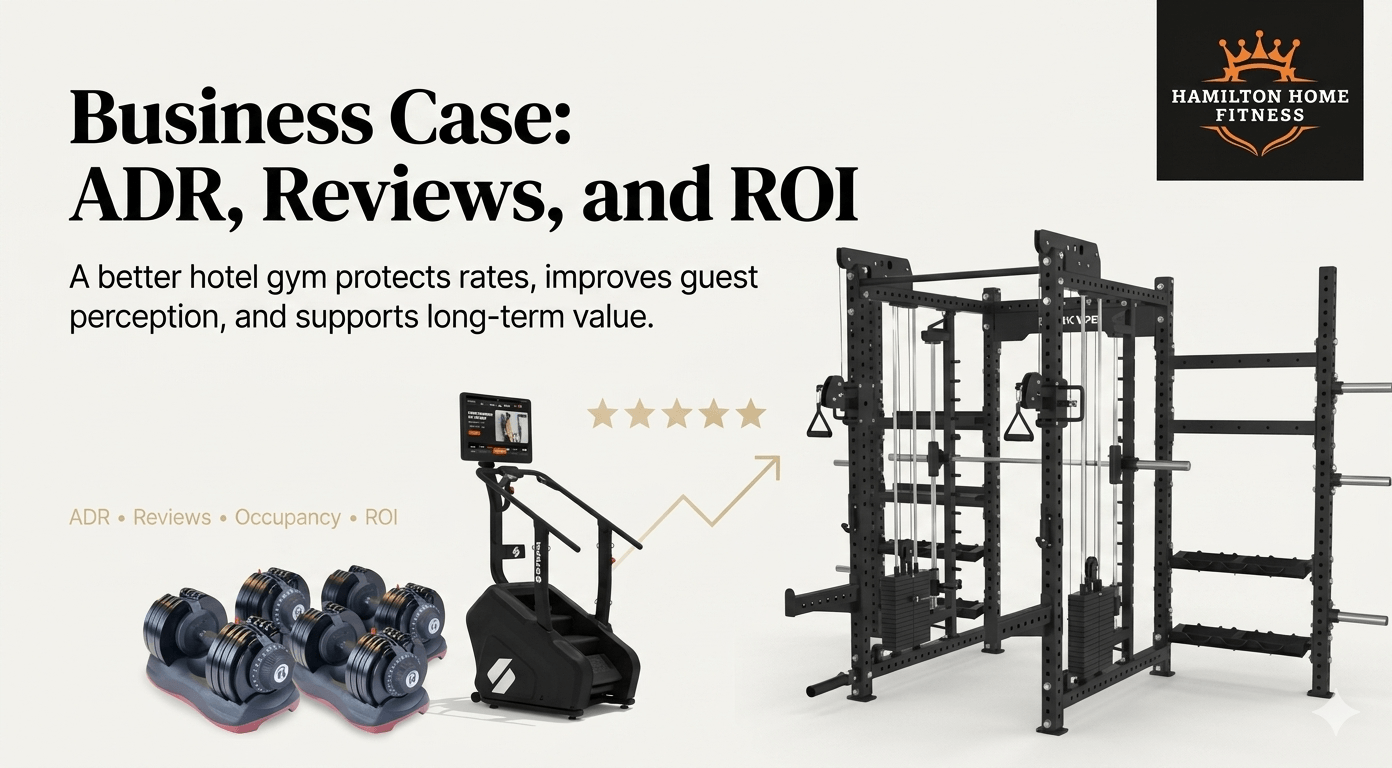
This section gives you the numbers and logic to take into an ownership or asset management conversation. The ranges are honest. The exact figure for your property depends on guest mix, comp set, and brand. Treat what follows as a framework, not a forecast.
How Hotel Gyms Influence ADR and Reviews
Hotel gyms rarely generate direct revenue, but their absence or poor condition consistently shows up in lost bookings and lower review scores.
The path runs through reputation. Cornell's Center for Hospitality Research has published extensively on the elasticity between online review scores and pricing power—the directional finding is that even a one-point rise in a property's average review score correlates with meaningful pricing flexibility, and the reverse is also true. Verify the current research and methodology directly through Cornell's published papers before citing specific figures in an ownership memo.
A few honest observations from the broader hospitality research and recent industry coverage:
Fitness amenities most often function as "lose-the-booking" features. Their absence costs more in lost demand than their presence earns directly.
Business travelers and wellness-focused leisure guests increasingly screen the gym during the booking decision—OTA photos, recent reviews, and amenity icons influence click-through.
Review impact tends to concentrate on a few specific complaints: out-of-order machines, cramped space, dated equipment, and poor cleanliness. These are operational and FF&E issues, not marketing issues.
The ADR lift attributed to a quality fitness amenity is typically modest in isolation—the bigger compounding effect runs through review scores, occupancy in shoulder seasons, and rate elasticity (including RevPAR).
The practical implication for your business case: pitch the gym as protection against reputation drag, not as a revenue line. A 1,000 sq ft gym that runs uptime above 95%, gets refreshed on a normal PIP cycle, and avoids "out of order" signage will support the property's review average. A neglected gym will quietly cost you more than the FF&E you saved.
Do Small Hotels Need a Gym?
Yes—small hotels increasingly need a gym, because business travelers and wellness-focused guests now treat it as a baseline expectation.
The "do we really need one" conversation comes up most often at properties under 80 rooms or at independent boutique hotels without brand pressure. The decision rule has three parts:
Guest profile. If more than roughly 30% of your demand is business travel or wellness-focused leisure, a gym is no longer optional. These segments filter for fitness amenities before they book.
Comp set. If three out of four direct competitors in your market have a gym, you are operating at a disadvantage without one. Check OTA listings for your comp set and count the amenity icons.
Brand requirement. If you are flagged, the brand standard answers this question for you. Skip the debate and pull the current spec from your franchise portal.
For independent properties under 50 rooms, the math still usually favors a small, well-curated gym over no gym. A 300 sq ft compact build with one or two commercial cardio pieces, a functional trainer, and a stretching corner gives you the amenity icon on Booking.com and TripAdvisor without occupying revenue-generating square footage. The investment is modest; the absence is increasingly visible.
The properties where a gym genuinely is not required are limited: leisure-only properties where guests come specifically for an off-grid experience, very small B&Bs where the brand identity excludes amenities, and properties with a partnership giving guests free access to a nearby fitness facility. Outside those exceptions, the answer is yes.
What a Hotel Gym Costs to Build
Hotel gym buildouts vary widely—equipment alone typically runs from the low five figures for a compact setup to the low-to-mid six figures for a full resort fitness center, before flooring, mirrors, AV, and installation.
Honest ranges for equipment cost only, in USD, at commercial-grade specs:
300 sq ft compact: roughly the low-to-mid five figures for cardio, one strength station, free weights, and basics.
500 sq ft standard: roughly the mid-to-high five figures for a complete brand-acceptable build.
1,000 sq ft mid-size: roughly the high five to low six figures, depending on cardio depth and strength station count.
2,000 sq ft resort: roughly the low to mid six figures, before optional sauna, cold plunge, or studio add-ons.
These are equipment-only ranges. The full FF&E budget — including flooring, mirrors, lighting upgrades, HVAC modifications, AV, signage, mats, accessories, and white-glove installation — typically adds 30% to 60% on top of equipment cost, depending on the building's existing infrastructure. Renovating an existing gym is usually cheaper than building one into a former meeting room or back-of-house space, because the HVAC and electrical are already in place.
The real numbers depend on:
Brand standard. A Marriott Autograph spec costs more than a select-service Holiday Inn Express spec.
Finish level. Matte-black premium cardio with integrated screens costs noticeably more than baseline commercial.
Region and labor market. Install rates and freight vary; coastal urban markets run higher than secondary markets.
New construction vs. PIP retrofit. Retrofits often need building-system work that ground-up buildouts already include.
New vs. certified refurbished. Refurbished commercial equipment can reduce cost meaningfully — confirm the warranty terms before assuming the savings stick.
The ranges above are anchors, not forecasts. The only way to land on a real number is a real quote against your specific brand standard, footprint, finish level, and timeline. A hospitality-focused supplier should be able to return that quote within a week or two of a confirmed scope.
Choosing a Supplier and Installation
Choose a supplier that handles hospitality-grade brands, offers design support, ships nationwide with white-glove install, and backs the package with a preventive maintenance plan. The equipment is half the relationship. The supplier behind it determines whether the gym is operational on day one, on day ninety, and on day one thousand.
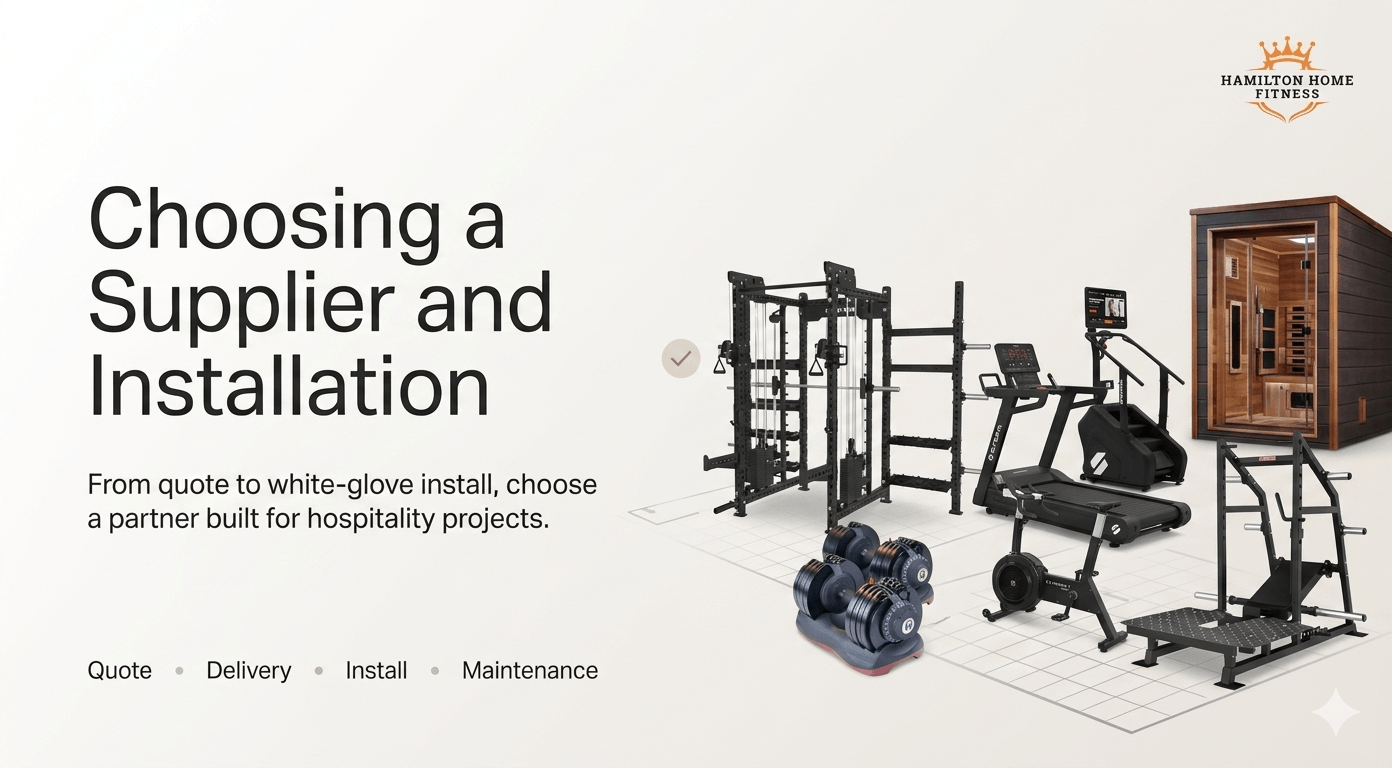
This section gives you the framework to compare two quotes apples-to-apples, the install realities that don't show up in any product spec, and a clear path from research to a real number.
What to Ask in a Hotel Package Quote
A complete hotel package quote should cover brand list, model specs, freight, liftgate, install, warranty, parts, labor, and lead time.
If a quote arrives missing any of these, you don't yet have a quote—you have a price. The full list also lets you compare two suppliers without getting trapped by a low equipment number that hides install or freight on the back end.
A buyer-side checklist for evaluating any hotel fitness equipment quote:
Brand and model list: specific manufacturer, specific model number, specific finish — not "commercial treadmill"
Commercial-use warranty confirmation: in writing, with hospitality use explicitly named
Parts coverage: how many years, on which components (motor, frame, electronics, upholstery)
Labor coverage: how many years, on-site versus depot, response-time commitment
Freight terms: included or separate, liftgate yes or no, inside delivery yes or no
White-glove install: included, separate, or not offered — and what is covered
Lead time: ship date and delivery window from order, with realistic buffers for specialty pieces
Floor protection and debris removal: assumed or extra
Old equipment removal: included, extra, or your responsibility
Payment terms: deposit percentage, balance trigger, financing options
Single point of contact: name, phone, response-time expectation post-sale
The single most useful question to ask any supplier is "What is not in this quote?" A confident supplier will name two or three line items they intentionally left out—typically permits, HVAC modifications, or specialty electrical—and explain why. A weak supplier will say "everything is in there," then surface the gaps after the deposit is paid.
White-Glove Install and Logistics
White-glove installation means freight delivery, liftgate, in-room placement, full assembly, testing, and debris removal—critical when the gym sits inside a running hotel.
Standard freight delivery drops pallets at the curb. That works in a warehouse; it fails in a hotel renovation. Picture a 90-room boutique on Floor 4 with active occupancy of 85% the week the equipment arrives. Without white-glove service, the front desk is suddenly responsible for moving a 600-pound functional trainer through a working lobby, up an elevator booked for room service, and through hallways with paying guests. Things get damaged — walls, equipment, or the guest experience.
A proper hotel white-glove installation includes the following:
Scheduled delivery window communicated to the property at least 48 hours in advance
Lift-gate truck and inside-delivery crew
Protection of lobbies, elevators, and hallways during move-in
Full equipment assembly with manufacturer-spec torque on bolted joints
Testing of every piece—power-on, console boot, belt or cable tension check
Calibration where required (incline, resistance, scale)
All packaging and debris removed from the property
A signed walk-through with property staff before the install crew leaves
For occupied hotels, scheduling matters as much as scope. Most installs run overnight or early in the morning to avoid lobby peak hours. If your supplier cannot accommodate that, the install will become a guest complaint generator. Hamilton Home Fitness offers a white-glove installation and equipment-moving service that includes coordination around active hotel operations.
Preventive Maintenance Contracts
Plan for at least quarterly preventive maintenance on commercial cardio, plus an as-needed service relationship for strength equipment.
Cardio is what breaks. Belts wear, decks compress, electronics drift, and consoles develop quirks long before they actually fail. A preventive maintenance contract catches these during scheduled visits rather than during a 3 a.m. guest workout. Strength equipment fails less often, but cable replacement and upholstery refresh are still on the calendar for any property running multi-year FF&E cycles.
A reasonable preventive maintenance contract should include the following:
Quarterly cardio visits: belt tension and tracking, deck inspection, motor brush check, lubrication, console diagnostics, and calibration
Semi-annual strength inspection: cable wear, pulley alignment, weight stack guides, bolted-joint torque, upholstery condition
Parts inventory: common wear items (belts, cables, pins, grips) stocked or shipped within a defined window
On-site response time: a documented window for emergency service calls (commonly 24–72 hours depending on contract tier)
Service log: written record of every visit, useful for OSHA compliance and insurance documentation
Documented escalation: named technical contact and supervisor in case a first-line response stalls
Properties that skip the PM contract usually pay more in the long run—emergency service calls cost two to three times the rate of scheduled visits, equipment lifespan shortens, and out-of-order signs show up in reviews. A contract running roughly 3–6% of equipment cost annually is industry standard and reliably pays for itself in protected uptime alone.
Hamilton Home Fitness Gym Design Service
Hamilton Home Fitness offers a "Book a Gym Design" service for hotels and resorts—a custom floor plan, equipment shortlist, and full package quote shipped nationwide from Tennessee.
You have two paths from this article to an actual installation:
DIY path. Use the framework above to define your sq ft tier, brand-standard requirements, and target package. Send the spec to two or three suppliers, compare quotes against the checklist, and select. This works when you have an internal designer or asset manager comfortable specifying commercial fitness equipment.
Design-assisted path. Book a hotel gym design consultation and have a custom floor plan, an equipment shortlist mapped to your brand standard, and a single coordinated quote built for your property. This is the faster path when you are managing a PIP buildout with other priorities or when the project requires a 3D rendering for ownership approval.
The Hamilton Home Fitness Commercial collection carries the hospitality-rated brands referenced throughout this guide—STEPR, Spirit Fitness, Tag Fitness, Body-Solid, BodyKore, Hoist, Concept 2, and others—and ships nationwide from its Tennessee base with white-glove installation and preventive maintenance available. The design service is available through Book a Gym Design, and the direct quote path runs through the hotel package quote request.
For most hotels, the design-assisted path saves more in avoided buildout mistakes than it costs in lead time—particularly on PIP-driven projects where brand-standard alignment and the renovation calendar both move on tight windows.
FAQ
What is the minimum equipment a luxury hotel gym should include?
A luxury hotel gym should include, at minimum, one or two commercial treadmills, one upright or recumbent bike, one elliptical, a functional trainer or compact multi-gym, an adjustable dumbbell set or fixed dumbbells up to roughly 50 lb, an adjustable bench, yoga mats, foam rollers, and a small stretching area.
This list satisfies most brand-standard minimums for upscale and luxury tiers. Add a stair climber, indoor rower, or recovery zone to differentiate at the upper end.
How much floor space is required for a typical hotel fitness center?
A typical hotel fitness center needs roughly 50 sq ft per machine, with most properties landing between 500 and 1,000 sq ft.
As a planning rule, hospitality designers commonly suggest allocating around 350 sq ft per 200 rooms as a starting point and then adjusting up for brand standard, guest profile, and competitive set. Smaller boutique properties can operate effectively at 300 sq ft with a tightly curated package.
Which cardio machines work best for unattended hotel gyms?
Commercial treadmills with continuous-duty motors, recumbent and upright bikes, ellipticals with enclosed drive systems, and indoor rowers work best for unattended hotel gyms.
The shared criteria are quiet operation, intuitive controls, enclosed mechanics that resist tampering, and a commercial warranty that explicitly covers hospitality use. Bluetooth and app-connected consoles are now an expectation for most travelers rather than a luxury.
Do hotel gyms need commercial-grade strength equipment or compact options?
Both are valid — they are not opposing choices. Commercial-grade construction is the baseline for any hotel gym, and compact formats (functional trainer, adjustable dumbbells, single-stack multi-gym) deliver commercial-grade quality in a smaller footprint.
For most hotels under 1,000 sq ft, a single functional trainer or compact multi-gym covers more exercise variety than a row of single-station machines while taking less floor space.
What kind of maintenance plan should a hotel gym have?
A hotel gym should have quarterly preventive maintenance on cardio, semi-annual inspection of strength equipment, parts and labor warranty coverage, and a service contact with a documented response time of 24–72 hours.
A preventive maintenance contract running roughly 3–6% of equipment cost annually is an industry standard. Skipping it typically costs more long-term—emergency calls run two to three times the rate of scheduled visits, equipment lifespan shortens, and out-of-order signs surface in guest reviews.
How do guest fitness amenities affect average daily rate and review scores?
Well-maintained hotel gyms typically protect ADR and improve review scores on the amenity dimension, while outdated or out-of-order equipment shows up in negative reviews and lost bookings.
The compounding effect comes from review-score elasticity. Research from the Cornell School of Hotel Administration has shown that improvements in overall review score correlate with measurable pricing power; the gym contributes to that overall score even when guests do not use it directly.
What are guests looking for in a hotel fitness center?
Guests are looking for a clean, modern, well-lit space; commercial cardio that actually works; quality dumbbells; a functional trainer; a yoga or stretching zone; clear signage; and 24/7 access.
Hotel review data consistently shows that guests form their impression of the gym within the first minute of walking in. Equipment selection matters, but so do flooring, lighting, ventilation, and mirrors—the environment carries as much review weight as the machines themselves.
Final Thought
A well-built hotel gym is a quiet asset. It does not announce itself in reviews when it works — it only announces itself when it does not. The framework above gives you what you need to keep it working: hospitality-grade equipment built for continuous-duty use, right-sized to your footprint, aligned with your brand standard, and supported by a maintenance plan that protects the asset across the full PIP cycle.
If you took one thing from this guide, take this: the best hotel gym equipment is the equipment that fits your specific property—your guest profile, your square footage, your brand, and your renovation calendar—and that gets installed and maintained by a supplier who treats hotels as a category rather than as one of many.
When you are ready for a real number, you have three clean paths forward:
Compare hospitality-rated models side by side in the Hamilton Home Fitness Commercial collection
Get a custom floor plan, equipment shortlist, and full quote through Book a Gym Design
Send your property's brand-standard spec to the team directly through the hotel package quote request
Hamilton Home Fitness ships nationwide from Tennessee; carries the hospitality-rated brands referenced throughout this guide—STEPR, Spirit Fitness, Tag Fitness, Body-Solid, BodyKore, Hoist, and Concept 2, among them; and offers design, white-glove installation, and preventive maintenance under one roof. The next step is whichever of the three paths fits how your project is moving: research, design, or quote.