Introduction
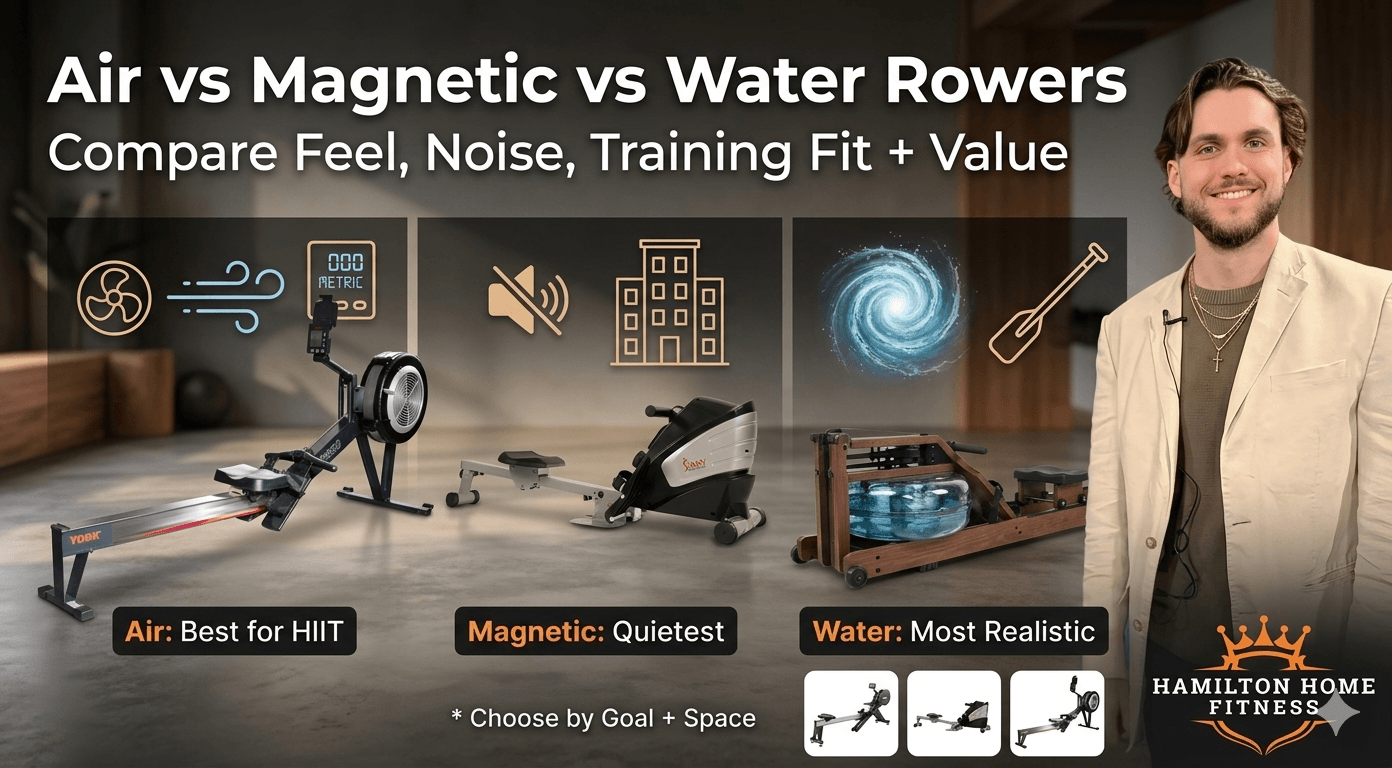
An air rower, a magnetic rower, and a water rower feel different on the pull, make very different amounts of noise, train different energy systems, and sit at different prices. For a home, an apartment, or a shared facility, choosing the wrong type usually means a rower that is too loud for the room — or wrong for how you train.
Rowing is now one of the most-bought home cardio categories, and the market is crowded with lookalike machines that blur these differences. This guide compares all three on the factors that decide the purchase — stroke feel, noise, training fit, space, upkeep, and price — and points to real models in each category, including an authorized Concept 2 line, so you can match the right rower to your program and your space.
How Each Rower Creates Resistance
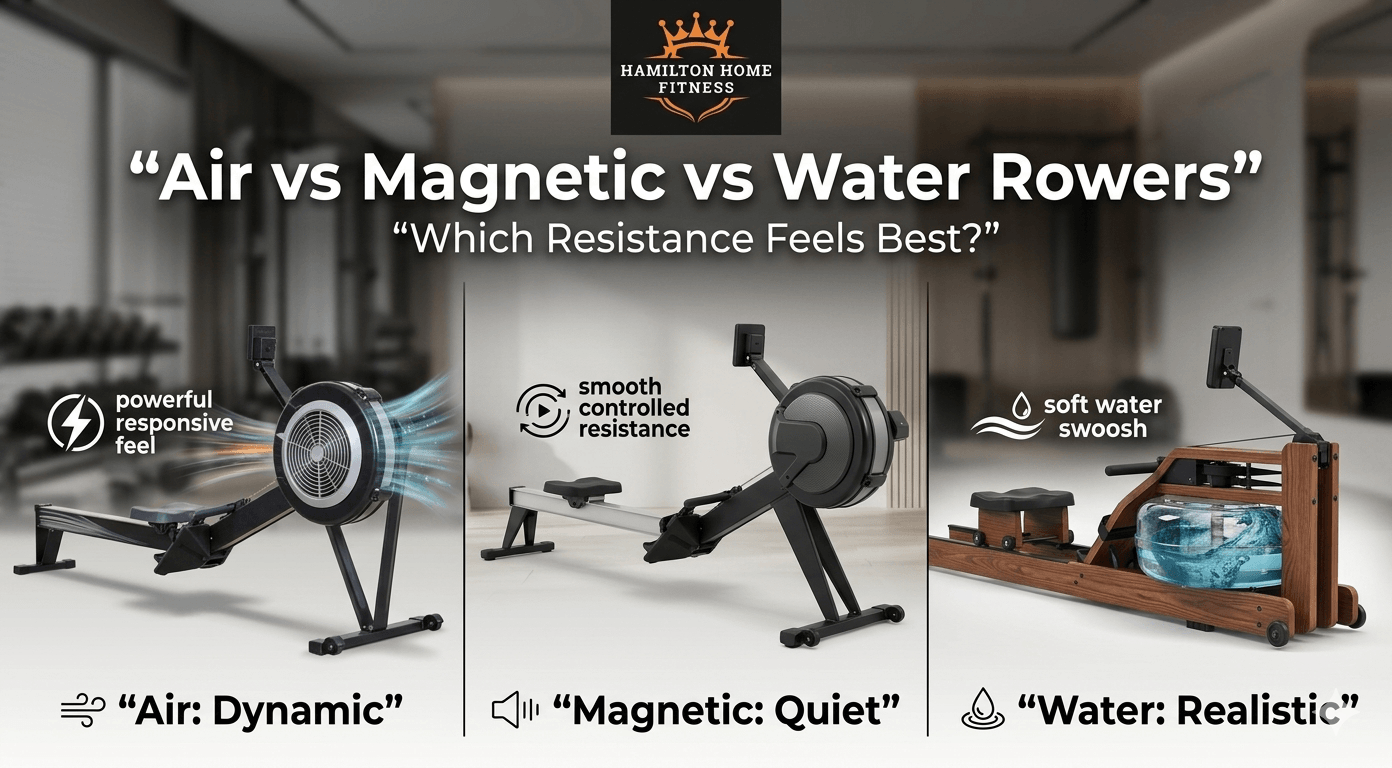
Air rowers give dynamic resistance that rises with effort, magnetic rowers give a steady level you set, and water rowers give effort-based resistance with a paddle-and-tank feel. The mechanism is what shapes how each one feels on every stroke, so it is the right place to start before weighing noise, training fit, or price.
Air: Dynamic, Loud, Responsive
Air rowers spin a fan flywheel, so the harder you pull, the more resistance you feel — much like rowing on water. There is no fixed "level": pull lazily and it is easy, pull hard and it pushes back, which makes air the most effort-responsive of the three.
Most air rowers, including the York R-350 air rower, use a chain drive and a damper. The damper opens or closes airflow into the flywheel housing, changing how the stroke feels — not how hard the workout is. That distinction trips up new buyers: difficulty comes from how hard you row, while the damper mostly changes the character of the catch. Higher airflow feels heavier and grabbier; lower airflow feels lighter and faster. The metric that actually tracks resistance is drag factor, which the monitor calculates from how quickly the flywheel slows between strokes.
Magnetic: Steady and Quiet
Magnetic rowers set resistance with magnets near the flywheel, giving a consistent pull at each level no matter how hard you row. You choose a level, and that resistance stays put for the whole piece.
Because the magnets never touch the flywheel, there is no friction and little noise, and most magnetic rowers use a belt drive rather than a chain. The trade-off is feel: the resistance does not surge when you accelerate, so a hard sprint and an easy stroke meet the same fixed force. That predictability is ideal for some goals and limiting for others — a difference that matters most when you match a rower to your training later in this guide.
Water: Realistic Swoosh and Look
Water rowers pull a paddle through a tank, so resistance climbs with effort and each stroke makes a soft swoosh. Like air, the pull is effort-based — row harder and the water pushes back harder — which is why many rowers say water comes closest to the feel of being on the river.
The sound is part of the appeal: a rhythmic swish rather than a fan's whir. So is the design, with many water rowers built on wood frames that look at home in a living space rather than a garage. Both come with realities covered shortly — water rowers have their own noise floor and a small amount of upkeep — but on feel and looks alone, this is the type people tend to fall for.
Noise and Apartment Suitability
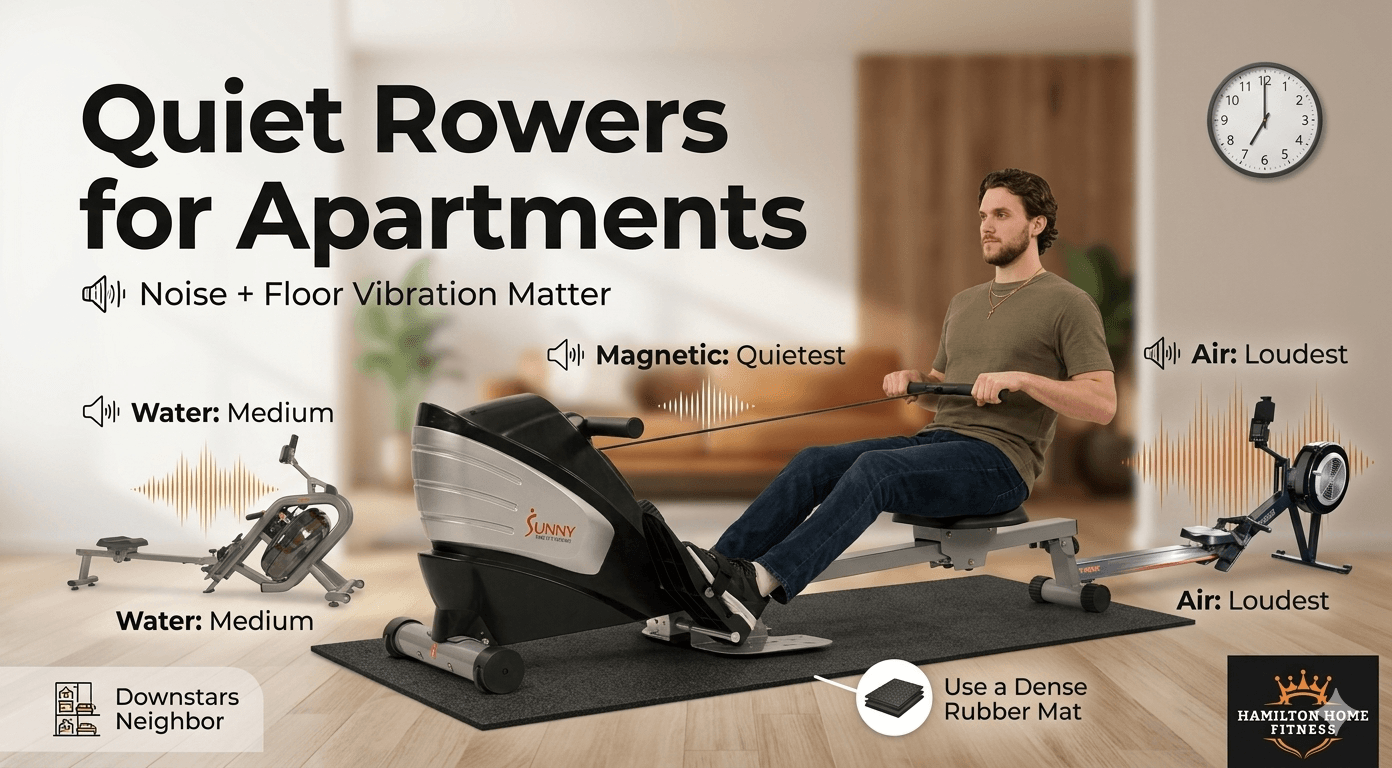
Magnetic is quietest, water sits in the middle, and air is loudest — but for anyone in an apartment or rowing before dawn, floor vibration matters as much as the decibels you hear. Both decide whether a rower is actually usable in shared housing.
How Loud Each Type Really Is
Magnetic rowers run roughly 50–60 dB, water around 60–70 dB, and air about 70–80 dB. In plain terms: magnetic is near-silent under load, water adds a rhythmic swoosh, and air produces a fan-like whoosh that gets louder the harder you pull.
One common mix-up is worth clearing up before you buy. The Concept 2 is often assumed to be quiet because it is so refined, but it is an air rower, not magnetic, and it measures around 71–77 dB at a moderate 24 strokes per minute — toward the loud end of the range. "Whisper-quiet" marketing language does not always match the resistance type, so check what mechanism a rower actually uses rather than trusting the adjective. (Decibel figures vary by model and intensity; confirm a specific machine against the manufacturer's stated noise data.)
Vibration and How to Cut It
For downstairs neighbors, vibration through the floor often matters more than the sound you hear. A rower can be acceptably quiet to your ears and still send a low thump into the room below, because much of the disturbance travels through the structure rather than the air.
This is where the ranking can flip. A water rower can transmit noticeably more vibration than a magnetic one, even when its airborne noise seems gentle, which is why neighbors sometimes report a thump they feel rather than a sound they hear. The fix is straightforward: a dense rubber mat under the rower absorbs vibration and meaningfully cuts what reaches the floor. If quiet is your top priority and you live above someone, lean magnetic and add a mat — the quiet magnetic rower options are built for exactly this situation.
Match the Rower to Your Goals
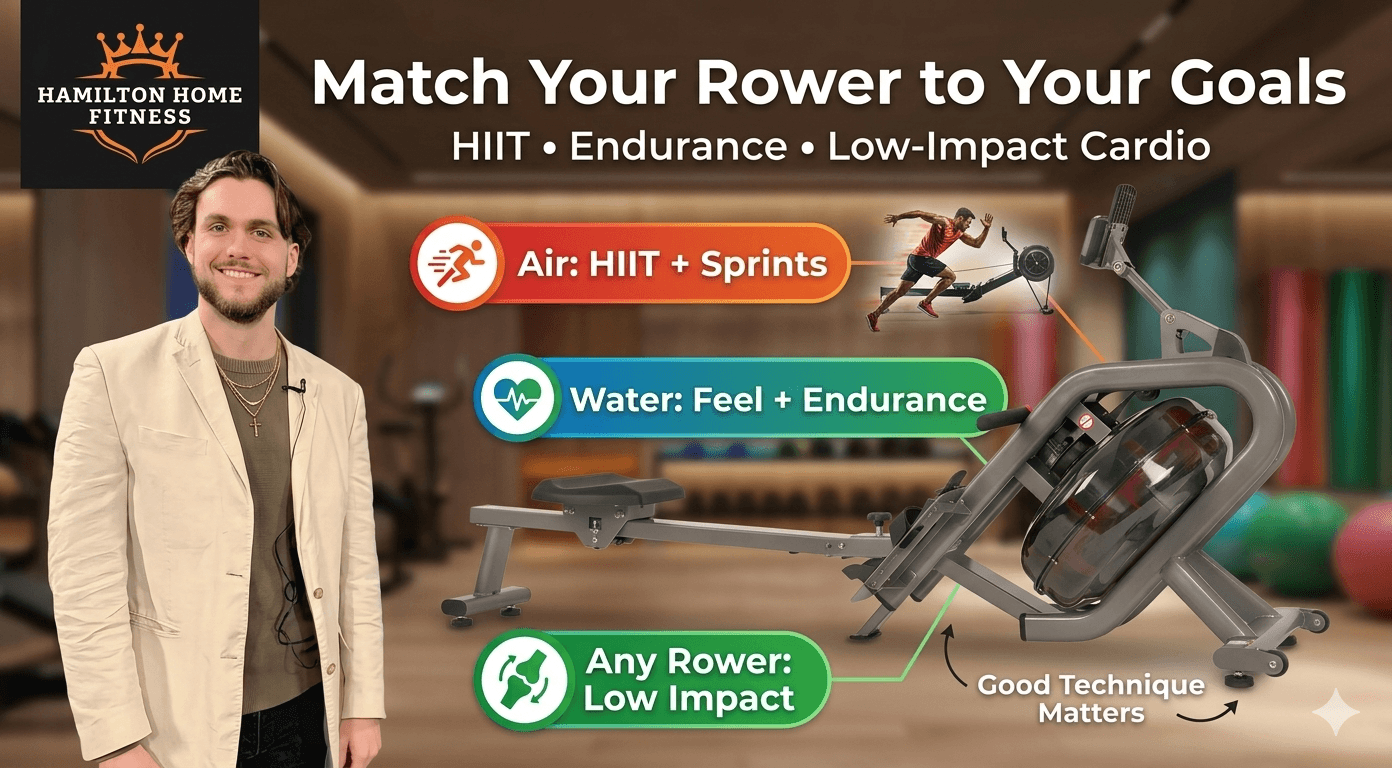
Air suits intervals and metric-driven training, water suits steady efforts and feel, and any rower delivers joint-friendly cardio with good technique. The resistance type matters less than picking the one that fits how you actually train, so match it to your program rather than the marketing.
Best for HIIT and Sprints
For HIIT and sprint work, air rowers respond instantly to power, making hard intervals feel natural. The moment you accelerate, the flywheel pushes back, so the effort scales with you instead of capping at a fixed level — which is what short, maximal bursts demand.
That responsiveness is also why air rowers carry the metrics interval training runs on: watts, 500m split, and stroke rate update in real time, so you can hold a target on every round and see when you fade. If your week includes Tabata sets, sprint intervals, or mixed conditioning for CrossFit-style training, hockey, or football, air is the most forgiving fit. A rower also pairs naturally with the rest of a functional program, so it slots in alongside other cross-training equipment rather than replacing it.
Best for Zone 2 and Endurance
For zone-two and long endurance pieces, both air and water hold a smooth, sustainable rhythm. Neither forces the abrupt resistance changes that make a 40-minute steady piece feel choppy, so you can settle into a pace and stay there.
The deciding factor is feel versus data. Water's effort-based swoosh suits rowers who want the session to feel like time on the river; air gives the cleaner split and pace readouts that base-building runners and triathletes use to govern easy efforts and stop zone two from creeping into zone three. Either works for long slow distance and marathon-style base training — choose by whether you pace off the numbers or off the feel.
Low-Impact Cardio and Joints
Rowing is low-impact and full-body, which can suit sensitive knees or backs — but only with correct form. There is no pounding as in running, and a single stroke drives the legs, hips, back, and arms through the catch, drive, finish, and recovery, working the posterior chain, lats, glutes, hamstrings, quads, and core in one movement.
Low-impact is not the same as risk-free. Rounding the back under load, over-reaching at the catch, or yanking with the arms can strain the lower back, and the wrong setup undoes the joint-friendly benefit. If you are managing or recovering from a knee or back injury, treat rowing as something to clear with a physician or physical therapist first, and lean on recognized technique guidance — such as standards from the ACSM or NSCA — rather than any promise that a rower will fix the problem.
Why Concept 2 Dominates Gyms
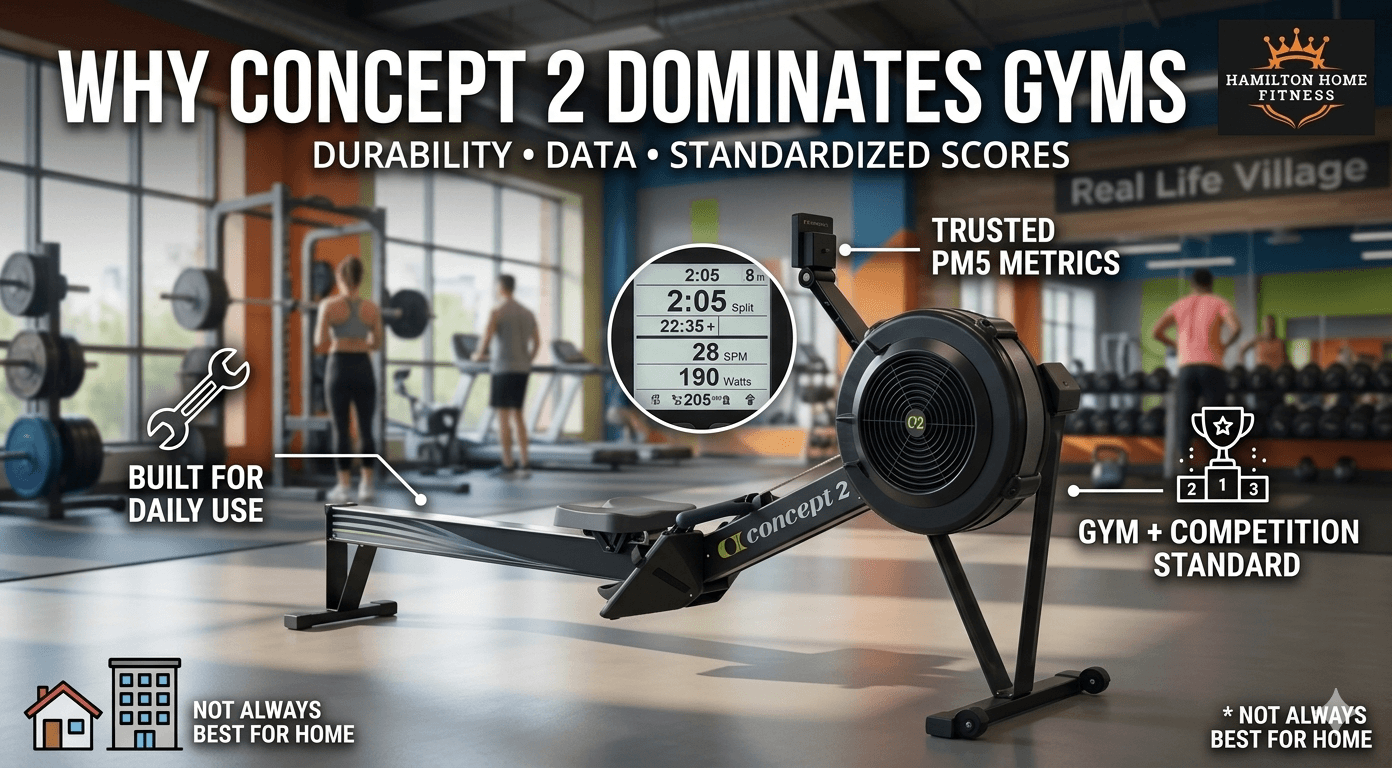
Gyms and competitive rowers favor Concept 2 air rowers for their durable build, trusted data, and standardized scores — but it is not automatically the right buy for your home. The reputation is earned; whether it fits you is a separate question.
The RowErg Standard
The Concept 2 RowErg is an air rower with a chain drive and the PM5 monitor, and it is the benchmark for gyms and competitive rowing. Three things explain the standing: it holds up to constant daily use, the PM5 reports consistent watts, 500m split, and drag factor, and those numbers are comparable from one machine and one athlete to the next. When a coach prescribes a 2,000m piece or a CrossFit workout calls for a calorie target, everyone is measured the same way — which is why affiliates and elite rowers standardize on it. The PM5 also connects over Bluetooth and ANT+ and syncs with the ErgData and ErgZone apps, so logging and racing carry over off the machine.
One naming note keeps listings clear: in May 2021 Concept 2 merged the old Model D and Model E into a single RowErg, offered in a standard and an elevated seat height. If you see "Model D" or "Model E" on the used market, they are the same core rower under the current name. Buying through an authorized dealer matters for warranty and support, and Hamilton carries the Concept 2 lineup as one.
When to Skip the Concept 2
If silence, a softer footprint, or design matters more than competition data, a magnetic or water rower can be the smarter buy. The RowErg is excellent at what it does, but it is an air rower — loud under load — and built for function over looks.
So the honest answer to whether magnetic rowers are "as good as" Concept 2 is that they answer a different question. A magnetic rower wins on near-silent operation for a shared apartment and often on price. A water rower wins on a living-room-ready frame and the feel many rowers prefer. If you are not training for a number on a leaderboard, the gold-standard label should not override what actually fits your room, your budget, and your ears.
Space, Storage, and Body Fit
Most rowers need roughly 8–9 feet of length and clearance overhead, and many fold or stand vertically — but body size also drives the right rail length and seat height. Confirm both the room and the fit before you buy, because this is where returns usually start.

Footprint and Ceiling Clearance
Measure for about 8–9 feet of rowing length plus room to extend your arms overhead at the catch. The machine's stated footprint is only the starting point: you also need clearance behind it for the seat's travel and enough ceiling height that a taller rower's hands clear at full reach.
Storage is the next question. Many rowers fold at the rail or stand upright on one end, and most ride on built-in transport wheels so you can tip and roll them into a closet or corner between sessions. Water rowers, with their tank and longer frame, most often store vertically rather than folding flat. Before buying, measure the rowing spot and the storage spot — a rower that fits the workout but not the closet is the most common reason one ends up returned.
Fit for Tall and Heavier Users
Taller and heavier users should check rail length, seat height, and the maximum user weight before buying. A rail that is too short cuts off the leg drive for anyone over about 6'2", and a low seat makes getting on and off harder for taller frames or anyone with limited mobility.
This is one place the Concept 2 line offers a direct answer: it comes in a standard 14-inch seat and an elevated 20-inch seat, and the higher option makes sitting down and standing up easier without changing how the rower performs — see the standard vs elevated height comparison for which suits you. Shorter rowers should confirm the foot stretcher and heel cups adjust down far enough for a secure catch, and every buyer should match the machine's max user weight to their own with margin to spare rather than buying right at the limit.
Upkeep, Value, and Buying
Magnetic needs the least upkeep, air needs occasional chain care, and water needs a purification tablet a couple of times a year — and price tracks features more than resistance type. Knowing the real maintenance load and the buying routes keeps the decision grounded once you have a type in mind.
Upkeep by Resistance Type
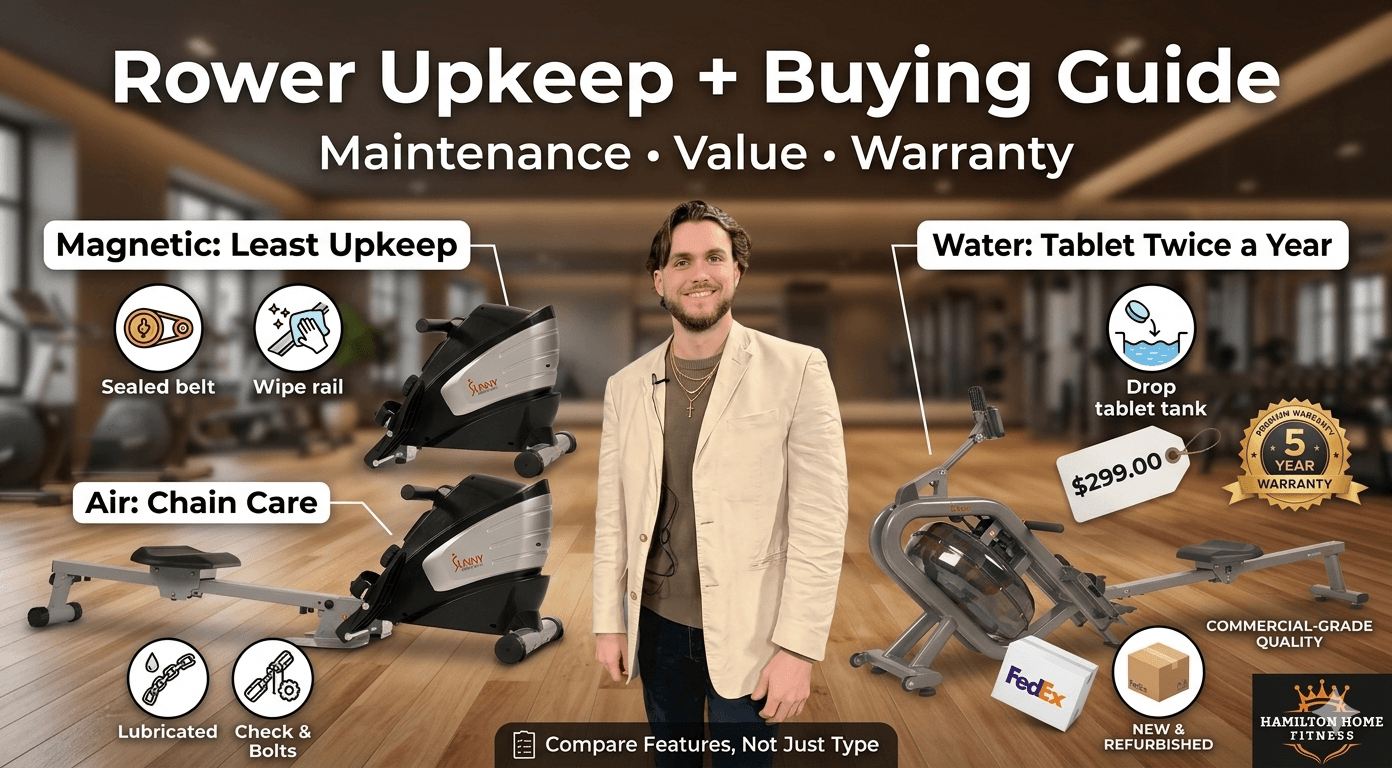
Magnetic rowers are near maintenance-free, air rowers need occasional chain care, and water rowers need a purification tablet roughly twice a year. None of the three is demanding, but the routines differ enough to matter if low effort is a priority.
Air rowers ask for the most regular attention, and even that is small: a light chain lubrication and the occasional bolt check. Magnetic rowers, with a sealed belt drive and no friction, ask for almost nothing beyond wiping down the rail. Water rowers carry the maintenance myth, but the reality is light — add a purification tablet about every six months, refill only if the water discolors, and never use bleach, which damages the tank. (Guidance on tap versus distilled water varies by brand, so follow your specific model's manual, and check the manufacturer's care page for exact intervals.) If you want the genuinely realistic feel with minimal fuss, a folding water rower keeps that upkeep to a few minutes twice a year.
Price, Value, and Where to Buy
Budget air and magnetic rowers start lower, premium water and competition air rowers cost more, and commercial-grade units sit highest. Resistance type alone does not set the price — build quality, the monitor, frame materials, and warranty do most of the work — so compare on features rather than category.
There is also more than one way to buy in. A new entry-level rower stretches a tight budget; a used or refurbished unit can put a higher-tier machine within reach, provided you check the chain, rail, seat, and monitor before committing. Facilities outfitting a floor for constant traffic should look at the commercial rowing machines built for heavier daily use and backed by commercial warranties. Whichever route fits, confirm the current price, the warranty terms, and the shipping cost for your address before you order, since freight on a long, heavy machine varies by location.
FAQ
What is the actual stroke feel difference between air, magnetic, and water rowers? Air and water resistance rise with effort for a lively, water-like pull, while magnetic stays at a fixed level you set. So air and water reward harder rowing with more push back; magnetic gives the same resistance whether you sprint or cruise.
Which rowing machine type is quietest for apartment living and early-morning use? Magnetic is quietest, water sits in the middle, and air is loudest. For shared housing, add a dense rubber mat to cut floor vibration — which can disturb neighbors as much as the sound itself.
Why do CrossFit affiliates and elite rowers almost always use Concept 2 air rowers? For their durable build, the trusted PM5 monitor, and standardized scores that compare directly across athletes and gyms. When everyone is measured the same way, results and competition stay fair.
Does a water rower require water changes, refilling, or treatment over time? Mostly just a purification tablet about every six months. Refill only if the water clouds or discolors, and never use bleach, which damages the tank — full water changes are rarely needed.
How much floor space and ceiling clearance does each rower type need? Plan for roughly 8–9 feet of length plus room to extend your arms overhead at the catch. Many rowers fold or stand vertically, so measure both your rowing spot and your storage spot before buying.
Which rower type is best for HIIT intervals, zone-two cardio, and long endurance pieces? Air is best for HIIT and metric-driven training because resistance scales instantly with power. For zone-two and long endurance, both air and water hold a smooth, sustainable rhythm.
Is rowing better cardio than running? Rowing is lower-impact and works more total muscle, while running burns comparable calories but puts more stress on the joints. Neither is universally better — rowing simply spreads the effort across the whole body with less impact.
Final Thought
The right rower is the one that matches your training, your space, and your budget. Air rowers like the Concept 2 and York R-350 suit intervals, cross-training, and serious metrics; magnetic is the quietest choice for an apartment; and water gives the most realistic feel in the best-looking frame. There is no single winner here — only the rower that fits how you train and where you train.