Introduction
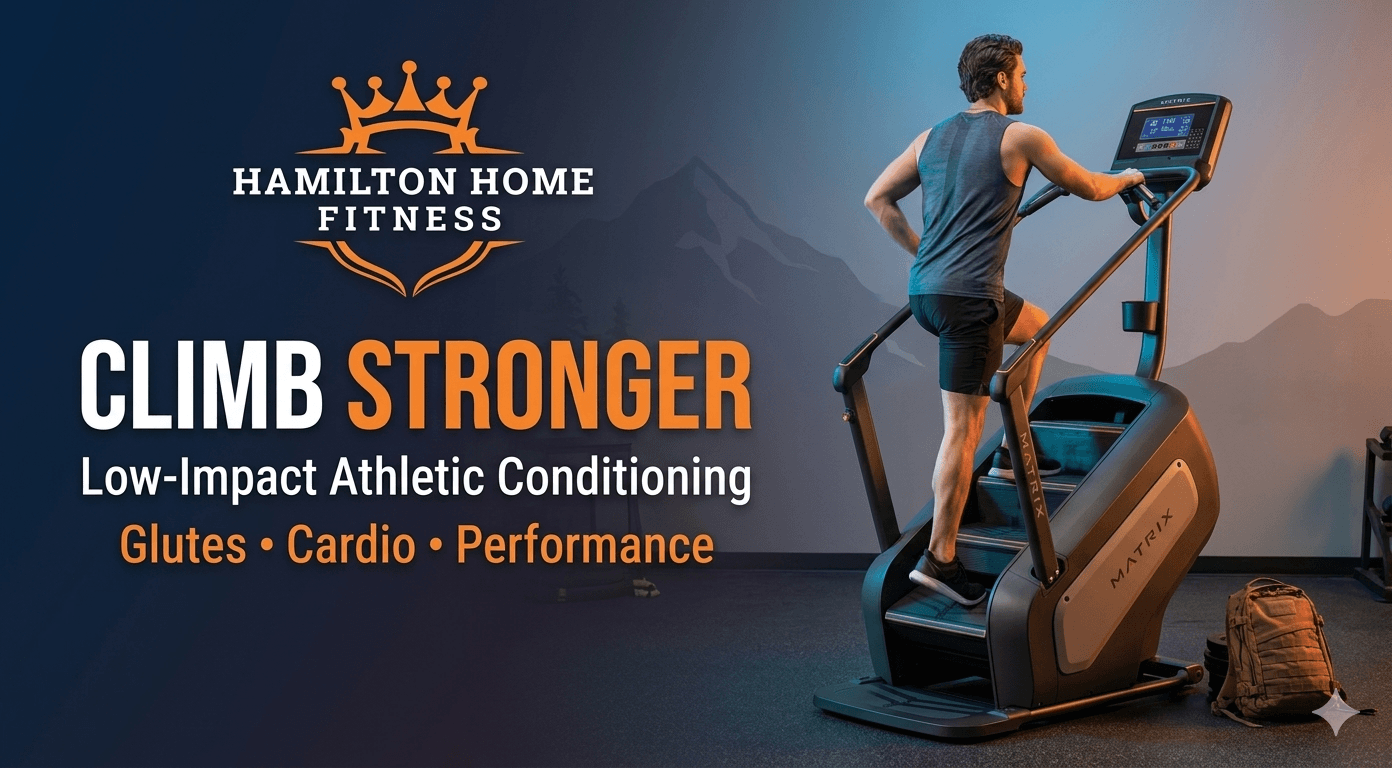
If the treadmill is hard on your knees, stalls your glute work, and doesn't carry over to climbing, rucking, or the trail, a commercial stair climber solves all three. The stepping motion loads your glutes and posterior chain directly while sparing your joints, which is why more hybrid athletes, runners, and mountaineers now train on a stepmill instead of grinding out flat miles.
This guide covers the commercial stair climber benefits that actually matter to athletes — what the machine trains, how it compares to the treadmill, how to program it for fat loss or conditioning, and how to pick one that fits your ceiling, your weight, and your goal.
Stair climber vs stepmill vs stepper
A stepmill (also called a climbmill) uses real revolving stairs, while a stair stepper uses two pedals you press down against resistance. "Stair climber" is the umbrella term that covers both, and the revolving-staircase versions give athletes the most sport-specific carryover because the motion mirrors actual climbing.
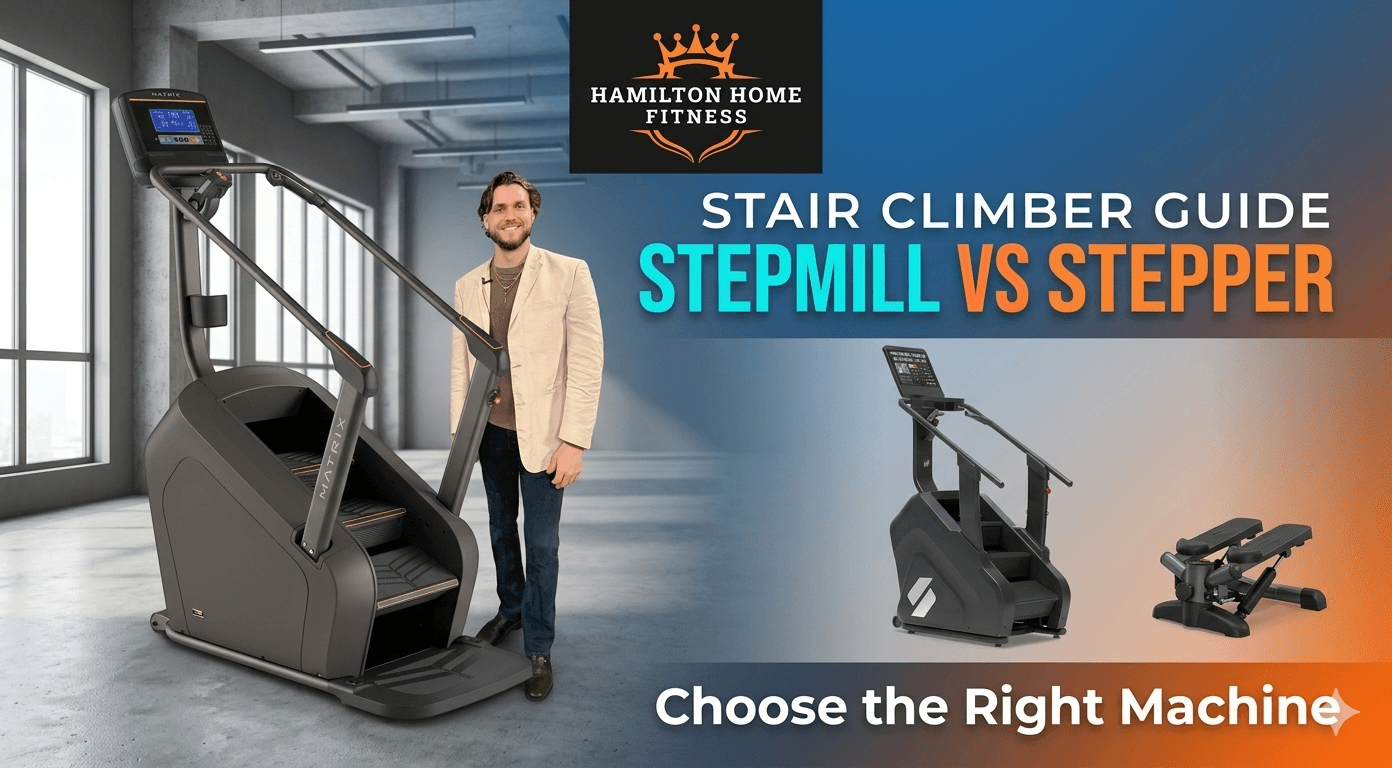
Getting this straight matters before you spend anything. A $200 mini stepper and a commercial stepmill share a category name but train you very differently—one is a light cardio add-on, the other is a serious conditioning tool. Match the machine to the job, not to the label.
The four machine types at a glance
Here's how the four common "stair" machines differ in motion, intensity, and who they suit.
Machine type | Motion | Intensity | Best-fit user |
Stepmill / climbmill | Revolving staircase you climb continuously | High, scalable | Athletes, hybrid lifters, serious conditioning and glute work |
Stair stepper | Two pedals pressed down against resistance | Low to moderate | General fitness, joint-sensitive users, steady-state cardio |
Mini stepper | Compact twin pedals, short range of motion | Low | Light home cardio, deskside movement, beginners |
Vertical / escalator climber | Upright climbing with arm involvement | High | Full-body conditioning, time-efficient interval work |
The practical takeaway: if your goal is glute development and climbing carryover, you want a revolving stepmill, not a pedal stepper. The pedal machines are fine for low-impact cardio, but they can't reproduce the full step height and hip extension that make a stair climber so effective for the posterior chain—which is exactly what the next section gets into.
Why a stepmill builds glutes
Stepping up against gravity drives repeated hip extension—the primary job of the glutes—so a stairmill loads your glutes and hamstrings more directly than walking on the flat. The taller the step, the bigger the stimulus.
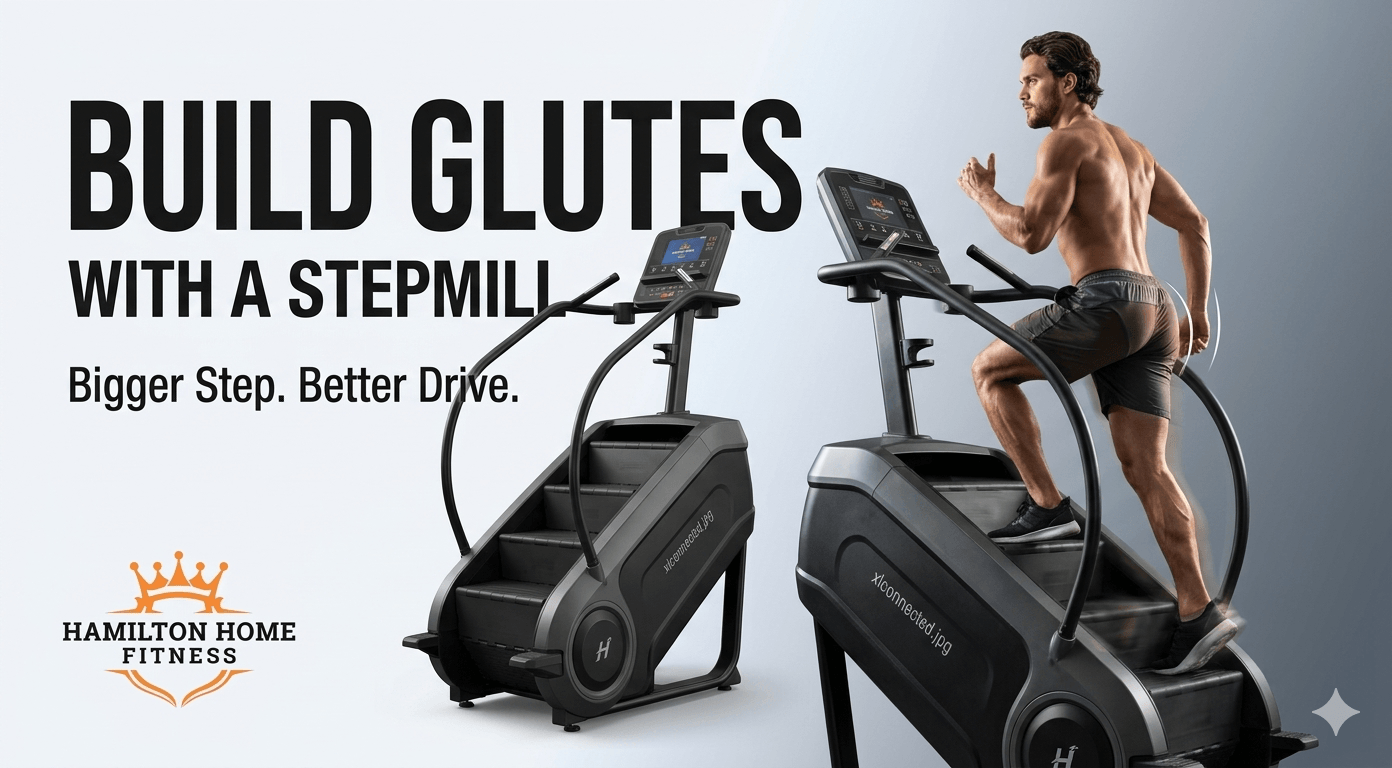
Each step is a single-leg drive that moves the hip from a flexed position to a fully extended one under your bodyweight. That motion recruits the glute max and hamstrings as the prime movers, with the quads and calves assisting, and because the stairs keep coming, the posterior chain stays under tension the whole session. Research on lower-body training consistently points to loaded hip extension as one of the main drivers of glute activation, which is exactly the pattern a stepmill repeats hundreds of times.
A treadmill incline helps too, but not the same way. Walking uphill raises glute involvement compared with flat ground, yet your stride stays short and fast, and much of each step is spent absorbing ground contact. A StairMaster instead forces a deliberate step-up through a larger range of motion on every rep, so the glutes and hamstrings work through more range with far less pounding.
Step height is the variable that scales all of this. Flagship stair mills use larger floating steps—the STEPR XL+ and its 9-inch floating steps sit at the tall end of the range—which let taller users and bigger feet drive through a fuller hip extension on each step. A deeper, taller step is designed to increase the demand on the posterior chain, which is why athletes chasing glute development tend to favor a true stepmill over a pedal stepper.
Is a stair climber low-impact?
A stair climber is lower-impact than running because there's no flight phase and no repeated landing shock driving through your joints. But it isn't zero-impact — your knees, hips, and back still work under load — so it suits many joint concerns only when you build intensity gradually and keep your form controlled.
The reason it's gentler comes down to ground contact. Running sends several times your bodyweight through each leg every time you land. On a stair climber you step rather than land, so the peak loads are lower and more even, which is why it's so often used as knee-friendly, hip-friendly cardio and as a way to hold fitness during an impact-related injury.
That gentleness has limits, and how it applies depends on the person. A runner sidelined by shin splints or plantar fasciitis can often keep an aerobic base on a stair climber while the impact-driven injury settles, as long as it stays pain-free. Someone returning to exercise postpartum may find the upright, steady motion manageable, but pelvic-floor and core recovery should come first. An older or master athlete gets a joint-sparing option with handrails for balance—provided they don't lean their body weight into the rails and quietly turn it into an easier workout. If you're building cardio around an injury or a recovery, it's worth browsing low-impact and rehab-focused equipment as a category rather than assuming one machine fits.
For knee and back concerns specifically, range of motion is the lever you control. Driving through a deliberate, upright step protects the joint; collapsing into deep knee flexion or hunching over the console does not. If a movement provokes pain, that's the signal to back off the intensity or stop — not to push through it.
A note on safety: This is general information, not medical advice. If you have a history of knee, hip, or back problems; are pregnant or postpartum; or are returning from an injury, clear stair-climber training with a physician or physical therapist before you start and stop and seek guidance if you feel pain.
Heart rate zones and fat loss
For fat loss, most people get the best return from longer, steadier Zone 2 efforts plus the occasional interval session. For conditioning, shorter and harder Zone 3–4 work raises your aerobic ceiling. The stair climber makes both easy to control because effort scales cleanly with speed and resistance.
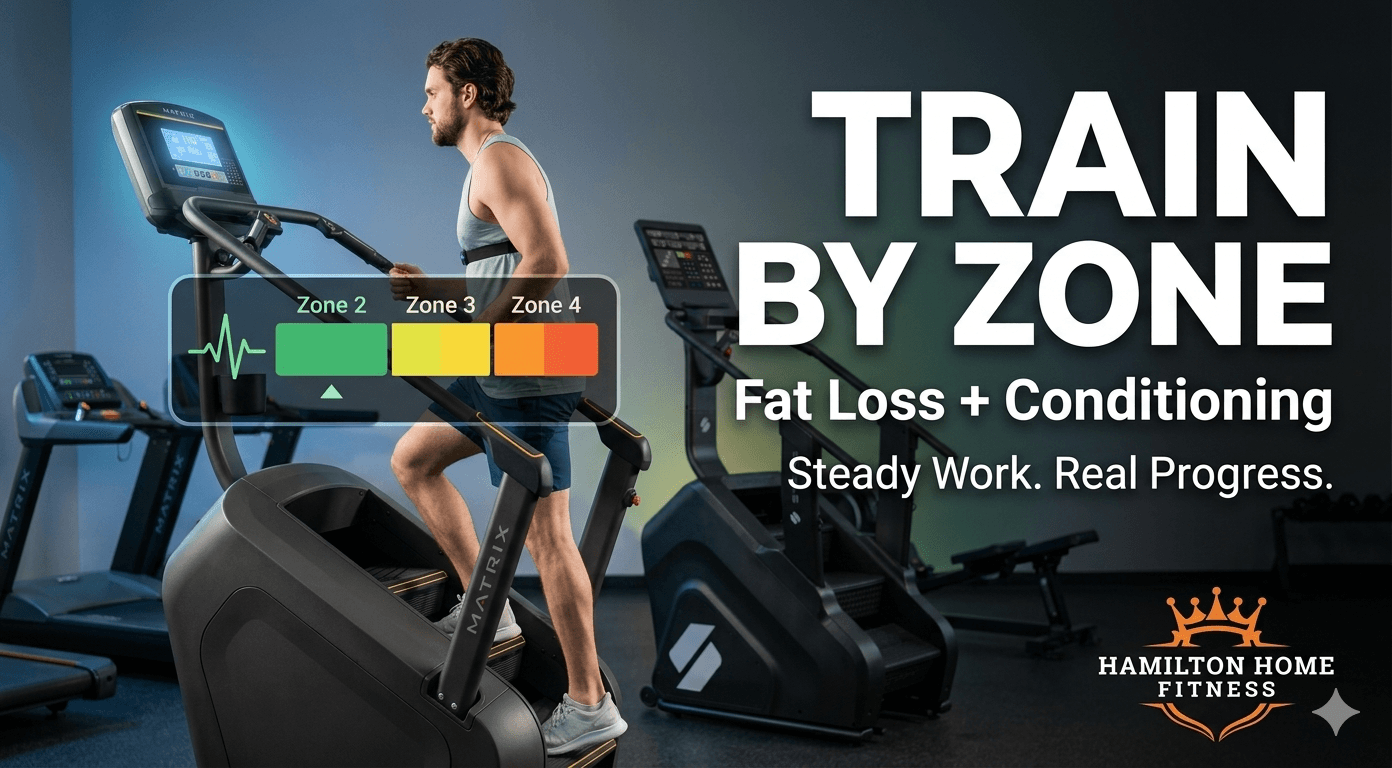
The mistake to avoid is treating every session as a max effort. Hard sessions drive conditioning but cost recovery; steady sessions build the aerobic base and burn calories without wrecking you for the next day. Knowing which one you're doing — and why — is what separates a training plan from random sweat.
Stair climber heart rate zones
Use these zones to match your stair-climber session to your goal. Heart-rate percentages are general ranges; let perceived effort confirm them.
Zone | How it feels | Primary goal | Sample duration |
Zone 2 | Conversational, sustainable | Fat loss, aerobic base (LISS) | 30–60 min |
Zone 3 | Working and talking gets harder | Aerobic capacity (MISS) | 20–40 min |
Zone 4 | Hard, short sentences only | Conditioning, threshold | 20–40 sec on / repeat |
Zone 2 is the workhorse for body recomposition and endurance because you can accumulate real weekly volume in it. Zone 4 intervals—short, hard pushes with recovery between—lift VO₂ max and lactate threshold, but a little goes a long way. Most people only need a couple of true interval sessions a week.
Fat loss vs conditioning
Pick your protocol based on whether the goal is fat loss or performance—not both at maximum at once.
If fat loss is the priority, anchor the week in steady Zone 2 volume and progress by adding minutes before adding intensity. If conditioning is the priority, keep some easy aerobic work but make the hard sessions genuinely hard and fully recovered. Trying to push intensity and volume every session is the classic way to stall both.
What makes zone training actually repeatable is feedback. Guessing your effort drifts over time; seeing your heart rate keeps you honest. A connected stairmill with onboard heart-rate tracking lets you hold a target zone session after session, which is where the real progress comes from—consistent, measured work, not occasional heroics.
Does it replace running for athletes?
A stair climber can replace some of your running volume, and for climbing-specific events—hiking, rucking, trail running, and mountaineering—it's often the better tool. But it doesn't reproduce running's ground-contact mechanics, so marathoners use it as low-impact aerobic and posterior-chain work rather than a full substitute.

The deciding factor is specificity. Your body adapts to the exact demand you give it, so the closer a machine matches your event, the more it carries over. Climbing under load is precisely what a stair mill trains—which is why it transfers so well to some events and only partially to others.
Where it shines: a hiker prepping for a fourteener or the Camino can build the uphill leg strength and aerobic base the trail actually demands without beating up their joints on pavement first. A rucker training for a GORUCK event gets loaded with vertical work that mirrors the real thing—add a weighted pack, and the carryover is direct. For trail runners, the climbing strength banks straight into long ascents.
Where it falls short: marathon and half-marathon racing happen on flat ground at running cadence, and the stair climber can't teach your legs to absorb and return impact the way road miles do. So a marathoner uses it to add aerobic volume on easy or recovery days, to protect the knees during a high-mileage block, and to strengthen the glutes and hamstrings that stabilize a long stride—but the key race-specific sessions still need to be run.
For athletes who want the machine to handle real conditioning work, step rate matters. A higher steps-per-minute ceiling—the STEPR XL Classic tops out around 190—opens up interval and threshold sessions, not just steady climbing, so a hybrid athlete can run their hard efforts on it when impact needs to come down.
Ceiling, footprint, and capacity
A full revolving stepmill is tall, so the height that matters is the machine's standing platform plus your own height with room to spare—usually more clearance than a treadmill needs. Measure the room and check the maximum user weight before you buy, and choose a home-oriented unit if your ceiling is low.
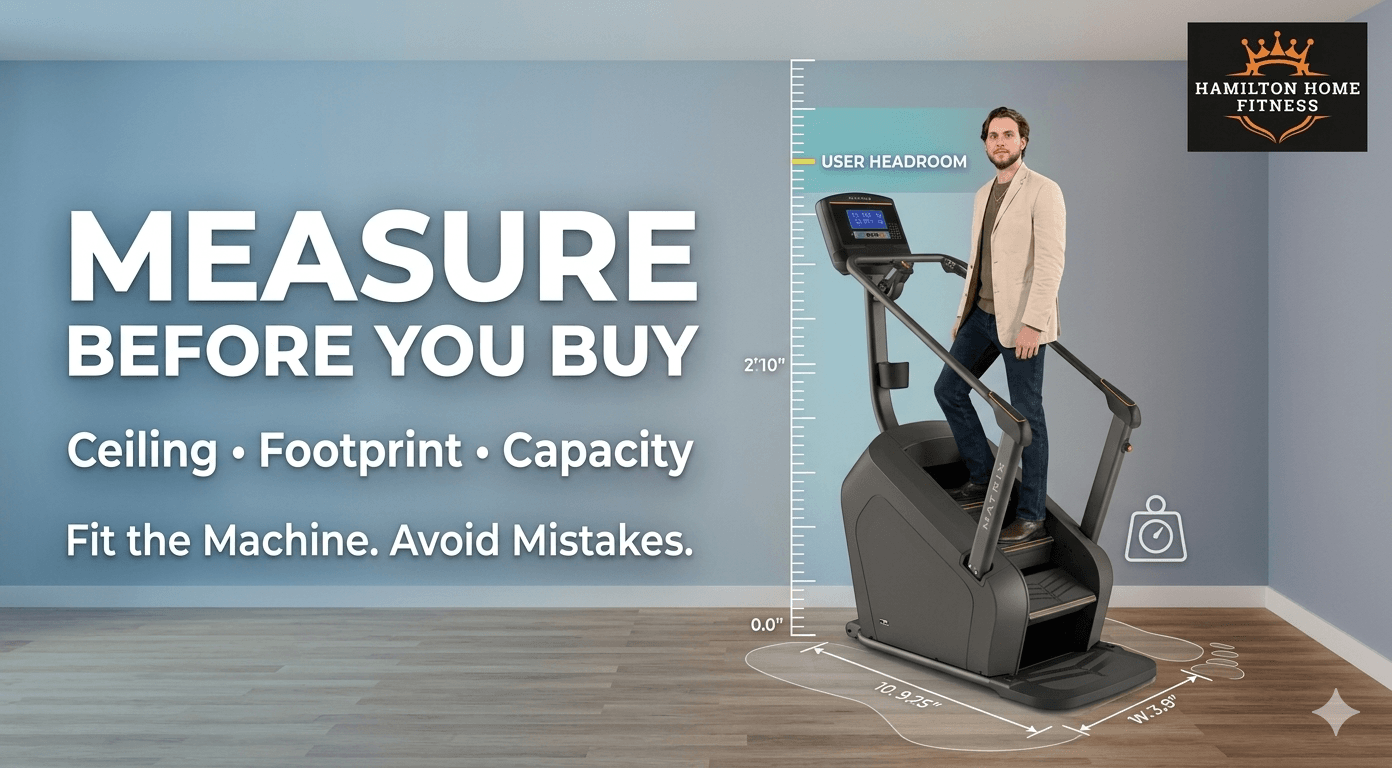
This is the step most people skip, and it's the one that turns a great machine into an expensive mistake. A stepmill that won't fit under the ceiling or can't be carried through the door is a problem freight can't fix after delivery.
How to measure ceiling height
Add the machine's standing-platform height to your full height with arms relaxed, then leave clearance above that.
Work through it in order:
Measure your ceiling at the exact spot the machine will sit—finished height, not the joists.
Find the machine's platform height from the product page (how high the top step sits off the floor).
Add your height standing on that platform, plus a few inches of headroom so you're not brushing the ceiling at full extension.
Confirm the footprint fits with walking space around it, not just the unit's length and width.
Check the delivery path—doorways, hallways, and stairwells the freight has to clear—for obstructions.
Tall users need to be especially careful here, since the platform height stacks on top of an already-tall frame. The other half of fit is capacity: confirm the maximum user weight rating, which varies by model, before assuming a machine suits a larger or heavier athlete.
If your ceiling is the constraint, you don't have to give up the modality. Home-oriented climbmills are engineered for exactly this—the Matrix ClimbMill C50, built for lower home ceilings, fits rooms that can't take a full commercial-height stepmill, while flagship commercial units need more headroom. Verify the exact platform height, total height, and weight rating on the product page or with the team before you commit, since these numbers differ between models.
Choosing your stair climber
Choose by three filters, in this order: training goal, then ceiling and footprint, then budget. Flagship connected stepmills suit athletes and studios that want the full feature set; home-oriented climbmills suit tighter rooms and tighter budgets without giving up the climbing motion.
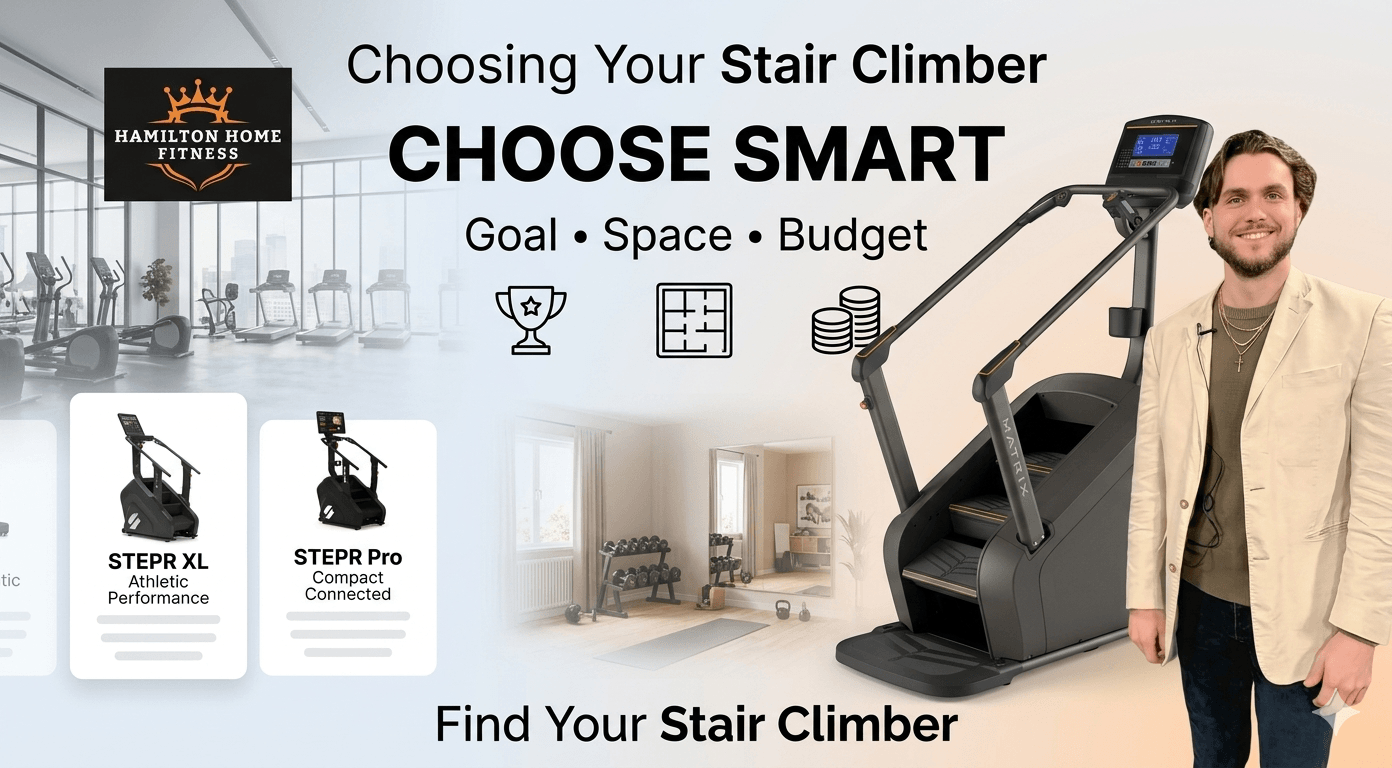
Run the filters in order, and the decision gets simple. A goal narrows the category, space rules out anything that won't fit the room, and budget settles the final shortlist—not the other way around. Letting price lead is how people end up with a machine that doesn't match how, or where, they actually train.
Match the machine to your goal
Use this table to match a model to how — and where — you'll train.
Model | Best-fit user / goal | Console & connectivity | Space note |
STEPR XL+ Connected | Athletes, studios wanting the full feature set | 27" HD touchscreen, on-demand classes, streaming, no required membership | Tall commercial frame — needs more ceiling |
STEPR XL Classic | Athletes wanting conditioning without the screen | LED console, high step-rate ceiling | Tall commercial frame — needs more ceiling |
STEPR Pro+ | Home and small studios wanting connected zone training | Touchscreen, onboard heart-rate tracking | Compact footprint |
STEPR Pro Classic | Home users wanting a straightforward climber | Streamlined console | Compact footprint |
Matrix ClimbMill C50 | Lower-ceiling rooms, joint-friendly home training | LED or touch console options, Bluetooth | Designed for lower home ceilings |
The pattern is straightforward: pick the flagship XL line if you want commercial-grade conditioning and have the headroom, the Pro line for a compact connected option, and the ClimbMill C50 when ceiling height is the deciding constraint.
When you're ready to see the differences for yourself, compare the commercial stair climbers side by side so you can line up console, step height, and footprint against your room and goal. And if you're still weighing whether you need a full commercial build or a home-grade unit, it's worth reading the difference between commercial and residential builds before you decide.
FAQ
How long should you stair climb for cardio? Most people get solid cardio from about 20–30 minutes at a steady effort. Go longer for steady-state fat loss, or shorter with hard intervals when the goal is conditioning.
How many calories does a stair climber burn per hour? Roughly 450–650+ calories per hour for most adults, though the figure varies with your body weight and how hard you push. Health sources like Harvard Health publish estimates in this range, so treat any single number as a ballpark, not a guarantee.
What is the maximum user weight on a commercial stair climber? Many commercial units support roughly 350–500 lb, but the rating varies by model. Confirm the exact maximum user weight on the specific product page before buying, especially for larger or taller athletes.
Do you need a subscription to use a connected stair climber? It depends on the model. Some connected stepmills include on-demand classes and streaming with no required membership, while others tie their content to a paid app, so check what's included before you assume there's a monthly fee.
How loud is a commercial stair climber at home? Quality commercial units run on quiet drive or induction systems and produce a steady mechanical hum rather than loud impact noise, which makes them workable in homes and apartments. If a specific decibel level matters to you, confirm it on the product page rather than assuming.
Final Thought
You now know what a commercial stair climber actually does: it builds your glutes and posterior chain through loaded hip extension, conditions your heart across controllable zones, and spares your joints in a way running can't—which is why so many hybrid athletes, hikers, and lifters have made the switch from the treadmill.
The decision itself is simple once you order it right: pick by goal, then space, then budget.
When you're ready to put that into practice, contact the Hamilton Home Fitness team for fit matching, and they'll help you line up ceiling height, weight capacity, and your training goal against the right model—so the machine that arrives is the one your room and your body were built for.