Introduction
Choosing between a Smith machine and a power rack is not a small home gym decision. Either one can cost thousands, arrive by freight, and occupy the same training space for years.
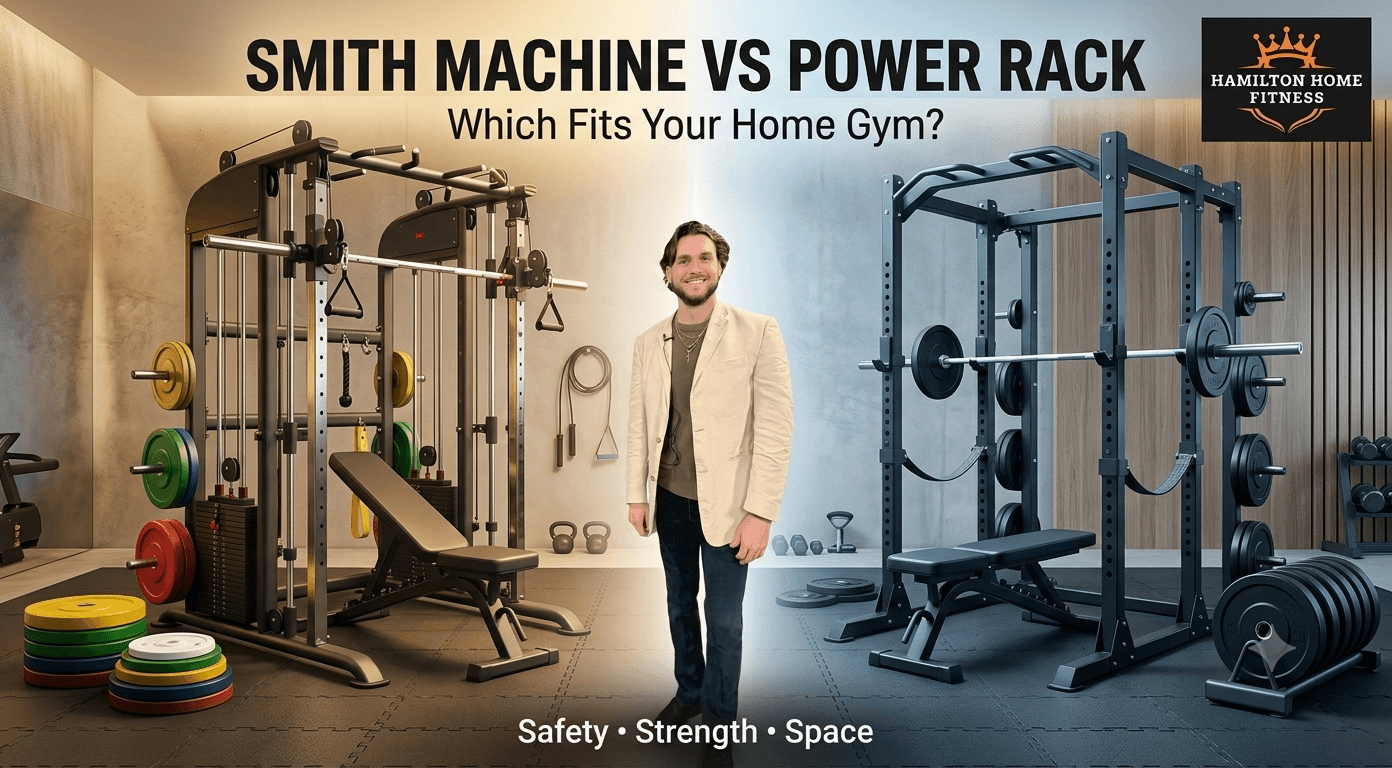
A Smith machine guides the bar along fixed rails, while a power rack gives you full control of a free barbell with adjustable safety hardware. For a solo lifter, the better choice depends on more than convenience.
This comparison breaks down solo lifting safety, strength carryover, usable footprint, ceiling clearance, and total setup cost. It also explains when a hybrid Smith-and-rack trainer may deliver more value than choosing either system alone.
Smith or Rack: Quick Verdict
A power rack is usually the stronger long-term choice for lifters who want free-weight skill, unrestricted barbell movement, and direct carryover to squats, bench presses, and overhead presses. A Smith machine may be the better fit when guided movement, quicker reracking, controlled hypertrophy work, or shared beginner use matters more.
Decision factor | Smith machine | Power rack |
Bar movement | Guided along fixed rails | Fully controlled by the lifter |
Solo safety | Hooks and adjustable catches | Pins, straps, or spotter arms |
Best training fit | Controlled volume and hypertrophy | Free-weight strength and technique |
Learning demand | Lower balance requirement | Higher technique requirement |
Expansion | Depends on the model | Usually supports more attachments |
Best suited for | Guided or shared training | Serious free-weight progression |
How Bar Path Changes Training
A Smith machine controls most horizontal bar movement by guiding the bar along fixed rails. A power rack does not guide the bar at all; it gives you space to control a free barbell while safety pins, straps, or spotter arms protect a failed repetition.
Guided Rail vs Free Bar
A guided rail handles part of the bar-control task, while a free bar requires you to manage balance and direction throughout every repetition.
That reduced balance demand is one reason a Smith machine squat may feel easier to control. It can help you focus more on leg drive and effort, especially during high-repetition sets or training close to failure.
Inside a power rack, your stabilizer muscles and movement skills play a larger role. You must control the bar path, maintain balance, and adjust naturally as your hips, knees, and torso move. This makes the rack more suitable for developing free-weight technique and improving performance in barbell squats, presses, and similar lifts.
Rail Angle and Starting Weight
Smith machines do not all move or weigh the same. Some use vertical rails, while others follow a slightly angled path that may affect foot placement and bench positioning.
A counterbalanced Smith bar may also feel much lighter than a standard Olympic barbell before plates are added. Check the rail direction, stated starting resistance, and safety-catch positions before comparing models. Hamilton’s guide explains how Smith machine starting weight varies between different systems.
Which Is Safer for Solo Lifting?
Both systems can support safe solo training, but neither protects you automatically. Smith machine safety depends on correct catch height, bench or body alignment, and your ability to rotate the bar into its hooks. Power rack safety depends on properly positioned pins, straps, or spotter arms and a stable rack setup.
Smith Catch Setup
The rotating hooks help you rerack a Smith bar, but the adjustable safety catches are what stop it from descending too far during a failed repetition.
Before a Smith machine squat, set the catches slightly below your lowest controlled depth. For a Smith machine bench press, position it low enough for a full repetition but high enough to keep the bar from reaching your chest or neck if you cannot complete the lift.
Bench placement also matters. The bench must align with the machine’s vertical or angled rail path so the bar travels comfortably over the correct pressing position. Do not rely only on a last-second wrist rotation to escape a failed repetition. Hamilton’s guide to bench pressing without a spotter explains the setup considerations in more detail.
Rack Safety Setup
A power rack can act as a mechanical spotter only when its safety pins or straps sit below the completed repetition but above the dangerous failure point.
For squats, set the safeties just below your normal bottom position. This allows full depth while giving you a controlled place to lower the bar if you cannot stand back up.
For bench presses, position the safeties so the bar can touch your chest during a normal rep but rests above your body when your chest is no longer elevated. Lift inside the rack whenever possible, and use spotter arms only within their stated limits.
J-hooks, safeties, and the bench must all be aligned before loading heavy weight. The rack should also be stable and anchored when the manufacturer requires it.
Strength, Muscle, and Carryover
Both systems can build muscle and strength when training includes progressive overload, consistent effort, and suitable exercise selection. The main difference is specificity: free-weight squats and presses improve most directly when you regularly practice those exact movements, while Smith machine training builds strength within a guided bar path.
Muscle Growth
A Smith machine can build substantial muscle because the target muscles still work against progressive resistance.
Its guided bar path reduces the balance demand, which can make it easier to focus on the working muscles during exercises such as Smith machine squats, incline presses, split squats, calf raises, and rows. Some lifters also feel more confident training close to failure because they can set the safety catches before beginning the set.
That does not make a Smith machine automatically better for hypertrophy. Muscle growth still depends on exercise technique, training volume, effort, recovery, and gradually increasing the challenge over time.
Free-Weight Carryover
Strength carries over most reliably when your training movement resembles the movement you want to improve.
A lifter who wants a stronger free-weight squat, bench press, or overhead press must practise controlling an unrestricted Olympic barbell. A power rack supports that goal by allowing the natural balance adjustments, bar path control, and motor learning required for free-weight lifting.
For example, a bodybuilder may use a Smith machine to perform controlled, high-effort leg and chest work without needing to master every balance demand. A powerlifter, however, will usually gain more direct competition carryover from training the squat and bench press inside a power rack.
Choose based on the result you want: guided resistance can build muscle and general strength, while a power rack offers the more direct route to improving free-weight performance.
Space, Ceiling, and Total Cost
Frame dimensions alone do not show how much room a Smith machine or power rack actually needs. You must also allow space for the loaded bar, plate changes, bench movement, pulley travel, pull-ups, storage pegs, walkways, flooring, delivery, and assembly.
Measure the Usable Zone
Measure the complete training zone, not only the steel frame listed in the product specifications.
Start with the machine’s width, depth, and height. Then add clearance for a seven-foot Olympic barbell, loading plates from both sides, moving an adjustable bench, and walking safely around the station.
Ceiling height also affects the decision. A tall power rack may physically fit in a basement but leave too little headroom for pull-ups. A Smith machine with a cable crossover may require extra rear clearance for weight stacks, while storage pegs can increase its usable width after plates are loaded.
Check doorway widths, staircases, corners, and freight access before ordering. For a complete room plan based on real operating clearances, you can plan the entire room around real clearances.
Count the Full Setup Cost
The cheaper frame is not always the cheaper finished station.
Cost item | Smith machine | Power rack |
Bench | Usually required for presses | Usually required for presses |
Barbell | Built-in guided bar | Separate Olympic barbell required |
Weight plates | Required for plate-loaded models | Required |
Safety hardware | Usually integrated | May require pins, straps, or spotter arms |
Flooring and storage | Often needed | Often needed |
Cable training | Model-dependent | Usually requires an attachment or upgrade |
A complete station may also require freight delivery, two-person assembly, floor anchoring, collars, and future attachments. Compare compatible weight benches for rack and Smith setups and the required barbells, plates, and collars before deciding which option truly costs less.
When a Hybrid Is the Better Buy
A hybrid system earns its space when you will regularly use guided Smith exercises, free-weight barbell lifts, and cable training but cannot fit three separate stations. It is usually unnecessary if your routine only requires squats, presses, pull-ups, and a few rack attachments.
When One Footprint Wins
A hybrid saves space only when it replaces equipment you would otherwise purchase and use.
It may suit a shared home gym where one person prefers Smith machine exercises while another trains with a free barbell. A trainer or serious home lifter may also benefit from having cable crossovers, pulleys, and multiple pressing or rowing options in one strength zone.
However, these systems are heavier, more complex to assemble, and often harder to relocate. Before buying, confirm that the cables, Smith bar, rack safeties, bench, and plate storage can all be used without interfering with one another. Compare available Smith machines and all-in-one home gyms based on the functions you will genuinely use.
Three Hybrid Models to Compare
Hamilton offers several systems worth comparing:
The Vortex VX1000 Power Rack with Functional Trainer combines rack, guided-bar, and cable-training functions.
The Ape Commercial Smith Machine with Rack Universal Trainer may suit buyers seeking a heavier commercial-style station.
The BodyKore MX1162-MF Smith/DAPS offers a premium Smith-and-adjustable-pulley configuration.
Compare current dimensions, included attachments, weight stacks, loading systems, warranty terms, freight requirements, and assembly needs before choosing.
Which Setup Fits Your Lifting?
Experience level alone should not decide between a Smith machine and a power rack. A beginner who wants to learn barbell lifts may benefit more from a rack, while an advanced bodybuilder may prefer the Smith machine for controlled, high-effort sets.
Beginner and Shared-Use Buyers
A beginner may feel more confident with the Smith machine’s predictable movement and quick reracking system. It can also work well in a shared home gym where family members have different strength levels or limited experience.
However, a properly coached beginner can safely learn squats and presses inside a power rack. The better choice depends on the training method they plan to follow long-term. Anyone returning from an injury or managing movement limitations should seek guidance from a qualified fitness or healthcare professional before choosing equipment.
Advanced and Sport-Specific Buyers
Advanced does not automatically mean power rack. Powerlifters and lifters focused on free-weight performance will usually benefit more from power racks and cages. Bodybuilders may prefer a Smith machine for controlled muscular loading.
Choose a power rack for free-weight progression, a Smith machine for guided volume, or a hybrid only when both training styles will be used consistently.
FAQ
Is a Smith machine worth it for a home gym?
Yes, when guided solo lifting, controlled bodybuilding work, predictable setup, or shared beginner use matches your needs. It may offer less long-term value if your main goal is unrestricted barbell training and direct carryover to free-weight squats and presses.
Can you bench press in a Smith machine safely?
Yes, provided the bench is correctly aligned, the rail path suits your pressing position, and the lower safety catches are set before the lift. Do not rely only on rotating the bar into the hooks if a repetition fails.
Final Thought
Choose a power rack when free-weight progression, barbell technique, and movement freedom are your priorities. Choose a Smith machine when you value guided lifting, controlled training volume, and straightforward solo setup.
A hybrid makes sense only when you will consistently use the Smith bar, free-weight rack, and cable system. Before ordering, confirm the complete footprint, ceiling clearance, safety hardware, required accessories, delivery access, and total setup cost.
Match the equipment to how you plan to train for years—not simply to which option feels easier today.