
Introduction
Your bench hasn't moved in months. Not because the reps got harder—because you train alone, and the rep you can't finish is the one you can't escape.
The fear is rational. The fix is mechanical. Bench pressing without a spotter is safe once something in the room can catch the bar without you. The danger isn't the weight. It's having no exit when a rep fails.
Four things fix it: where to set your safeties, whether your bench fits inside a rack, how to bail out of a failed rep, and how hard to push when nobody's watching.
Where to Set Your Safety Pins or Arms
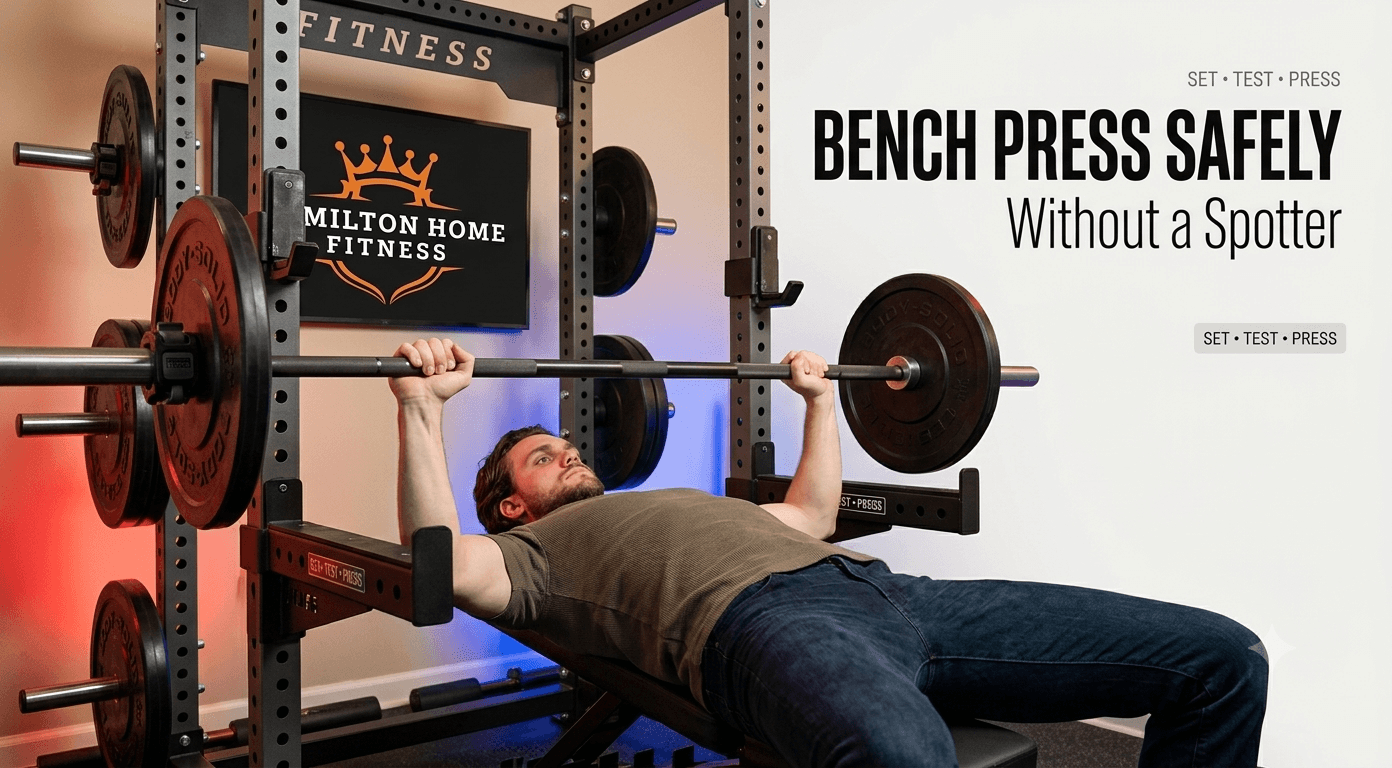
Set your safety pins or spotter arms just below the point where the bar touches your chest at the top of your arc—usually one hole down. Level with your chest, they block your reps. Too far below, and the bar reaches your ribs before the steel catches it.
That gap is a window, not a number. The ceiling is the height that stops you finishing a clean rep. The floor is the height that lets the bar settle on you before it lands. You're looking for the space between.
This is why a fixed measurement in inches fails. Your touch point depends on your arch. Press with a pronounced arch, and your chest sits higher than it does lying flat, so the correct hole moves with it. Two lifters using the same bench in the same rack often end up on different settings.
Straps and flip-down safeties follow the same rule. Only the hardware changes.
The Empty-Bar Test
Before you load a single plate, lie down with an empty bar and run the failure you're afraid of.
Set the pins where you think they belong.
Unrack with your shoulder blades pinned back, lower the bar to your chest, and stop.
Flatten your arch and let the bar go down onto the safeties.
Confirm it lands clear of your ribs and throat.
Slide out from underneath without moving the bar.
If step three takes effort, they're too low. If the bar hits steel on a normal rep, it's too high. Move one hole and run it again.
Will Your Bench Fit Inside the Rack?
Measure three things before you assume your bench fits. The base length against the rack's internal depth, the pad height against the rack's hole spacing, and the pad centerline against the uprights. Plenty of standard benches are simply too long to sit inside a cage.
What to measure | Why it matters | What goes wrong if you skip it |
Bench base length vs. rack internal depth | The whole bench has to sit inside the frame, not just the pad | The bench sits half in, half out—and your touchpoint ends up outside the safeties entirely |
Pad height vs. rack hole spacing | The correct safety hole has to exist at your touch height | Your only options are one hole too high or one hole too low |
Pad centerline vs. the uprights | You need to lie centered under the bar | You press off-center, or the uprights sit in your press path |
The half-in problem is the one that catches people out. If the head of the bench pokes past the front uprights, the bar comes down over the open floor—the safeties are behind you, doing nothing.
Some benches are built specifically around this. The Body-Solid GFID31B, built with a shortened base for rack use, is a flat/incline/decline bench designed to fit inside power racks, Smith machines, and multi-press racks, with a manufacturer-stated capacity over 600 lb.
Fit is one problem. Flex is another. If your bench holds position but shifts under a heavy top set, that's a stability issue, and a rigid flat bench for heavy pressing is the fix.
Cage, Half Rack, or Squat Stand?
A full cage is the safest solo pressing station because the safeties run the length of the frame. A half rack works when the spotter arms are rated for your load and set correctly. A two-post squat stand with no catch bars is not a solo benching setup.
The difference comes down to where you lie and what stops the bar. Inside a cage, you're surrounded—the safeties span front to back, so it doesn't matter much where along the frame your bench ends up. That margin for error is why solo lifters keep choosing cages.
A half rack moves you out in front of the uprights. The spotter arms cantilever forward, and they catch a failed rep just as well, but only across the length of the arm. Your bench position matters more here, and so does the arm's load rating. Set it up right and it's a genuinely good solo option with easier access and less bulk.
A squat stand gives you two posts and J-cups. Nothing catches anything. It's fine for getting a bar off the floor and wrong for pressing alone.
Whatever you're looking at, check one thing: does it have a catch system rated for what you actually lift, and does it adjust to a hole where your touch point lands? Compare full cages, half racks, and squat stands once you know which answer your room can take.
How to Bail Out of a Failed Rep
If the bar stalls, stop pressing immediately and lower it under control to your lower chest. Flatten your arch so it settles onto the safeties. Without safeties, roll the bar down your torso toward your hips, then sit up and lower it to the floor.
The mistake is fighting it. Every second you grind against a rep you've already lost burns the strength you need to get out from under the bar. Decide fast. The moment it stops moving up, it's over — switch from pressing to escaping.
The Roll of Shame, Step by Step
The roll of shame is an escape, not a plan—but it's the one that keeps a loaded bar off your throat.
Lower the bar to your lower chest, near the bottom of the sternum. Never let it drift up toward your neck.
Keep your feet planted.
Roll it down your stomach toward your hips.
Sit up as it reaches your lap, then lower it to the floor in front of you.
It hurts, and it will bruise. Use it once, then fix the setup that made it necessary.
Why the Thumbless Grip Costs You
Wrap your thumbs around the bar every set, especially when nobody is in the room. A thumbless grip leaves nothing holding the bar in an open palm. Sweat, a shifting wrist, or grip fatigue late in a set—and it slides straight down onto your chest or face.
How Hard to Push When You Lift Alone
Train close to failure, not to it. The rep you can't finish is the rep that pins you, so the practical stopping point when you lift alone is the last rep you're confident you can complete cleanly. Save all-out attempts for sessions where your safeties are set and tested.
In practice that means stopping with one rep in reserve—one you could have done, but didn't. Say your top set is five at 205. Work up with a few warm-up sets, then pick a weight where the fifth rep is hard but the bar still moves at a steady speed. If rep four slows to a crawl, you've picked wrong for a solo session.
You lose very little this way. What you gain is a set that always ends with the bar back on the hooks.
If you're training around a shoulder, chest, or wrist injury or returning to pressing after a layoff or rehab, check your progression with a qualified coach or clinician before loading heavy.
Your Pre-Press Safety Check
Run the same four checks before every heavy set. Safeties set and tested with an empty bar, collars matched to your setup, phone within reach, and someone who knows you're training. It takes under a minute, and it's the difference between an inconvenience and an emergency.
Safeties tested empty — not eyeballed, tested
Collars on if your safeties are set; off if they aren't
Phone within arm's reach of the bench, not across the room
Someone knows you're lifting and roughly when you'll be done
Run it cold, every session. If a measurement in your room just ruled out the setup you had in mind, have the layout planned around your actual room before you buy anything.
FAQ
Should I bench without collars so I can dump plates, or is that more dangerous?
It depends entirely on whether you have safeties. With safeties set correctly, keep collars on—the bar never needs to be tipped. Without safeties, going collarless gives you a way to dump the plates, but it's a fallback, not a system: sliding plates damage floors, bend bars, and endanger anyone nearby. If you're already there, quick-release barbell collars let you switch between setups in seconds.
Are dumbbells a genuinely safer option than a barbell for solo pressing?
Partly. Dumbbells remove the pinning risk because nothing traps you, but they introduce a different one — a heavy pair is hard to control at failure and awkward to set down. Finish a set by bringing them to your chest, tucking your chin, and sitting up with them rather than dropping them from lock-out. They work well at light and moderate loads, and they're a real option while a rack is still on the list.
Is a Smith machine safer for solo bench pressing?
Only when its adjustable stops are set. The racking hooks are not the safety system — they need a deliberate wrist rotation, which is exactly what you can't manage at the point of failure. With the stops set just below the bottom of your press, a Smith machine is a workable solo option.
Do you need a power rack to bench press at home?
Not strictly, but you need something that can catch the bar without you. That means adjustable safeties, spotter arms, or an Olympic bench with integrated safety catches. A bench with no catch system of any kind is the one setup that leaves you with no exit.
Final Thought
The weight you stopped adding was never a strength problem. It was an exit problem—and exits are measurable.
You now know which part of your setup is missing one. If published specs won't tell you whether a specific bench sits inside a specific rack, check bench and rack compatibility before you order. Hamilton Home Fitness ships nationwide from Tennessee as an authorized dealer.