
Introduction
The treadmill stays clean. So does the leg press, because the transfer onto it is one no resident will attempt alone. Meanwhile, the resistance bands in the corner get used every single day.
If you run a fitness room in an independent living, assisted living, or continuing care community, you already know that pattern. Senior living fitness room equipment gets approved on specification—capacity, footprint, warranty—and specification turns out to be a poor predictor of who actually sits down.
The room carries two jobs at once. It is a marketed amenity families ask about on tours, and it is part of a fall-reduction commitment. Both fail quietly when residents find the equipment intimidating.
What follows is what gets used, what makes it get used, how to split a limited room, the standards to hold equipment to, the layout for walkers and wheelchairs, what needs supervision, and what it costs. This page does not screen residents or replace your clinical team's assessment.
What Residents Actually Use Every Day
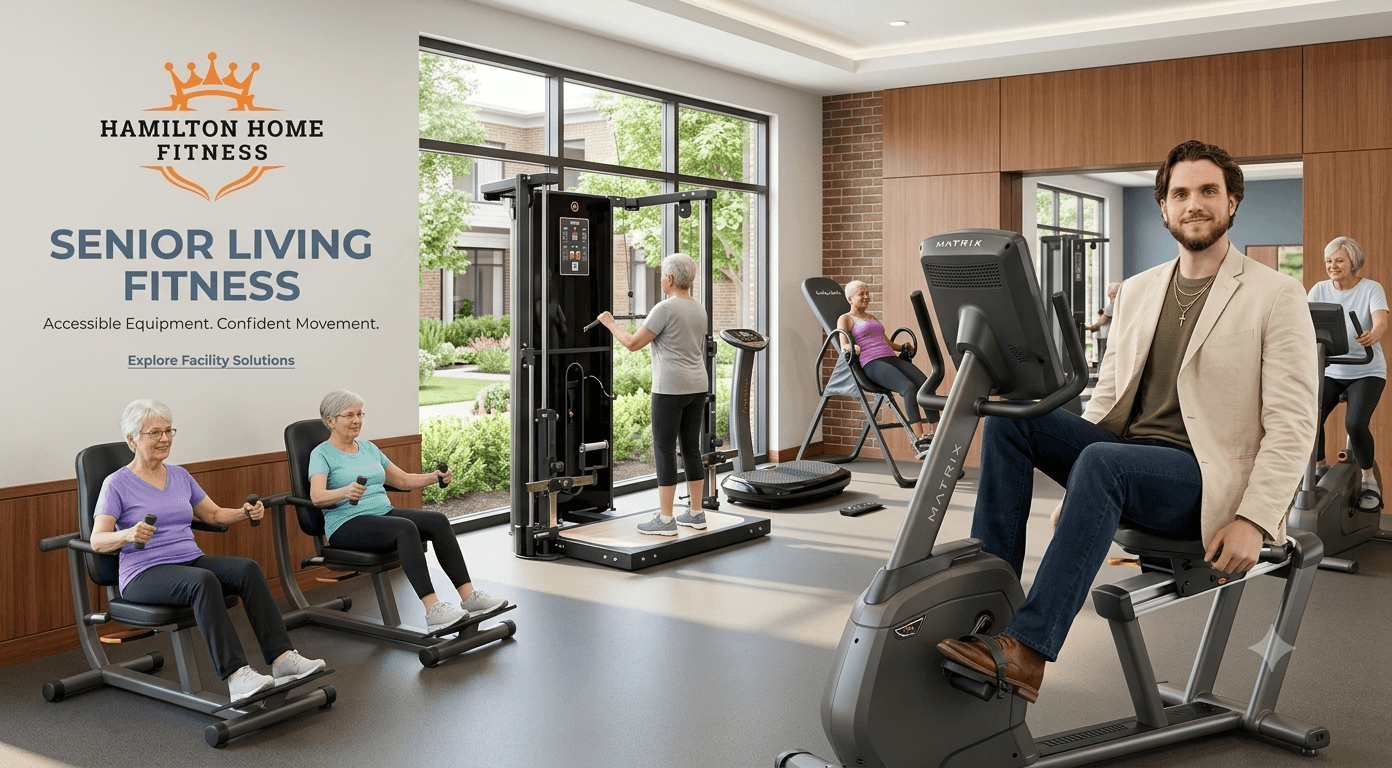
The pieces that earn their floor space in a senior living fitness room are low-impact and mostly seated: recumbent cardio, light resistance, balance and stretching tools, and a low adjustable step. They win for one reason—a resident can sit down and start within seconds, without asking anyone for help.
The idle side is just as consistent. Plate-loaded strength, upright bikes, and standard treadmills all ask the resident to do something before exercising—climb on, transfer across, or balance on a moving surface.
Equipment Type | Typical Use Level | Why |
Recumbent or step-through bike | High, daily | Sit down, no balancing. |
Upper body ergometer | High | Usable from a wheelchair |
Bands and light dumbbells | High, daily | No setup, no waiting |
Stability balls, mats, rollers | High in classes | Staff-led, low intimidation |
Low adjustable step | Moderate | Group programming staple |
Treadmill with handrails | Moderate | Walking pace, supervised |
Upright bike | Low | Mounting needs balance. |
Plate-loaded strength | Low | Transfer and setup barrier |
Recumbent Bikes and Seated Cardio
Recumbent and step-through bikes carry the highest daily use in most senior living fitness rooms, because a resident can sit, pedal, and stop without balancing on a moving surface. A walk-through frame and a lumbar-supported seat remove the two moments where hesitation starts—getting on and getting off.
An upright bike asks for a swing-over and a moment of single-leg balance. A treadmill asks a resident to step up onto a deck and then trust it. Seated ellipticals and upper-body ergometers sit closer to the recumbent end. When you shortlist recumbent bikes with step-through frames, check the step-on height and whether the seat slides rather than lifts.
What Makes a Machine Get Used
Four things decide whether a machine gets used: entry and step-on height, seat design and the transfer path onto it, where the handholds sit, and whether the controls can be read at a glance. Residents make that call in the first ten seconds at the machine, before any exercise starts.
Step-on height. Measure it yourself. If a resident has to lift a foot higher than a curb, most won't try.
Seat and transfer path. The transfer path is the route from a walker or wheelchair onto the seat. Sit down and get back up.
Handhold placement. Handles belong where hands land during a stand-up—not overhead, not behind the shoulder.
Control legibility. Read the console from the seat without leaning in. Large buttons, high contrast, one obvious start.
How to Split Cardio, Strength, and Balance
In a limited room, give roughly half the floor space to seated and low-impact cardio, a quarter to light strength, and the last quarter to balance and stretching. Cardio drives daily drop-in use. Balance work costs the least and often gets used the most, because it runs as staff-led group programming.
Picture a 500-square-foot converted lounge. That is two or three cardio pieces along one wall, a small selectorized or band-based strength corner, and an open floor area for chairs, mats, and balance and mobility equipment. The open area is the one people cut first when they run short. Cut it last instead—it holds your classes.
Consumables You Will Rebuy
Stability balls, foam rollers, bands, and step platforms are consumables, not capital equipment—plan to replace them on a rolling basis rather than once a decade. They take punishment, they walk off, and they cost almost nothing to refresh.
The scale is worth seeing. As of August 2026, stability balls run $21.00 to $23.00, 18-inch foam rollers $19.98, and an adjustable aerobic step $19.50. Prices change, but the ratio holds: the entire balance boards and stability tools layer for a full room usually costs less than freight on a single cardio machine.
Standards for Facility Equipment Must Be Met
Hold every piece to four lines on the spec sheet: rated user weight, application rating, upholstery and surface cleanability, and parts and service availability. Application rating is the one that decides survival. It separates equipment built for multi-user traffic from equipment that only looks the part on a showroom floor.
Application rating. Manufacturers grade equipment as residential, light commercial, or full commercial. Much of the seated cardio marketed to senior communities is rated residential. Put a residential bike in a room serving forty residents, and you are running a machine designed for one household through forty households of use. It will not last the warranty, and running it that way may void it. Ask for the rating in writing before you order.
Rated user weight. Check the number, then check whether it drops when the machine is used with a transfer.
Cleanability. Wipeable upholstery with sealed seams. Fabric absorbs, stitched seams trap, and staff cleaning between users needs surfaces that survive daily disinfectant.
Parts and service. Ask how long replacement parts stay available and who services the unit. A seven-year plan needs both. This is where facility-rated commercial equipment separates from consumer models that get discontinued in two years.
Laying Out the Room for Walkers
Plan 400 to 800 square feet for a basic room holding four to six pieces, then let circulation set the real capacity. A room's usable capacity comes from the space between equipment, not from the number of machines you can push against the walls.
Aim for 48 to 60 inches of clear circulation between pieces. A walker is about two feet wide, and its user needs more than that to turn. Park walkers at the entry so aisles stay open.
The 30 x 48 Inch Clear Floor Rule
Under the 2010 ADA Standards, at least one of each type of exercise machine must have a 30-by-48-inch clear floor space served by an accessible route—the machine itself is not regulated. There is no ADA certification for exercise equipment.
Three details change the floor plan. The clear space grows to 36 by 48 inches when enclosed on three sides, the accessible route must run 36 inches wide, and clear spaces may overlap between adjacent machines—which buys back floor area.
Then it has to stay that way. A bench pushed into a clear space undoes it quietly. If the maths is tight, book a gym design consultation first.
What Needs Staff Supervision
Seated, supported, self-limiting equipment is generally suitable for independent use. Anything involving standing balance, a transfer, or an unfamiliar stimulus belongs in supervised programming, with individual clearance from the resident's own clinical team. Sort the room this way before you set open hours, not after.
That puts recumbent cardio, ergometers, and bands on the unsupervised side. Balance boards, standing work, and platforms go on the staffed side.
Vibration Plates: An Honest Answer
Whole body vibration has shown benefits for strength, balance, and mobility measures in older adults living independently, but the evidence for reducing falls specifically in care-facility populations is not strong enough to treat it as a fall-prevention measure. Treat it as supervised activation, screened resident by resident.
If it fits your programming, the range splits sharply. The Power Plate whole body vibration platforms run from the MOVE, specified as a home and studio unit rated to 300 pounds, up to the commercially proven Pro5 HP at roughly four times the price. That gap is the real decision. A residential-rated plate in a shared room runs into the same problem as any residential machine.
If the budget is contested, a second-seated strength station usually does more for the same money.
What Outfitting the Room Costs
Three things drive the number: how many cardio pieces you buy, what application rating you hold them to, and freight plus installation. Everything else is noise against those. The consumables layer—balls, rollers, bands, steps—is a rounding error next to a single machine.
Cardio sets the floor. Application rating sets the multiplier, and it is the line most often cut to make a budget work, which is how rooms end up replacing equipment in year three.
Freight and installation are quoted per order and vary by brand, room access, and whether you need liftgate or white-glove delivery. Nobody can price that from a web page, honestly. Build your capital request around the cardio count and the rating, then get commercial cardio equipment quoted against your actual room.
FAQ
What flooring works best in a senior fitness room?
Firm, level, non-slip, and continuous. Rolled rubber beats interlocking tiles here, because seams and raised edges are trip hazards and walker wheels catch on them.
How often should facility equipment be serviced or replaced?
Service intervals scale with traffic, so plan a lifecycle for core pieces rather than replacing them on failure. Confirm intervals and coverage at the quote—terms are brand-specific.
Final Thought
A senior living fitness room succeeds on adoption. Entry height, seat design, handhold placement, and clearance decide that—not machine count or capital spend. You now have the specification.
The rest genuinely requires a conversation. Freight, installation, warranty terms, and lead times are brand-specific and quoted per order, which is why a good equipment list stops being a list at this point. Request a facility quote against your actual room and resident count.