- TAG FITNESS
Authorized:











Stability Balls


Stability Ball Exercises Start With the Right Size
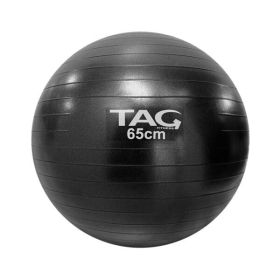
Stability ball exercises train the deep core, hips, and shoulders by forcing constant balance corrections on an unstable surface. Results depend on fit: the ball should let you sit with feet flat and knees near 90 degrees. Hamilton Home Fitness stocks TAG Fitness balls in 55, 65, and 75 cm.
Most exercise guides skip that step and jump straight to the movement list. Yet size and firmness decide whether a rollout feels controlled or chaotic and whether a bridge supports your lower back or fights it. This collection gives you both halves of the answer—the ball and how to set it up for the work you actually plan to do.
How to Pick Your Stability Ball Size
Choose by standing height first, then confirm by sitting on the inflated ball. Your feet should rest flat on the floor with knees bent near 90 degrees and hips level with or slightly above the knees. If your knees ride higher than your hips, size up.
| Size | Best for heights | Where it shines |
|---|---|---|
| 55 cm | About 5'0" – 5'5" | Seated work, tighter rooms, shorter frames |
| 65 cm | About 5'6" – 6'0" | The default pick for most home gyms |
| 75 cm | About 6'1" and taller | Long limbs, wide bridging, tall lifters |
What size stability ball do I need? For adults between 5'6" and 6'0", the 65 cm ball is the reliable default. Two things shift that answer: heavier users compress the ball more and often sit better on the next size up, and anyone splitting the difference between two heights should size up for comfort or down for a harder balance challenge.
Match the Ball to Your Exercises
Firmness is a difficulty dial, not a fixed setting—and almost no exercise guide tells you this. A fully inflated ball gives you a smaller contact patch, more wobble, and a harder session. Letting a little air out increases surface contact, steadies the ball, and makes the same movement far more controllable.
Use that dial deliberately:
- Seated work, pelvic tilts, wall squats — slightly softer, so your base stays predictable while you learn the pattern
- Supine bridges and hamstring curls — medium firmness, enough give to keep your heels planted
- Prone rollouts, planks and pikes—firmer, and consider the next size down for a shorter lever and cleaner shoulder position
- Stretching and mobility—softer, so the ball conforms to your spine instead of pushing back
Should a stability ball be firm or soft? Be firm when you want the challenge, softer when you want control. Beginners and anyone following a therapist's program usually progress faster starting soft and adding air over several weeks, rather than fighting a rock-hard ball on day one.
Why TAG Fitness Balls Hold Up
Burst-resistant construction rated to 1,000 lb is the specification that matters most, because it means the ball is not the weak link when you load a bridge or press a dumbbell from a supine position. Sudden failure is the real risk with cheap exercise balls, and a burst-resistant build is what removes it.
Latex-free, hypoallergenic material widens who can train on these safely. That matters for shared studio floors, clinic settings, and anyone with latex sensitivity—a detail most retail listings never mention.
Three sizes instead of one also means you are buying a fit, not a compromise. Priced between $19 and $23 depending on size, the Tag Fitness Stability Balls sit well under what a comparable commercial-grade ball usually costs, which makes stocking two sizes for a two-person household realistic rather than extravagant.
Ready to order? Pick your size from the grid above and add it to your cart today.
Who These Balls Suit Best
These balls fit anyone building core control without adding machines or floor space. Home gym owners get a piece that stores in a corner and works with almost every bodyweight movement they already know. Trainers and studio owners get a low-cost station that scales from beginner to advanced through inflation alone.
Physical therapy and recovery use are where the ball has the longest track record. Clinicians have used stability balls for decades in low-load core and balance programs, which is why this sits inside our rehab and recovery collection alongside balance boards and foam rollers. If you are training around back pain, pregnancy, a recent injury, or a diagnosed condition, work from a program your physician or physical therapist has approved rather than a generic exercise list.
Older adults and desk workers form the third group. Balance training carries real value with age, and short daily sessions on a correctly sized ball are an easy way to start — provided you have a wall or chair within reach for the first few weeks.
Key Selection Criteria
✅ Burst-resistant build rated to 1,000 lb
✅ Latex-free material for sensitive skin
✅ Three sizes: 55 cm, 65 cm and 75 cm
✅ Sized by your height, not by guesswork
✅ Firmness you control through inflation
✅ Works for core, balance and stretching
✅ Suits home gyms and training studios
✅ Used in physical therapy programs
✅ Light enough to move and store easily
✅ Backed by a 30-day return window
✅ Sold by an authorized TAG Fitness dealer
✅ Ships to all 50 US states from Tennessee
Care and Inflation Basics
Inflate in two stages and your ball will hold its shape far longer. Fill to roughly 80% of the stated diameter, leave it for 24 hours so the material stretches, then top up to full size. Skipping that step is the most common reason a new ball never quite reaches its printed dimension.
Keep it away from grit, pet claws, and direct sun. Concrete and rough carpet abrade the surface over time, so a mat under the ball is worth the small investment. Wipe it down after sweaty sessions, and check the seams every few months.
How long does a stability ball last? With indoor use and no abrasion damage, several years of regular training is a reasonable expectation. Replace it when the material feels tacky or thin, when it loses air noticeably faster than before, or when you see any surface nick—a compromised ball is not worth the risk.
Stability Ball FAQs
Do stability balls help lower back pain?
Core stabilization exercises are commonly used in back-pain programs, and low-load ball work is one delivery method clinicians use. That is not the same as a treatment guarantee. Anyone with ongoing or severe back pain should get a diagnosis and a specific program from a physician or physical therapist before starting.
How often should I train on the ball?
Two to three focused sessions per week is a sensible starting point for balance and core work, with rest days in between. Short sessions of 10 to 20 minutes done consistently beat long, occasional ones. Add difficulty by increasing inflation or removing points of contact rather than by adding hours.
Can I use a stability ball as a chair?
You can, but the evidence for it is weaker than the marketing suggests, and full workdays on a ball tend to produce fatigue and slumping. If you want to try it, start with 20 to 30 minutes a day, slightly under-inflate for a steadier seat, and keep a normal chair available.
Does the ball come with a pump?
The product listing does not specify an included pump, so plan on sourcing one separately or confirming before you order. Our team can check current packaging for you—reach out through Hamilton Home Fitness, and we will verify before the order ships.
Which size works during pregnancy?
Many people size up during pregnancy for a higher, more open hip position, which often means 65 cm or 75 cm depending on height. Pregnancy exercise is individual, so confirm both the size and the movements with your midwife or physician rather than following a general chart.
Stability ball or balance board?
They train different things. A stability ball gives you a large, compliant surface for core, bridging, and stretching work. A balance board challenges ankle and foot stability on a small base. Serious balance programs usually end up using both, and the ball is the more versatile first purchase.
Order Your Size Today
Measure your height, pick the matching size from the grid, and add it to your cart. All three sizes ship nationwide from our Tennessee base, and every order is backed by a 30-day return window on undamaged equipment in its original packaging — full terms are on our returns and shipping page. As an authorized TAG Fitness dealer, we can also confirm specifications before you buy if you are outfitting a studio or clinic and need to order in volume.
Secure Payments