Introduction
You already own the rack, the bench, and the plates. Now you're adding five dedicated machines—leg press, row, chest press, shoulder press, and lat pulldown—and one question is holding up the order: plate-loaded vs. selectorized.
They train the same lifts, but not the same way. A selectorized stack changes weight with a pin in seconds; a plate-loaded iso-lateral machine gives you a higher load ceiling and a more direct, barbell-like feel. Which one wins depends on the lift, your space, and how busy your floor gets.
This isn't a decision you walk back easily. These machines cost real money, last a decade or more, and claim floor space you won't get back—so guessing wrong is expensive.
Below, you'll see exactly how the two differ, which suits hypertrophy, general strength, rehab, and high-traffic use; what you'll actually pay; and which type to choose for each of your five lifts—with real machines to make every trade-off concrete.
What each machine type really is
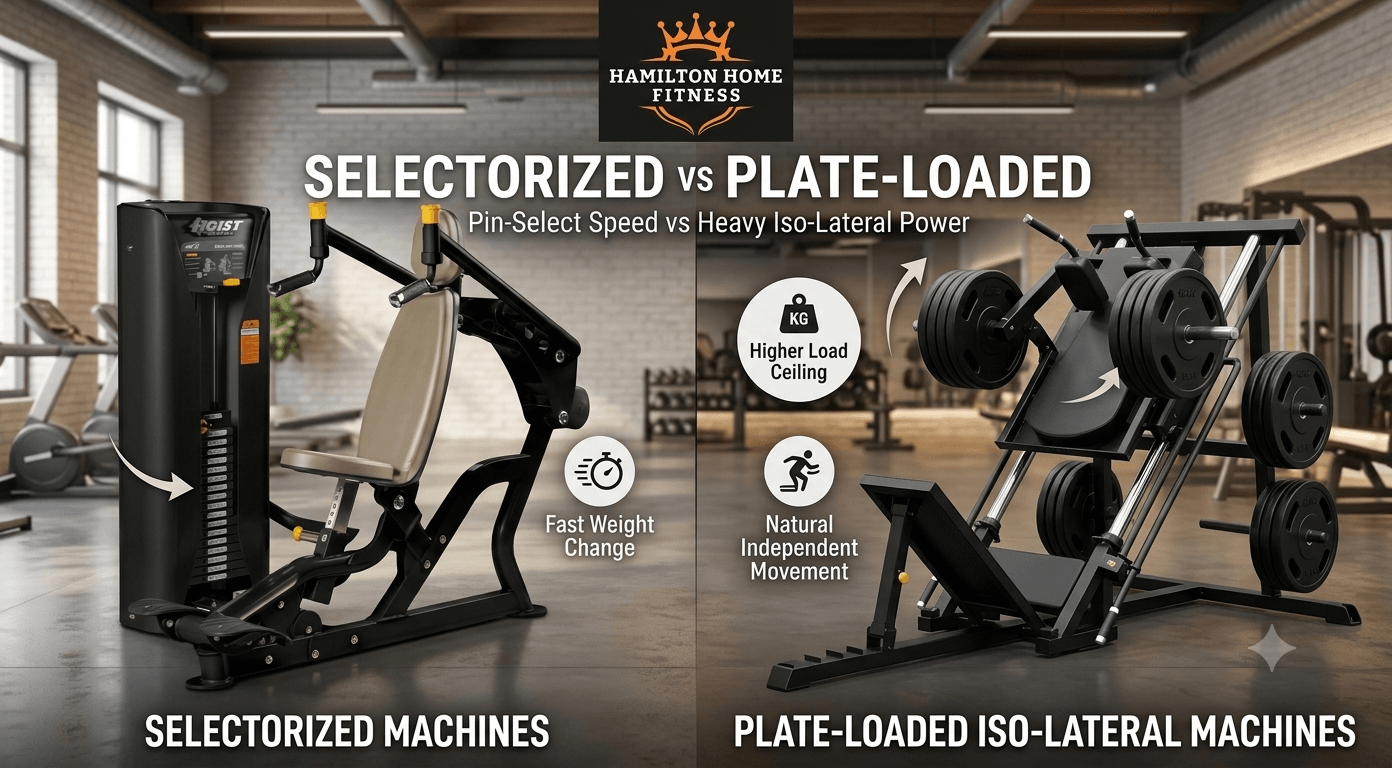
Selectorized machines use a built-in weight stack you change with a pin, so adjusting the load takes a second. Plate-loaded iso-lateral machines use your own Olympic plates on two independent arms, giving a direct, barbell-like feel and a much higher load ceiling.
Here's the quick contrast before the detail:
Selectorized | Plate-loaded iso-lateral | |
Weight change | Move a pin (seconds) | Load and unload plates by hand |
Load source | Built-in stack | Your own Olympic plates |
Load ceiling | Capped by the stack | Very high—add plates as needed |
Movement | Fixed, guided path | Independent arms, natural arc |
Feel | Smooth, cable-driven | Direct, barbell-like |
Strongest use | Speed and fine increments | Heavy loading and fixing imbalances |
Selectorized pin-select stacks
A selectorized machine has a built-in weight stack you adjust with a pin—no plates to load or store. The pin sets how many plates the cable lifts, and a pulley guides the motion along a fixed, repeatable path.
That's why selectorized is fast and beginner-friendly: sit down, drop the pin, and start. The stack is usually shrouded for safety and a clean look, and many machines offer a stack upgrade for more weight.
The trade-off is a ceiling. A stack tops out at a set number, so the strongest lifters can run out of weight on big movements.
At Hamilton Home Fitness, the selectorized leg machines show the type in action, and machines like the Body-Solid Pro Select and Pro ClubLine lines or the Hoist RS-2501 shoulder press are designed around this pin-and-stack format. One note for accuracy: Hoist's MI6 and MI7 are pin-select functional trainers—cable-based, not fixed-path single stations—so treat them as a different tool from a standard selectorized press.
Plate-loaded iso-lateral designs
Plate-loaded iso-lateral machines use your own plates on two independent arms, so each side works on its own through a natural arc. Because the arms aren't linked, your stronger side can't take over for the weaker one.
The arms converge and diverge to follow your joints rather than locking you into a straight line, and a lever or linear guide rod connects you directly to the plates—which is where the crisp, barbell-like feel comes from. Loading is built around heavy-gauge steel, so the ceiling is high; a machine like the BodyKore FL1801 holds far more than any stack.
So "iso-lateral" buys you three things: it corrects side-to-side imbalances, lets you load heavy without running out of weight, and gives a more direct feel. Hammer Strength-style machines are the well-known archetype.
You can see the format across the plate-loaded leg press options, where the BodyKore FL1801 and GR808 are built for this kind of heavy, independent leg work.
Loaded weight vs felt resistance
The weight you load is not always the resistance you feel—pulley ratios and sled angles change it. This is the detail most buyers miss, and it changes how you read the numbers.
On a cable machine, the pulley ratio matters. A 2:1 ratio means a 200 lb stack feels like about 100 lb in your hands, while a 1:1 machine gives you the full number.
On an angled plate-loaded sled, leverage does the same thing. Because of the sled's angle, the plates you load aren't the exact resistance your legs press.
The takeaway: a "200 lb stack" and "four plates" don't compare one-to-one across machines, so don't assume the bigger number is the harder lift. Track your progress within a single machine, and you'll never be misled by the label.
How the two train differently
Selectorized machines change weight in seconds on a fixed path, which keeps your sets moving. Plate-loaded gives you a freer arc, a stronger lowering phase, and a higher ceiling—but you pay for it in loading time.
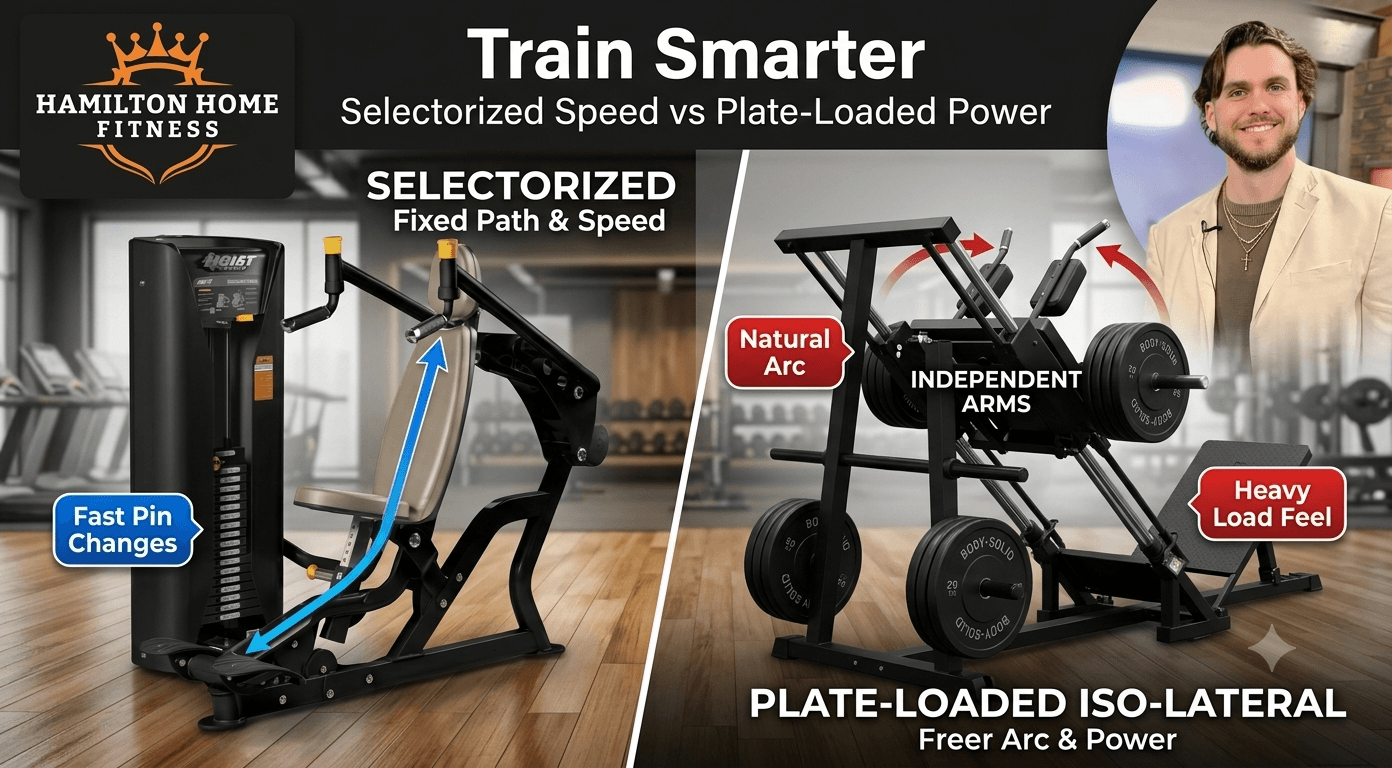
The three differences that actually shape your training are speed, path, and how the resistance feels through the rep.
Loading speed and weight changes
Selectorized wins on speed: move a pin and go; plate-loaded needs hands-on loading for every change. On a stack, your next set starts the moment you reset the pin.
On a plate-loaded machine, every change means sliding plates on or off—and on a heavy leg press, those can be several 45s per side, twice, each time you adjust them.
For a slow, heavy session with long rests, that loading time barely registers. For anything fast-paced, it adds up quickly and breaks your rhythm.
Range of motion and path
Selectorized guides you on a set path; iso-lateral arms let each limb travel a more natural arc. The cable and pulley keep the movement fixed and repeatable, which is easy to learn and easy to coach.
Iso-lateral arms converge and diverge to follow your shoulders, hips, or elbows instead of locking you into one line. Many machines also adjust the seat and range-of-motion stops so the path fits your body and your joints stay comfortable.
If a fixed path feels forced on your frame, the freer arc is worth real consideration. If the guided path feels fine, you lose nothing by staying with it.
Strength curves and cam feel
A cam shapes how heavy a selectorized move feels at each point; a plate-loaded lever ties the feel to leverage and angle. Two machines can be set to the "same" weight and still feel completely different through the rep.
On a stack, an eccentric cam can make the load feel lighter where you're weak and heavier where you're strong, smoothing out the sticking point. On a plate-loaded machine, the lever arm and angle decide where the lift feels hardest — often deep in the stretch.
That's why the BodyKore GR808 plate-loaded leg press feels most demanding at the bottom of the press, where leverage is worst, rather than at lockout. Knowing the curve helps you load the machine for the result you want, not just the number on the bar.
Hypertrophy, strength, or rehab
No machine type builds muscle on its own. Effective load, training close to failure, full range of motion, and steady progressive overload do. So the type matters only because of how well each supports those things. Pick by goal, not by hype.
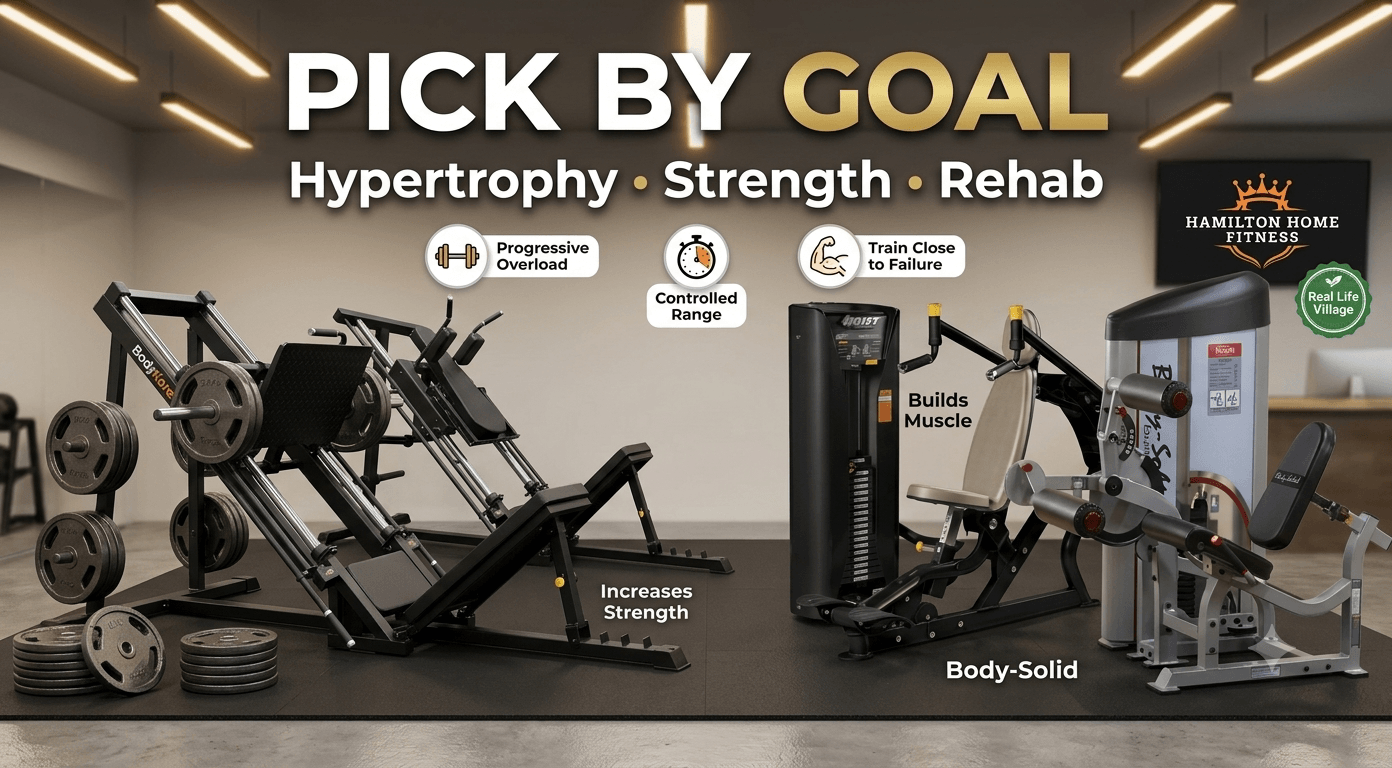
Do they build more muscle?
No machine type "builds more muscle" on its own, but iso-lateral loading helps fix side-to-side imbalances and add range. The mistake is buying plate-loaded expecting the machine itself to add size; the growth comes from how you train it.
Where isolateral genuinely helps is with unilateral loading. Because each arm moves on its own, your stronger side can't carry the weaker one, which evens out a lagging limb over time. The independent path can also let you reach a deeper stretch, and you can run a mechanical drop set by training the weak side to failure, then finishing strong.
A selectorized stack grows muscle just as well when the load and effort are there. So buy for the feel and the ceiling you'll actually use—not for gains a machine type can't deliver by itself.
Strength and athletic use
For heavy lower-body and pulling work, plate-loaded's high ceiling and direct feel suit advanced and athletic lifters. When you're pressing or rowing serious weight, a stack that tops out becomes the limit before your muscles do.
Picture an advanced lifter on a leg press or a chest-supported row: four, five, or six plates per side is normal, and a fixed stack would cap the lift well short. The direct, barbell-like feel also carries over better to explosive pulling and pressing, which is why hybrid athletes lean on plate-loaded for their heaviest movements.
If your big lifts are already strong and still climbing, stack limits will frustrate you. That's the clearest signal to choose plate-loaded.
Rehab and recovery fit
For rehab and lighter, precise loading, selectorized stacks make small, controlled jumps easy on a guided path. Fine increments matter most when you're rebuilding, and a pin lets you add a little at a time without wrestling plates.
The guided path keeps the movement stable and repeatable, which helps when control matters more than load. Adjustable range-of-motion stops let you work within a safe, comfortable arc, and prehab and isolation movements are easy to dial in—the BodyKore hip abductor/adductor machine is a good example of fine, controlled selectorized loading for the hips and knees.
One important note: this is general guidance, not medical advice. If you're recovering from an injury, follow the program your physical therapist or physician sets for you, and treat no machine as a guarantee of safety or recovery.
Footprint and superset speed
Isolateral machines usually need more floor space and plate storage; selectorized machines are faster for supersets, drop sets, and circuits because there's nothing to load. If your room is tight or your training is fast-paced, that trade-off often decides it.
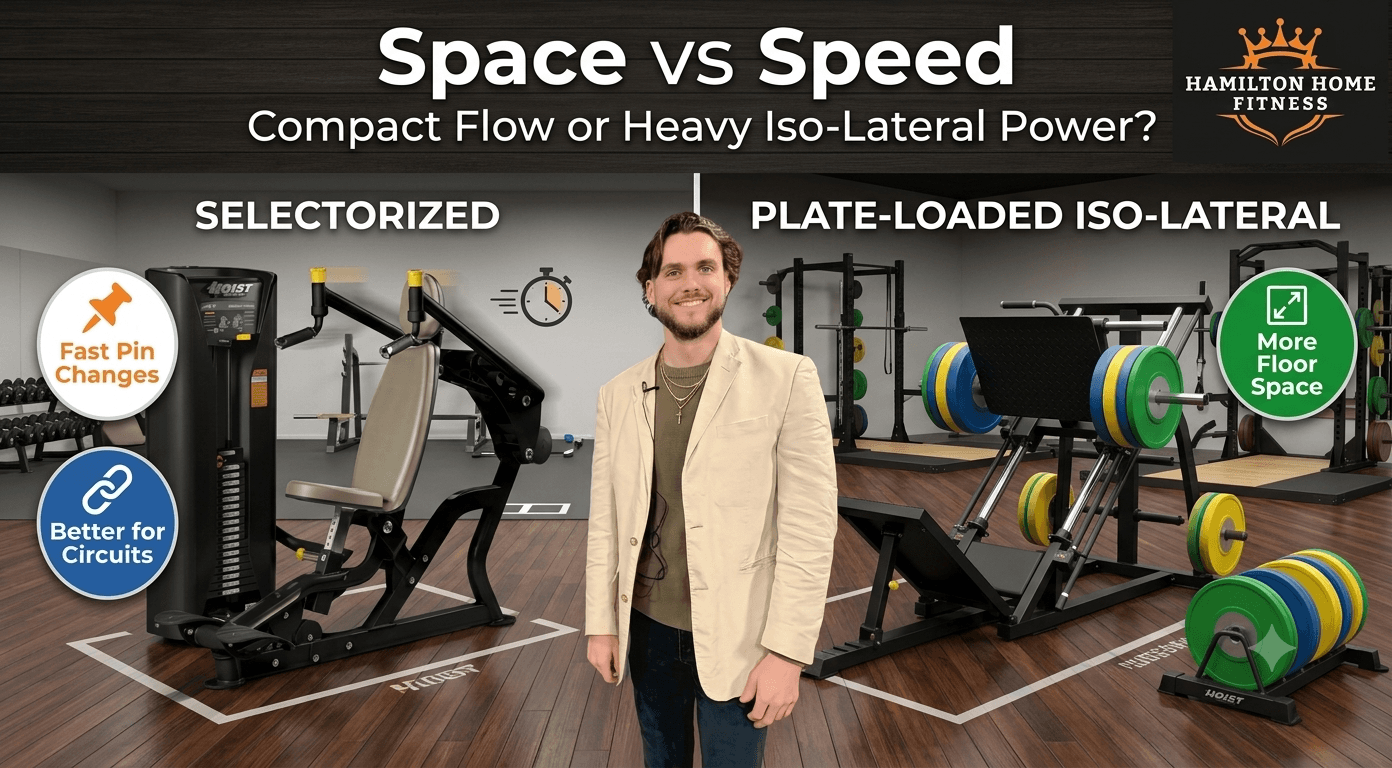
Is ISO worth the footprint?
Isolateral is worth the footprint if you train heavy, value the independent-arm feel, and have room for plate storage. The machine itself is often larger, and you also need somewhere to keep the plates close by.
Most plate-loaded machines include storage posts for exactly this reason, but those posts still take floor space, and loaded plates push the real footprint wider than the spec sheet suggests. Before you buy, measure the machine, the plate storage, and the clear space you need to get in and out, plus ceiling clearance for any upright movement.
If you train heavy and have the room, the space is well spent. If your floor is tight or shared, a more compact selectorized unit may fit your space better for the same lift.
Supersets, drop sets, circuits
For supersets, drop sets, and circuits, selectorized is faster — drop the pin and keep moving. When the goal is density, every second spent loading plates works against you.
A drop set is the clearest case: on a stack, you finish a set, move the pin down, and keep going with almost no break. On a plate-loaded machine, you'd be stripping plates between drops, which kills the intensity the technique depends on. The same speed advantage helps in supersets, giant sets, and circuit training, where fast turnover keeps your heart rate up and the next person moving.
If you train in dense, fast blocks—or run a busy floor where machines can't sit idle—selectorized keeps everything flowing. If your sets are slow and heavy with long rests, the loading time barely matters.
Durability in high-traffic gyms
Plate-loaded machines have fewer wear parts—no cables or pulleys—so they're simpler to maintain. Quality selectors hold up well in traffic too, but they have more serviceable components, and warranty coverage depends on the type of facility.
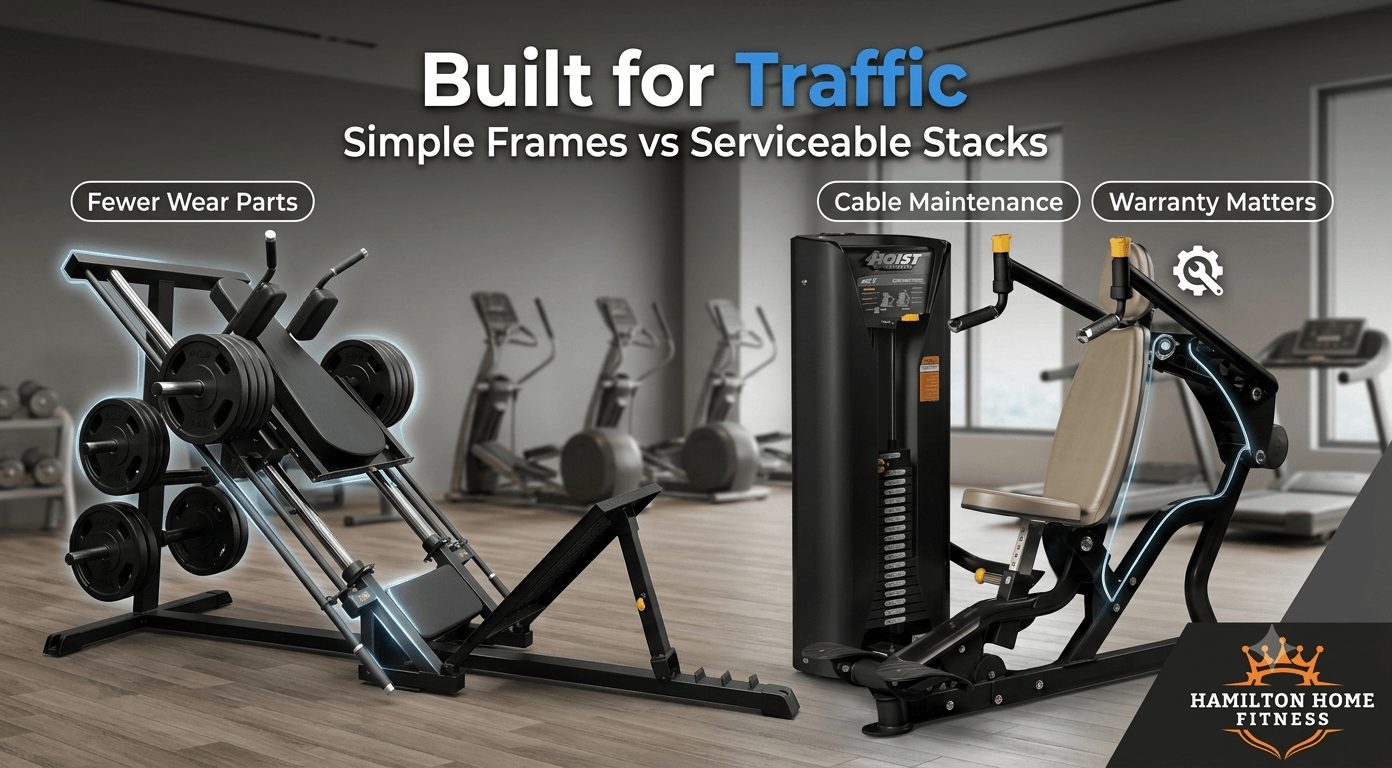
Maintenance and warranty
Plate-loaded has fewer parts to fail; selectorized adds cables and pulleys that need occasional servicing. A plate-loaded machine is mostly a welded frame, bearings, and a lever or guide rod—little that wears out under heavy use. A selectorized machine adds a cable, pulleys, and a stack, and over years of high traffic those cables stretch and eventually need replacing.
Neither is fragile when it's well built. Both rely on heavy-gauge steel for stability, and quality selectorized machines run for years in busy gyms—they just carry a slightly longer maintenance list.
Warranty tiers matter as much as the build, because coverage usually splits by how you use the machine. A home setting, a light commercial facility (often defined as no membership dues and a capped number of users per day, like a hotel, apartment gym, or studio), and a full commercial floor each fall under different terms—frames, moving parts, and cables are often covered for different lengths. For a lower-traffic room, a light-commercial-rated machine like this light-commercial leg press and hack squat combo is matched to the use without overpaying for a full-commercial rating.
One caution: warranty terms vary by brand, model, and facility type, and they change. Confirm the current coverage for your exact machine and your setting before you buy.
Best pick for your five lifts
A simple rule of thumb covers most of your build: choose plate-loaded where load ceiling and feel matter most and selectorized where speed and fine increments matter more than a high ceiling does. Here's how that plays out across your five machines.
Leg press, row, and chest
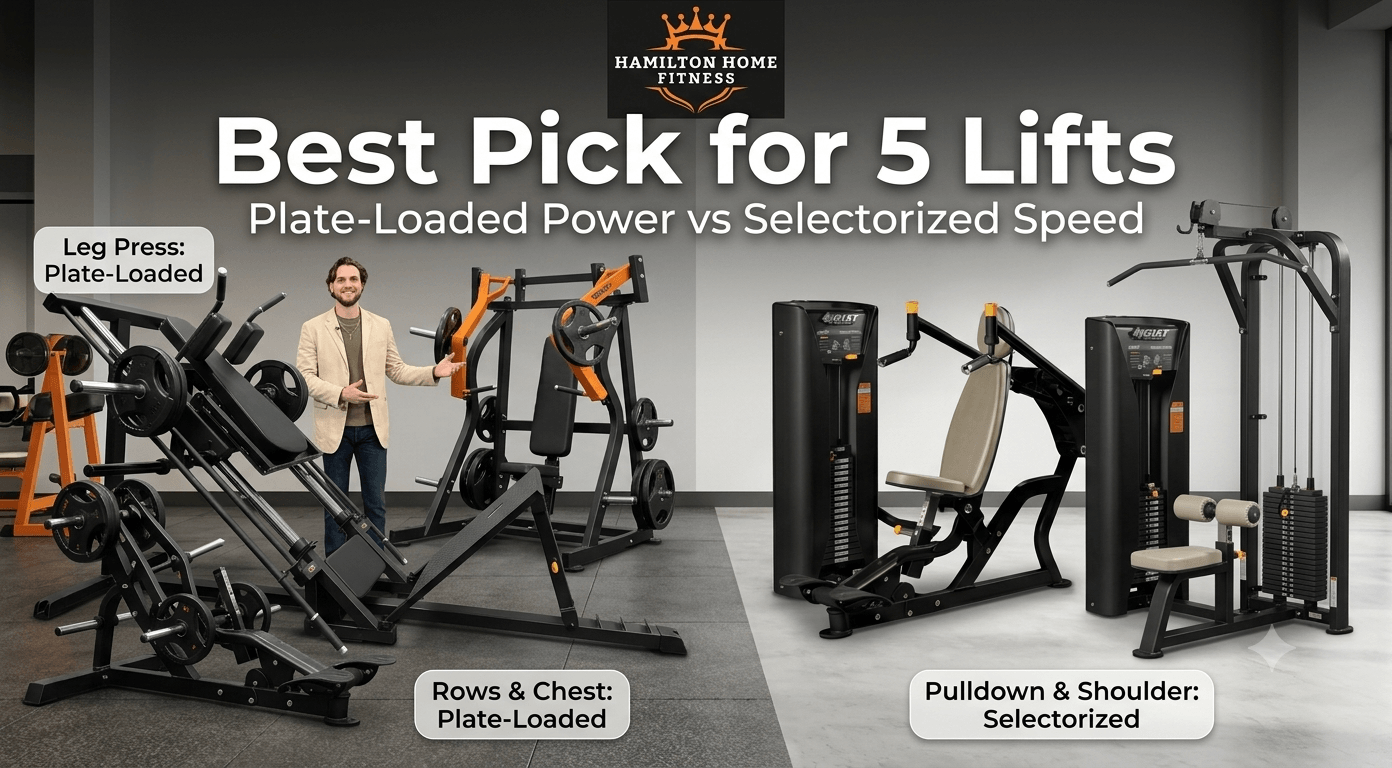
Leg press, rows, and chest press are where plate-loaded iso-lateral shines—high ceiling, strong eccentric, and independent arms. These are your heaviest pressing and pulling movements, and a fixed stack tends to run short on exactly these lifts as you get stronger.
The leg press is the clearest case: it's often the heaviest thing you'll load, and plate-loaded lets you keep adding without hitting a wall. On rows and chest press, the independent arms even out a stronger side, and the direct feel carries over well to heavy work. The commercial leg press machines at Hamilton Home Fitness show both types side by side at real prices, which makes the trade-off easy to see for your single heaviest lift.
If these three are where you push the most weight, lean on plate-loaded machines.
Shoulder press and pulldown
For lat pulldown and shoulder press, a selectorized stack is usually plenty—fast changes, fine increments, and enough load for most people. You rarely run out of weight on these, so the higher ceiling of plate-loaded adds little, while the pin's speed and small jumps add a lot.
The lat pulldown almost always lives comfortably within a stack's range, and for many lifters the shoulder press does too—a true single-station selectorized press like the Hoist selectorized shoulder press handles it cleanly with quick changes between sets. Spending more for plate-loaded here usually buys a ceiling you won't reach.
Unless you press unusually heavy overhead, selectorized is the practical pick for both.
Cost and how to choose
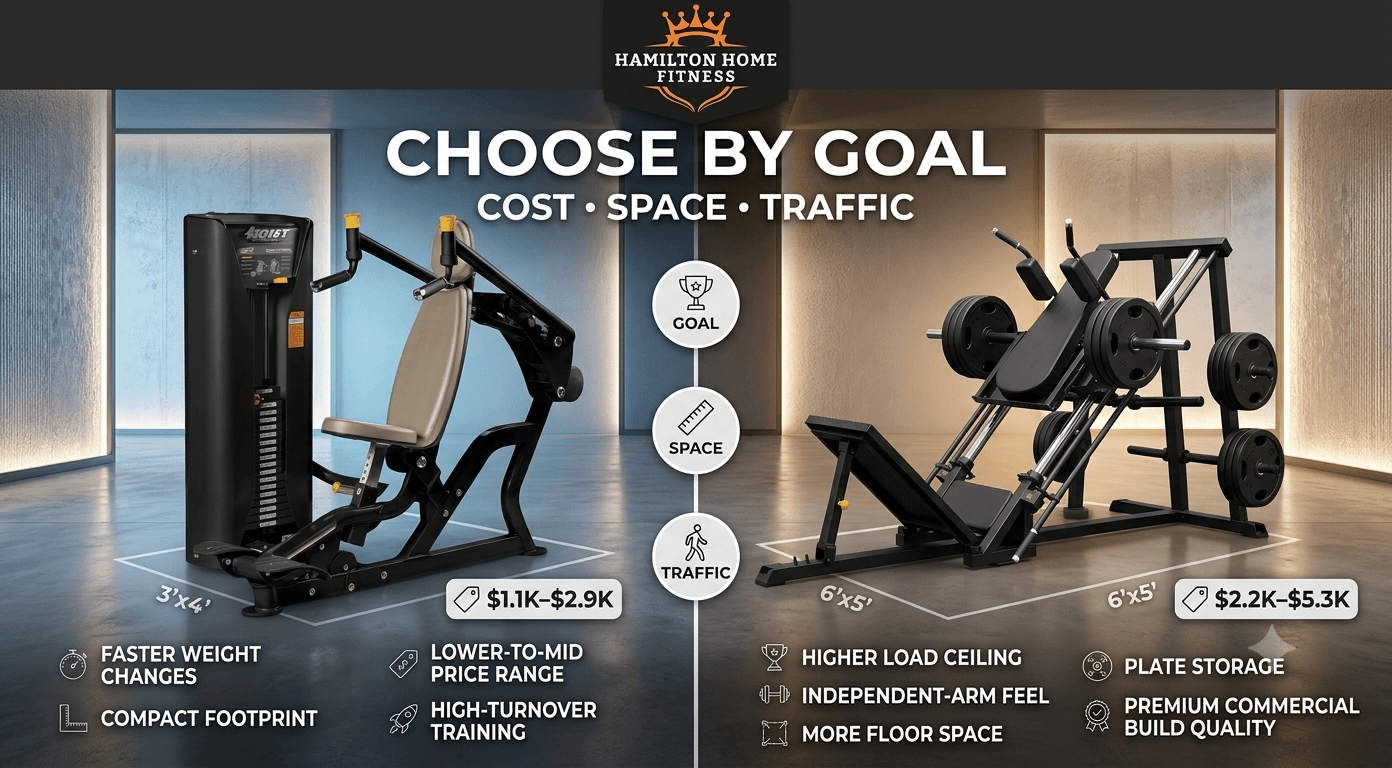
Expect roughly $1,100–$2,900 for selectorized leg machines and about $2,200–$5,300 for plate-loaded—the premium iso-lateral models sit at the top. The key correction: build quality and design drive price more than the loading mechanism, so a high-end plate-loaded unit can cost well above an entry selectorized one.
What you will actually pay
The ranges above tell the real story, and they dispel the common claim that plate-loaded is always cheaper. At Hamilton Home Fitness, selectorized leg options run from about $1,100 for a compact Body-Solid leg press up to roughly $2,895 for a Pro ClubLine leg press and calf machine. Plate-loaded spans about $2,198 for a Tag Fitness combo up to $5,280 for the BodyKore FL1801 iso-lateral leg press—which means the iso-lateral plate-loaded machine costs more than every selectorized leg option on the floor.
So the loading mechanism alone doesn't set the price; the steel, the design, and the brand do. For a full commercial fit-out, the math scales up fast—a complete 12-to-18-machine line typically runs $40,000–$120,000, and most facilities mix both types rather than commit to one.
A few brands don't list public pricing at all. Premium commercial lines like the Hoist range (private quote) are quote and private-invoice only, so the way to get a real number is to ask. Whatever you compare, confirm current pricing before you buy — prices change, and freight and delivery can shift the total.
Pick by goal, space, traffic
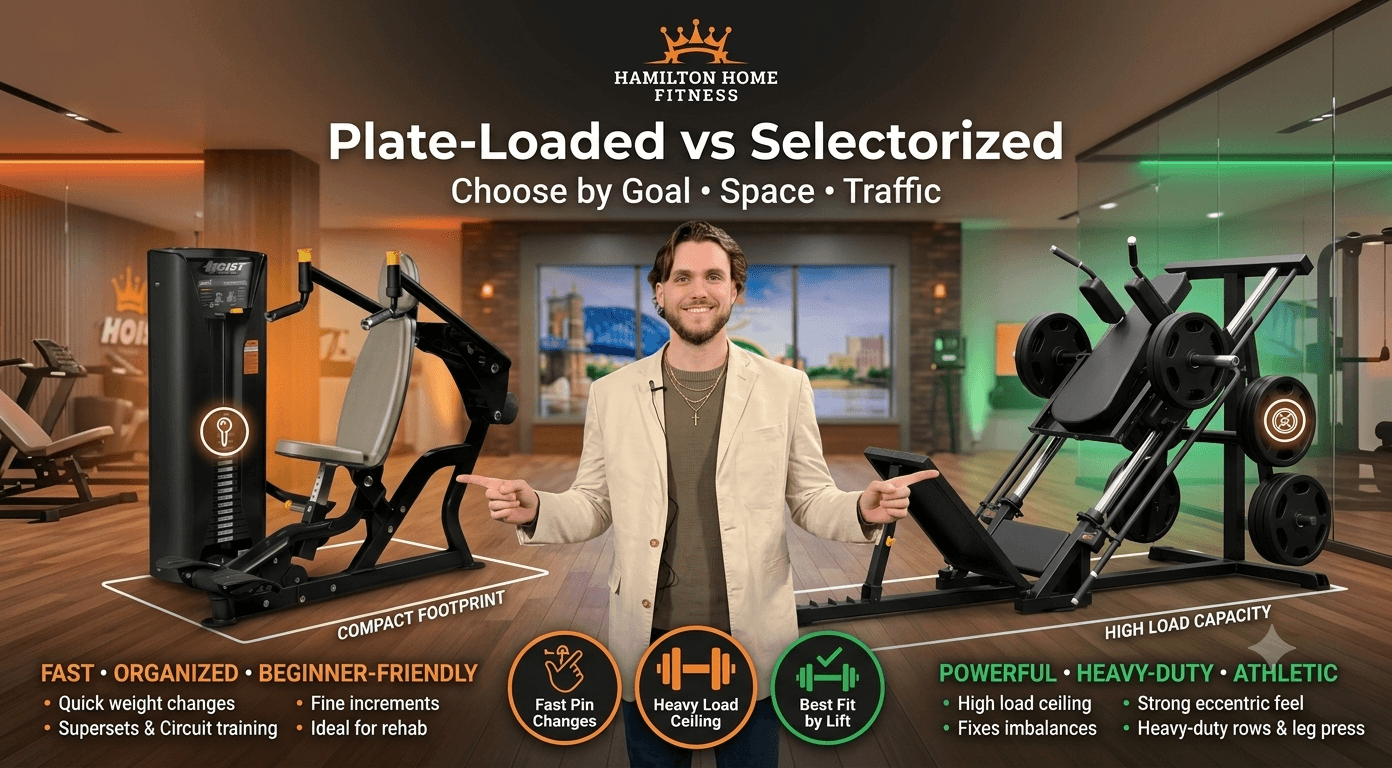
Choose by goal, space, and traffic: heavy or ISO feel and room to spare lean plate-loaded; speed, small footprint, and high turnover lean selectorized. Run your decision through those three filters, and the answer usually settles itself.
If you train heavy, want the independent-arm feel, and have the floor space and plate storage, plate-loaded earns its cost — especially on your big lifts. If you value fast weight changes, a compact footprint, and quick turnover for a busy floor or dense training, selectorized fits better. And for most serious setups, the smartest move isn't all of one—it's a mix, with plate-loaded on the heaviest movements and selectorized everywhere speed matters more than ceiling. To go deeper on the machine most buyers start with, this guide on how to choose a plate-loaded leg press walks through the same decision in detail.
Filter by goal, space, and traffic, and you'll land on the right build for your room.
FAQ
Are plate-loaded machines better than selectorized?
Neither is universally better. Plate-loaded gives you a higher load ceiling and a direct, barbell-like feel, while selectorized gives you faster weight changes and finer increments. The right pick depends on your goal, your space, and how busy your floor is — and many setups use both.
Are selectorized machines worth it for a home gym?
Yes, for many home users. If you value quick weight changes with a pin, a smaller footprint, and low setup friction, selectorized is a strong fit—especially when you don't need a very high load ceiling. Lifters who already push heavy weight on big lifts may still want plate-loaded for those movements.
Can you convert a plate-loaded machine to a weight stack?
Sometimes. A few models offer conversion kits, but most don't, so check the specific machine before buying if that flexibility matters to you. If you think your needs might change, confirm whether a kit exists for that exact unit first.
Final Thought
There's no universal winner here. The right choice is the one that fits your goal, your space, your traffic, and your budget—and for most serious builds, the smartest setup mixes both: plate-loaded on your heaviest lifts and selectorized everywhere speed and fine increments matter more than a high ceiling.
When you're ready to compare real options side by side, browse the Home Workout Machines collection at Hamilton Home Fitness, and request a tailored quote when you've narrowed it down—private invoicing is available for premium commercial brands.