
Introduction
You're comparing the same machine across two or three brands, and the warranties don't line up. One says lifetime. So does the other. Read closely, though, and they cover completely different things.
That gap is where the money hides. When a motor or a console fails outside its coverage, the repair lands on you—sometimes hundreds, sometimes well into the thousands.
A real gym equipment warranty comparison means reading past the headline number to what's actually protected: the frame, the motor, the parts, the labor, and the service network standing behind all of it.
This guide shows you how to do exactly that and how the residential, light commercial, and full commercial tiers change the answer—whether you're building a home gym or outfitting a full facility.
How Gym Equipment Warranties Work
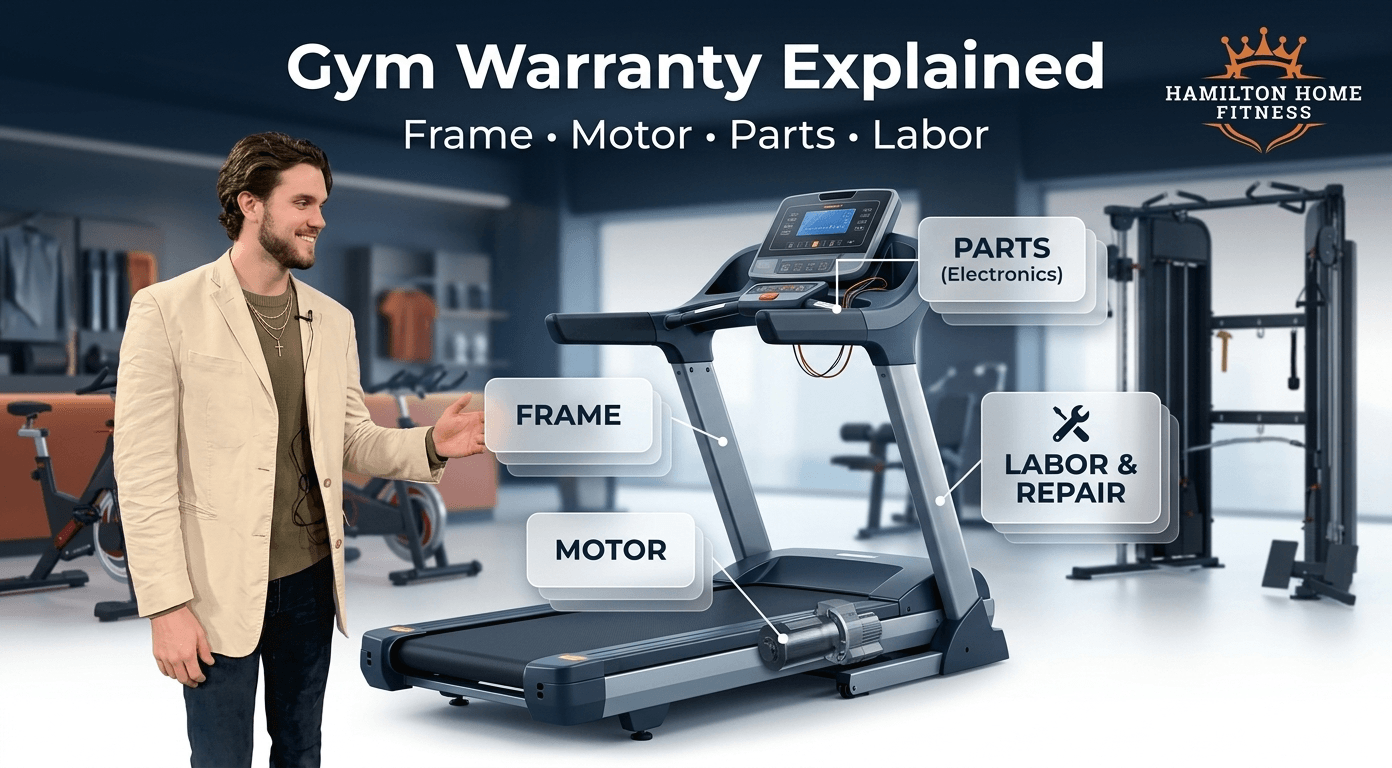
A gym equipment warranty isn't one promise. It's several stacked layers—frame, motor, parts and electronics, labor, and the service network behind them. Each layer has its own length and its own conditions. The big number on the box almost always refers to just one of them: the frame, the part least likely to fail.
That's the trap. A "lifetime warranty" can sit right next to two years of labor coverage, and both statements are true.
Picture a treadmill three years in. The motor controller dies. The board itself is covered, so the part ships free. But labor expired at year two, so the technician's visit is on you—often $200 or more before anything gets fixed. Same machine, same day, two different answers depending on which layer you're standing in.
Read all five layers, and the comparison gets honest. Here's what each one actually covers.
Frame coverage explained
The frame is the welded steel skeleton that holds the machine together. Because it has no moving parts and takes no electrical wear, it carries the longest warranty on the spec sheet—often 10 years to lifetime.
This is the number brands lead with, and it's the safest promise they make. A frame rarely fails. So a long frame warranty tells you less about real-world reliability than the shorter numbers below it.
Read it, then look past it. The frame coverage is the easy part to honor.
Motor warranty terms
On any powered cardio machine, the motor warranty protects your single biggest repair risk. A replacement motor or controller is the most expensive failure most owners will ever face, so this is the number that matters most on a treadmill or powered bike.
Coverage swings widely. Some motors carry lifetime terms; others stop at three to five years. Watch how the motor is rated, too — a continuous-duty rating signals a motor built to run for hours without strain, which usually tracks with stronger coverage.
When you compare cardio machines such as treadmills and bikes, put the motor warranties side by side before anything else.
Parts and electronics
Parts and electronics carry the shortest coverage on the machine—and this is where buyers get surprised. The category covers consoles, circuit boards, drive belts, cables, pulleys, and bearings: the components that actually wear out with use.
Here's the catch. These are the parts most likely to fail, yet they're often covered for the shortest window. A frame you'll never replace might be covered for life, while the console you touch every workout is covered for one year.
Scrutinize the short numbers. They tell you more about your real costs than the long ones do.
Labor coverage
Labor coverage pays the technician, and it's frequently the shortest term of all—often just one or two years, even when parts are covered far longer.
This is the gap that catches people. A covered part is not a free repair. If a pulley fails in year three and parts coverage runs five years, the pulley ships free — but if labor ended at year two, you pay for the install. The fix you assumed was covered comes with a bill anyway.
When you compare two warranties, line up labor against parts. The space between those two numbers is money out of your pocket.
Residential vs Commercial Warranties
The same treadmill or rack is often sold under three different warranties — residential, light commercial, or full commercial. The difference isn't the machine. It's the daily-use load each tier assumes. Put a residential-warranty machine in a shared gym, hotel, or apartment facility, and the manufacturer can void the coverage outright.
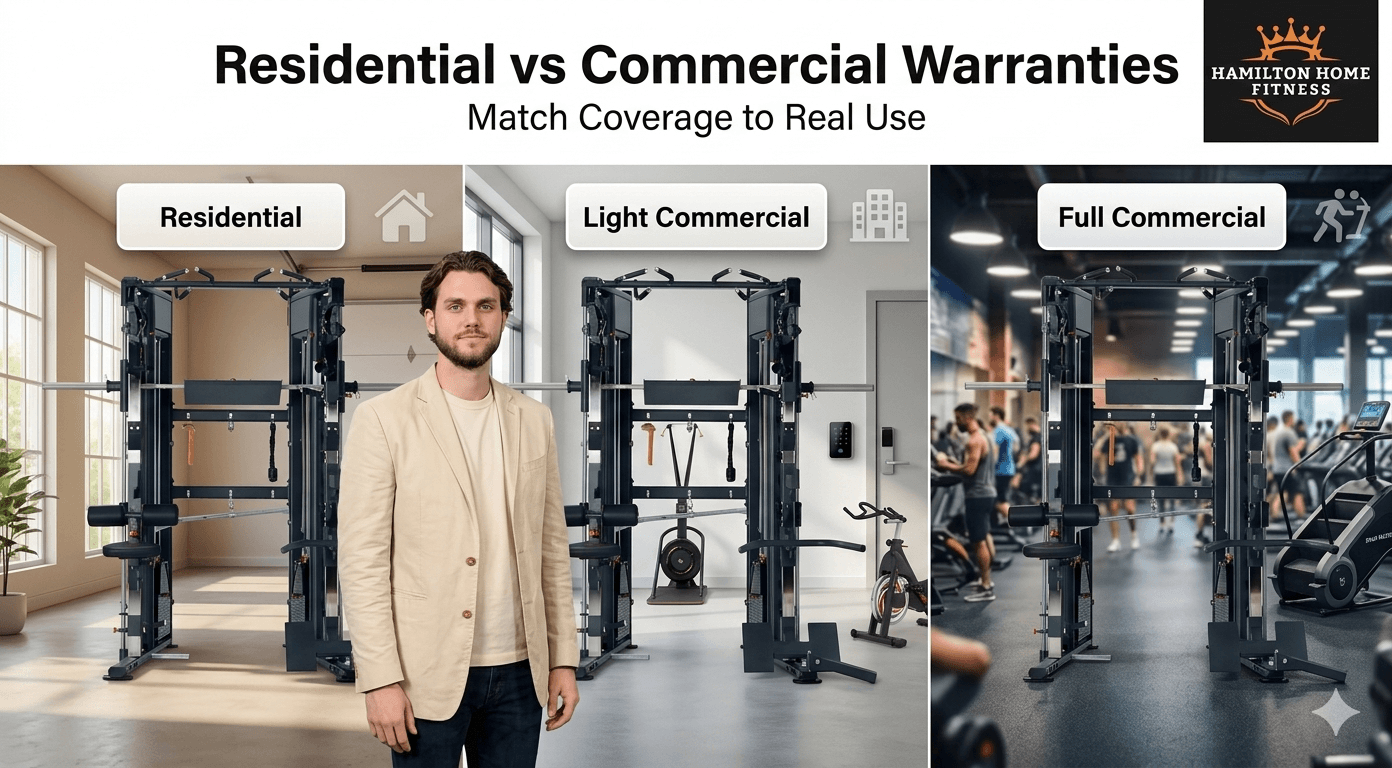
In short, residential is built for one household's light use; light commercial for shared but capped settings like apartment gyms and hotels; and full commercial for high-traffic public facilities. Each step up assumes more hours, more users, and a higher duty cycle—and carries coverage and terms to match.
Use class | Typical setting | Warranty posture |
Residential | Home, garage, single household | Built for light, single-user hours; voids under commercial use |
Light commercial | Apartment gym, hotel, studio, office, wellness room | Mid-tier coverage for shared but limited, capped-membership use |
Full commercial | Public gym, health club, 24/7 facility | Longest, heaviest-use coverage with the strictest conditions |
The rule is simple: match the tier to how hard the space will actually use the equipment, not to whichever option looks like the better deal. The cheaper tier stops being a saving the moment a claim gets denied.
When home use voids cover
If equipment is rated residential and lands in a gym, hotel, or apartment fitness room, the manufacturer can deny the claim — and the property owner absorbs the cost.
Picture a multifamily property manager buying homeowner-grade treadmills to outfit the building's fitness room on a budget. One motor fails at month eight. The claim comes back denied because the machine was used commercially, outside its rated environment. The replacement now comes straight out of the building's budget, and the upfront "savings" are gone.
The exposure runs deeper than a repair bill. Say a small studio runs residential cable machines and a cable snaps mid-set, injuring a member. The facility carries the liability—and equipment used outside its rated, hospitality-grade, or commercial environment can leave an owner harder to defend when something breaks under shared use.
To match the right tier to your setting before you buy, the full residential vs. commercial tier breakdown walks through each use class in detail.
Service Networks and In-Home Repair
A warranty is only as good as the service standing behind it. Coverage on paper means little if no technician will come to your location, so before you buy, weigh how repairs actually happen—in-home service versus depot service; how fast a claim gets a response; and what role the dealer plays once the equipment is delivered.
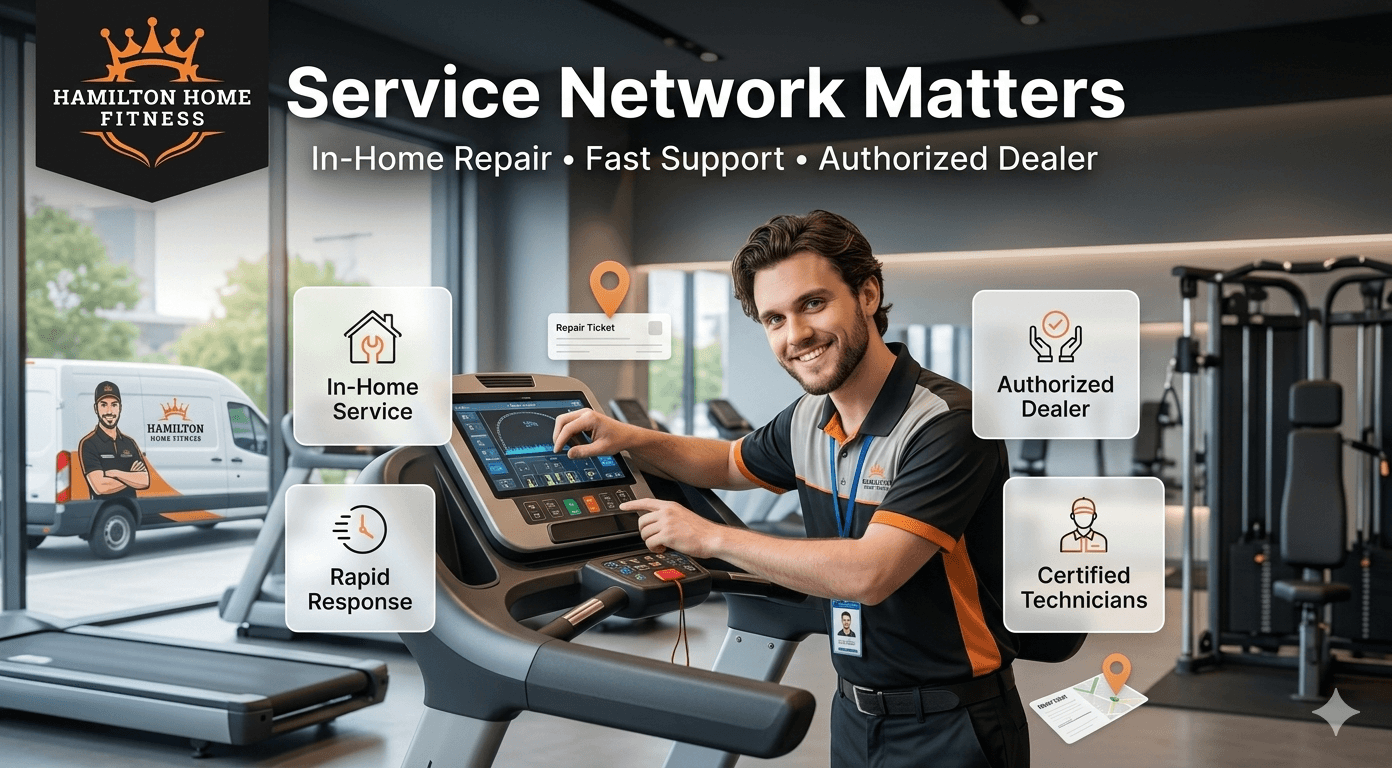
This is the layer most buyers skip, and it's the one they feel most. A covered part still has to reach you, and someone still has to install it. For a home, a two-week wait is an annoyance. For a gym, every day a popular machine sits dead is a lost member workout—and sometimes a lost member.
In-home service vs depot
In-home service sends a technician to you. "Depot service" means you ship the unit—or the failed part—out for repair and wait for its return. That gap is minor for a small console board. It's enormous for a 400-pound rack or a treadmill a facility can't afford to lose for two weeks.
Two more things shape the real experience. The first is the service network — how many technicians the manufacturer has near your ZIP code, because coverage is worthless if the nearest tech is three states away. The second is response time, sometimes written as a response-time SLA: the service agreement's promise for how quickly someone acts on your service ticket, which is just your logged request for a repair.
So ask plainly before you buy: Is this in-home or at the depot, and is there a technician near me? On a heavy machine, that answer can matter more than an extra year of parts coverage.
How the dealer affects support
Buying from an authorized dealer keeps the manufacturer's warranty intact and gives you one point of contact to match the right coverage tier before you buy. The opposite—buying gray-market or from an unauthorized seller—can void the warranty before the machine ever ships.
Here's where a dealer earns its place. The warranty itself is backed by the manufacturer, not the store, so the dealer's real value is upstream: helping you pick the tier that fits your use, confirming the equipment is rated for your setting, and pointing you to warranty registration so coverage actually starts on time. For a facility, a good dealer can also help you plan a preventive maintenance contract — a scheduled service plan, often called a PM contract, that catches wear before it turns into a denied claim.
Hamilton Home Fitness is an authorized dealer for more than 40 brands, which keeps your manufacturer coverage valid across cardio, strength, and commercial lines. For a facility mapping out equipment, layout, and service before purchase, you can book a gym design consultation and get the warranty tiers matched to how the space will actually be used.
What Voids a Gym Equipment Warranty
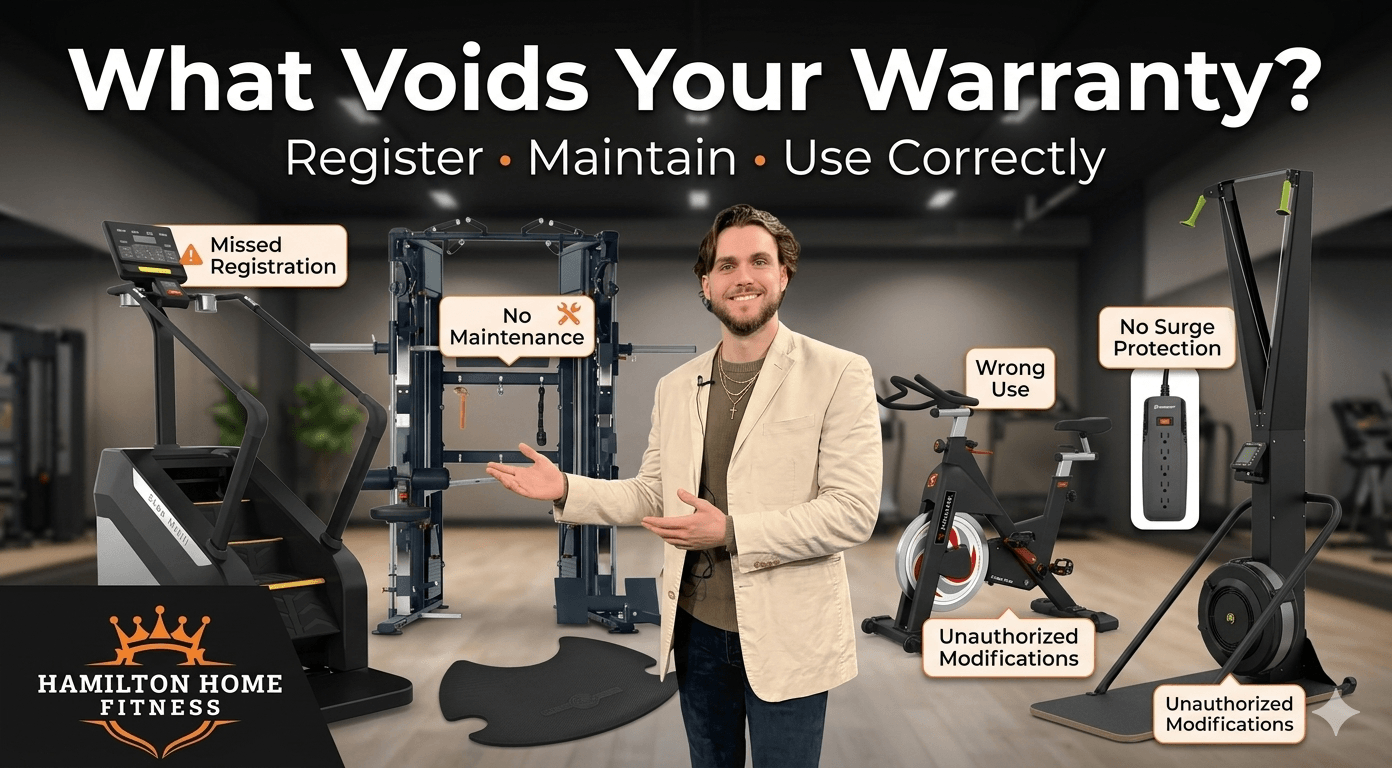
Most denied claims trace back to a handful of avoidable mistakes. Skip the registration, neglect the maintenance the manual requires, run residential equipment in a commercial setting, plug a treadmill straight into the wall without a surge protector, or modify the machine yourself—any one of these can hand the manufacturer a reason to say no.
The five most common warranty killers:
Skipping registration. Many brands require you to register within a set window — often 30 days — for full coverage to start. Miss it, and you may be arguing about whether coverage exists at all.
Neglecting required maintenance. Treadmills usually require belt lubrication on a schedule. No proof you did it, and a belt or motor claim can be denied.
Using residential equipment commercially. A home-rated machine placed in a gym, hotel, or apartment fitness room voids its warranty the moment it goes into shared use.
No surge protector on cardio. A power surge that fries a console or board often isn't covered if the machine wasn't on a dedicated surge protector.
Modifying the equipment. Swapping in non-approved parts or altering the machine gives the manufacturer grounds to reject the claim.
One real pattern shows how easily it happens. An owner stores a treadmill in an uninsulated garage, never lubricates the belt, and runs it straight off a wall outlet. The motor fails at year two. The frame is still under lifetime coverage — but the denied claim isn't about the frame. It's the motor, killed by skipped maintenance and no surge protection, and that repair is now entirely out of pocket.
Keep the receipts. Register on time, follow the maintenance schedule, log what you do, and use the equipment in the setting it was built for. Those four habits keep almost every warranty intact.
Are Lifetime Warranties Transferable?
Mostly, no. Most manufacturer warranties—including many labeled "lifetime"—cover only the original owner and don't transfer when you sell your home or upgrade your facility. And "lifetime" itself rarely means full coverage forever. It almost always means partial lifetime on the frame, with the moving parts covered for far shorter terms.
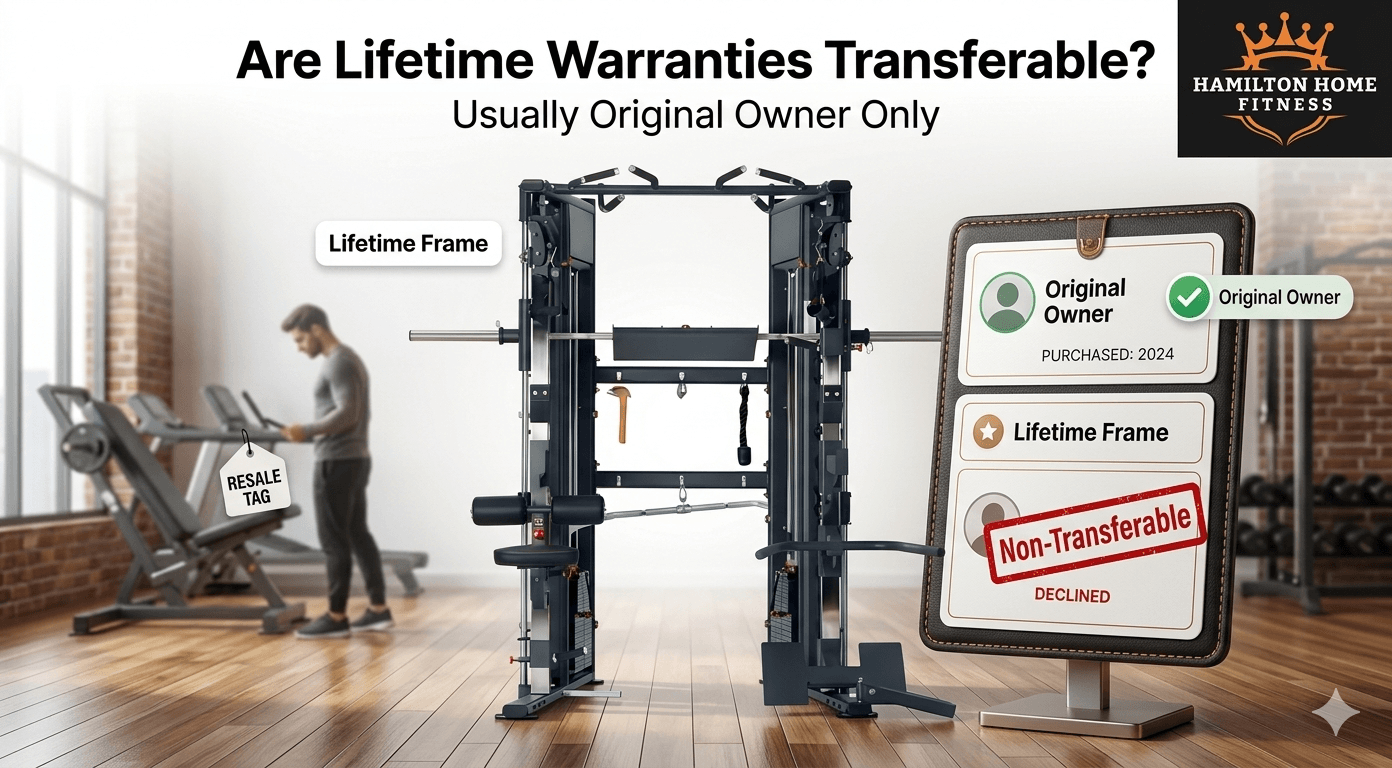
So two assumptions trip buyers up at once: that "lifetime" covers the whole machine and that the coverage follows the equipment to the next owner. Both are usually wrong.
What lifetime really means
"Lifetime" usually applies to the frame alone and only for as long as the original buyer owns it.
The word does real marketing work. It sits on the spec sheet and signals confidence, but it attaches to the one component least likely to fail. The motor, the electronics, the cables — the parts that actually wear — run on their own shorter clocks underneath that lifetime headline. Read "lifetime frame warranty" as exactly that, and judge the machine on the shorter numbers.
Transfer when you sell or upgrade
If you sell your home gym or trade up your facility, assume the warranty does not follow the equipment unless the manufacturer specifically allows transfer.
For a homeowner, that shapes resale value. A buyer eyeing your used treadmill should know the remaining frame coverage almost certainly won't carry over to them—which is part of why used equipment sells for less. Price it as a machine with no warranty behind it, because for the next owner, that's usually what it is.
For a facility, it cuts the other way. A gym replacing a fleet of cardio machines can't count on passing residual coverage to whoever buys the old units, so the resale value of aging equipment should be set on condition alone, not on warranty time left.
If you're weighing the trade-offs on either side of that, buying used or resale equipment is worth thinking through before you sell or upgrade.
When an Extended Warranty Pays Off
An extended warranty pays off when the likely repair cost, multiplied by the odds it happens, comes out higher than the plan price. That math usually favors buying coverage on motor-driven cardio and high-use facility equipment, where failures are expensive and more frequent—and usually argues against it on simple strength pieces with few moving parts to break.
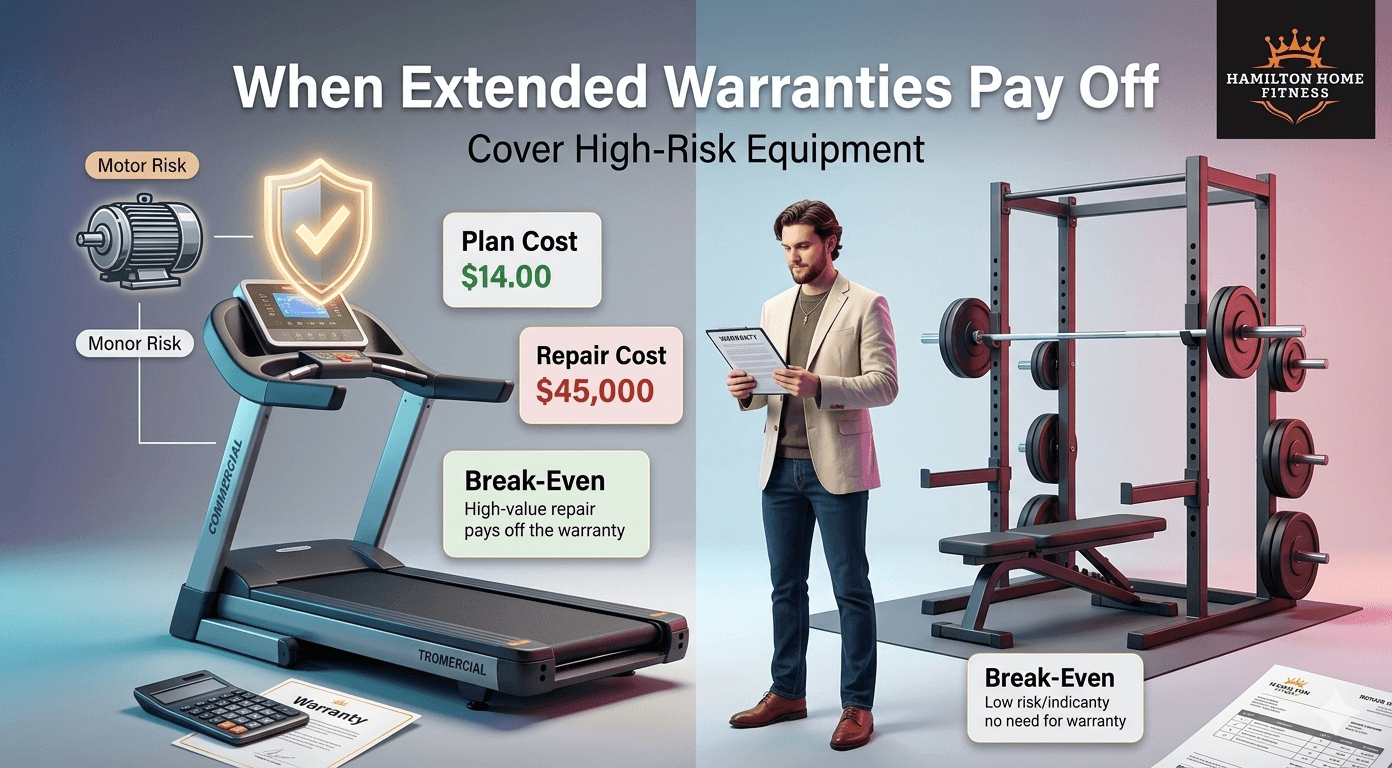
The principle is the same whether you're buying one treadmill or outfitting a gym: pay for coverage where a failure would hurt and skip it where the machine has little that can fail.
Break-even math for a plan
Compare the plan's price to the cost of the most likely repair. If a single covered fix would cost more than the plan, it's usually worth it.
Work a quick example. A treadmill's extended plan runs $250. The repair you're really insuring against is a motor or controller failure—call it $600 in parts and labor. If there's a reasonable chance that happens within the coverage window, the plan clears the bar: one covered repair more than pays for it, and you've capped your downside.
Now flip it to a power rack. There's no motor, no console, no drive belt—just steel and a few wear parts. The odds of an expensive failure are low, so a $250 plan is likely money spent protecting against a repair that never comes. Same dollar amount, opposite decision, because the failure risk is what changes.
For a wider view of where to spend on coverage across a full equipment list, our commercial gym equipment buying guide walks through the trade-offs piece by piece.
Depreciation and total cost
For a facility, warranty length, lifespan, and depreciation together set the true cost per year—not the sticker price.
A $6,000 commercial treadmill covered well and lasting ten years costs roughly $600 a year in equipment terms. A cheaper machine that fails in four costs more per year of use, even though it rang up for less at purchase. Stretching coverage and lifespan across more years is what drives the real cost per use down — and it's why facility buyers weigh the warranty and the expected lifecycle, not just the price tag.
Depreciation adds a tax layer on top of that, and this is where you bring in a professional. How equipment is written down — and whether options like Section 179 or bonus depreciation apply to your purchase — depends on your business, your tax year, and rules that change. Treat depreciation as a real part of total cost, but confirm the specifics with a qualified tax advisor before you build it into the numbers.
Cardio vs Strength Warranty Coverage
A "strong warranty" means different things depending on what you're buying. Cardio warranties live or die on frame and motor length, because the motor is the costly failure point. Strength warranties center on the frame and the parts — cables, pulleys, bearings, and upholstery — since there's no motor to protect. Compare them by the same standard and you'll misjudge both.
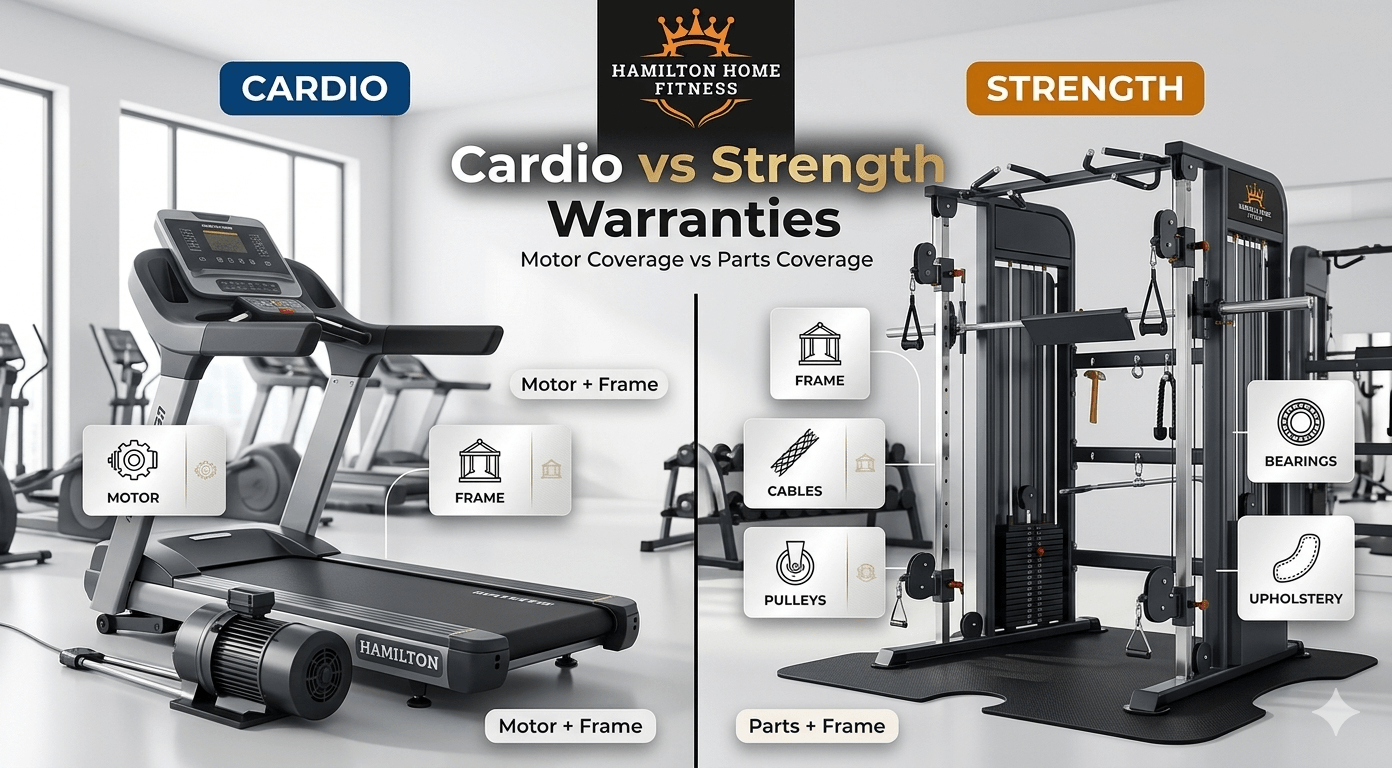
So before you weigh one machine against another, know which numbers carry the weight in that category. The right question for a treadmill isn't the right question for a power rack.
Cardio: frame and motor focus
On cardio, prioritize the longest motor and frame coverage you can get, because those are the expensive parts to replace.
The motor is the heart of the machine and the priciest thing that can fail, so its coverage is the number that protects you most—whether you're comparing a treadmill, an exercise bike, or an elliptical. The frame matters too, but it rarely fails, so treat a long frame term as table stakes rather than the deciding factor. Among the cardio brands Hamilton Home Fitness carries, Spirit Fitness and True Fitness are examples worth comparing on those motor and frame terms; check each brand's coverage directly, since terms vary by model.
Line up the motor warranties first and the frame second, and let the shorter part numbers break a tie.
Strength: frame and parts focus
On strength equipment, the frame should be long-covered, but the real test is the parts—cables, pulleys, bearings, and upholstery.
A power rack or selectorized machine has no motor, so the frame warranty is usually generous and easy to honor. What actually wears is everything that moves or takes friction: cables fray, pulleys and bearings grind down, and upholstery splits under daily use. That's where coverage length tells you whether a brand stands behind the parts you'll actually replace. Body-Solid and Tag Fitness are examples HHF carries that are worth checking on parts coverage model by model.
For facility buyers comparing across both categories, commercial-grade cardio and strength machines sit side by side in one place, which makes the warranty terms easier to weigh against each other.
FAQ
Do gym equipment warranties cover commercial use?
Only if the equipment is rated and warrantied for commercial use. A machine sold with a residential warranty almost always has its coverage voided the moment it's placed in a shared facility like a gym, hotel, or apartment fitness room. Always match the warranty tier to the setting before you buy.
How long do commercial treadmills last?
A well-maintained commercial treadmill commonly runs for many years under heavy daily use, with its lifespan tied to its duty cycle, maintenance, and how much traffic it sees. Skipped maintenance, no surge protection, and constant peak-load use are what shorten it most. For machines built to handle that load, commercial-grade treadmills are rated for far more hours than home models.
Are lifetime warranties really for a lifetime?
Usually no. "Lifetime" typically means partial lifetime on the frame and only for the original owner. The moving parts that actually wear out — the motor, electronics, and cables — run on their own shorter terms underneath that lifetime headline, so read it as frame coverage, not whole-machine coverage.
Does buying from a dealer change my warranty?
Buying from an authorized dealer keeps the manufacturer's warranty intact. The risk is buying gray-market or from an unauthorized seller, which can void the coverage before the equipment ever ships. Authorization matters because manufacturers honor warranties only on units sold through approved channels.
Final Thought
You can now read any gym equipment warranty the way it's meant to be read — across all five layers, not just the headline. Frame, motor, parts, labor, and the service network behind them each tell you something different, and together they reveal whether the coverage matches how and where you'll actually use the machine.
Hold onto the core takeaway: the longest number on the box isn't the real story. A "lifetime" frame can sit beside two years of labor, and the gap between them is money out of your pocket. What a warranty is truly worth comes down to the parts that wear, the labor that fixes them, the service that shows up, and whether any of it survives a move or a resale.
That's also the difference between a machine that protects your investment and one that becomes a surprise repair bill. The brand on the spec sheet matters less than the coverage standing behind it—and matching the right tier to a home gym or a full facility is where the decision is won or lost.
This is where buying from the right dealer pays off. As an authorized dealer for more than 40 brands, Hamilton Home Fitness can match the right warranty tier to how you'll actually use the equipment, keep your manufacturer coverage intact, and help you avoid the gaps that catch buyers later. If you'd like that mapped to your space before you spend, talk to our team about your warranty options for a personalized walkthrough.