Introduction
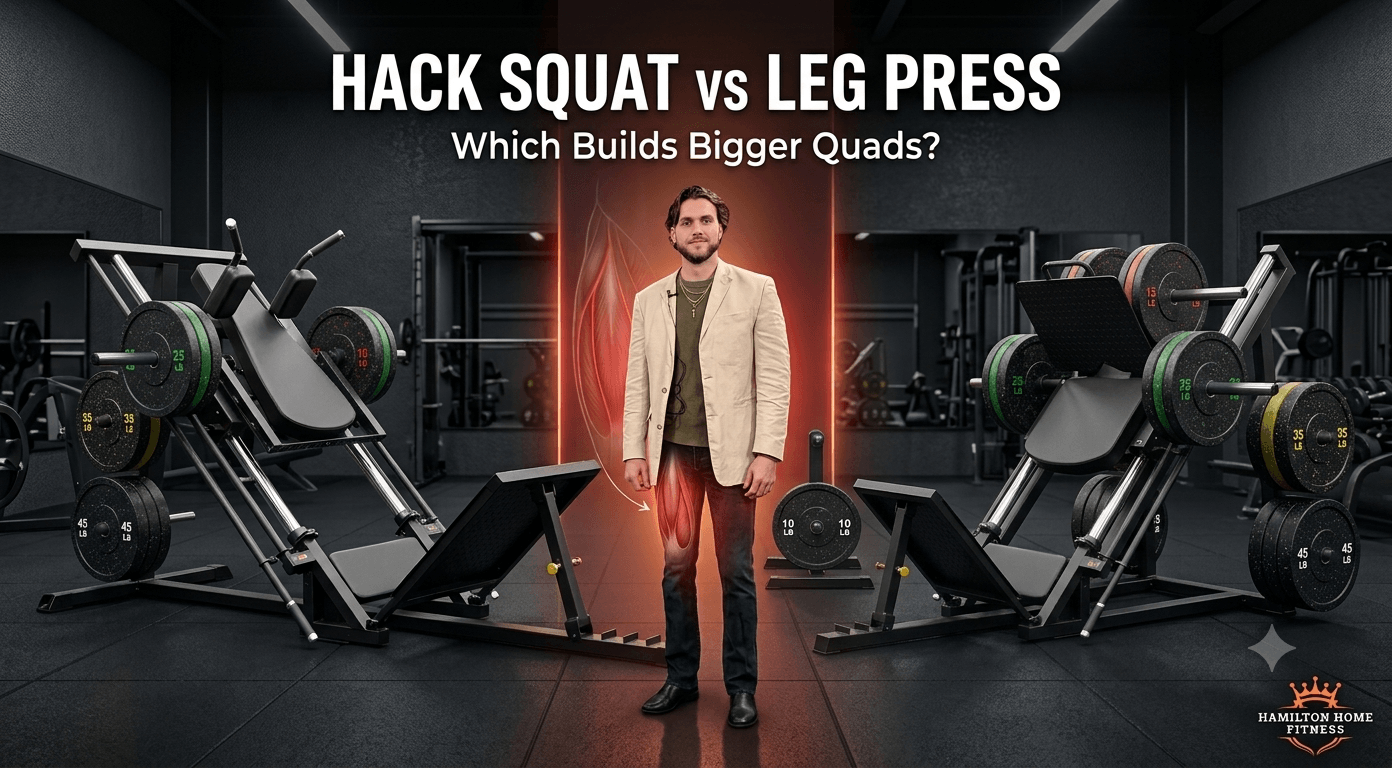
You have room for one serious lower-body machine, but the choice is not simply about which one holds more plates. A hack squat gives you a supported, squat-like pattern that often places greater emphasis on deep knee flexion and the quads, while a leg press supports the torso and makes high-volume leg training easier to manage.
Neither machine is automatically better for every lifter. Your ideal choice depends on quad-growth priorities, knee and lower-back tolerance, preferred foot placement, usable training depth, and the space available in your home or garage gym.
This comparison breaks down how the hack squat and leg press differ in muscle bias, joint load, loading potential, and real-world footprint. It also explains when a plate-loaded leg press and hack squat combo may provide more value than choosing only one movement.
Quick Verdict: Which Machine Wins?
Neither machine is the universal winner. The hack squat is usually the stronger choice for lifters who want a supported, squat-like movement with deep knee flexion and a clear quad emphasis. The leg press is often better for back-supported volume, heavier loading, and single-leg training with less balance demand.
Choose this. | When your priority is |
Hack squat | Squat-like quad training, controlled depth, and a more upright movement pattern |
Leg press | High-volume leg work, torso support, loading flexibility, or unilateral sets |
Combo unit | Both movement patterns in one frame without buying two separate machines |
Choose by Your Main Constraint
Choose the machine that solves your limiting factor, not the one that lets you move the most plates.
A hack squat suits quad-focused lifters who still want a squat pattern. A leg press suits lifters who need more back support or fatigue-controlled volume. A combo machine makes sense when both patterns matter and the full working footprint fits your room.
Which Builds Quads Better?
The hack squat often creates a stronger squat-like quad bias because it allows deep knee flexion while the torso stays supported. The leg press can still build substantial quad size through stable progressive overload, high effort, and repeatable training volume. Neither machine is a proven universal hypertrophy winner because machine geometry, range of motion, foot placement, and individual anatomy change the stimulus.
Why Hack Squats Bias Quads
Hack squats usually feel more quad-dominant because the knees travel through a large flexion range while the back remains supported against the pad. This position allows the quadriceps—particularly the vastus lateralis, vastus medialis, and rectus femoris—to produce force without balance becoming the main limitation.
A lower foot position and controlled heel elevation may increase knee travel and quad emphasis. However, the lifter should still maintain full-foot pressure and use a depth that remains stable and pain-free. A stronger quad burn does not automatically prove superior long-term growth.
Where Leg Press Shifts Load
A leg press remains an effective quad hypertrophy machine, but its back-supported position makes it easier to adjust muscle emphasis. Lower foot placement generally increases knee flexion and quad demand, while higher placement typically increases hip flexion and glute involvement.
The leg press also supports heavier loading, high-rep sets, drop sets, and single-leg press variations with minimal balance demand. For many lifters, that stability makes it easier to accumulate productive volume and train close to failure without the torso or core becoming the limiting factor.
Knee and Back Load Compared
Neither machine is automatically safe or harmful for your knees or lower back. Hack squats can place substantial demand on the knees during deep flexion, while leg presses support the torso but may strain the lumbar spine if the pelvis rolls away from the back pad. Your technique, load, anatomy, machine geometry, and existing symptoms determine how well each movement is tolerated.
Knee Load Is Technique-Dependent
Knee stress changes with technique; the machine name alone does not determine how much force reaches the joint.
A low foot position, deeper knee flexion, narrow stance, or rapid descent can increase knee demand on either machine. That does not make these positions inherently harmful, but they require controlled loading and a range of motion you can maintain without sharp pain or unstable knee tracking.
Keep your feet fully planted, lower the carriage under control, and avoid forcefully snapping the knees into lockout. If discomfort persists after adjusting depth, stance, and resistance, stop the movement and seek guidance from a qualified professional.
Back Support Has Limits
The leg press supports your back, but it cannot protect you from using more depth than your hips and pelvis can control.
When the knees move too close to the torso, the pelvis may roll forward and the lower back may lift from the pad. Reduce the depth before this lumbar rounding begins, even if the sled could travel farther.
Hack squats usually require more core bracing and upright control, although the back pad still reduces balance demands. Lifters with a history of lower-back pain should test both machines conservatively rather than assuming one option will always be pain-free.
Foot Placement and Depth
Lower foot placement generally increases knee flexion and quad emphasis, while higher placement usually shifts more work toward the hips and glutes. Stance width and toe angle should match your anatomy. The best setup preserves full-foot pressure, controlled depth, and stable knee tracking throughout every repetition.
High vs. Low Foot Placement
Moving your feet changes joint angles more reliably than it isolates one muscle completely.
Foot position | Likely effect | Main trade-off |
Low | More knee flexion and quad demand | Greater knee stress at deep ranges |
High | More hip flexion and glute involvement | Less direct quad emphasis |
Narrow | Often increases quad focus | May feel restrictive for some hips |
Wide-armed with toes out | More glute and adductor involvement | Requires controlled knee alignment |
Avoid extreme positions that cause your heels to lift, knees to collapse inward, or hips to shift unevenly.
Depth Without Pelvic Rounding
Use the deepest range you can control without the pelvis rolling, heels lifting, or knees losing their intended path.
On the leg press, stop before your lower back separates from the pad. On the hack squat, set the safety stops and descend only as far as you can maintain stable foot pressure and controlled knee tracking. More depth is useful only when position remains strong.
Which Machine Fits Your Gym?
Compare more than the published machine dimensions. You also need enough room to enter the unit, operate the safety handles, load plates, complete assembly, and move around the frame safely.
A 45-degree leg press or hack squat usually requires considerable floor length. A vertical leg press may use less floor space, but it demands more ceiling clearance. Before buying, measure the full operating area—not just the empty space where the frame will sit.
Measure the Working Footprint
A machine that technically fits between two walls may still be difficult to load, enter, service, or adjust.
Check:
- frame length, width, and height
- loading-peg and plate-storage clearance
- space for entering and exiting
- access to safety stops and adjustment handles
- doorway, hallway, and stairway dimensions
- garage-door tracks or low-ceiling fixtures
Leave extra room around moving sleds and carriages. For help checking room dimensions, delivery access, and freight requirements, confirm the footprint and freight route before ordering.
Match Resistance to Your Space
Plate-loaded machines suit buyers who already own Olympic plates and want simple progressive overload. However, they also require plate storage and room to access the loading pegs.
Selectorized machines allow faster weight changes and reduce plate handling, which may suit personal training studios or shared facilities. They can cost more and may offer less loading flexibility than a plate-loaded design.
After deciding which resistance system fits your room and training style, browse squat machine options that match your available space.
When a Combo Unit Makes Sense
A well-designed leg press and hack squat combo can replace two separate frames when it provides secure safety stops, usable footplates, smooth carriage travel, and quick position changes. It may not duplicate two premium standalone machines perfectly, but it can offer better floor-space value for a serious home gym or light-commercial facility.
Who the TAG Combo Suits
The TAG Fitness Plate Loaded Leg Press / Hack Squat Combo is worth considering when one frame must provide both a 45-degree leg press and an adjustable hack squat.
Its plate-loaded design, 770-pound stated capacity, and 104 × 40 × 54-inch frame suit lifters who want progressive overload across both movement patterns. However, buyers should confirm that the working footprint, loading clearance, and light-commercial rating match their room and expected usage.
When a Multi-Gym Fits Better
A multi-gym makes more sense when you need a seated leg press alongside upper-body and leg-extension stations—not two lower-body movement patterns.
The BodyKore MTI4005 3-Station Multi-Gym combines a seated leg press with selectorized chest, back, and leg stations. It suits larger home gyms, studios, or facilities seeking a complete training system rather than a dedicated quad machine.
Plates, Freight, and Final Checks
Before ordering, verify the required plates, storage space, delivery route, assembly area, warranty coverage, and adjustment clearance.
A plate-loaded combo also requires enough Olympic plates and free weights for meaningful progression. Confirm current shipping terms, freight access, and product specifications before completing a high-ticket equipment purchase.
FAQ
Can Hack Squats Replace Barbell Squats?
Hack squats can replace barbell squats when your main goal is controlled quad hypertrophy with less balance demand. However, they do not develop free-weight bracing, coordination, and whole-body stability in the same way.
For lifters with limited mobility, no spotter, or lower-back concerns, the hack squat may be a practical squat alternative machine. Powerlifters and athletes who need barbell-specific strength should usually keep some form of free-weight squat in their program.
How Much Weight Should You Leg-Press?
Use a weight that lets you maintain consistent depth, controlled tempo, full-foot pressure, and stable contact with the back pad. Reduce the load if your hips lift, your lower back rounds, or you forcefully hyperextend your knees at lockout.
Do not compare leg press numbers across different machines. Sled angle, carriage weight, friction, foot-plate design, and range of motion can make the same plate-loaded resistance feel very different.
Final Thought
Choose the hack squat when you want a supported, squat-like movement with strong quad emphasis. Choose the leg press when back-supported volume, loading flexibility, and single-leg training matter more.
A combo unit becomes the practical choice when both movement patterns support your training goals and one frame fits your available space. Before committing, measure the room, loading-peg clearance, ceiling height, and delivery path. Then contact Hamilton Home Fitness to confirm the machine’s footprint and freight requirements.