
















Premium free weight dumbbell set picks
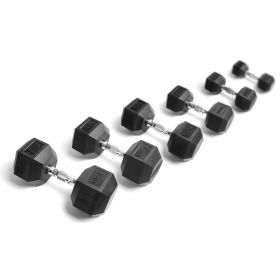
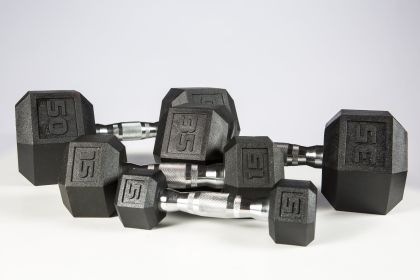
A well-chosen free weight dumbbell set is the simplest, most reliable way to add real strength training to any space. Free weights force stabilizer engagement that machines cannot match, and a fixed-pair set gives you instant readiness for presses, rows, lunges, carries, and dozens of accessory lifts. This collection brings together rubber, urethane, hex, and chrome options curated for home gyms, studios, schools, and commercial floors—shipped nationwide from our Tennessee headquarters with the durability, balance, and finish quality that serious buyers expect from a long-term investment.
What's in a free-weight dumbbell set?
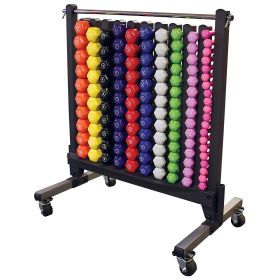
A free weight dumbbell set is a curated group of fixed-weight dumbbell pairs sold together, often with a matching storage rack. Each pair is a single sealed piece you grab and lift—no plates to load, no locks to check, no setup time between exercises.
That simplicity is the point. What is the best free weight dumbbell set? The best set is the one that matches your strongest user's weight ceiling, your weakest user's starting load, and your available floor space—built from a coating that survives daily handling without chipping, loosening, or fading. Standard sets typically run 5–50 lb in 5 lb jumps, while strength-focused configurations extend to 100 lb or beyond with optional 2.5 lb micro-steps in the lighter pairs.
Coating guide: rubber, urethane, hex, chrome
The coating decides how long your dumbbell set looks and feels new. Each material trades off price, noise, durability, and appearance, and the right choice depends on traffic volume, floor type, and how the space will be used.
| Material | Best Use | Strengths | Watchouts |
|---|---|---|---|
| Rubber hex | Home gyms, garages, small studios | Quiet, floor-friendly, strong value | Light odor when new |
| Urethane | High-traffic studios, commercial floors | Premium wear resistance, holds appearance. | Higher cost per pound |
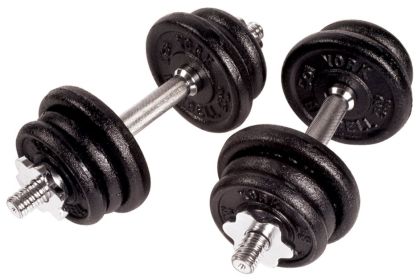
| Chrome / cast iron | Pro-style aesthetics, controlled rack rooms | Classic look, balanced feel | Noisier, tougher on flooring |
| Neoprene / vinyl | Light fitness, rehab, group classes | Soft grip, color-coded, hand-friendly | Limited to lighter loads |
For most home buyers, a rubber hex set delivers the best value-to-durability ratio. For shared studio and facility floors that see constant rack contact, urethane usually wins on total cost of ownership.
How to choose the right weight range
Choose your weight range by the strongest lifter who will use the set, then layer in lighter pairs for warm-ups, accessory work, and rehab. The wrong range either caps progress early or wastes money on weights nobody touches.
What weight range should I buy?
- Beginner home setup: 5–25 lb in 5 lb jumps covers starter routines and toning work.
- General home gym: 5–50 lb in 5 lb jumps is the most common, most flexible base.
- Strength-focused home or garage: 5–75 lb or 5–100 lb supports presses, rows, and split-squat progressions.
- Commercial floors: 5–100 lb with 2.5 lb micro-steps on the lighter end for accurate progression.
- Rehab, senior, and wellness use: add 1, 2, and 3 lb micro-pairs for safer, smaller jumps.
If demand for the 25, 30, 35, and 50 lb pairs bottlenecks your sessions, buy duplicate pairs of those specific weights rather than extending the range upward. Our full breakdown on how heavy your dumbbell set should be walks through goal-based selection in more detail.
Fixed vs. adjustable: Which set fits you?
Fixed-pair sets win on speed, feel, and durability; adjustable systems win on footprint and budget. The right choice depends on how often you change weights, how much floor you can spare, and whether you train solo or in supersets.
Are adjustable dumbbells as good as fixed dumbbells? For most home users they're close in capability, but a fixed free weight dumbbell set offers a more solid, predictable feel during heavy lifts, faster transitions in supersets, and far better drop tolerance. Adjustable systems are the smarter pick when storage space is limited and you train mostly solo. For a side-by-side comparison, see our guide on the adjustable vs. fixed dumbbell decision and our overview of the best fixed-weight dumbbell set options for serious buyers.
Key Selection Criteria
✅ Tight, rotation-free head construction
✅ Wear-resistant rubber or urethane coating
✅ Clear, long-lasting weight markings
✅ Consistent knurl across every pair
✅ Chamfered handle edges for comfort
✅ Anti-roll hex or stable round heads
✅ Rack-friendly, non-marring cradles
✅ Balanced, predictable pair-to-pair feel
✅ Low-odor finish for indoor use
✅ Expandable matching pairs over time
✅ Easy-clean surface for shared spaces
✅ Warranty matched to real-world use
Buyer fit by audience
The right set depends on who actually trains with it. A studio set takes daily punishment a home set never would, and a rehab set needs increments a strength athlete would skip past.
- Home gym owners and weekend lifters: rubber hex sets in the 5–50 lb or 5–75 lb range cover almost every training plan.
- Apartment and condo users: rubber-coated heads keep noise down and protect flooring; pair with a thick mat for added insulation.
- Small studios and personal trainers: urethane sets hold appearance under constant rack contact and shared cleaning routines.
- Commercial gyms, schools, and teams: extend to 100 lb or 150 lb with duplicate workhorse pairs in the 25–50 lb range.
- Rehab, senior, and corporate wellness programs: prioritize lighter micro-steps, soft coatings, and clearly readable labels.
- Faith-based and family fitness spaces: safe, quiet, anti-roll designs that work across mixed ages and skill levels.
Racks, floor protection, and space planning
Treat the rack and the floor as part of the dumbbell system, not as afterthoughts. A good rack speeds re-racking, protects coatings, keeps labels visible, and helps the floor stay organized.
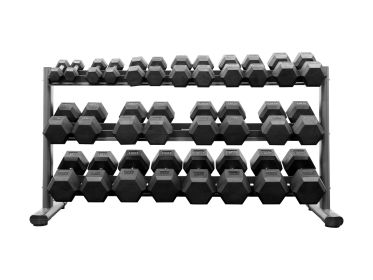
How much space do I need for a dumbbell set and rack? A typical 5–50 lb hex set on a three-tier vertical rack fits in roughly 4–6 feet of wall space, plus a clear lifting radius of about 6–8 feet for safe pickup, presses, and rows. Two-sided racks reduce congestion in busy rooms but need additional walk-around clearance. Rubber stall mats under the rack extend coating life, dampen sound transfer in upstairs studios, and reduce the risk of floor damage from accidental drops.
Maintenance, longevity, and total cost
A well-built free weight dumbbell set is a multi-year investment, and small habits protect it. Mild weekly wipe-downs with a non-petroleum cleaner keep rubber and urethane finishes sharp. A monthly rack check catches loose heads, fraying knurl edges, and worn cradles before they become safety issues. Buying a higher-grade coating up front almost always beats replacing a budget set after two seasons of heavy use—fewer replacements are also a meaningful sustainability win for eco-conscious buyers and facility managers tracking long-term equipment budgets.
Why shop with Hamilton Home Fitness?
Hamilton Home Fitness curates premium fixed-pair sets, adjustable systems, and matching racks for buyers who plan to keep their equipment for the long haul. Every set is built around the same priorities: tight construction, honest weight tolerance, comfortable grip, and finishes that age well under real use. Browse the broader dumbbell collection for fixed and adjustable options, or explore the dedicated fixed-weight dumbbell collection when you're ready to outfit a complete floor. Shipping nationwide from Tennessee. Order today and start lifting on the first delivery.