Introduction
GFID31B, GFID71B, FID46, and GFID100B. Body-Solid names its benches like part numbers because that is what they are, and none of them tell you which bench belongs in your gym.
The differences are real, though. They come down to four things: frame material, published weight capacity, footprint, and which attachments the bench will accept.
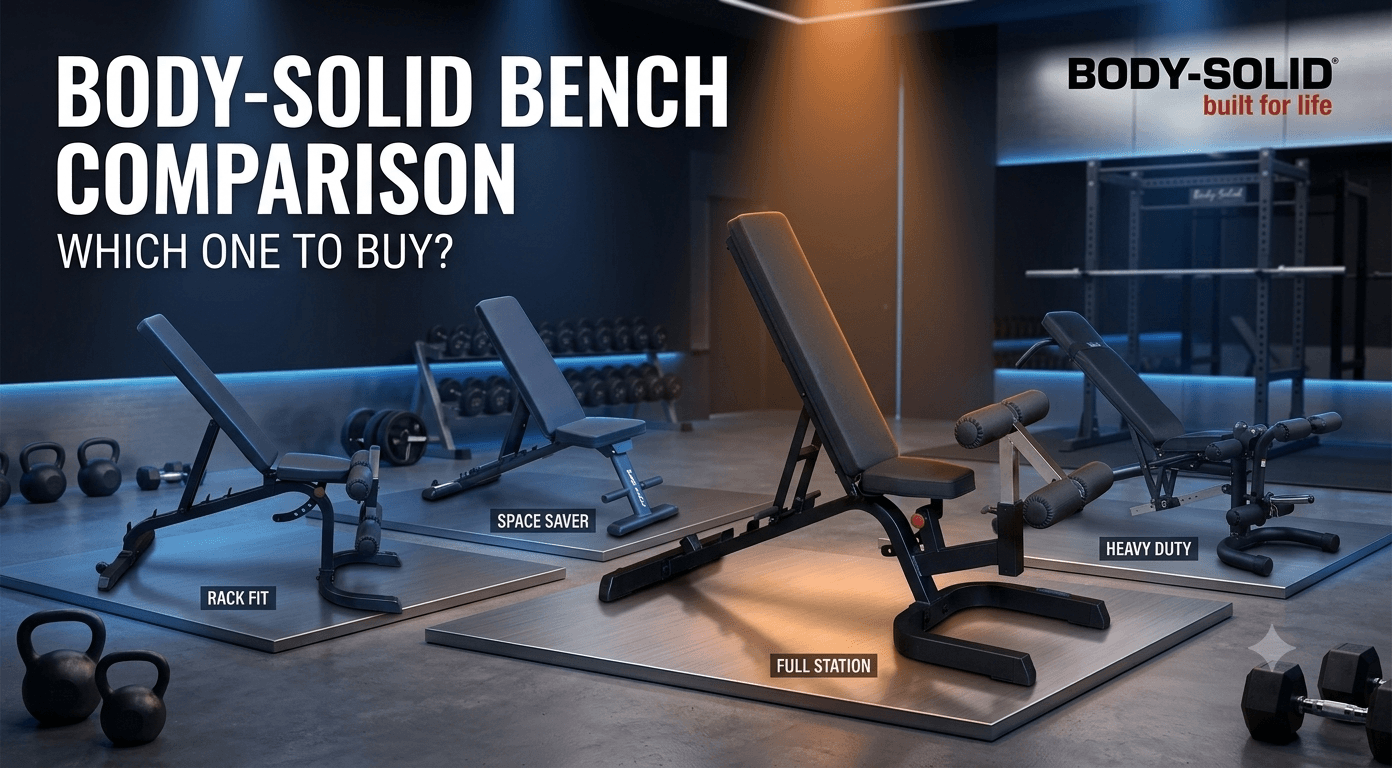
This Body-Solid bench comparison puts every model side by side, then names a specific pick for each situation—one bench for a garage gym and several for a studio or school weight room.
Still choosing between bench types rather than models? Read flat, adjustable, and FID benches compared first, then come back.
What Separates Each Body-Solid Bench
Four things separate these benches: frame material and gauge, published weight capacity, footprint, and which attachments the frame accepts. The model codes track build tier, not feature count. A higher number does not mean a better bench, and the cheapest model in the range is not the weakest.
Model | Frame | Capacity | Adjustment | Attachments | Best for |
GFB350B | 2"×3" heavy-gauge, welded 4 sides | 1,000 lb | Fixed flat | — | Budget flat pressing |
SFB125 | 2"×3" 11-gauge | 1,500 lb | Fixed flat | — | Heaviest flat pressing |
GFID100B | 3" round stock | 600 lb | 8-position back and seat, independent | Leg developer, preacher curl | Angle variety, lowest cost |
FID46 | 3" round stock | 600 lb | 9-position, synchronized | Leg developer included | Legwork without a machine |
GFID31B | 2"×3", welded 4 sides | 600 lb | 6-position back, 8-position seat | Leg developer, preacher curl | Working inside a rack |
GFID71B | 2"×3" commercial | 600 lb | 6-position back, 7-position seat | Leg developer, preacher curl, lat | Building a full station |
GFID225B | 2"×4" 14-gauge | Not published | 7-position ladder | None offered | Folding storage |
SOFB250 | 2"×3" 11-gauge | 1,000 lb | Fixed flat, with uprights | — | Dedicated press station |
SODB250 | 2"×3" 11-gauge | 1,000 lb | Fixed −18° decline | — | Dedicated decline pressing |
One note on the capacity column. Body-Solid publishes a spec-sheet rating and, in some marketing copy, a higher frame-load figure. Every number above is the spec sheet rating, so the comparison stays like-for-like.
GFID31B vs GFID71B: The Real Difference
The GFID31B is built on a shortened base frame designed to fit inside racks. The GFID71B is a full-size bench that trades that rack compatibility for a heavier build and the widest attachment support in the range.
Pick the GFID31B if your pressing happens inside a power rack or Smith machine and the bench needs to roll in and out between sets.
Pick the GFID71B if the bench itself is the station—the only model here that will take a lat attachment on top of the leg and curl options.
Which Benches Fit Inside a Power Rack
Body-Solid documents one model as purpose-built for this: the GFID31B Flat Incline Decline Bench, whose shortened base frame is designed to fit Smith machines, power racks, and multi-press racks. For every other model, fit depends on your rack, not on the bench.
So measure before you order. Take the inside width between your uprights, then the clear depth from the front upright to whatever sits behind the rack. Compare both against the bench footprint on the product page.
Two dimensions catch people out. Uprights on a heavy rack sit further inboard than the outer frame suggests, and a bench with transport wheels needs clearance to roll in at an angle rather than lift straight down.
If the measurements are tight and the bench you want will not go in, the fix is often the rack. Our power racks and cages include deeper models that give a full-size bench the room it needs.
Which Models Take Which Attachments
Attachments are model-locked. The GFID71B, the only model that takes all three, accepts a leg developer, a preacher curl, and a lat attachment. The FID46, which includes its leg developer, arrives with that part already fitted. Everything else takes some or none.
Bench | Leg developer | Preacher curl | Late attachment |
GFID31B | GLDA1 | GPCA1 | Not offered |
GFID71B | GLDA3 | GPCA1 | GLRA81 |
GFID100B | GLDA3 | GPCA1 | Not offered |
FID46 | Included | Not confirmed | Not confirmed |
GFID225B | None | None | None |
Flat and Olympic models | — | — | — |
GLDA1 vs GLDA3: Ordering the Wrong Part
The two legs' developers are not interchangeable. The GLDA1 is specified for the GFID31B, while the GFID71B and GFID100B require the GLDA3. Order by bench model, not by product photo — they look nearly identical.
One measurement before you commit to a lat attachment: the GLRA81 stands 83 inches tall once mounted, close to seven feet. Basement and garage ceilings often lose that argument.
Is any of it worth buying? An attachment earns its cost when it replaces a machine you have no room or budget for—a leg developer instead of a leg extension station, we say. It stops making sense once you are stacking three attachments onto one bench. At that point a dedicated station trains better and costs less than the parts.
When Pro ClubLine Beats the Standard Line
Pro ClubLine is Body-Solid's full-commercial range, built on 11-gauge steel—a heavier wall thickness than the standard line, rated for gym floors where equipment gets used all day by people who did not pay for it. The threshold is traffic, not budget.
A hotel gym with a dozen guests a day does fine on the standard line. A studio running back-to-back sessions from six in the morning does not. Once a bench is under load for most of the working day, the Pro ClubLine SFID325B may be a stronger fit than anything in the home range.
There is a detail here worth reading correctly. Pro ClubLine adjustable benches do not accept leg or curl attachments, and that looks like a missing feature on a spec sheet. It is deliberate. Body-Solid's own reasoning is that leg attachments obstruct movement on a busy floor — they get in the way of dumbbell work and slow down turnover between users. A clean frame is the point.
So the step up is not simply "more bench." You gain frame rating and lose attachment support. For a facility, that trade is usually right. For a home gym, it rarely is—you would pay more for commercial steel and give up the leg developer you actually wanted.
Folding, Olympic, and Space-Limited Picks
Two situations the table above cannot settle.
If floor space is the constraint, the GFID225B Commercial Folding Bench is the pick. Seven ladder positions, pull-pin folding, transport wheels—and it ships fully assembled, which no other bench here does. Pull it out, train it, and fold it against a wall.
If you want a dedicated pressing station instead, the Pro ClubLine SOFB250 Olympic flat bench gives you uprights and a spotter platform in one frame. Check the footprint first: it runs about 50 inches wide against roughly 25 for a standard bench. Two of them fill a garage bay.
Does that replace a rack? Not quite. The SOFB250 includes a spotter platform, and the SODB250 has bar catches, but neither offers safety bars you can set at multiple heights. Training alone near a maximum, that difference matters.
Match a Body-Solid Bench to Your Budget
Under $300 buys a flat bench. Around $350–$450 covers the FID range. $500–$600 reaches upper FID and is fully commercially adjustable. Olympics start near $600.
Pressing flat on a budget: the GFB350B flat bench is the entry point into the range.
Pressing heavily and only flat? Skip the adjustables. The Pro ClubLine SFB125, rated at 1,500 lb, carries the highest capacity of any bench here and costs less than most of them.
Want angles at the lowest cost, with no rack to work around? The GFID100B adjustable bench sits at the bottom of the FID band.
Or browse by type: adjustable benches, flat benches, incline-decline benches, and curl and preacher benches.
FAQ
Is Body-Solid a good brand for weight benches?
Yes, for buyers who want welded steel frames and lifetime frame coverage at mid-market pricing. One honest caveat: the range prioritizes durability over refinement. Owners of the heavy-duty FID model consistently mention the gap between seat and back pad.
Are Body-Solid benches commercial grade?
Some are. The Pro ClubLine range is full-commercial-rated. Standard-line benches are rated for in-home or light commercial use depending on the model—check the comparison table above before specifying them for a facility.
Do Body-Solid benches come with a warranty?
Yes, and the tier depends on where the bench is installed, not just which model you buy. Residential use carries lifetime coverage on frames and welds. Body-Solid defines "light commercial" as facilities that do not charge membership dues and see no more than 50 users a day—hotels, apartment gyms, and training studios among them. Commercial settings keep lifetime frame coverage but carry shorter terms on wear parts.
Do Body-Solid benches arrive assembled?
Most ship flat-packed and need assembly. The GFID225B folding bench is the exception and arrives fully assembled.
Final Thought
The right Body-Solid bench is the one whose frame, footprint, and attachment support match your room and your training—not the one with the highest number in its code.
You should be able to name yours now.
Browse the full Body-Solid range to see the complete lineup. Hamilton Home Fitness is an authorized Body-Solid dealer: full manufacturer warranties, free shipping on Body-Solid, shipped nationwide from Tennessee.
Not certain on sizing? Contact the team for a fit recommendation on body size, rack compatibility, and attachment planning before checkout.