
Introduction
You've already got the rack, and your working sets are past 225 pounds—or you're specing benches for a floor full of lifters who press that heavily. Now you need the right bench, and the choice is messier than it looks: flat, flat Olympic, FID, and adjustable benches all press differently, spec sheets bury what actually matters, and a bench that wobbles or isn't built for the load becomes a safety problem the moment you reach 315 or 405.
This guide sorts the four types by who each one suits and what it costs you in stability or versatility, then lays out the pad, frame, capacity, base, and seat-gap specs to require before you pay. Types and specs come first; where to buy comes last.
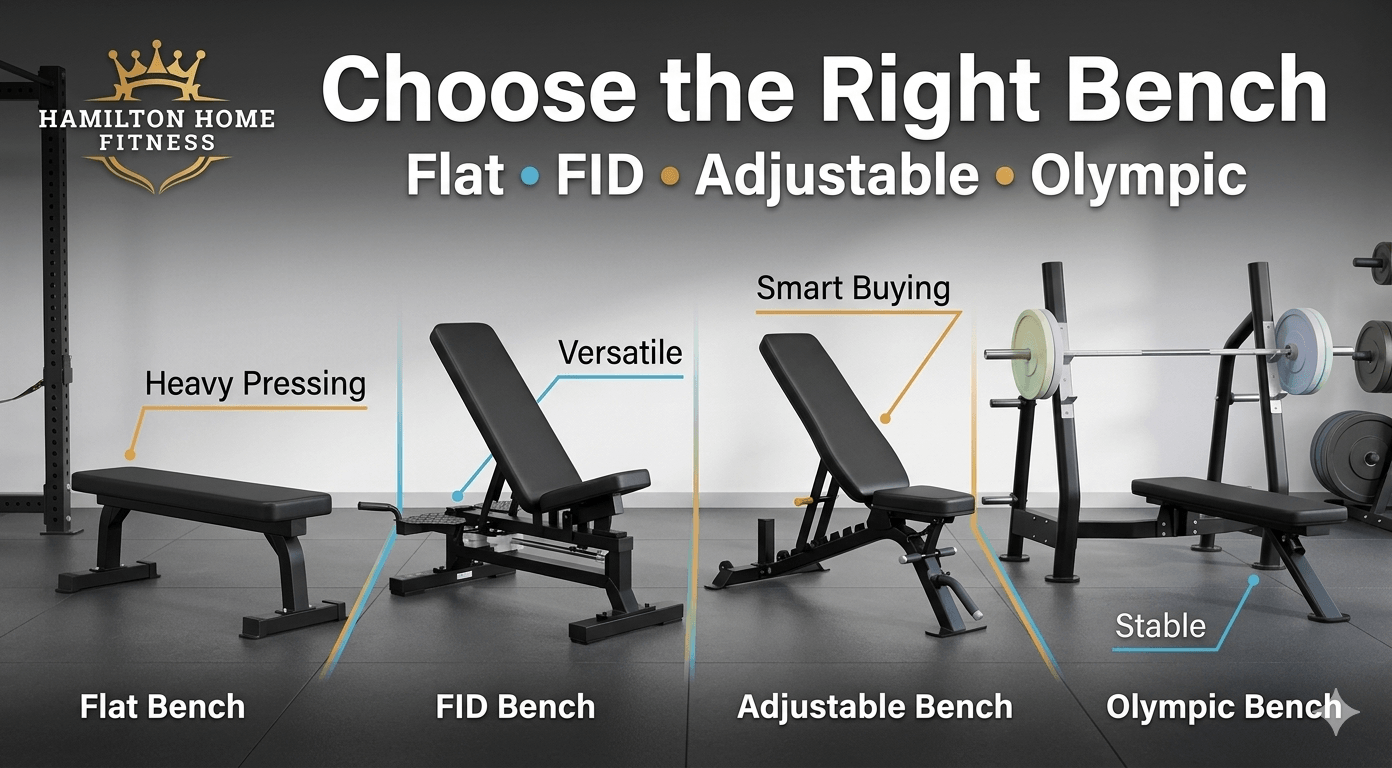
Flat, adjustable, FID & Olympic compared
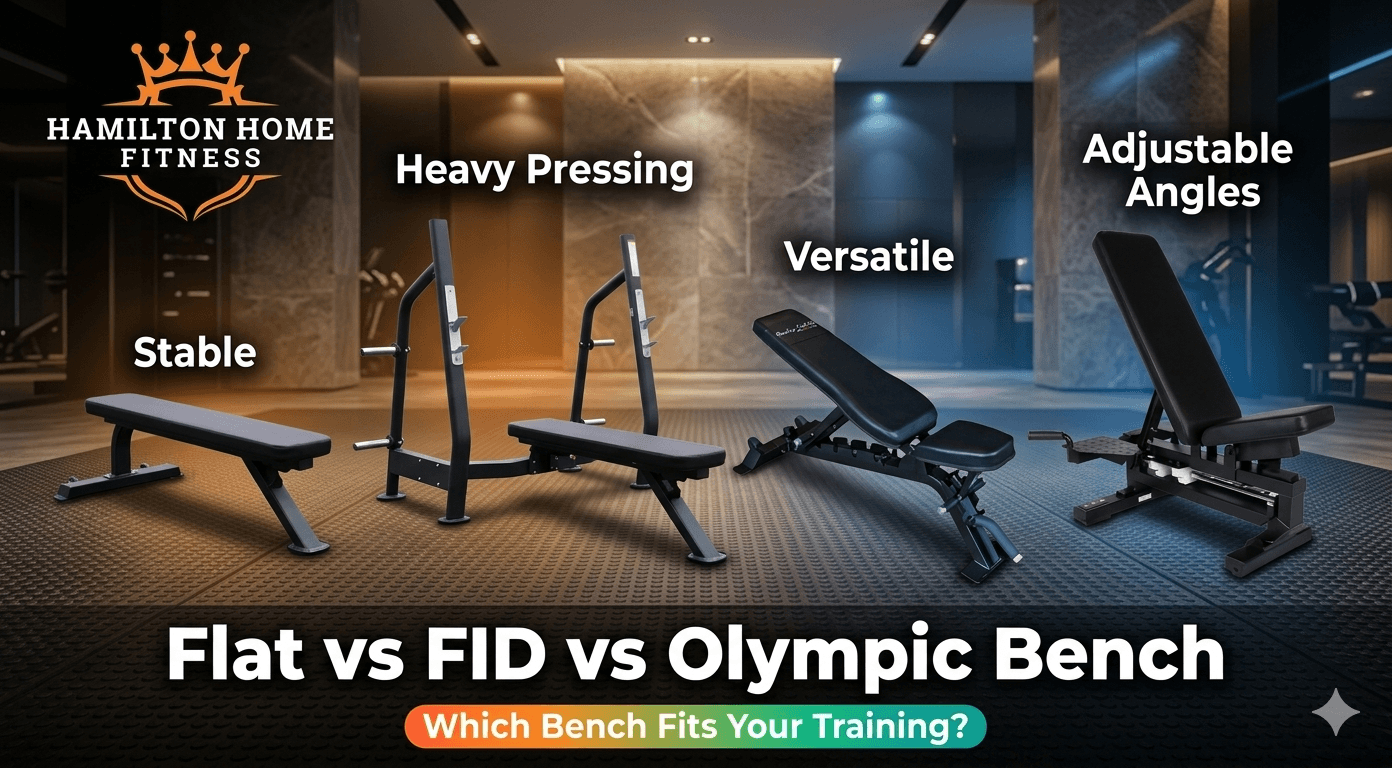
Here's the quick map: a flat utility bench is the simple, stable, budget pick for pressing; a flat Olympic bench is the dedicated home for heavy barbell benching; an FID bench covers the widest range of angles on one frame; and a premium adjustable bench prioritizes angle versatility for pressing and hypertrophy. The table compares them at a glance, and the details follow.
Bench type | Stability | Versatility | Capacity | Footprint | Best for |
Flat utility | High, no moving parts | Low | High | Small | Simple, stable pressing on a budget |
Flat Olympic | Highest, fixed base | Low | Highest | Larger | Heavy, dedicated barbell pressing |
FID | Good, slight pivot play | Highest | High (varies by model) | Medium | The widest range on one frame |
Premium adjustable | Good, not fully fixed | High | High (varies by model) | Medium | Angle variety and hypertrophy |
Flat benches: utility vs Olympic
A flat utility bench is a single fixed pad for pressing and accessory work, while a flat Olympic bench adds built-in barbell uprights so you can unrack heavy loads without a separate rack. The utility bench is the lighter, cheaper, smaller option, but it has to live inside a rack to press a barbell. The Olympic version is a self-contained pressing station with its own bar catches at the cost of more weight and floor space. Both share the flat-bench advantage that matters most under a max single: a fixed pad with no moving parts, so there's nothing to flex, rattle, or shift. You can see both styles among Hamilton Home Fitness's flat and flat Olympic benches.
FID benches
An FID bench is an adjustable bench whose back pad sets to flat, several inclines, and a decline, covering the widest pressing range on one frame. Body-Solid's GFID series is a clear example of the pattern: an 11-gauge steel frame, a ladder-adjusted back pad, a decline leg hold-down to keep you anchored, and optional leg developer, preacher curl, and lat attachments that turn one bench into a small training station. The trade-off is that the back-and-seat pivot adds a little play compared with a fixed flat bench, and decline work needs the hold-down so you don't slide off. If a do-everything frame appeals, compare options in Body-Solid's bench range.
Premium adjustable benches
A premium adjustable bench has independently adjustable back and seat pads with multiple angles, trading a little maximum rigidity for the broadest exercise range. Choose one when angle variety—flat, incline, and the occasional decline—matters more to you than the fixed-base stability of a flat bench; it's the strongest single choice for dumbbell incline and shoulder pressing and general hypertrophy work. Look for a secure adjustment system, whether pop-in, ladder, or gas-assist, and check the back-to-seat fit closely, since lesser models can develop a seat gap and side-to-side play under load. Browse the premium adjustable benches to compare angles and adjustment styles.
Match the bench to your lifts
Start from what you train: pressing-first lifters lean toward a flat or flat Olympic bench, while lifters who want angle variety and accessory work lean toward an FID or adjustable one. Here's how the common lifts sort out.
Heavy barbell bench press belongs on a fixed flat or flat Olympic bench, where there's no pivot to flex under a max single. Dumbbell incline and shoulder pressing need an adjustable or FID back pad set to incline. Rows, single-arm work, and chest flies work on any stable flat surface. Hip thrusts, step-ups, Bulgarian split squats, and box squats want a low, rock-solid bench that won't tip when you load one edge—a flat utility or Olympic bench, not a tall, adjustable one. Decline presses, ab and crunch work, and skull crushers call for an FID with a decline setting and a leg hold-down to keep you anchored.
If your program centers on one or two heavy barbell lifts, stability decides the bench. If it spreads across angles, dumbbells, and accessories, versatility decides it.
Pad, frame, & weight capacity
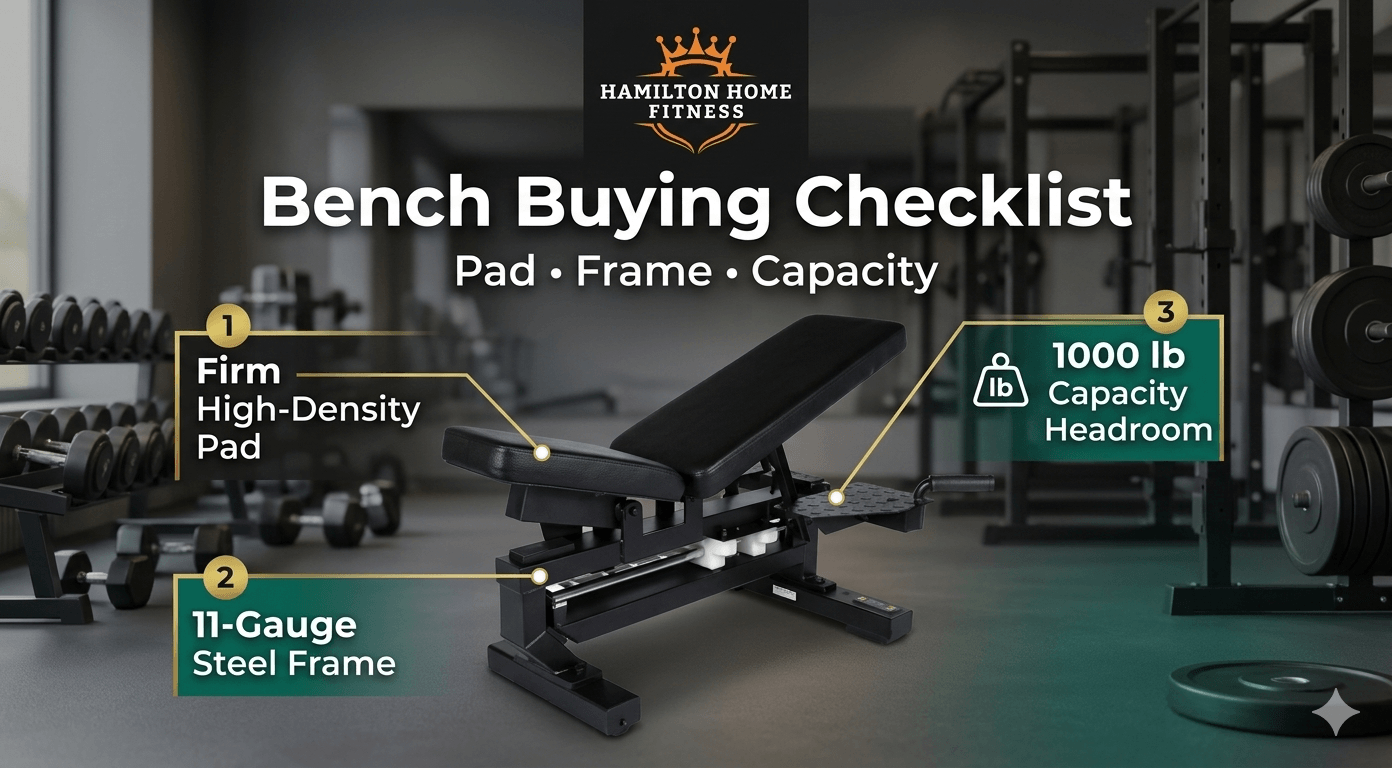
Three things separate a bench that lasts from one that flexes, sags, or fails under load: the pad, the frame, and the rated capacity. Check all three before anything else.
Pad density, width & cover
For pressing over 315 pounds, use a firm, high-density pad about 2 to 2.5 inches thick; 10 to 12 inches wide suits most lifters, while roughly 12 to 14 inches adds shoulder support for broader frames. Firmness matters more than plushness here. Soft foam compresses and lets you sink, which shifts your bar path and bottoms out under a heavy load, while high-density foam holds its shape so your scapula stays planted. Width is a trade-off: a narrower pad gives more room to retract your shoulder blades and a fuller range of motion, while a wider one supports the shoulders but can crowd the arms on a smaller frame. Whatever the width, a grippy vinyl cover keeps you from sliding when you arch and drive—the reason competition pads run firm and around 12 inches.
Frame gauge & tubing
Look for 11-gauge steel with 2x3 or 3x3 tubing—a thicker tube and a lower gauge number resist flex under heavy loads and over years of use. The gauge scale is backward from what you'd expect: 11-gauge steel is thicker and stronger than 12-gauge, not thinner. Tube size adds the rest of the rigidity, so 3x3 tubing carries heavy loads with less flex than 2x3. A fully welded frame stays tighter than a bolted one, which can loosen and creak over time. On a spec sheet, gauge and tube dimensions tell you far more than the words "heavy-duty."
Weight capacity & headroom
Choose a rated capacity that comfortably exceeds your bodyweight plus your heaviest working load, with margin to spare. A 200-pound lifter benching 405 is already at 605 pounds, so a bench rated near 1,000 pounds leaves real headroom; commercial floors should be sized up further for constant use. Note whether a listing quotes max user weight or total rated load, since they're different numbers. And confirm the figure on the manufacturer's page rather than trusting a single spec, because published ratings vary by listing—the same model can appear at 600 pounds on one seller and 1,000 on another. Treat capacity as a safety spec, and give yourself the margin.
Stability, posts & adjustability
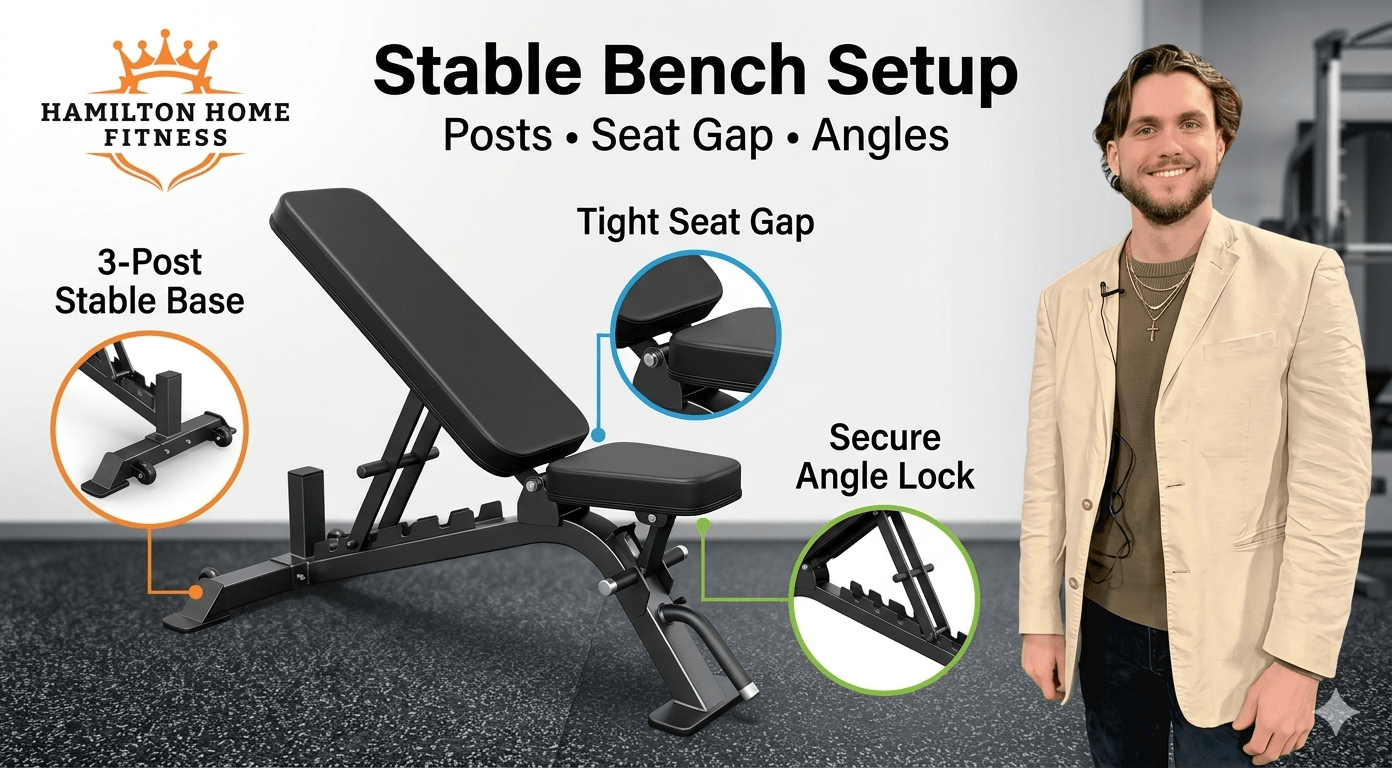
A bench can pass over a pad and frame and still feel unsettled under a heavy load. The reason is usually here: too many wobble points, a loose base, or a seat gap that leaves you unsupported. The rule is simple — fewer points of movement and a smaller gap mean a more stable bench.
Two-post vs three-post bases
A three-post flat Olympic bench—two legs at the head, one at the foot—avoids the rock of a four-leg base and keeps the front leg clear of your feet, which is why heavy pressers prefer it. A four-leg base behaves like a four-legged table: one corner can lift, and you feel it move at lockout. Moving to a single front post removes that fourth contact point, so the bench settles flat, and it clears space for your feet to plant and drive. For max-effort barbell work, a three-post or fully fixed base is what you want under you.
The seat gap problem
The seat gap is the space between the back and seat pads on an adjustable bench; keep it to about two inches or less so your hips and lower back stay supported under heavy presses. On less adjustable benches, a wide gap leaves a hollow right where your glutes and lower back need contact, which pinches and undercuts your base when you set up flat. Before buying, check the bench in its flat position specifically—not just at an incline—and confirm the two pads sit close and level. A tight gap is one of the clearest signals that an adjustable bench was built to press heavy, not just to look versatile.
Ladder positions & angles
Most lifters actually use flat, around 30 degrees, around 45 degrees, and roughly 75 to 90 degrees; more ladder positions add flexibility, but you'll rarely use every hole. A long list of angles looks impressive on a spec sheet, yet in practice, incline pressing lifts are near 30 to 45 degrees, and shoulder work sits near vertical. What matters more than the count is that the adjustment locks securely—pop-pin, ladder, or gas assist—with no play once it's set. Don't pay a premium for angle positions you'll never set foot on.
Heavy bench press: what is required?
You can bench 405 pounds on a high-quality adjustable bench rated well above that load, but a fixed flat or flat Olympic bench gives a more stable, wobble-free base for true max-effort pressing. The adjustable bench's pivots add a small amount of play that you feel most at the limit; the fixed bench has nothing to move. If max barbell pressing is the priority, that rigidity is worth more than angle versatility.
For loads at 225, 315, and 405 pounds and up, require these:
Rated capacity that clears your bodyweight plus your heaviest set with real margin—near 1,000 pounds for most heavy home lifters and more for commercial use.
A firm, high-density pad, standard to narrow width, with a grippy cover so you stay planted as you arch and drive.
An 11-gauge frame with 3x3 (or at least 2x3) tubing, welded over bolted.
A three-post or fully fixed base—and on an adjustable bench, a seat gap of about two inches or less.
One safety point that the bench alone can't solve: a bench does not catch a failed rep. For heavy pressing on your own, set up inside a rack with adjustable safeties or spotter arms at chest height, or use a spotter. Pair the bench with power racks and cages so a missed lift lands on the safeties, not on you.
How to choose and where to buy
Match the bench to where it lives and what you'll spend, then handle delivery and setup. Type and budget point most buyers to one clear answer.
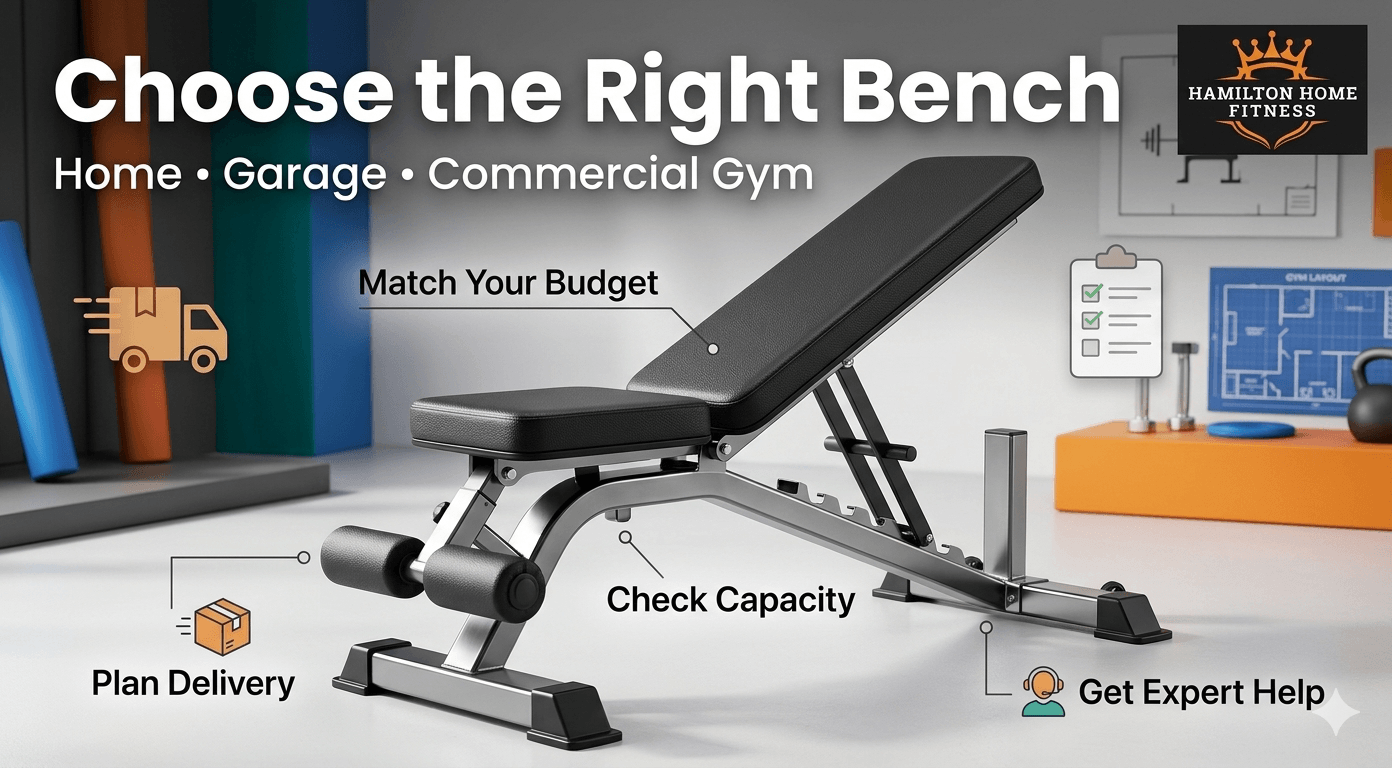
Pick by gym type & budget
Garage and home lifters who press heavy lean toward a flat Olympic or a heavy FID; versatility-first home gyms lean toward a premium adjustable; and commercial or facility floors need higher capacity and commercial warranties. A few more profiles: small-space setups should weigh footprint and transport wheels or vertical storage; rehab, senior, and beginner users want a stable, easy-to-adjust bench over a high angle count; and budget buyers are usually best served by a solid flat utility bench now, with an FID or adjustable added later. If you're outfitting a hotel, studio, or multi-unit facility and want the bench planned into the wider floor, you can book a gym design consultation.
Shipping, bundling & help
Hamilton Home Fitness ships benches nationwide from Tennessee, with freight delivery for heavier commercial models and free shipping on select brands. The cleanest way to decide is to put the four types next to each other—compare the weight benches' collection by type, capacity, and adjustment style, then size the rest of your setup around it. If you're building from the rack out, add barbells, plates, and dumbbells to match the bench to your lifts. And if you're still weighing flat Olympic against FID or adjustable for your body size and program, talk to a Hamilton Home Fitness specialist for a fit recommendation before you order.
FAQ
What's the difference between a flat, FID, and adjustable bench? A flat bench is one flush, fixed pad for stable pressing. An FID (flat-incline-decline) bench has a back pad that sets to flat, several inclines, and a decline, covering the widest range on one frame. An adjustable bench has independently adjustable back and seat pads for angle versatility.
What pad density and width are best for benching over 315 pounds? Firm, high-density foam about 2 to 2.5 inches thick that won't bottom out under load. A width of 10 to 12 inches suits most lifters; up to about 14 inches adds shoulder support for broader frames. A grippy cover keeps you set as you arch.
How many ladder positions and back-pad angles do you actually use? Most lifters use flat, around 30 degrees, around 45 degrees, and roughly 75 to 90 degrees. Extra positions add flexibility, but you'll rarely use every hole—a secure, play-free lock matters more than a high angle count.
What is the seat gap on adjustable benches, and how do you avoid it? The seat gap is the space between the back and seat pads. Choose a bench with about two inches or less so your hips and lower back stay supported, and check the fit in the flat position specifically before buying.
Two-post or three-post flat Olympic bench for stability? Three-post—two legs at the head, one at the foot. It resists the wobble of a four-leg base and clears your feet for leg drive, which makes it the stronger choice for heavy pressing.
What weight capacity should you require for a home or commercial bench? Your bodyweight plus your heaviest working load plus a safety margin—near 1,000 pounds for most heavy home lifters and more for commercial use. Confirm the figure on the manufacturer's page, since published ratings vary by listing.
Are commercial benches worth it for a home gym? Worth considering if you press heavily, plan to keep the bench for years, or want commercial-grade stability and a warranty. Lighter or occasional use can be served well by a quality residential model.
Do you need a leg developer attachment? Useful if you want leg extensions, curls, or extra lower-body work on the bench itself. Skippable if a rack and free weights already cover those lifts—don't pay for an add-on that duplicates what you own.
Final thoughts
The decision comes down to how you train. If you press heavily on one or two barbell lifts, a flat Olympic or fixed flat bench gives you the stable base that matters most under a max. If your work spreads across angles, dumbbells, and accessories, an FID or premium adjustable earns its place. Either way, you now have the standard to hold any bench to before you pay: a firm, high-density pad; an 11-gauge welded frame; capacity with real headroom; a three-post or fixed base; and a tight seat gap.
That short checklist is what separates a bench that lasts from one that flexes. Apply it as you compare the bench range at Hamilton Home Fitness — put the flat, Olympic, FID, and adjustable options next to each other, match one to your lifts and body size, and bring a specialist into the decision if you want a second opinion before you order.