
Introduction
Building a smarter home gym starts with choosing a bench that matches how you actually train. This guide is for serious home gym buyers, trainers, small facilities, sports programs, and budget-conscious shoppers who want an Adjustable Decline Bench that feels stable, fits the space, and delivers real value.
The problem is that many benches look similar until you compare the details that matter most in daily use. Build quality, decline support, comfort, footprint, and long-term durability can change whether a bench feels like a smart buy or a fast regret, and if you need a quick primer first, see What Is Adjustable Decline Bench before moving into the side-by-side comparison.
By the end, you will be able to shortlist the best Adjustable Decline Bench for your setup, training style, and budget with more confidence. Whether you want a strong value pick, a premium upgrade, or a commercial-ready option, this guide will help you compare the right choices clearly and buy with less guesswork.
Best Adjustable Decline Bench Picks
If your goal is to compare the best Adjustable Decline Bench options without wasting time on weak fits, start by narrowing the field by buyer type. Most shoppers do not need the same bench, so the smartest shortlist separates the market into best overall, best budget, and best for commercial-ready environments.
Best overall for home gyms
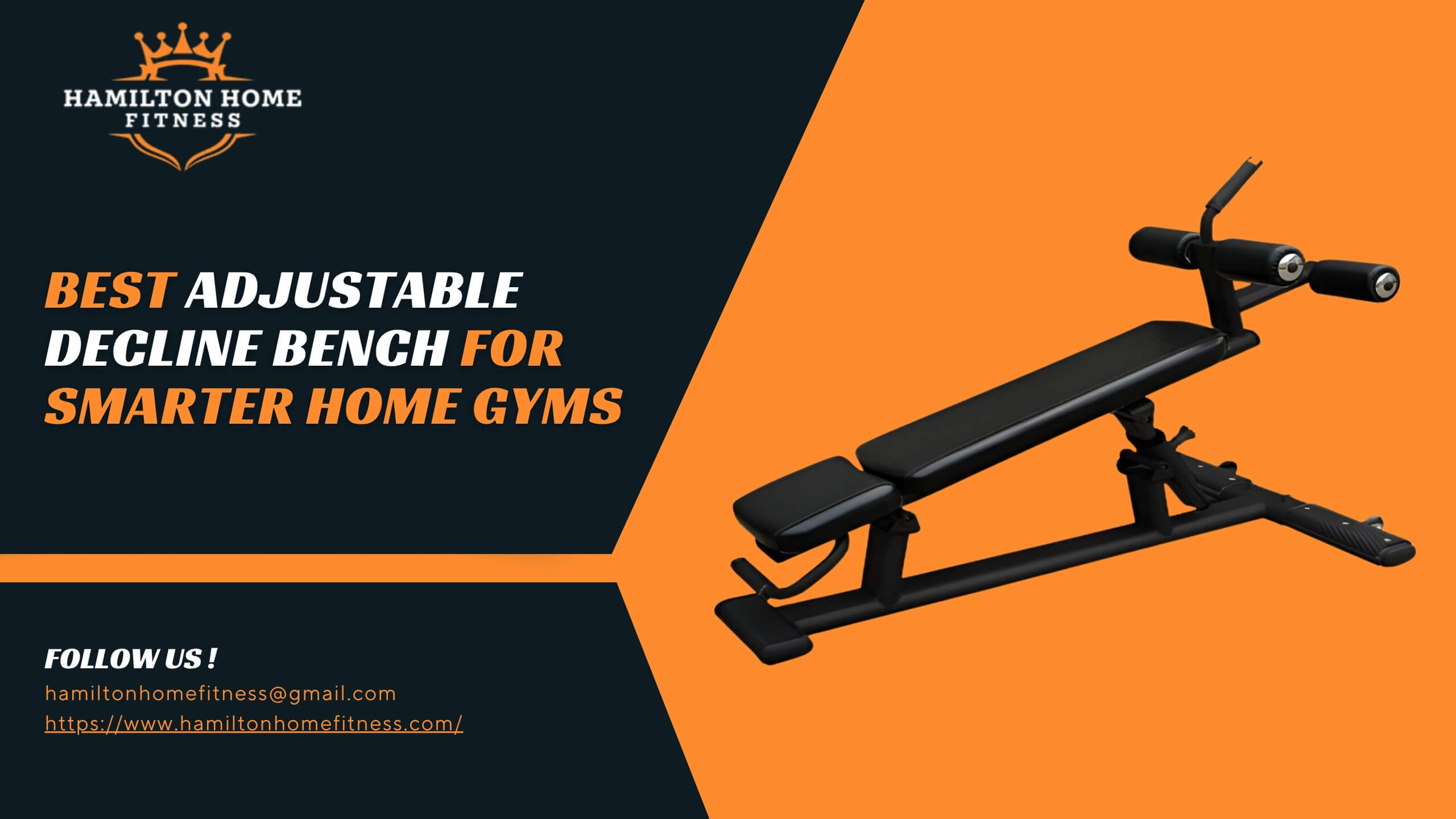
For most serious home gym buyers, Hamilton Home Fitness’s TAG Adjustable Decline Bench is the best overall place to start because it combines commercial-ready construction with true decline usability, stable support, and a design that still makes sense outside a full commercial floor. TAG lists 11-gauge steel construction, ankle and knee roller support, 8 to 30 degree position adjustments, a mobility handle, and commercial-rated use, which gives it a stronger long-term value case than many lighter home-only benches.
For buyers who want the strongest overall shortlist starter, Buy the Adjustable Decline Bench first, then compare it against lower-cost FID benches and premium alternatives. That is especially true if you want one bench that can serve a serious garage gym, a trainer-led studio, or a higher-end home setup without feeling underbuilt after a few months of harder use. Based on the official TAG specs, this bench stands out because it is not just adjustable on paper; it is built around decline-specific support and commercial durability, which is where many cheaper benches start to show limits.
Best budget for the money
If your top priority is value, a budget-friendly FID bench is usually the better answer than jumping straight into a commercial-rated decline model. REP positions the AB-3000 2.0 as a best-value FID bench for home gyms, with eight back pad adjustments down to a -12 degree decline and five seat settings, while Titan’s Elite Series Adjustable FID Bench offers flat, incline, and decline positions, upright storage, foam foot anchors, rear wheels, and a listed sale price of $279.97 at the time of review.
The trade-off is simple: budget benches can be excellent for home use, but they usually aim at affordability first and commercial-grade confidence second. If you mainly want decline access, space efficiency, and lower upfront cost, REP and Titan make strong budget comparisons; if you want a bench that feels more like a facility-grade purchase from day one, Hamilton’s TAG option makes a stronger case even at a higher price point.
Best for commercial floors
For commercial gyms, training rooms, sports programs, and high-traffic wellness spaces, the best adjustable decline bench is the one that stays stable, moves easily, and keeps working under repeated daily use. Hamilton Home Fitness’s TAG Adjustable Decline Bench earns attention here because TAG explicitly lists it as commercial rated and pairs that with 11-gauge steel construction, integrated roller support, and built-in mobility features that suit shared environments.
That does not mean premium commercial buyers have only one route. Rogue’s AB-3 is positioned as a premium heavy-duty bench with integrated decline functionality, and Life Fitness’s adjustable decline bench line emphasizes multiple decline settings with fast transitions for pressing and core work. Still, for buyers trying to balance commercial readiness with practical value, Hamilton’s TAG bench stands out as a strong middle ground between lower-cost home FID benches and higher-priced premium commercial options.
Features That Matter Most
The best Adjustable Decline Bench is not the one with the longest feature list. It is the one that stays stable under load, gives you a usable decline setup, and feels comfortable enough to use consistently without wasting floor space or budget.
Stability for heavy lifting
If you lift heavy, stability matters more than flashy adjustability. A bench should feel planted during presses, controlled during setup, and secure enough that you are not compensating for wobble or weak support when the load gets serious.
In practical terms, that means looking first at frame construction, overall bench confidence, and how the lower body is supported in decline positions. Hamilton Home Fitness’s TAG Adjustable Decline Bench stands out here because TAG lists 11-gauge steel construction, commercial-rated use, and ankle and knee roller support, while Titan highlights a tripod frame and foam foot anchors on its Elite Series FID Bench, and Rogue positions the AB-3 as a heavy-duty decline-capable bench for more demanding training. Those are the kinds of signals that matter more than marketing language when comparing benches for heavy lifting.
Decline range and leg hold-down
A real decline bench should make decline work feel secure, not awkward. The most important question is not whether a bench technically declines, but whether the angle range and leg hold-down design make pressing, core work, and repeated sets feel stable enough to use with confidence.
This is where many shoppers separate stronger designs from weaker ones. TAG lists support rollers and position adjustments between 8 and 30 degrees on its Adjustable Decline Bench, giving buyers a clear example of what usable decline looks like, while TAG’s separate commercial FID bench adjusts from -10 to 80 degrees and Titan’s Elite Series FID Bench is built around flat, incline, and decline training for full-body use. If decline is central to your training, a bench with secure lower-body support and clearly defined decline functionality is usually the better buy than a bench that only treats decline as an afterthought.
Pad gap, comfort, and wheels
Pad gap, comfort, transport wheels, and storage convenience matter more than many buyers expect. These are the details that shape daily satisfaction, especially for home gyms where the bench may need to move often, store cleanly, and still feel comfortable across pressing, dumbbell work, and decline movements.
The easiest way to judge these features is to match them to your actual usage, and How to Choose Adjustable Decline Bench becomes more useful when you think in terms of training frequency, available floor space, and how often you will move the bench. REP explicitly markets ZeroGap technology on its bench lineup, which helps explain why premium buyers pay more for finer comfort and positioning, while TAG emphasizes easy mobility and Titan builds in rear-wheel convenience and upright-storage appeal for buyers who care about space efficiency. Zero-gap can be worth the extra money, but mostly for lifters who train often enough to notice the comfort difference; for many buyers, strong stability and smart mobility features will matter more.
Budget vs Premium FID Benches
Price alone does not tell you which bench is the smarter buy. In this category, the real difference is how much stability, decline support, comfort, and long-term durability you get for the money.
What budget benches trade away
Budget FID benches can still be a smart buy for lighter home use, but they usually trade away some mix of refinement, heavier-duty construction, or long-term confidence. REP positions the AB-3000 2.0 as a strong value FID bench for home gyms, and Titan markets its Elite Series FID Bench around full-body versatility, space-saving convenience, and heavy-lift support, which makes both attractive for shoppers trying to keep costs down.
Where budget models usually give ground is in the overall “buy once” feel. You may still get decline capability, built-in rollers, and solid training value, but premium and commercial-ready benches tend to move more smoothly, feel more confidence-inspiring under repeated use, and hold up better when the bench will serve harder training or shared users over time.
When premium is worth it
Premium pricing becomes easier to justify when the bench will be used often, loaded hard, or expected to last in a serious home gym or commercial setting. REP’s higher-end bench line highlights features such as ZeroGap-style refinement and upgraded build quality, Rogue positions the AB-3 as a premium heavy-duty bench with integrated decline functionality, and Ironmaster leans into a broader attachment ecosystem for buyers who want one bench to support more training variations.
This is also where Hamilton Home Fitness makes more sense for the right buyer. Hamilton Home Fitness positions itself around premium equipment for home and commercial gyms, and the TAG Adjustable Decline Bench sits in that step-up lane with commercial-rated construction, 11-gauge steel, mobility features, ankle and knee roller support, and decline positions from 8 to 30 degrees. If your priority is not just saving money today but buying a bench that feels more commercial-ready from the start, the Hamilton-supported TAG option is easier to defend than a cheaper bench that may feel limiting later.
How much to spend in 2026
Most buyers should think in price bands, not one magic number. Based on current official pricing, budget-minded shoppers are mostly looking at roughly the high-$200s to mid-$300s for value-focused FID benches, with Titan’s Elite Series Adjustable FID Bench shown at $279.97 to $349.99 and REP’s AB-3000 2.0 listed from $349.99.
From there, the market steps up fast. Ironmaster’s Super Bench PRO V2 is listed at $499.00, TAG’s commercial FID Bench is listed at $650.00, and TAG’s Adjustable Decline Bench is listed at $910.00, which puts commercial-ready and premium decline-specific options into a different buying tier. For many home gym shoppers, the sweet spot is a value FID bench unless they know they want heavier use, better decline support, or a more commercial-grade purchase path. For those buyers, Hamilton’s TAG Adjustable Decline Bench makes more sense as a longer-term investment than a budget compromise.
Best Fit by Gym Type
The right bench depends less on hype and more on where it will live and how it will be used. Small-space buyers, heavy lifters, and commercial operators usually need different trade-offs, so the smartest shortlist starts with gym type before brand loyalty.
Best for small spaces
For small spaces, the best adjustable decline bench is usually the one that is easiest to move, easiest to store, and still stable enough for real training. That usually points buyers toward compact FID benches rather than a larger commercial-style decline bench with a bigger footprint.
REP’s AB-3000 2.0 and Titan’s Elite Series FID Bench are strong fits for tighter home gyms because REP highlights its AB-3000 2.0 as a value-focused home-gym FID bench with maneuverability and vertical storage, while Titan explicitly markets its Elite Series model around space-saving convenience for home and garage setups. By comparison, TAG’s Adjustable Decline Bench is commercial rated and measures 51 inches high by 33 inches wide by 79 inches long, which makes it a better fit for buyers who have room for a more dedicated decline setup.
Best for heavy lifters
For heavy lifters, bench confidence comes first. The best option is the one that feels planted under load, keeps the decline position secure, and does not start to feel like the weak point of the setup as training gets heavier.
Hamilton Home Fitness’s TAG Adjustable Decline Bench deserves a serious look here because TAG lists 11-gauge steel construction, commercial-rated use, ankle and knee roller support, and easy mobility features on the bench. Rogue’s AB-3 is another strong heavy-duty benchmark, with a 117-pound build and 11-gauge steel construction, while Titan’s Elite Series FID Bench appeals to strength-focused value buyers with a stated 1,000-pound flat capacity, 500-pound incline rating, tripod frame, and foam foot anchors. For lifters who want a stronger commercial-ready feel without jumping straight to a premium prestige price, the TAG bench is one of the more balanced options in the category.
Brands worth shortlisting
The best brands depend on the buyer type, not just the logo. Hamilton Home Fitness is best viewed as a retailer for premium home and commercial gym equipment, while TAG stands out for commercial-ready value, REP for refined home-gym FID value, Rogue for premium heavy-duty builds, Titan for budget-friendly versatility, Ironmaster for attachment-driven flexibility, and Life Fitness for polished commercial-style design.
That shortlist matters because different buyers need different strengths. A space-conscious home gym buyer may lean toward REP or Titan, a heavy lifter may compare TAG and Rogue first, and a buyer who wants a more premium facility feel may look harder at Life Fitness. Ironmaster remains useful for shoppers who care more about expanding bench function through attachments than chasing a dedicated decline-first design.
People Also Ask
What is the best adjustable decline bench for home gyms?
For many serious home gym buyers, the best adjustable decline bench is the one that balances stability, true decline usability, and long-term value without forcing a full commercial price jump. For that reason, the TAG Adjustable Decline Bench is a strong overall choice for buyers shopping Hamilton Home Fitness, while REP’s AB-3000 2.0 remains one of the clearest value-focused FID alternatives for home gyms.
The reason this split matters is simple: TAG is built around commercial-ready decline use, while REP leans harder into the “best value FID bench for home gyms” lane. Buyers should choose based on how hard they train, how often the bench will be used, and whether decline performance is a core need or just a nice extra.
Which adjustable decline bench is best for heavy lifters?
For heavy lifters, the best bench is the one that feels planted under load and stays secure in decline positions. That usually puts heavy-duty models like the Rogue AB-3, Titan Elite Series FID Bench, and commercial-ready decline benches such as TAG at the top of the shortlist.
Rogue’s AB-3 is built from 11-gauge steel and weighs 117 pounds, while Titan lists a 1,000-pound flat capacity and 500-pound incline rating for its Elite Series FID Bench. Those specs do not automatically make one bench best for everyone, but they do show why heavy lifters should prioritize frame strength, bench mass, and secure lower-body support before anything else.
What is the best budget adjustable decline bench?
For most budget-focused shoppers, the best value answer is usually a lower-cost FID bench rather than a dedicated commercial-style decline bench. Right now, Titan’s Elite Series FID Bench and REP’s AB-3000 2.0 are two of the clearest budget-to-midrange options because both offer flat, incline, and decline capability at a much lower entry price than premium commercial-ready models.
The trade-off is that budget benches are usually optimized for home use first, not repeated high-traffic use. They can still be excellent buys, but shoppers should expect fewer premium refinements and less of the “buy once for everything” feel that comes with heavier-duty benches.
Which adjustable decline bench is best for small spaces?
For small spaces, the best adjustable decline bench is usually the one that stores more easily, moves cleanly, and still gives you a stable training base. In practice, compact FID benches from brands like REP and Titan are often the smarter pick for tighter garages, spare rooms, and multipurpose home gyms.
That is because many compact FID designs combine decline capability with easier maneuverability and, in some cases, upright storage. Larger commercial-style decline benches can be the better long-term tool, but only if your room can comfortably support the bigger footprint.
What is the difference between a premium and budget FID bench?
The simplest difference is that budget FID benches aim to cover the essentials, while premium FID benches usually improve stability, adjustment quality, comfort, and long-term durability. Premium models also tend to offer better engineering around seat gap, finish quality, and optional attachments.
That does not mean every buyer needs premium. A budget FID bench is often enough for lighter home use, while premium makes more sense when the bench will be used often, shared by multiple lifters, or expected to feel more like a commercial-grade purchase.
Which brands make the best adjustable decline benches?
There is no single best brand for every buyer. Hamilton Home Fitness is best viewed as a premium retailer for home and commercial gym buyers, while TAG fits the commercial-ready value lane, REP fits value-to-premium home gym buyers, Rogue fits heavy-duty premium shoppers, Titan fits budget-conscious FID buyers, Ironmaster fits attachment-driven versatility, and Life Fitness fits polished commercial-style environments.
The better question is which brand matches your setup. A small home gym often leans toward REP or Titan, a commercial or high-use space may favor TAG or Life Fitness, and buyers who want a more modular system often look harder at Ironmaster.
Is a zero-gap bench worth the extra money?
A zero-gap bench is worth the extra money for lifters who train often enough to notice comfort and positioning differences across many pressing angles. It is especially appealing for buyers who dislike the seat-to-back-pad gap common on standard adjustable benches.
For everyone else, zero-gap is a premium convenience, not a must-have. If your budget is limited, bench stability, decline usability, and overall build quality will usually matter more than paying extra just to remove pad gap.
Which adjustable decline bench is best for commercial use?
For commercial use, the best adjustable decline bench is the one built for repeated daily use, easy movement, and durable construction. That is why commercial-ready options like TAG and Life Fitness make more sense than lighter home-focused FID benches when the bench will serve many users.
Life Fitness specifically frames its adjustable decline bench around multiple decline positions, a balanced pivot design, and transport-friendly handling, while TAG is positioned as a commercial-ready option for buyers who want stronger durability than a typical home bench. For Tennessee and nationwide buyers shopping Hamilton Home Fitness, that makes TAG one of the most relevant commercial-ready routes to compare first.
What features matter most when comparing adjustable decline benches?
The features that matter most are stability, usable decline support, comfort, footprint, and value. Those factors affect whether the bench actually feels secure and worth owning, which matters more than long spec lists or marketing language.
In practical buying terms, shoppers should compare frame strength, lower-body support in decline positions, pad gap, wheel design, storage convenience, and how well the price matches the intended use. A home bench can be “good enough” for occasional use, while a bench for heavy lifting or commercial traffic needs a much stronger margin of confidence.
How much should I spend on an adjustable decline bench in 2026?
Most buyers should think in tiers instead of one exact number. In the current market, many value-focused FID benches sit around the high-$200s to mid-$300s, while premium modular and higher-end adjustable benches often start closer to $499 and move up from there.
That means budget shoppers often find the strongest value around Titan or REP, while buyers who want heavier-duty construction, more refinement, or a commercial-ready feel should expect to spend more. The smarter move is to match spend to usage: lighter home use can stay budget-conscious, but serious daily lifting or shared use usually justifies stepping up.
Final Thought
The best Adjustable Decline Bench is the one that matches how you train, how much space you have, and how much long-term durability you actually need. Budget buyers should focus on value, serious home gym owners should focus on stability and decline usability, and commercial buyers should focus on build quality, daily performance, and confidence under repeated use.
If you want to make the right decision faster, start by identifying your buyer type and comparing your shortlist against the features that matter most. Then explore Shop Quality Fitness Gear and Equipment - Hamilton Home Fitness to see how Hamilton Home Fitness supports smarter home gyms and commercial spaces with premium equipment built for real-world training, and move next to the TAG Adjustable Decline Bench if you want a commercial-ready option that stands out for stability, support, and long-term value.