
Introduction
Your bench creeps backward a little further every rep. Or the top edge digs into your back, and by the third set that's all you're thinking about.
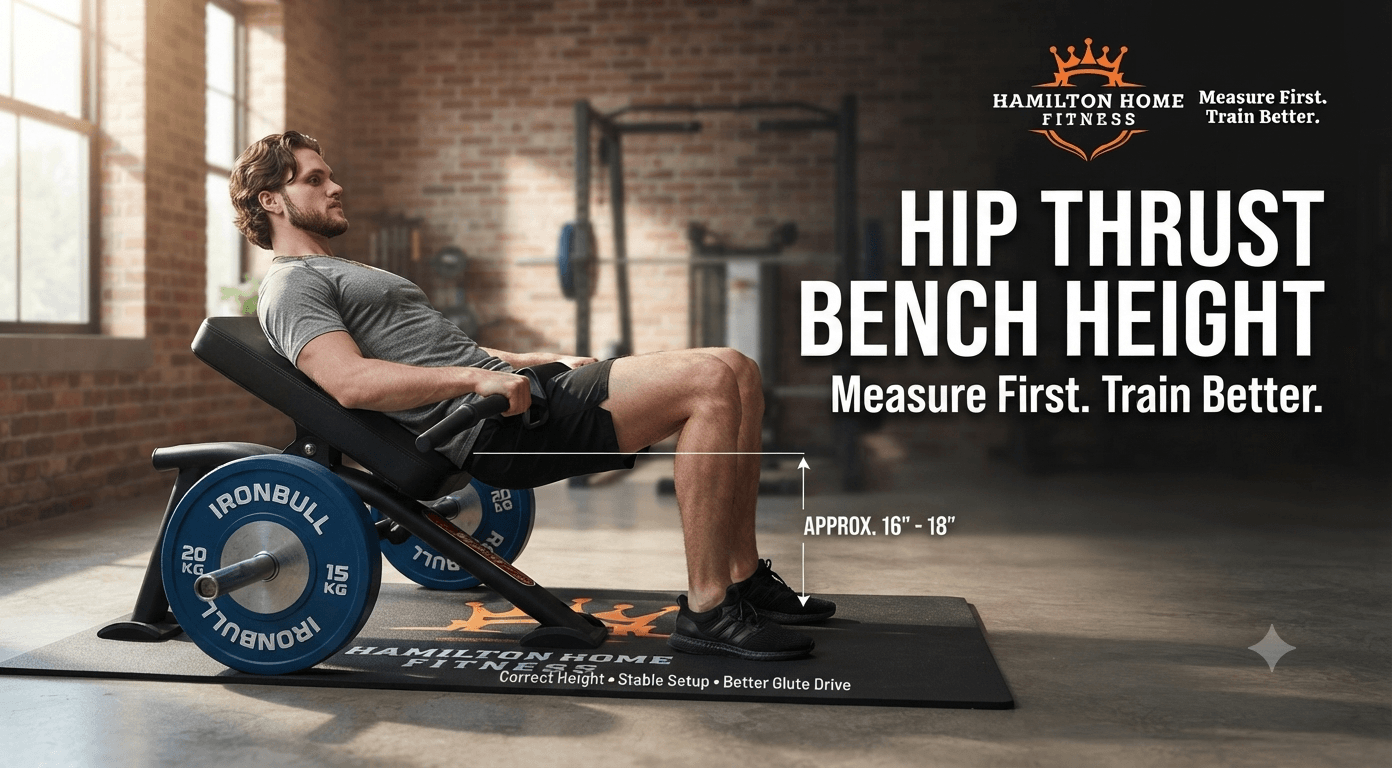
Usually the bench is too tall. Most gym benches sit higher than the hip thrust wants, and that extra height costs you range at the top.
The right bench height for hip thrusts comes down to your proportions, not your overall height. You can measure yours in ten seconds — and that number tells you whether your bench is worth keeping.
What Bench Height Suits Most Lifters?
Most lifters do best with a bench in the low-to-mid teens in inches, and a slightly wider band covers almost everyone. Treat that as a starting point, not an answer. Your leg length and torso length decide where you land inside it, which is why measuring beats picking a number off a chart.
Height matters because it sets where your body pivots. Too tall and you can't reach a level torso at the top without arching your lower back to fake the lockout. Too short and you run out of range before the glutes finish the rep.
Two women who both stand 5'6" can need different benches. The one with longer femurs and a shorter torso sits lower to the floor at the same knee angle, so a bench that suits her training partner leaves her folded and reaching.
Your situation | Where to start |
Shorter legs, or the bench feels tall | Lower end of the range |
Setup already feels level and easy | Middle of the range |
Longer legs, and you can't get low enough | Upper end of the range |
Start there, then test it on your own body.
The 10-Second Height Test
Stand up and find the bony bump just below your kneecap—that's a sensible ceiling for your bench height.
Anything at or under that bump should work. Sit against the bench and check two things: your knees bend to roughly a right angle with your feet flat, and at the top of the rep your torso finishes level with the floor rather than angled up.
If you can't get level without arching, the bench is too tall for you. Run this on any bench, anywhere, including one you're thinking about buying.
Adjusting for Short and Tall Lifters
Taller doesn't automatically mean higher — plenty of tall lifters find standard gym benches too tall to thrust from comfortably.
That surprises people, but it follows from the movement. The bench supports your upper back, not your whole height. A tall lifter with a long torso and short femurs may want the same bench as a much shorter training partner.
Shorter lifters usually feel it faster. If the bench edge sits above the bottom of your shoulder blades when you're seated on the floor against it, you're being asked to hinge from too high up, and the setup will fight you every rep.
If you're at either edge of the range and the numbers aren't resolving it, talk to our team about bench fit—a quick measurement conversation beats guessing.
Is Your Current Bench the Problem?
A bench is too tall when you can't reach a level torso at the top without arching or when the edge lands above the bottom of your shoulder blades while you're seated on the floor against it. Both are checkable inside a single warm-up set.
Check one: where the edge lands. Sit on the floor with your back against the bench. The edge should meet you just below the shoulder blades—roughly the bra strap line. Higher than that and you're hanging from the wrong point, which is what makes the pad feel like it's cutting into you.
Check two: your finish position. Do a bodyweight rep and stop at the top. If your hips are level with your shoulders and knees, the height works. If your ribs are flaring and the lockout is coming from your lower back, the bench is asking you to travel further than your setup allows.
Check three: what moves first. Watch whether the bench shifts before your hips reach the top. A bench that walks early is usually reacting to how you're pushing, not to its own weight—that one has a fix, and it's not a new bench.
Two failed checks and the bench is genuinely wrong for you. One failed check, especially the third, is often a setup problem you can solve this week.
Pad Width, Firmness and Back Contact
A firm pad roughly 10 to 12 inches wide supports your upper back without restricting your shoulder blades. Narrower pads concentrate the load into a line across your back. Soft pads let your torso sink, which shifts the pivot point partway through the set.
Width is about spreading pressure. Under a loaded bar, your body weight and the weight are both pressing your upper back into a small patch of pad. A 12-inch pad spreads that across your shoulder blades. A 9 or 10-inch pad concentrates it into a narrow strip, and that strip is what you feel digging in by the third set.
Firmness does something different. High-density foam — dense enough that it barely compresses under load — keeps your contact point where you put it. Softer foam compresses more as the set goes on, so the bench edge effectively creeps up your back while you're still working.
That's worth knowing if your pad feels fine on rep one and wrong on rep eight. Nothing changed in your setup. The foam gave way.
Benches built specifically for hip thrusts and glute bridges tend to use a wider upper-back pad for exactly this reason. It's worth considering if pressure across your back is your main complaint rather than height.
Why Your Bench Slides Backward
A sliding bench is usually a direction problem before it's an equipment problem. Pushing back into the bench instead of driving down through your feet will move almost any bench, and feet planted too far forward make it worse.
You can hear this happen across a set. The first few reps feel clean. Then fatigue arrives, and you start hunting for leverage, and leverage means pressing harder into the bench behind you. Each rep walks it another inch. By the last one you're chasing it across the floor.
Work through the fixes in this order:
Check your foot position. Feet too far out turn your drive into a backward push.
Drive down, not back. Think about pressing the floor away rather than pushing into the bench.
Keep one contact point. Let your upper back stay put and hinge around it instead of sliding up and down the pad.
Anchor the bench. Set it against a wall or rack, or park a couple of plates behind the feet.
Check the feet on the bench itself. Worn or missing rubber feet on a smooth floor will slide no matter what you do.
Anchoring is step four for a reason. It's the fastest fix, but if the push is coming from your setup, an anchored bench just means the force goes somewhere else—usually into your lower back.
Check Your Feet First
Before you blame the bench, look at where your feet are landing.
At the top of the rep, your shins should sit close to vertical. If your feet are out past that, you're pushing at an angle, and part of every rep goes backward instead of up.
Bring your feet in an inch or two and repeat the set. Most people find the bench stops traveling, and the glutes suddenly do more of the work—the same bench, the same load, and a different direction.
Capacity, Bar Pads and Plate Clearance
Rated capacity has to cover your bodyweight plus the loaded bar plus a margin — not just the bar. Hip thrusts stack both on the same pad, which is why the number that felt generous for pressing can look thin once your thrust weight climbs.
Run your own sum. A 150-pound lifter working up to 275 on the bar is already putting 425 pounds through the bench press. Add a year of progress, and she's near 500. Buy for where you're heading, not where you are, and leave real headroom above that.
Plate diameter decides whether the setup works at all. Full-size plates hold the bar high enough to slide your hips underneath. Smaller-diameter plates sit the bar too low, and you end up wrestling it into position or rolling it up your thighs before every set. If you're loading light with small plates, put a pair of full-diameter plates on first and hang the smaller ones outside them.
A bar pad isn't about comfort for its own sake. It spreads the bar across your hip crease so you can hold a heavy load long enough to actually finish the set—without it, pressure ends the set before your glutes do.
Once you know your working load, match your Olympic bars, plates, and collars to it so clearance and capacity line up from the start.
Choosing a Bench That Fits Your Height
There's no single right bench here. A standard flat bench suits lifters whose measured height lands near the top of the range and anyone who wants one bench for pressing, rows, and thrusts. A purpose-built bridge bench suits lifters who are shorter or whose main complaint is back contact.
Bench type | Who it fits | Main strength | Main limitation |
Flat bench | Measures at the upper end; wants one bench for everything | High capacity, rigid, no moving parts | Built at pressing height, which is taller than many lifters want |
Bridge bench | Measures lower; struggles with pad pressure | Built around the movement, wide upper-back pad | Does one job |
Adjustable, locked flat | Already owns one; trains varied angles | Versatile, already in the room | The backrest must lock firmly against a rearward push |
No bench yet | Training at home, light loads | Costs nothing to test | Not for a heavy bar |
Be honest about the mismatch. A flat bench is wrong for you if you measured at the low end and the height test failed—buying a better-built version of the same problem won't fix anything. A bridge bench is wrong for you if you also want to press and row or if you're loading beyond what it's rated to hold.
If your measurement puts you near the top of the range, browse flat weight benches built for stable, heavy loading, where capacity and rigidity are the real advantages.
If you measured lower, the BodyKore G216 Bridge Bench is designed around hip thrusts and glute bridges, with a wide upper-back pad and rubber feet to resist sliding.
FAQ
Should I use a flat bench or an adjustable bench set to flat?
Both work for hip thrusts. The deciding factors are pad height and how firmly the backrest locks. Adjustable benches often sit taller than flat ones, and a backrest that shifts under a rearward push will cost you your contact point mid-set. If yours locks solid at flat, use it. For the wider comparison, see how flat, adjustable, and FID benches compare.
What is the real difference between a glute bridge and a hip thrust?
The glute bridge starts from the floor with a shorter range. The hip thrust elevates your upper back on a bench, giving a longer range and letting you load much heavier. In practice, the bridge is the entry point and the thrust is the progression—most lifters build the pattern on the floor first, then move to a bench once they need more load.
What can I use instead of a bench for hip thrusts?
A low plyo box, a sturdy step platform, a weight bench at a hotel gym, or the edge of a couch at home. Check the height the same way you'd check a bench. One caution: unsecured furniture is fine for bodyweight and light dumbbell work, but it isn't a base for a heavy barbell.
Are hip thrusts better than squats for glutes?
They load the glutes differently through the range—the thrust peaks at the top, the squat at the bottom. Most programs are better with both than with either alone.
Final Thought
You have a number you measured on your own body and a test that works on any bench. That's the whole decision: measure first, then fix or replace. If you land at the edge of the range, a quick fit check with the Hamilton Home Fitness team will settle it before you spend anything.