
Introduction
Your lower back gives out before your hamstrings do—or it aches by Thursday from sitting, and loading a heavier barbell feels like the wrong fix for a back that already hurts. Roman chair exercises come at it from the other direction, training the lower back, glutes, and core against your own bodyweight instead of a bar.
One catch before you start. The name sits on at least three different machines—a 45-degree bench, a flat horizontal one, and an upright dip-and-leg-raise tower—so plenty of the advice online describes equipment you don't own.
This guide sorts that out first, then covers the movements worth doing, how to hinge from your hips instead of curling your spine, and who should leave this bench alone.
What a Roman chair! Actually Is
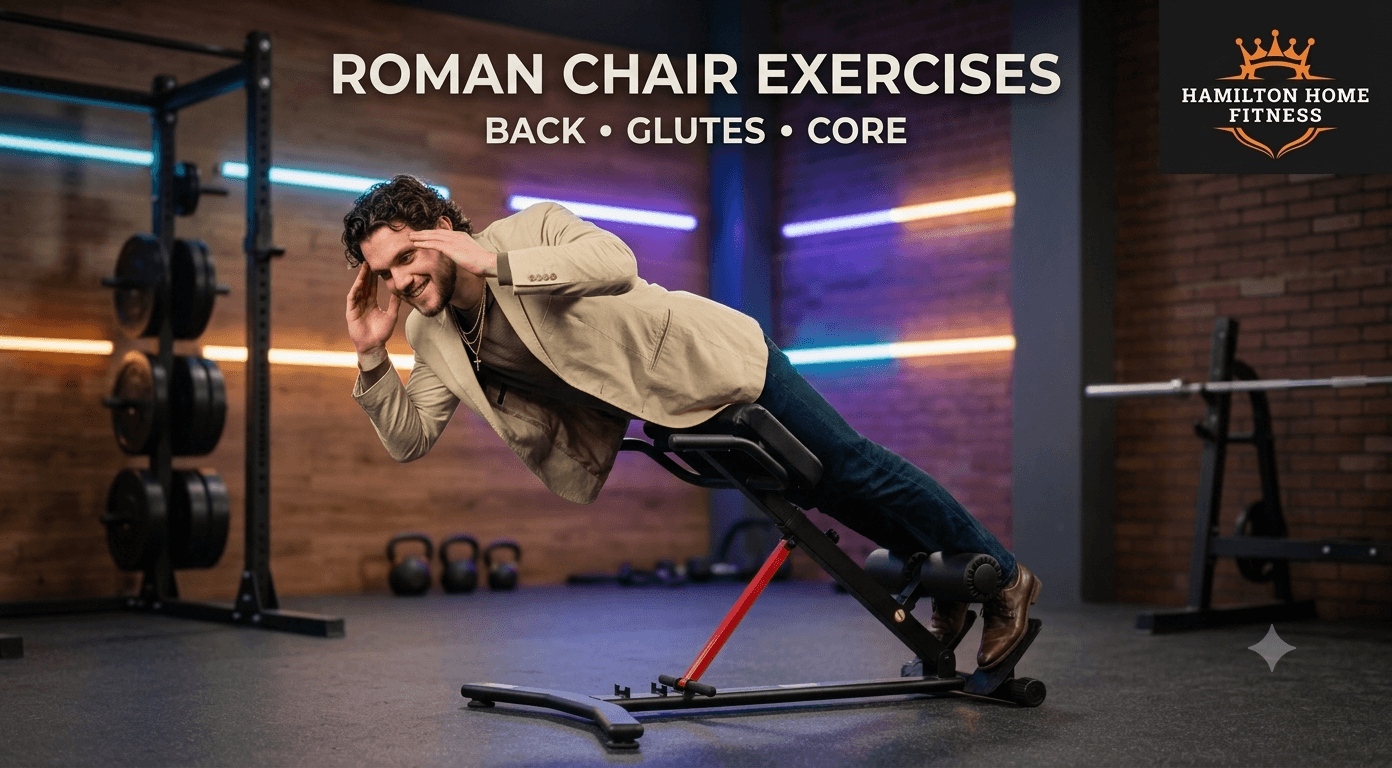
A Roman chair is a padded frame that locks your ankles or thighs in place so your upper body can move freely against gravity. That one idea covers several different builds, and each trains something different — which is why the name lands on machines that look nothing alike.
Build | How you're positioned | What it trains best |
45-degree hyperextension bench | Thighs on an angled pad, ankles under rollers, torso hanging down the slope | Lower back, glutes, hamstrings |
Horizontal back extension bench | Hips on a flat pad, ankles hooked, torso hanging straight down | Lower back and glutes, with a harder top position |
Upright dip and leg-raise tower | Standing upright, forearms on pads or hands on handles, legs hanging | Abs and hip flexors, plus chest and triceps on the dip handles |
That third build trains the front of your core, not your back. Everything below applies to the two bench styles.
45-Degree vs Horizontal Benches
The angle changes how hard the top of the rep is. A 45-degree bench keeps part of your weight on the pad; a horizontal one asks you to hold your torso out flat.
On a 45-degree bench you lie along the slope, so the pad carries some of your weight the whole set. The rep gets harder as you rise but never leaves you holding your full torso in space. It's the easier of the two to learn on.
A horizontal bench moves through a longer range of motion and finishes with your torso flat, with nothing supporting you at the top. It's harder and less forgiving—the urge to arch past straight hits is exactly where the load peaks. Start on the 45-degree angle if your back is deconditioned, and move across when bodyweight reps stop challenging you.
Muscles a Roman Chair Trains
The erector spinae—the long muscle columns running on either side of your spine—are the main workers on a Roman chair. Your glutes and hamstrings extend the hips through the same rep, while the deeper stabilizers hold position without visibly moving. How you execute the rep decides which of those does most of the work.
Sitting under the erectors are the multifidus, small muscles bridging one vertebra to the next, and the quadratus lumborum, which runs from your lowest rib to your pelvis. Neither produces much visible movement here. Both fire constantly to stop your spine folding or drifting sideways, and both tend to be weak in people who sit all day.
Your abs work too, just not the way they do in a crunch. The rectus abdominis and obliques brace against the pull of gravity to keep your ribcage stacked over your pelvis. That's isometric work — tension without shortening — and it's why a controlled back extension leaves your midsection tired without a single sit-up.
How to Bias Glutes or Lower Back
Keeping a flat back and driving through the hips loads the lower back and hamstrings; tucking the pelvis and rounding the upper back shifts more work to the glutes.
For the lower back, hold your spine in its natural shape and treat the rep as a pure hip hinge. Your erectors work isometrically to resist folding, your glutes and hamstrings pull you upright, and you stop the moment your body forms a straight line. This is the default and the version to master before trying anything else.
The glute-biased version asks you to round your upper back and tuck your pelvis under, which shortens the range your hips travel and puts the glutes in a stronger position at the top. It works. It also means deliberately flexing and unflexing your lower back under load—the exact pattern at the center of the safety debate covered in the next section. If your back is healthy and your form is solid, it's a reasonable tool. If your back is the reason you bought the bench, leave it alone for now.
Hinge From the Hips, Not the Spine
The rep is a hip hinge, not a spinal curl. Lower yourself by folding at the hips while your spine holds its natural shape, then rise until your body forms one straight line from head to heels—and stop there. Going past straight is where most people get into trouble.
Brace your midsection like someone's about to poke you in the stomach, then push your hips back into the pad as you lower. Come up by squeezing your glutes, not by yanking your shoulders upward. Three seconds down beats a fast rep every time.
Here's a check that works without a mirror. Rest one hand flat on your lower back and run a slow rep. If the muscles under your palm bunch and shift, you're curling your spine. If your back stays flat and the movement happens behind you at the hips, you're hinging.
Four mistakes account for most bad reps:
Rising past straight. The top of the rep is a line, not an arch.
Bouncing out of the bottom. Momentum does the work your muscles should.
Dropping fast. The lowering phase builds more than the lift does.
Pulling on your neck. Hands at your temples, not laced behind your head.
Where the Hip Pad Should Sit
Set the pad so its top edge sits just below your hip bones, leaving your hips free to fold.
Too high, and the pad blocks the fold—your hips can't move, so the bend happens in your lower back instead. That's the setup error that quietly turns a hip hinge into a spinal curl.
Too low and you lose support. With the pad down on your thighs, you slide forward on every rep, the ankle rollers take the strain, and the whole thing feels unstable.
Adjustment range matters more than any other spec here — pad travel is what decides whether a bench fits a 5'3" user, a 6'2" user, or both. Check the listed range against your height before ordering. A compact 45-degree hyperextension bench with a sliding pad handles a wider spread of body sizes than a fixed one.
Are Hyperextensions Bad for Your Back?
Performed as a hip hinge with a neutral spine and a controlled tempo, back extensions are well tolerated by most healthy adults. The risk sits in two specific places: repeatedly rounding and unrounding your lower back under load and driving past a straight line at the top. Avoid both, and the exercise earns a better reputation than it has.
Qualified people do disagree here, and the disagreement is worth understanding rather than glossing over.
One position holds that repeatedly bending and straightening a loaded lower spine is what wears discs down over time, so any exercise built on that pattern carries avoidable risk. The other holds that a correct back extension involves almost no spinal movement at all—the spine stays locked while the hips do the work—meaning the criticism describes bad reps, not the exercise.
Both are describing something real. The version people actually run in gyms often is a spinal curl. The version done as a hinge isn't.
That gives you a usable rule: if you can't feel the movement happening at your hips, you're doing the version the criticism is about. Fix that before adding weight, reps, or the rounded glute variation.
Who Should Check With a Pro First
Anyone with a diagnosed disc problem, a history of back surgery, unexplained back pain, or pain that travels into a leg should get individual clearance before using this bench.
The same applies if arching backwards is what sets your symptoms off. Some backs tolerate bending forward badly, others tolerate extending badly, and the right approach differs completely between the two. A qualified professional can sort that out in one appointment.
Beginners, seniors, and anyone returning from a deconditioned stretch aren't automatically in the ask-first group. Start with short isometric holds, add reps slowly, and stop if anything sharpens. If your back stiffens between sessions, recovery tools like foam rollers are worth keeping nearby.
Exercises Beyond the Back Extension
A Roman chair supports more than back extensions. Depending on the build, you can run isometric holds, oblique crunches, side bends, and leg raises, plus dips on models with handles. Check what your bench is designed for before adding a movement to it.
Back extension. The foundation. Everything below assumes you've got the hinge right.
Isometric hold. Hold the top position 20–40 seconds instead of repping. Trains endurance, which matters more than peak strength for a back that aches.
Oblique crunch. Rotate your torso as you rise, alternating sides each rep. Shifts load off the erectors and onto the obliques.
Side bend. Lie on one hip rather than face down and bend sideways. Needs a pad wide enough to support you in that position — not every bench qualifies.
Leg raise. Fix your torso and lift your legs instead. Reverse-hyper in spirit, and gentler on the spine than the standard rep.
Dips. Only on units built with handles. A model with integrated dip handles is what turns a single-purpose bench into a chest and triceps station too—the honest reason to consider one over the simpler frame.
Reps, Sets and Adding Load Safely
Most people do well with two to three sets of eight to fifteen controlled reps or timed holds of twenty to forty seconds. Place them after your main lifts, not before. Progress by slowing the lowering phase first, and add external load only once your form holds at every rep.
The order matters. Slow the descent to three or four seconds, then add reps, then add holds at the top, and only then add weight. Most people skip to the last step and lose the hinge.
When you do load it, a plate hugged to your chest is the simplest option. A weighted vest sits closer to your center of mass and lets you keep your hands free. Bands anchored under the frame add resistance that builds as you rise. All three work — adding a weighted vest or plate is just the most common starting point.
One catch nobody mentions: rated capacity covers you and the weight combined. A 200 lb lifter on a 250 lb bench has 50 lb of headroom, not 250. Check the rating before you buy the plates.
Floor Space and Real Buying Trade-Offs
A compact 45-degree bench takes up roughly 39 by 24 inches of floor. A dip-station model runs closer to 47 by 24. Both are smaller than a folded treadmill, but the footprint isn't the whole answer, because you also need clearance in front for your torso to travel.
Model | Assembled footprint | Rated capacity | Folds away |
45-degree bench | 39 × 24 × 33 in | 250 lb | Yes |
Dip-station model | 47 × 24 × 34 in | 330 lb | Yes |
Add about three feet in front of the pad. Your head and shoulders swing through that space on every rep, and a wall or a rack leg parked there turns a full range of motion into half of one.
This earns its space if you sit for a living, train your posterior chain regularly, or want back work that doesn't put a bar on your spine. It doesn't if you already own an adjustable bench and train your back twice a month—you'll get more from adding sets to what you have.
One limit worth knowing before you order: both models are rated for home use. A studio, clinic, or school weight room running shared daily traffic needs a commercial-rated frame instead. Both home models are listed with our curl and specialty benches, which is where the bench range groups them.
Roman Chair vs GHD and Machines
A glute ham developer and a plate-loaded back extension machine train similar muscles, but both cost more and take considerably more floor space.
A GHD adds knee flexion, so it loads the hamstrings harder than any fixed bench can. A plate-loaded machine lets you dial resistance precisely instead of hugging a plate to your chest.
What you give up with the compact option is loading precision and hamstring range. What you get is a frame that fits a spare bedroom and folds flat. For most people training at home, that's the right trade.
FAQ
Can you do hyperextensions on a regular bench?
Partly. With a partner holding your ankles or a loaded barbell pinning them, a flat bench allows a limited back extension. The range is shorter and the setup far less stable than a purpose-built frame.
How much does a Roman chair cost?
Compact home models start around $90, and dip-station versions run near $160. Commercial-rated frames cost significantly more.
Do I need one if I already deadlift?
Not necessarily, but it fills a gap deadlifts leave. It trains the lower back and hip extensors with far less spinal load — useful on days when heavy pulling isn't an option.
Start With the Hinge
A Roman chair earns its space when you want to train the lower back and hips without a bar on your spine. It only works if the movement comes from your hips.
If you've got an existing back condition, get individual clearance before you start.
Otherwise: measure your floor, check the rated capacity against your bodyweight plus anything you plan to hold, and ask us about sizing and capacity if you're stuck between the two models.