
Introduction
If you're outfitting a hotel, multifamily property, or corporate wellness facility, the hardest part of the purchase isn't picking equipment—it's telling true commercial gear apart from upgraded residential machines wearing the same finish.
Get it wrong, and the warranty voids the day the first guest steps on the treadmill. Service tickets stack up. Negative reviews follow.
This guide walks through what to look for in commercial gym equipment using four anchors a procurement reader can defend in any budget meeting: traffic rating, warranty depth, ADA flow, and true commercial build—plus service and a five-to-ten-year cost.
Hamilton Home Fitness, a Tennessee-based multi-brand commercial dealer shipping across all US states, appears later as one option among several. The criteria come first.
Full Commercial vs Light Commercial
Full commercial equipment is built and warrantied for high-traffic, multi-user, unsupervised public use. Light commercial uses commercial-grade components but is warrantied only for restricted-access facilities running roughly eight hours of daily use or less. Residential equipment voids its warranty the moment it lands in a hotel, apartment, or office gym.

The three tiers separate cleanly on warranty language, not on how the machine looks:
Full commercial warranty for health clubs, large hotels, 24/7 multifamily access, and corporate gyms with hundreds of daily users. Heavier steel, stronger motors, longer parts coverage.
Light commercial — warrantied for boutique studios, small corporate rooms, controlled-access amenity gyms, hotel gyms under a defined room count, fire and police stations, and small private training facilities.
Residential — warrantied for single-household use only. Putting it in any shared-access setting cancels coverage immediately.
The trap is that residential and light commercial machines often look identical to full commercial ones on the showroom floor. The difference shows up in the warranty PDF and in the use-class clause.
When Light Commercial Is Enough — and When It Is Not
Light commercial fits supervised or low-traffic settings—typically under eight hours of daily use—but it loses its warranty inside a membership gym or unmanaged public space.
Light commercial works for a 40-room boutique hotel with morning and evening peak windows, a 50-employee corporate wellness room with badge access, a clubhouse gym at a small townhome community, and a single-room rehab clinic. In all four cases, total daily use stays low, and access is either supervised or restricted.
Light commercial fails the moment any of three conditions appear: unsupervised 24/7 access, daily use above the manufacturer's published hours threshold, or treatment as a public accommodation amenity for a property over a certain size. A 300-unit apartment community with keyed but unstaffed access does not qualify as "restricted" for warranty purposes—it reads as a full commercial load.
When in doubt, specify full commercial. The price gap is recovered in the first warranty claim that does not get denied. You can browse the commercial equipment category to see how the tiers and brands are organized by use class.
Match Equipment to Real Traffic Load
Traffic rating is the manufacturer's stated maximum hours of daily or weekly use a machine is warrantied to handle. Estimate your peak-hour load, multiply by operating days, and only specify equipment rated above that number.
The math is short. Count machines by category (treadmills, ellipticals, bikes, selectorized strength). Estimate peak-hour occupancy per machine in minutes. Multiply by operating days per week. Compare against the published rating in the manufacturer's spec sheet.
Example — 200-room hotel gym. Industry occupancy data points to roughly 5–10% of guests using the gym on a given day. At 70% occupancy and a 6:00–8:00 AM peak, that pushes 15–25 guest sessions into a two-hour window. Four cardio machines absorb most of that load. Each treadmill realistically hits 4–6 hours of true running time per day. Specify a full commercial rating — light commercial gets buried inside the first quarter.
Example — 300-unit multifamily gym, unstaffed, 24/7 keyed access. Lower instantaneous peaks than a hotel, but no idle recovery window because access continues overnight. Treadmills routinely log 6–10 hours of daily use across spread-out sessions. A full commercial is the only defensible spec. Light commercial machines in this setting fail inside two to three years and void coverage along the way.
The same logic applies to strength. A selectorized chest press at a 300-unit community sees several hundred reps per week—well inside the full commercial range but punishing for light commercial frames.
Two rules to lock in:
If estimated daily use exceeds the manufacturer's published threshold by even one hour, move up a tier.
If the facility is unsupervised or runs 24/7, default to full commercial regardless of headcount.
Spirit Fitness commercial and light-commercial cardio lines are a useful reference because the brand publishes distinct ratings for each tier, which makes it easy to see how a single manufacturer separates a hotel-grade unit from a health-club-grade unit on the same chassis family.
Warranty Depth, Service, and Parts Network
A real commercial warranty breaks out frame, parts, electronics, and labor separately; names the allowed use class; and is backed by a service network that can dispatch a tech to your address—not just ship a part.

Read every warranty as four separate clauses, not one number:
Frame or structural—the longest term, often lifetime on full commercial-strength frames and 10 years on cardio frames. Confirm "lifetime" applies to your use class, not residential only.
Parts — typically 3–10 years on full commercial, 1–3 years on light commercial. Check whether wear items (belts, decks, cables, and upholstery) are included or excluded.
Electronics and motor — often 3–5 years on full commercial cardio. Console and motor failures drive most cardio downtime, so this clause matters more than the headline number.
Labor — usually 1 year on full commercial, sometimes 90 days on light commercial. Labor is where surprise bills appear, because shipping a part is cheap and sending a tech is not.
Then read the use-class line. A warranty that reads "valid in fitness facilities with restricted access under eight hours of daily use" is a light commercial warranty wearing commercial paint. If your facility runs unsupervised 24/7, that warranty is already void on day one.
The service network matters as much as the warranty document. Three questions to put on every RFQ:
Do you have an authorized service technician within 50 miles of our zip code?
What is your average response time for a downed cardio unit under the labor warranty?
Which parts do you stock domestically versus order from overseas?
Preventive maintenance is where most facilities underspend. A workable rule of thumb for full commercial:
Cardio under heavy load — quarterly preventive maintenance (belt tension, lubrication, deck inspection, console firmware).
Cardio under moderate load — semi-annual preventive maintenance.
Selectorized strength—semi-annual cable, pulley, and upholstery inspection.
Plate-loaded and racks—annual weld, bolt, and pad inspections.
Skip preventive maintenance, and the warranty often pivots from "covered" to "denied for lack of documented maintenance" the first time you file a claim.
For an example of how a private-invoice commercial brand structures warranty tiers and service expectations, the Hoist commercial selectorized strength line publishes use-class language and parts coverage that's typical of what a procurement buyer should expect to see on any full commercial quote.
Build-Quality Specs That Actually Matter
Separate cardio specs from strength specs on every RFQ. For cardio, demand continuous duty horsepower, deck thickness, belt thickness, step-on height, and max user weight. For strength, demand frame steel gauge, weld quality, weight capacity per station, and the right machine type for your user mix. Require manufacturer documentation for each line on the quote.
The two H3s below give you the exact language to put in front of a vendor.
Cardio — CHP, Deck, Belt, Step-On Height
Full commercial cardio machines should publish continuous duty horsepower, a reversible deck, belt thickness, step-on height, and a max user weight high enough for your real user range.
The five specs to require are the following:
Continuous duty horsepower (CHP) — 3.0+ CHP for light commercial treadmills, 3.5–4.0+ CHP for full commercial. Ignore "peak HP" numbers—they're marketing, not engineering.
Reversible deck—doubles the walking surface life by flipping the deck when one side wears out. Standard on full commercial, rare on light commercial.
Belt thickness — multi-ply belts (often 2-ply or 4-ply) handle heat and friction better than single-ply residential belts.
Step-on height—a lower step-on height (typically 8 inches or less) matters for senior users, rehab settings, and ADA equipment-type coverage.
Max user weight—350 lb is a residential benchmark; 400–500 lb is typical for full commercial hospitality and multifamily units. Spec to your real user range, not the brochure average.
For ellipticals, bikes, and rowers, the equivalent specs are flywheel weight, frame steel, console refresh rate, and max user weight. Concept2 rowers, for example, are a recognized full commercial benchmark because their published service life and parts availability are well documented.
A reader walking onto a showroom or opening a quote PDF should be able to find each of these specs in under two minutes. If the vendor can't produce them, the unit isn't fully commercial regardless of how it's labeled. You can scan the commercial cardio equipment selection to see how brands present these specs side by side.
Strength — Frame, Welds, Capacity, Type
Full commercial-strength frames typically use 11-gauge steel with continuous welds, publish a per-station weight capacity, and come in three machine types: plate-loaded for serious lifters, selectorized for unsupervised mixed users, and functional trainers for space-efficient, full-body training.
A few clarifications that procurement readers run into:
Steel gauge is inverted — lower number means thicker steel. 11-gauge is thicker and stronger than 14-gauge. 7-gauge appears on the heaviest competition racks.
Weld quality — full commercial frames use continuous welds at every stress point. Spot welds and stitched welds are the giveaway for budget builds. Inspect photos or sample units before signing.
Weight capacity — should be published per station, not as a single number for the whole machine. Selectorized stacks commonly range 200–310 lb; plate-loaded stations should support 1,000+ lb of plates.
The machine-type decision follows the user, not the budget:
Selectorized (pin-loaded stacks) — choose for hotels, multifamily, and corporate gyms. It's safer for novices, faster between sets, has fewer dropped plates, and has lower liability. Most full commercial brands carry a dedicated selectorized series.
Plate-loaded—choose for athletic, tactical, first-responder, and CrossFit-affiliated facilities where users want feel and progressive loading. Higher liability ceiling — supervised settings work best.
Functional trainer (cable column) — add one to almost any facility. Replaces multiple single-purpose machines in a compact footprint and supports rehab, mobility, and full-body training across user skill levels.
For most hotel, multifamily, and corporate builds, the right mix is a selectorized circuit plus one or two functional trainers, with a power rack only if the facility has supervised hours or a clear power-user demographic.
A reference point for the 11-gauge spec is the HHF Commercial Fitness 11-gauge steel house brand, which publishes its steel gauge and offers custom metal and upholstery colors — useful for hotels and multifamily properties that need equipment to match brand standards.
ADA and Accessibility in Public Gyms
Under the 2010 ADA Standards, fitness centers built or altered after March 15, 2012, in places of public accommodation must provide an accessible route, a 30-inch by 48-inch clear floor space at one of each type of exercise equipment, and equipment usable by people with disabilities. The standard does not require every machine to be accessible — only that at least one of each type meets the clearance rule.
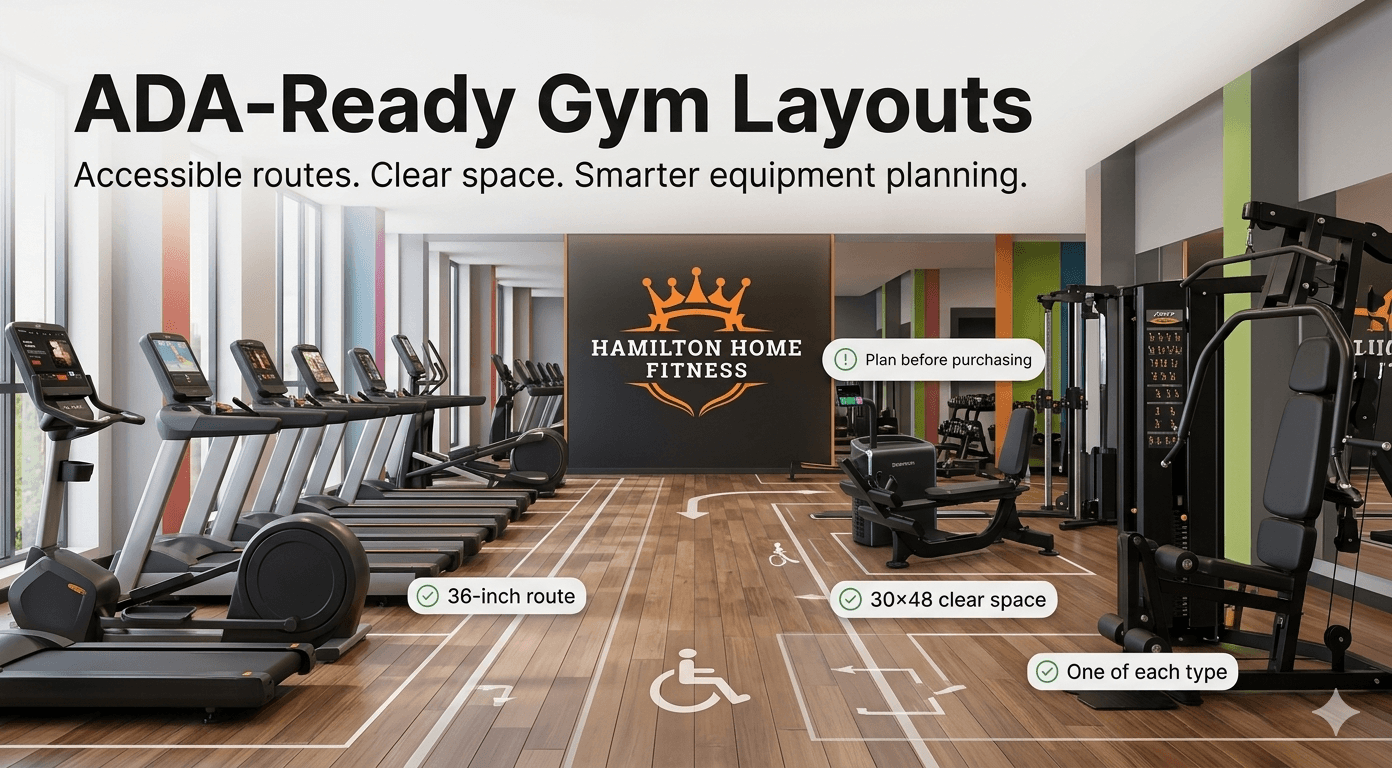
The key sections to cite on an architect's plan set:
Section 206.2.13 — accessible route serving exercise machines and equipment.
Section 236 — at least one of each type of exercise machine must meet clear floor space requirements.
Section 1004.1 — clear floor space of 30 inches by 48 inches positioned for transfer or for use by a person seated in a wheelchair, serving at least one of each equipment type.
"Each type" is the phrase that matters. One treadmill, one elliptical, one upright bike, one recumbent bike, one selectorized chest press, etc.—each type needs clearance. A second or third unit of the same type does not.
Hotels are explicitly covered as places of lodging. Multifamily common-area gyms are covered when the property qualifies as a public accommodation or falls under separate fair housing accessibility rules—confirm scope with counsel for your specific property. Corporate wellness facilities open to the public, to tenants, or to clients trigger the same standards; employee-only facilities have a different analysis under Title I and ADAAG that's worth verifying.
A practical layout checklist for the procurement file:
Accessible route—at least 36 inches clear from the gym entrance through to each accessible equipment piece, with no protruding hazards.
Clear floor space — 30 inches by 48 inches at one of each equipment type, positioned for forward or parallel transfer.
Equipment-type coverage — at least one of each cardio category and each strength category that the facility offers.
Accessibility-friendly equipment choices—low-step-on treadmills (8 inches or under), recumbent bikes with swivel seats for lateral transfer, selectorized strength machines with accessible adjustment pins, and low-entry ellipticals where available.
Existing facilities—even outside new construction or alteration triggers, there is a continuing obligation to remove barriers to the extent readily achievable.
Two limits to flag clearly. First, the ADA does not specify technical performance requirements for the machines themselves—it regulates routes, clearances, and equipment-type coverage. Second, this section is general guidance for procurement planning, not legal advice; ADA compliance is a facility-level outcome that depends on layout, route, and design choices a qualified accessibility consultant or attorney should review for your specific property.
For hotel and multifamily projects where layout, clearance, and equipment-type coverage need to be planned together before purchasing, you can book a commercial gym design consultation to work through the floor plan before the freight ships.
Total Cost of Ownership and Dealer Fit
Full commercial equipment usually costs more up front but lasts roughly 10–15 years under typical hospitality and multifamily traffic, often producing a lower cost per year than replacing light or residential units every 3–7 years. A real commercial dealer adds value beyond the sticker price by sourcing across brands, structuring service contracts, and handling installation logistics that big-box retailers do not.
Run the math on cost-per-year, not on purchase price. A $6,000 full commercial treadmill that runs for 12 years lands at $500 per year. A $2,500 light commercial unit that fails inside a 300-unit multifamily gym in 3 years lands at $833 per year—and that ignores the second-replacement freight, the negative reviews during downtime, and the voided warranty on the first failure.
A workable five-to-ten-year cost frame for a small to mid-size commercial gym:
Equipment — the largest line. Full commercial cardio and strength for a small- to mid-size hospitality or multifamily gym typically runs in a wide range depending on machine count, brand tier, and whether plate-loaded or selectorized strength is specified. These are planning ballparks, not quotes—actual numbers vary by spec, brand, region, freight, and current pricing, and only an RFQ will produce a real figure.
Freight and installation — often 5–15% of equipment cost for white-glove delivery and assembly. Skipping professional install voids many warranties.
Flooring — rubber roll or tile flooring for the equipment footprint, plus a deadlift platform if any plate-loaded work is planned.
Preventive maintenance — an annual service contract for cardio and strength, typically a fraction of replacement cost.
Replacement reserves — set aside a percentage of original cost per year toward the next refresh cycle. Light commercial accelerates this line significantly.
What a real commercial dealer does that a big-box retailer does not:
Sources across multiple manufacturers, so the recommendation matches the facility instead of the catalog.
Reads warranty fine print across brands and flags use-class mismatches before the order ships.
Structures service contracts and coordinates authorized techs in your zip code.
Handles freight, white-glove delivery, and rigging — not just curbside drop-off.
Carries private-invoice brands that often are not available through online checkout, with pricing structured for B2B procurement rather than consumer retail.
Helps you plan layout, ADA clearances, and equipment-type coverage before purchase rather than after.
The dealer relationship is also where private-invoice brands like Hoist, Matrix Fitness, Horizon Fitness, BeaverFit, Hudson Steel, and Legend Fitness become accessible—these manufacturers typically do not sell through consumer-facing carts and require a quote process through an authorized dealer.
About Hamilton Home Fitness, a Tennessee-based commercial dealer serving all USA states, explains the multi-brand model and the nationwide shipping and service footprint that underpins both the inventory and the design-consultation process.
Brand and Category Fit by Facility Type
Brand fit follows facility role. Hospitality favors clean-line selectorized strength and intuitive cardio consoles. Multifamily prioritizes unsupervised durability and ADA flow. Corporate prioritizes quiet operation and compact footprints. Healthcare and rehab need swivel and low-entry access. Tactical and first-responder facilities need plate-loaded racks and abuse-tolerant builds.

The mapping below is segment guidance, not a ranking. Every facility is different, and the right shortlist comes from a real RFQ.
Hotels and resorts. Selectorized strength for unsupervised guest use, two to four cardio pieces with intuitive consoles (no learning curve for a guest who has 25 minutes before a meeting), a functional trainer, and free-weight dumbbells in a 5–50 lb range. Aesthetic consistency matters here in a way it does not in a health club — frame color, upholstery, and console finish should match brand standards. Hoist, Matrix Fitness, Horizon Fitness, True Fitness, and Spirit Fitness are commonly specified in hospitality. The Matrix Fitness private-invoice commercial line is a typical example of a hospitality-grade selectorized and cardio fit.
Multifamily—apartments, condos, townhomes, and clubhouse gyms. The defining constraint is unsupervised 24/7 access. Specify selectorized strength (no loose plates left on the floor at 2 AM), full commercial cardio with reversible decks, a functional trainer, and rubber roll flooring across the equipment footprint. ADA equipment-type coverage matters at the property scale. Skip plate-loaded equipment unless the property is staffed. The commercial selectorized weightlifting machines for unsupervised gyms category is the right starting point for this segment.
Corporate wellness. Compact footprints, quiet operation (motor noise carries into adjacent meeting space), intuitive consoles, and a mix that supports 20–30-minute lunchtime sessions. A selectorized circuit plus two or three cardio pieces and a functional trainer covers most mid-size office gyms. Power Plate and OxeFit fit corporate well when the wellness program includes recovery or executive-level training.
Healthcare, rehab, and physical therapy. Low step-on cardio, swivel-seat recumbent bikes, NuStep-style total body trainers where budget allows, selectorized strength with light starting weights (often 5 lb increments), and clear floor space for therapist-assisted transfers are all good options. Concept2 rowers are widely used in rehab for low-impact full-body conditioning. BodyKore and TAG Fitness both publish lines that work in rehab-adjacent settings.
Tactical, first responder, fire, police, and military. Plate-loaded strength, power racks, competition bumper plates, Olympic bars, sled and prowler work, climbing rope, pull-up rigs, and abuse-tolerant cardio (curved manual treadmills, air bikes, and rowers). Aesthetics are secondary; building tolerance is primary. The Beaver Fit tactical-grade commercial equipment line is purpose-built for this segment and is commonly specified in military and first-responder facilities.
Education and athletic programs. Plate-loaded strength, racks, platforms, and field-sport accessories. Hudson Steel, Legend Fitness, and TAG Fitness all carry lines that fit high school and college weight rooms. Specify with the strength coach in the room, not against the coach.
Cruise ships and unusual environments. Corrosion resistance, footprint flexibility, and freight logistics drive the spec. Coastal and shipboard installations need stainless or coated frames where possible and accelerated preventive maintenance schedules.
The pattern across all segments: match the equipment tier to who uses the gym, when they use it, and whether anyone is supervising. Brand selection follows from that match, not the other way around.
FAQ
What is the difference between light commercial and full commercial gym equipment in real terms?
Full commercial is warrantied for unrestricted high-traffic public use and built with heavier steel, stronger motors, and longer parts coverage. Light commercial uses commercial components but is warrantied only for restricted-access facilities running under roughly 8 hours of daily use — putting it in a membership-style gym, an unsupervised 24/7 multifamily building, or a large hotel voids the warranty on day one.
How long should commercial cardio and strength equipment last under heavy daily traffic?
Full commercial cardio commonly delivers 10–15 years of service life under typical hospitality and health-club traffic when supported by quarterly preventive maintenance. Full commercial-strength frames often outlast cardio because they have fewer wear parts—many last 15+ years with only cable, pulley, and upholstery refreshes. Lifespan drops sharply when light commercial or residential equipment is installed in public-access settings, often failing inside 3–7 years.
What ADA features must commercial gym equipment include for hotels and multifamily?
Under the 2010 ADA Standards (Sections 206.2.13 and 236, with clear-floor-space rules in 1004.1), public-accommodation fitness centers built or altered after March 15, 2012, must provide an accessible route and a 30-inch by 48-inch clear floor space at one of each type of exercise equipment. The standard does not require every machine to be accessible. Existing facilities that are not undergoing alterations still have a continuing obligation to remove barriers to the extent readily achievable. Confirm scope with a qualified accessibility consultant or attorney for your specific property.
How do I evaluate continuous duty horsepower, frame gauge, and weight capacity for commercial use?
For full commercial treadmills, look for continuous duty horsepower in the 3.5–4.0+ range, a max user weight of 400 lb or higher, a reversible deck, and a multi-ply belt. For strength frames, 11-gauge steel with continuous welds and a published per-station weight capacity are the typical full commercial baselines. Ignore peak horsepower numbers—only continuous-duty horsepower reflects sustained performance. Remember that steel gauge is inverted: lower numbers mean thicker steel.
When should a facility choose plate-loaded vs. selectorized vs. functional trainer machines?
Choose selectorized for unsupervised mixed-user settings such as hotels, multifamily, and corporate gyms—pin-loaded weight stacks are safer and quicker for novices. Choose plate-loaded for athletic, tactical, and first-responder facilities where users want feel and progressive loading. Add a functional trainer to almost any facility for space-efficient, full-body cable training that supports rehab, mobility, and mixed-skill users in a compact footprint.
Which fitness brands offer the strongest commercial warranties and service network coverage?
Warranty depth and service-network strength vary by line within the same brand, so verify the specific model's commercial warranty document and confirm authorized service-tech availability in your zip code before signing. Recognized full-commercial lines frequently specified in hotels, multifamily, and corporate include Hoist, Matrix Fitness, Horizon Fitness, True Fitness, Spirit Fitness, Hudson Steel, Legend Fitness, BodyKore, and TAG Fitness. Segment-specific options include Beaver Fit for tactical and first-responder facilities and Concept2 for commercial rowing.
Final Thought
The right commercial gym equipment for a hotel, multifamily property, or corporate wellness facility comes down to five anchors: a traffic rating that matches your real facility load, warranty depth that survives the first claim, ADA flow that meets the 2010 Standards, true commercial build verified on the spec sheet, and a dealer who handles service after the install.
The fifth anchor is the one with the most procurement files under weight. A multi-brand commercial dealer matches equipment tier to facility load, reads warranty fine print across manufacturers, and keeps the gym running for the full 10–15 year cycle the build was designed for.
When you have your machine count, facility type, and budget range ready, request a commercial RFQ, and Hamilton Home Fitness will return a quote built around the criteria in this guide.