Introduction
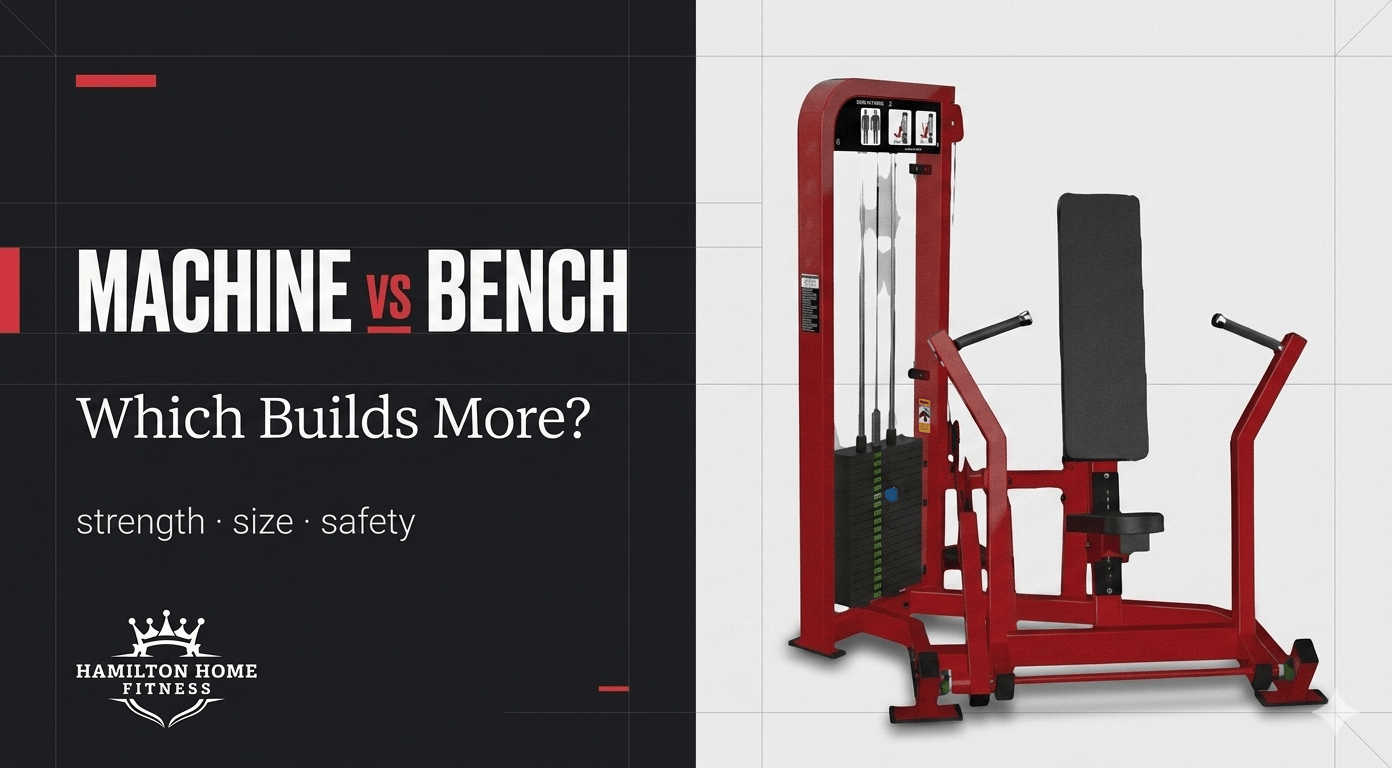
You’re here because you want the straight answer: in a Vertical Chest Press Machine vs Bench matchup, which one builds more—strength, size, or both—without wrecking your shoulders. Most lifters aren’t really choosing a “better exercise.” They’re choosing the tool that lets them train hard, safely, and consistently for their body and setup.
At Hamilton Home Fitness (Tennessee-based, shipping nationwide), we spend our days matching people to pressing options that actually work in real life: the tall lifter whose bench feels cramped, the beginner who trains alone, the coach outfitting a studio, or the rehab-minded client who needs a stable path and pain-free range of motion. When we see someone stall, it’s rarely motivation—it’s usually mechanics, load selection, or a tool mismatch.
This guide compares chest press machine vs bench press the way you’d explain it to a training partner: what muscles each emphasizes, how stabilizers and shoulder stress change, why carryover to the barbell bench differs, and how to program both for chest growth or strength. We’ll also cover quick setup cues so your reps hit your chest, not your joints. You’ll finish knowing exactly which press to prioritize today—and how to use the other as your smartest backup always.
Is a chest press better than bench?
For most people, “better” comes down to what you can train consistently and progress safely. In a vertical chest press machine vs bench press comparison, the bench rewards skill—setup, bar path, and full-body tension—while the chest press machine rewards repeatability—stable movement, smoother reps, and easy progression. At Hamilton Home Fitness, we see this play out daily: lifters who train alone often push harder on a machine because they’re not worried about failing a rep, while experienced lifters keep the bench to build maximal strength and carryover.
Which builds more strength?
If your definition of strength is a bigger barbell bench, the bench usually wins because it trains the exact coordination and stabilizer demand needed under a free weight. But machine press strength is still real strength—especially for the pecs and triceps—because you can load it aggressively without technique breaking down. A common pattern we see: someone stuck at the same bench numbers adds a plate-loaded chest press for heavy, controlled overload and their bench lockout improves within a few training blocks.
Which builds more muscle size?
For hypertrophy, the chest press machine can be just as effective as the bench press because it lets you stack quality volume close to failure with consistent tension. We’ve watched beginners grow faster on a selectorized chest press simply because their reps stay clean and they actually add weight week to week. When the machine fits your shoulder structure and grip, it’s one of the most reliable “machine press for chest growth” tools you can own.
Is bench one of the big three?
Yes—bench press is a powerlifting staple and the most recognized upper-body strength benchmark. If you care about testing heavy singles, competing, or “bench press carryover,” you keep the bench in your plan. Many lifters get the best of both worlds by benching for skill and topping up with chest press machine volume work for size.
Do they work the same muscles?
In the chest press machine vs bench press debate, the short answer is: mostly yes—but not in the same way. Both primarily train the pectoralis major (sternal and clavicular fibers) with strong help from the triceps brachii and anterior deltoid. The difference is how the load is stabilized and how your shoulder joint “finds” its path. In our showroom conversations at Hamilton Home Fitness, the same lifter can feel “all chest” on one vertical chest press machine and “all shoulders” on another simply because handle angle, seat height, and line of push change the mechanics.
Is chest press the same as bench?
Not exactly. A bench press lets your shoulders and elbows self-organize through a free bar path, so technique and scapular control matter a lot. A vertical chest press machine guides the movement and reduces the coordination demand, which can make it feel more targeted and repeatable. That’s why many people use bench press alternatives like machines when they want consistent chest stimulus without spending half the session dialing in form.
Do they train stabilizers the same?
No. Stabilizer muscles in bench press—like the rotator cuff, serratus anterior, mid/lower traps, and even your trunk—work harder because you’re controlling a bar in space. Machines reduce that requirement, so your prime movers can be the limiter more often. That’s also why bench press technique vs machine often feels “harder” even at lighter loads: the stability demand is part of the lift.
Is the vertical press ROM limited?
Often, yes. Many machines limit range of motion (ROM) at the bottom or top, and the chest press machine ROM control depends on the start position and handle design. The fix is setup: seat height so handles line up with mid-chest, shoulder blades set back and down, and a grip that doesn’t force your elbows too flared. When the ROM fits your body, the machine’s strength curve can keep tension on the chest through the press—great for hypertrophy and safer volume work.
Is bench press enough for chest?
Bench press for mass can absolutely work—but “enough” depends on whether your bench is actually stimulating your pecs, and whether you can recover from it. In our experience helping home lifters and small gyms choose equipment, the most common issue isn’t effort—it’s that the bench becomes a triceps-and-shoulder lift because of bar path, grip width, or shoulder discomfort. When that happens, adding a chest press machine for hypertrophy often fixes the problem fast because it keeps the line of push consistent and makes progressive overload easier to track.
Do I need heavy weight to grow?
No. Heavy singles are great for practicing maximal strength, but chest growth mainly responds to hard sets taken close to failure with enough weekly volume. Many lifters grow better using moderate loads they can control for 8–15 reps, especially on a machine press for overload where form doesn’t break down. A practical example we see often: someone chasing bench press heavy singles stalls for months, then starts doing controlled chest press machine volume work twice a week—suddenly their chest and triceps start filling out again because they’re accumulating more quality reps.
How long to get a bigger chest?
Most people notice performance changes first—more reps, smoother presses, less shoulder irritation—within a few weeks. Visible size usually takes consistent training and nutrition over months. The key predictor is whether you’re progressing: more reps at the same weight, more weight for the same reps, or better control through the same range of motion. If none of those are happening, the program needs an adjustment—not motivation.
Can machines help bench plateaus?
Yes. Chest press machine progression is a simple way to add targeted work when your bench is stuck. If your bench press plateau solutions include more practice but your shoulders can’t handle extra barbell volume, a selectorized or plate-loaded chest press lets you overload safely. Many lifters use it as assistance work to build the midrange and lockout—then return to the bench with stronger pecs and triceps.
What are bench press negatives?
The bench press is a classic, but it isn’t “free gains.” The biggest negatives usually show up when people chase numbers faster than their shoulders, technique, or setup can handle. In real home gym setups, we see problems most often when someone benches alone without safeties, benches with a grip that flares the elbows too much, or repeats the same heavy pattern without enough recovery. That’s where the safety of chest press machine training becomes a meaningful advantage: you can work hard without the same risk of a missed rep.
What are the negative effects?
The most common bench press negatives are shoulder irritation, wrist discomfort, and stalled progress from inconsistent bar path. Bench press shoulder stress often climbs when the bar touches too high, elbows flare wide, or the shoulder blades aren’t set for a stable pressing base. Another overlooked downside is fatigue cost: heavy barbell benching can drain the nervous system and upper back, which can limit how much weekly volume you can handle for chest growth.
Is the machine safer for beginners?
For most beginners, yes. A chest press machine for beginners vs bench is simpler to learn, easier to load, and safer to train close to failure—especially if you’re working out alone. At Hamilton Home Fitness, we regularly recommend a selectorized chest press to first-time lifters because it teaches pressing mechanics without the fear factor, while still allowing measurable progression every week.
Better choice for shoulder pain?
Often, the chest press machine is the shoulder-friendlier bench press alternative—if the machine fits you. A neutral or slightly angled grip, controlled depth, and stable back support can reduce irritation compared to a fixed barbell path. If you feel pinching on the bench, switching to a vertical chest press machine for shoulder pain for a training block is a smart, ego-free move: keep training the press pattern, rebuild tolerance, then reintroduce bench with better setup and load control.
Final Thought
The clean takeaway from the vertical chest press machine vs bench debate is this: the bench press is the best tool for building a bigger bench, and a chest press machine is one of the most reliable tools for building chest size with repeatable tension, controlled range of motion, and lower failure risk. If your goal is strength testing and carryover, keep the bench and treat machine press as assistance work. If your goal is hypertrophy, joint comfort, or training alone, the machine often wins on consistency—because the “best” program is the one you can progress week after week.
At Hamilton Home Fitness, we’ve watched the same pattern across beginners, busy professionals, and small gym owners: when the pressing setup fits the lifter—grip, seat height, and movement path—results accelerate and shoulder stress drops. If you want help choosing a shoulder-friendly bench, a plate-loaded chest press, or a selectorized machine that matches your space and goals, Hamilton Home Fitness (based in Tennessee, shipping nationwide) can guide you to the right press for long-term progress.