Introduction
You want one strong machine to build your gym around, but you're stuck between a Smith machine, a power rack, and a half rack with a Smith built in. Maybe you train alone with no spotter, you're chasing size, or you're outfitting a facility—in every case, the wrong pick wastes money and floor space.
These three don't train the same. And two build details change how each one feels and how long it lasts: whether the smith is counterbalanced and whether its finish is stainless steel or powder-coated.
This guide compares bar path, real bar weight, safety, and hypertrophy fit so you can decide fast. The right answer comes down to how you actually lift and the space you have.
Which one fits you: quick verdict
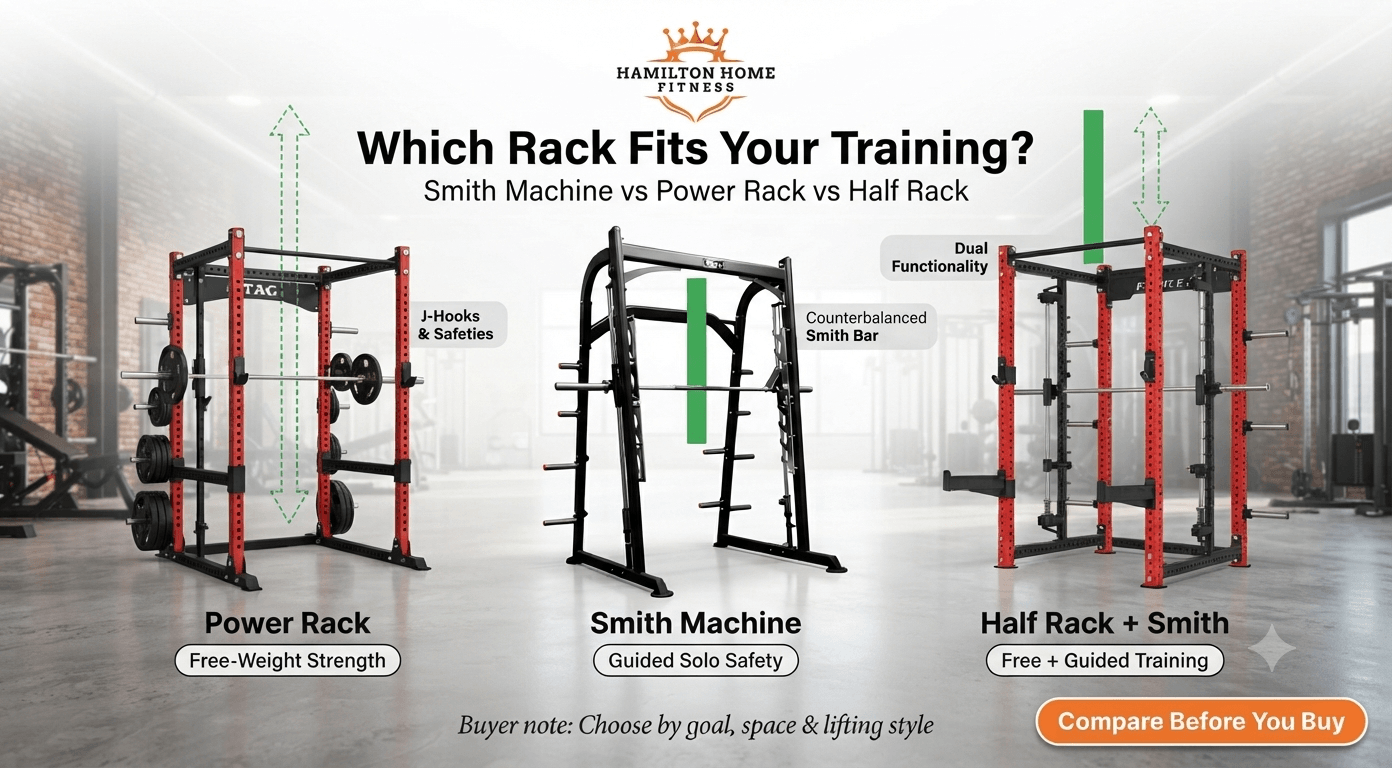
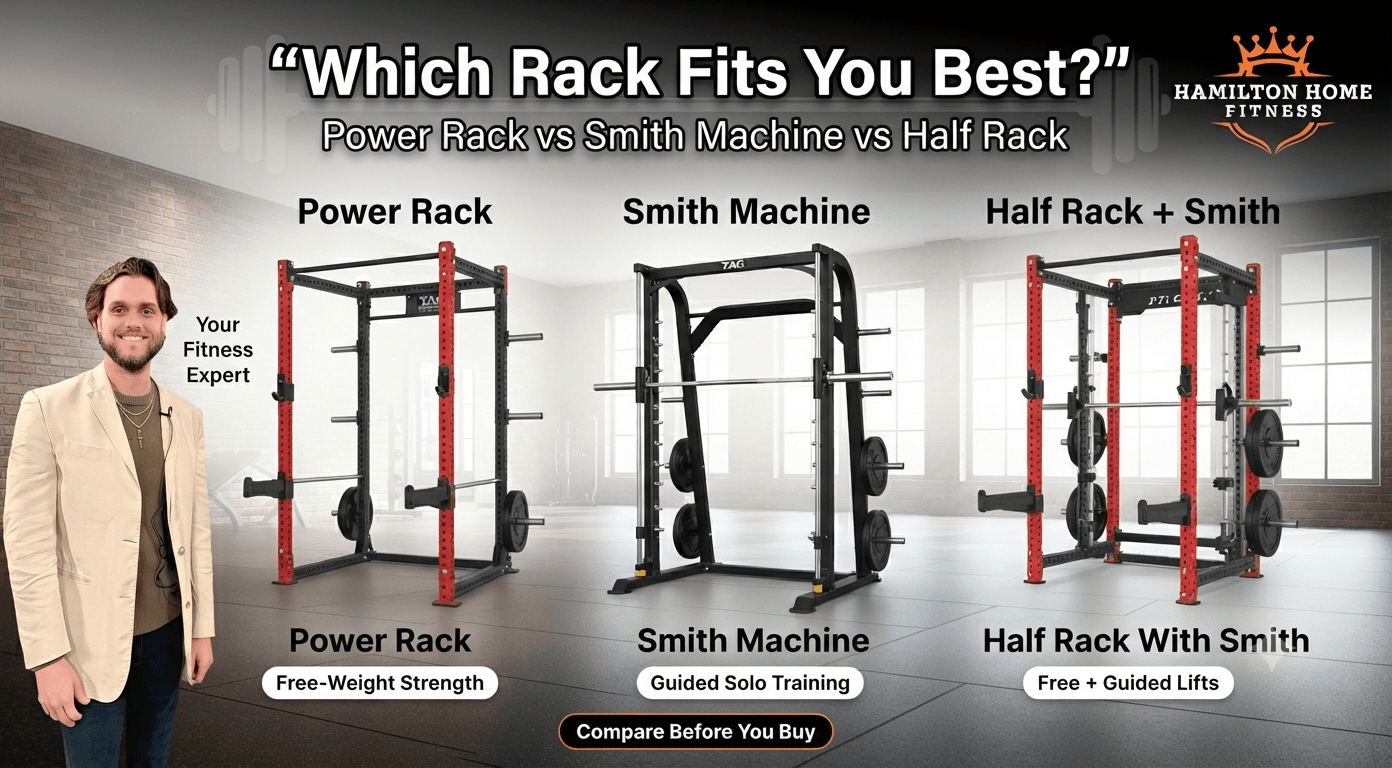
A power rack suits free-weight strength and the widest exercise range. A dedicated Smith machine suits guided, solo-safe training and hypertrophy work. A half rack with a Smith suits lifters who want a fixed rail and free-bar J-hooks in one footprint. Your best pick depends on how you lift and your floor space.
Still weighing the structure? You can browse the full power racks and cages range to compare all three side by side.
Power Rack | Smith Machine | Half Rack With Smith | |
Bar path | Free—you control it | Fixed on steel rails | Both rail and free J-hooks |
Best for | Free-weight strength and skill | Guided hypertrophy, solo safety | Two stations in one footprint |
Footprint | Larger as a full cage | Dedicated, mid-sized | Compact for what it does |
Solo safety | Safe with arms set right | Stops catch a failed rep | Stops plus rack safeties |
Exercise range | Widest | Focused, guided lifts | Broad—free plus guided |
How each bar path actually differs
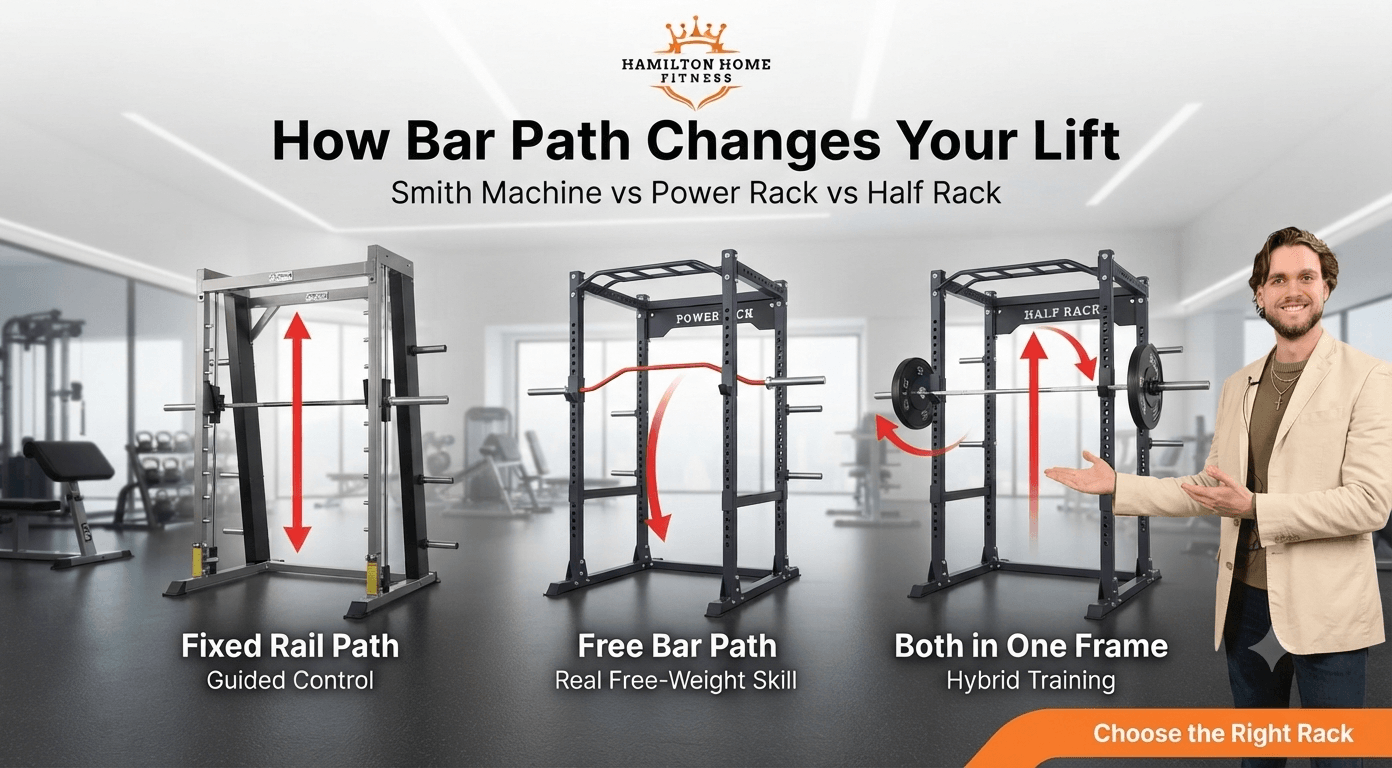
The bar path is the one mechanical difference that drives every trade-off that follows. A Smith machine fixes the bar to steel rails. A power rack lets the bar move freely. A half rack with a Smith gives you both a guided rail and free-bar J-hooks in the same frame. What that means for your lifts is where these three split apart.
The fixed path of a Smith machine
A Smith machine locks the bar to steel rails, so it only travels up and down along a set line. You can't push the bar forward or let it drift back—the rails decide the route.
That happens because the bar rides on linear bearings, which are low-friction sleeves that glide along the guide rods. The result is a smooth, repeatable path rep after rep. Take an overhead press: the bar tracks the exact same line every time, so you stop spending effort keeping it balanced and spend it pressing instead.
The trade is control given up for consistency. Your stabilizer muscles—the small muscles that steady a free bar—do far less work here. That's a feature for some goals and a limit for others, which the later sections sort out. Guided rails like this show up on machines built for it, including the TAG Fitness commercial strength range.
The free path of a power rack
In a power rack, nothing guides the bar — you control the path from the first inch to lockout. You lift the bar off the J-hooks, move it however your body moves, and rack it yourself.
Compare a back squat in each. On a Smith, the rail holds the line for you. In a rack, the bar drifts the moment your form slips, and you have to correct it mid-rep. That demand is the point: correcting the bar builds coordination, barbell skill, and the kind of free-weight strength that carries over to real lifting. The cost is that a rack asks more of your technique, so a sloppy setup punishes you faster.
The half-rack-with-Smith hybrid
A half rack with a Smith attachment puts a guided rail and free-weight J-hooks in the same frame, so you can switch between both. One station, two bar paths.
Picture a normal training week. You run guided incline presses on the Smith rail on Monday, then load free-bar squats on the J-hooks on Thursday—without buying or making room for two separate machines. For a tight garage or a basement gym, that combination often does the job of two units in the footprint of one.
What a counter-balanced bar weighs
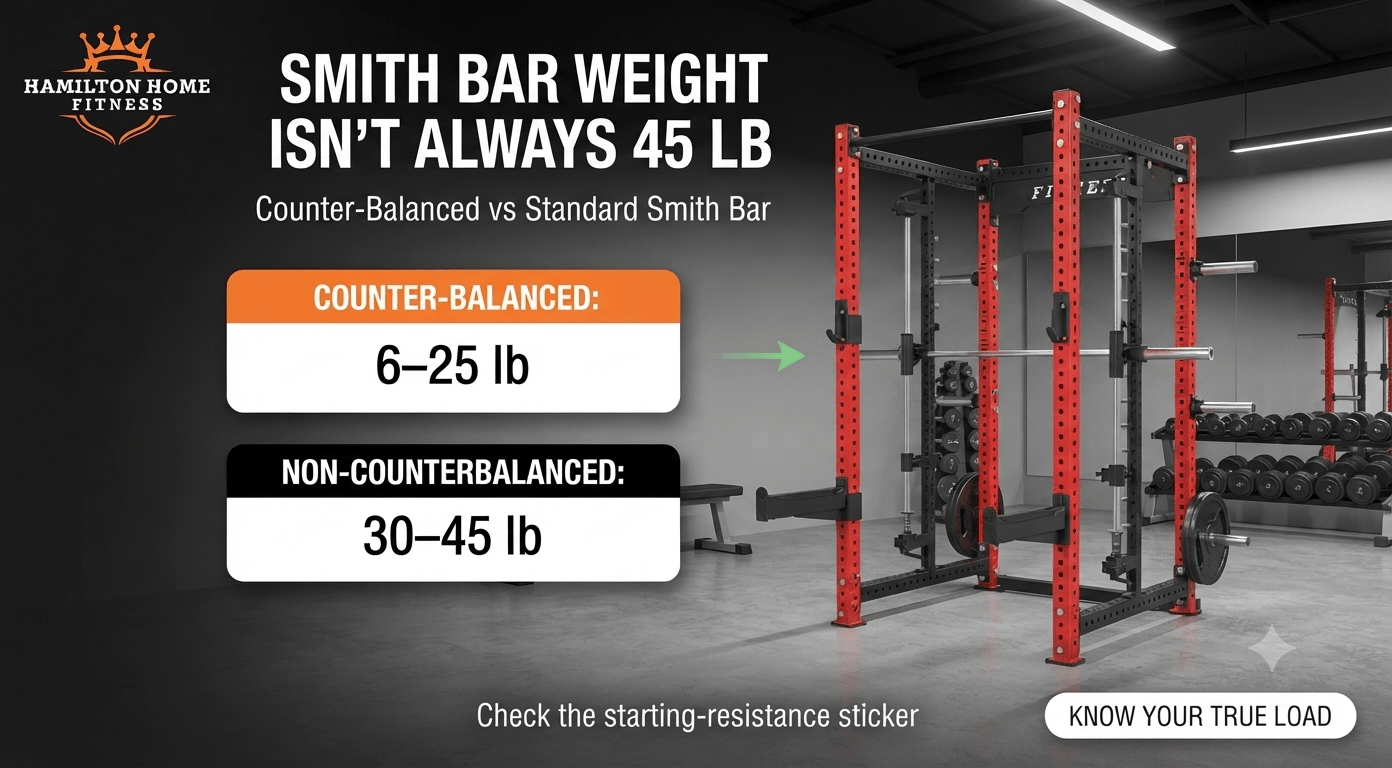
A counterbalanced Smith bar usually starts somewhere between 6 and 25 pounds, depending on the model. A non-counterbalanced bar sits closer to 30 to 45 pounds. Neither matches a free barbell, so don't assume the bar weighs 45 pounds until you check the machine's spec.
Bar type | Typical starting weight | What it means for you |
Counter-balanced | ~6–25 lb | Light off the hooks; easy to control for high-rep and pressing work |
Non-counterbalanced | ~30–45 lb | Close to a standard barbell feel; smaller gap when you switch |
To check any machine, look for a starting-resistance sticker on the frame, usually near the safety-stop instructions. No sticker? Loop a luggage scale around the middle of the bar and lift until it clears the hooks. That reading is your real starting weight.
Counterbalanced vs. standard bars
A counterbalanced Smith uses hidden weights, cables, and pulleys to offset the steel bar, dropping the starting resistance well below a 45-pound barbell. The counterweight sits inside the vertical columns and pulls up on the bar, so the empty bar feels light in your hands.
How light depends on the build. Some commercial counterbalanced machines start as low as 6 pounds; many land in the 15-to-25-pound range. A non-counterbalanced Smith skips that system, so the bar feels close to a standard barbell—often 30 to 45 pounds once you count the hooks and the bearing housing.
That gap is why two Smith machines with the same plates loaded can feel completely different. The York ST counterbalanced Smith runs a low starting resistance and a walk-through design, so you step in and out without ducking under the bar.
Tracking your true working load
Because the bar is lighter and the path is guided, a Smith lift usually feels about 10 to 15 percent easier than the same free-weight load. Squat 200 pounds on a Smith, and your true free-barbell squat is likely nearer 170 to 180.
So log your Smith numbers and your barbell numbers separately. Treat them as two different lifts. If you don't, you'll walk up to a free bar expecting a personal record and get pinned by weight you thought you owned. Accurate logs are also the only way to know your progressive overload is real and not just the machine helping.
One more variable: friction. On a poorly maintained machine, drag on the guide rods makes the bar feel heavier on the way up and lighter on the lowering (eccentric) phase. The same load won't feel identical machine to machine, so stick with one unit and one logging method whenever you can.
Training alone without a spotter
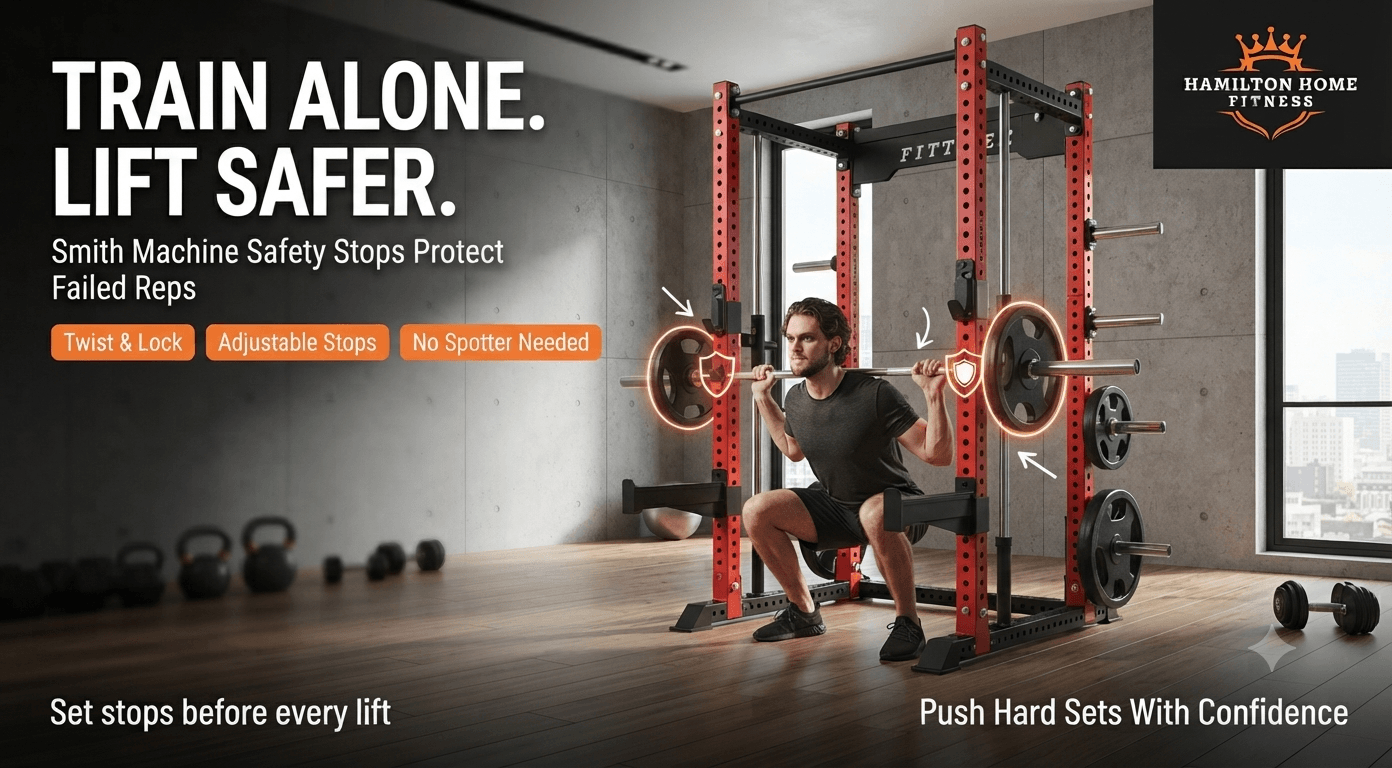
A Smith machine's safety stops let you bail out of a failed rep without a spotter. When a rep stalls, a short twist of the wrist or a controlled drop onto the catches racks the bar for you. For most solo lifters, that single feature is the reason a Smith earns a spot in the gym.
How the safety stops protect you
Set the safety stops just below your bottom position, and a failed rep simply lands on the catches instead of on you.
Here's how it plays out. Say you're squatting and the last rep dies at the bottom. On a free bar, you'd be pinned or dumping plates. On a Smith, the bar drops a couple of inches onto the catch positions you set, and it stops there. You step out, reset, and move on.
The stops adjust to your height and your lift, so the catch point for a squat sits lower than the one for a bench press. Set them once for the movement, test the bottom position empty, and then load up. That two-minute habit is what makes solo failure safe instead of scary.
Benching and pressing without help
You can bench and press on a Smith alone because a quick wrist turn re-racks the bar at any height.
This is where a spotter usually matters most and where a Smith replaces one. Picture a garage gym with nobody around. You press for a hard set on the bench, feel a rep slipping, and rotate your wrists back—the twist-and-lock hooks catch the bar right where you are, mid-press, with no spotter needed. The same holds for incline press and overhead press: if the rep won't move, you rack it in place.
That said, match your stops to the lift. On a flat bench, set them just above your chest so a failed rep can't settle onto you. Get the setup right and pressing alone stops being the risk it is with a free bar.
Who benefits most from a fixed path
A fixed path helps most when no one is around to spot you and confidence under the bar is the limiting factor.
Think in terms of your situation, not your label. A solo lifter training at 6 a.m. with an empty gym gains real security. So does anyone coming back from an injury who wants to load a movement without risking a balance slip—the guided path lets you unload and rebuild carefully. Master lifters protecting joints get the same benefit, and so do the many people who simply train alone at home and want to push hard sets safely.
The common thread isn't who you are. It's that you lift without a spotter and want to reach failure without gambling on it.
When a Smith beats a rack for size
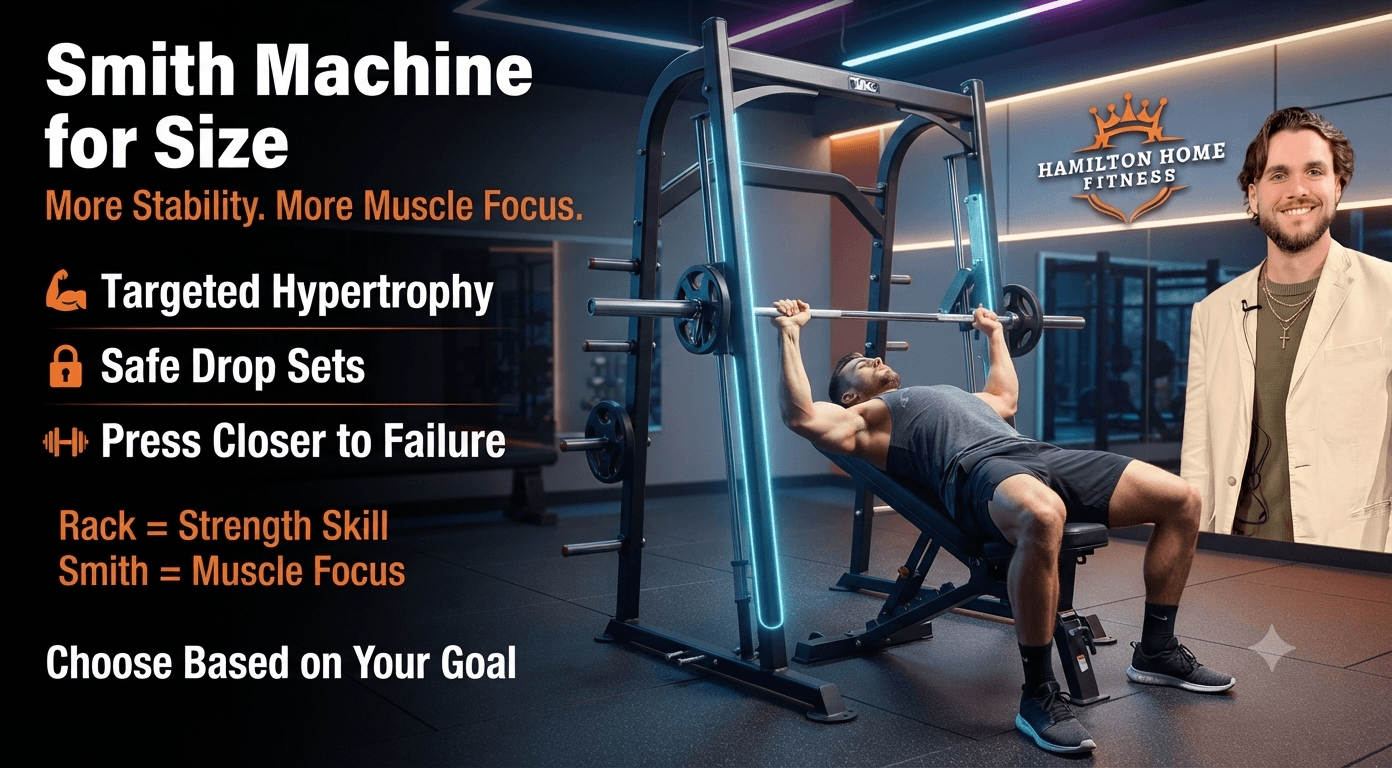
A Smith machine can beat a power rack for muscle growth on isolation and pressing work. By removing the need to balance the bar, it lets you push a target muscle closer to failure safely — and training close to failure is one of the main drivers of size. That's a big reason bodybuilders keep Smith machines in their programs.
Why stability drives muscle growth
When the machine handles balance, you can send nearly all your effort into the working muscle instead of stabilizing the bar.
Muscle grows when you expose it to enough tension and real effort over time. On a free bar, part of that effort leaks into steadying the load. On a Smith, the rail does that job, so more of the work lands where you want it. Take a Smith chest press: with the path locked, you can slow the lowering, squeeze hard at the top, and actually feel the chest do the work—the mind-muscle connection that isolation training is built around.
That focus is the point. You trade some real-world balance for the ability to drive one muscle harder, rep after rep.
Drop sets and isolation made safer
A fixed path makes drop sets, rest-pause, and other failure-based methods far easier to run alone.
These techniques all push a muscle past normal failure, which is exactly when a free bar gets risky solo. On a Smith, the bar racks itself, so you can strip plates fast for a drop set, catch your breath for a rest-pause cluster, and keep going without a spotter standing by. The same stability suits pre-exhaustion and post-exhaustion work and higher-rep sets taken close to the edge.
Pressing variations open up too. Set an incline or decline, and you turn one station into several angles of chest work. Pair the machine with an adjustable bench that fits inside the frame, and your Smith covers flat, incline, and decline pressing from a single spot.
Where the power rack still wins
A power rack still wins when your priority is barbell skill, coordination, or heavy free-weight squats, deadlifts, and presses.
The rack asks your stabilizer muscles to control the bar, and that carries over to lifting outside the gym in a way a guided path can't match. It also handles the hinge patterns a Smith struggles with—a true Romanian deadlift or rack pull follows a path the rails fight against.
So be honest about your goal before you buy. If you want raw barbell strength and skill that transfers, the rack is the better tool. If you want targeted size and safe solo failure, the Smith earns its place. Many lifters end up wanting both, which is where the next section comes in.
Angled vs vertical: which lifts win
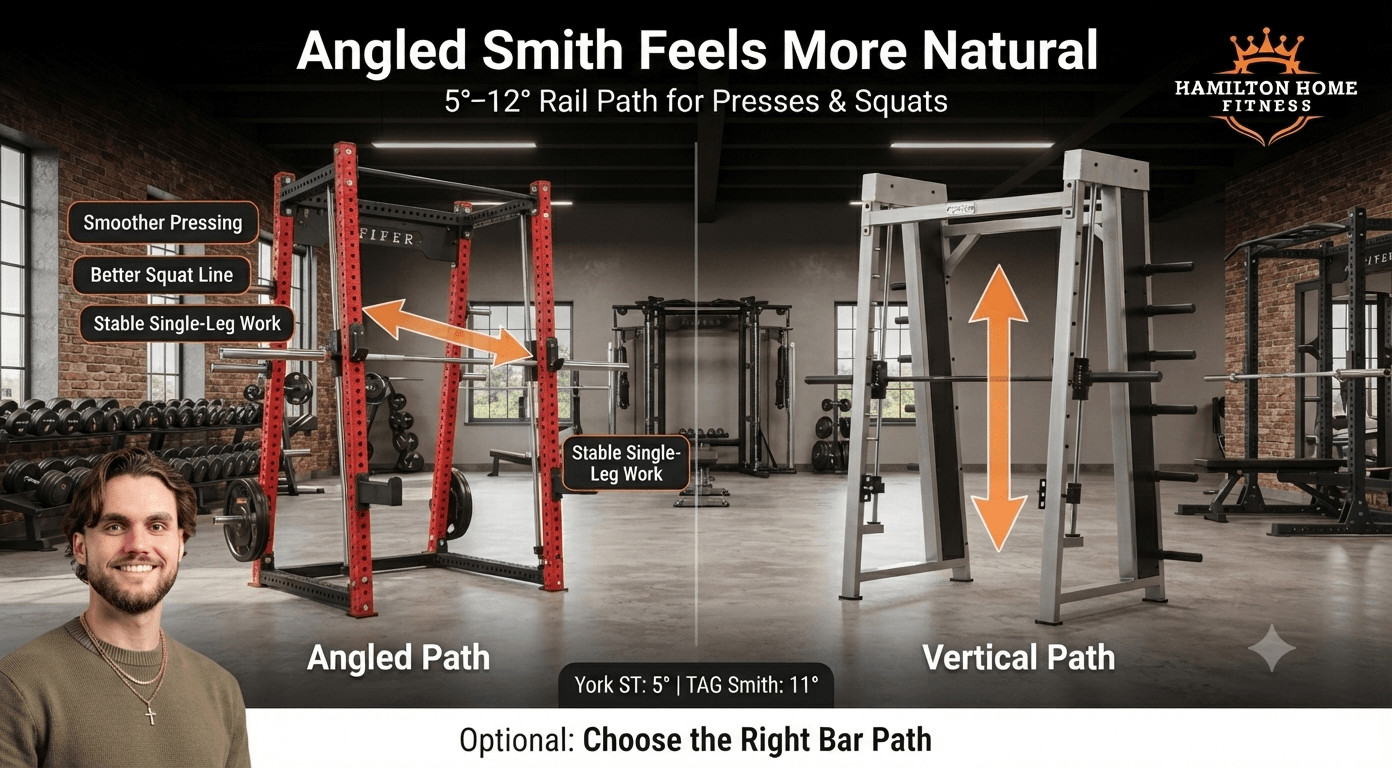
A slight forward angle — usually between 5 and 12 degrees — follows your body's natural pressing and squatting line better than a straight vertical rail. That's why many press and squat movements feel smoother on an angled Smith than on a purely vertical one.
What the bar angle actually changes
An angled rail moves the bar slightly forward or back as it travels, tracking closer to how your body naturally presses or squats.
A vertical Smith runs the bar straight up and down. The problem is that your joints don't move in a perfect vertical line—press a bar and it wants to drift slightly toward your face at the top; squat and your hips shift the balance point. A small tilt lets the rail follow that drift instead of fighting it. The payoff is a path that feels more natural and puts less awkward strain on the shoulders and knees.
Lifts that benefit from an angle
Incline presses, back squats, and split squats usually feel most natural on an angled Smith.
The incline press gains the most, since the bar can travel up and slightly back the way your shoulders want to press. Back squats sit more comfortably because the tilt tracks your natural descent. Split squats and Bulgarian split squats benefit too — the guided path keeps you steady while you focus on one leg. Even hip thrusts and lunges feel cleaner when the rail matches the line your body already moves through.
The angles on HHF's Smith machines
Hamilton Home Fitness carries angled Smiths rather than vertical ones—the York ST runs a 5-degree bar angle, and the TAG Smith uses an 11-degree frame angle.
That gives you two genuine options within the angled range. The York ST sits at the gentle end, close to vertical, with a walk-through design and linear bearings on case-hardened shafts for a smooth glide. TAG's angled, counter-balanced Smith machine runs a steeper 11-degree frame angle and a light, counter-balanced bar. Neither is a straight vertical machine, so if the angle matters for your main lifts, you already know the exact path each one gives before you buy.
Stainless vs. powder coat: worth it?
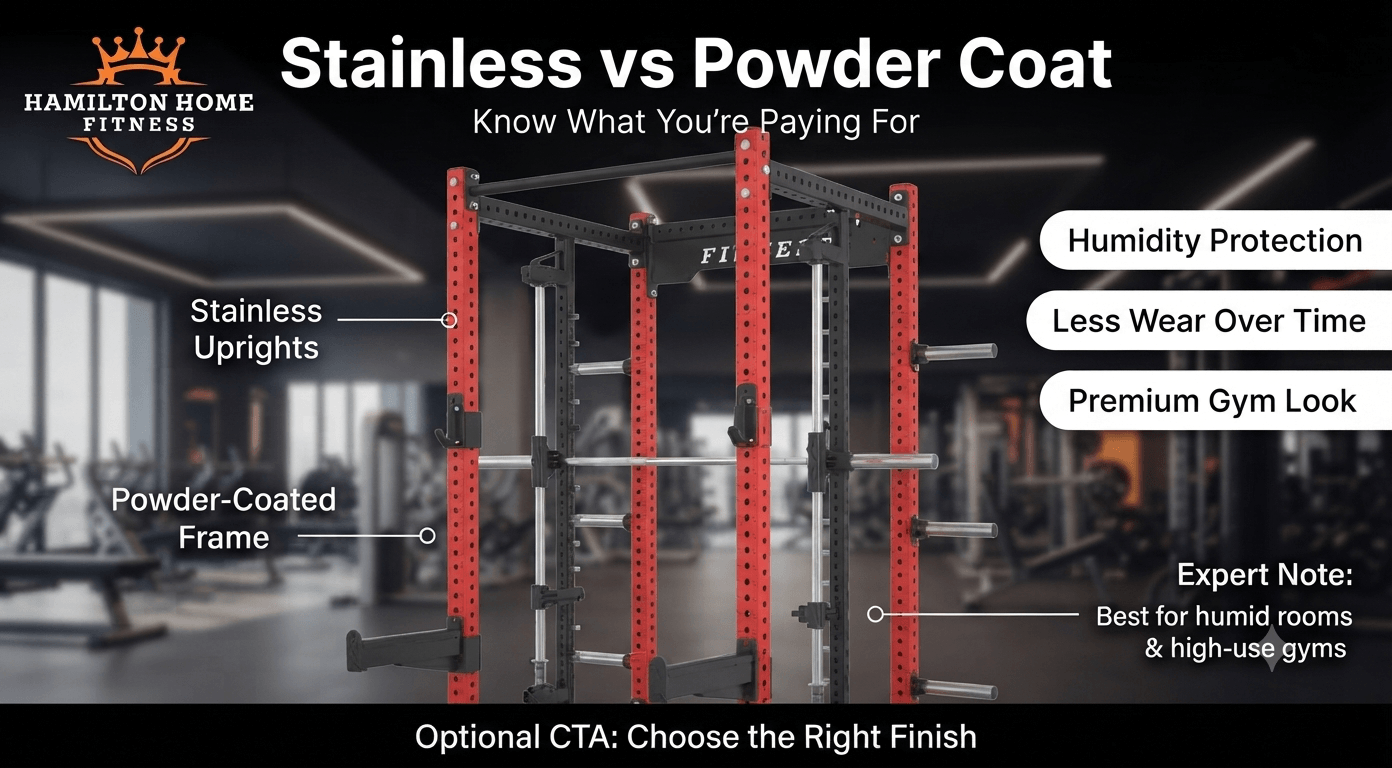
On the racks carried here, "stainless steel" means stainless racking uprights on a powder-coated frame—not a fully polished stainless machine. Knowing that upfront matters, because it changes what you're actually paying the premium for and when that upgrade is worth the money.
What "stainless" really means here
On these half racks, the stainless steel is in the numbered racking uprights the J-hooks contact, while the main frame keeps a durable powder-coat finish.
So a "stainless" half rack isn't a mirror-polished machine from top to bottom. The stainless steel sits where it earns its keep: the uprights with the laser-cut numbers and the strips your J-hooks and safeties slot into and wear against over years. The frame around them wears a crinkle powder-coat finish, the same tough coating used across most commercial racks. Buy with that picture in mind, not the assumption that "stainless" means the whole unit.
When the premium finish is worth it
The stainless upgrade earns its cost in humid basements, high-traffic gyms, and setups where finish wear and looks matter over years.
Stainless resists corrosion, so a damp basement or a garage that swings with the seasons is a real case for it. So is a busy multi-user gym, where the racking surfaces take constant contact and you want them holding up for a decade. And if the equipment sits in a space where appearance counts — a commercial floor or a showcase home gym — the finish pays off in how it looks and lasts.
When powder coating is the smart pick
For a climate-controlled home gym, a quality powder-coat frame holds up fine and keeps more budget for plates and a bench.
If your gym stays dry and temperature-steady, powder coat is not a compromise—it's the sensible call. It handles home and light-commercial use for years, and the money you save goes toward weight and a bench that actually change your training. Pay for stainless when your environment demands it, not by default.
Not sure which fits your room? Contact the Hamilton Home Fitness team, and they'll help match the finish to your space and how hard the equipment will work.
Half rack with Smith, or standalone?
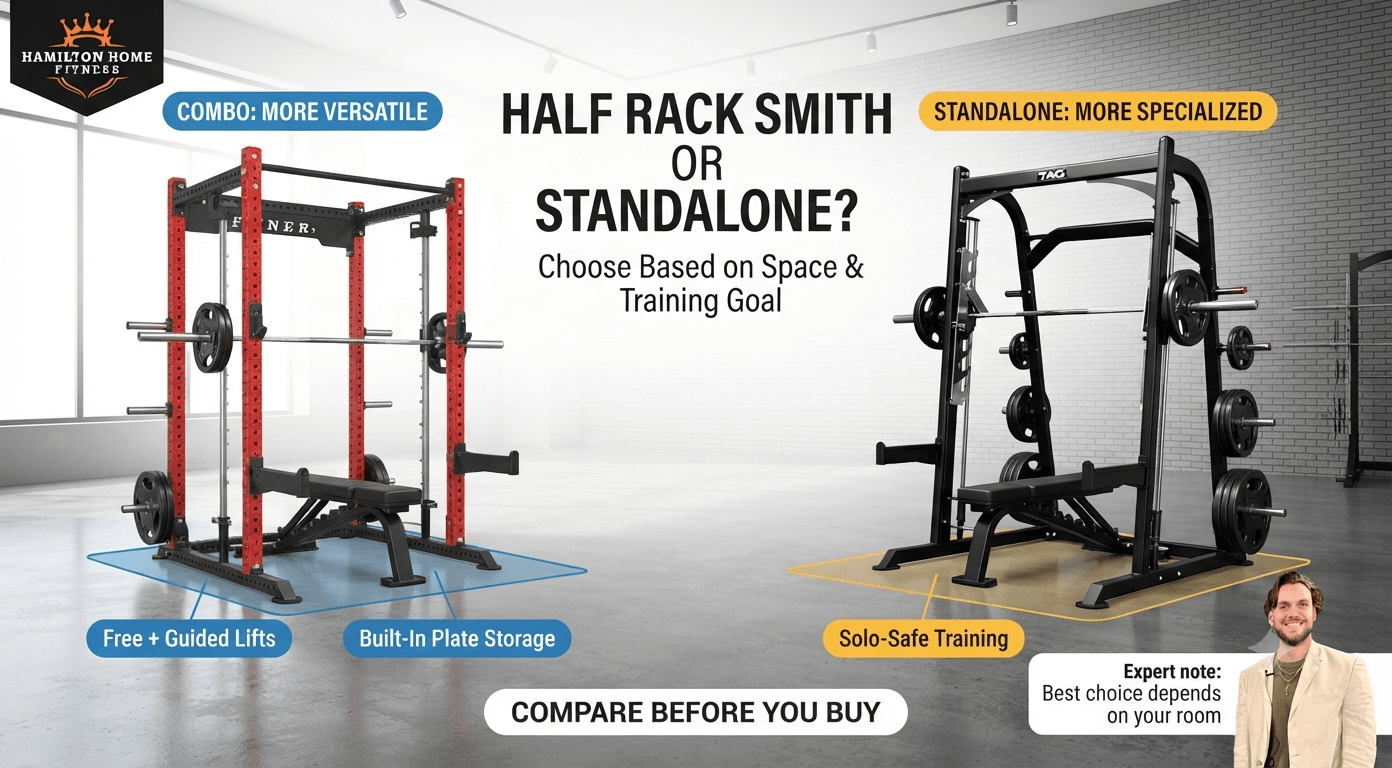
A half rack with a Smith can replace a standalone for lifters who also want free-bar J-hooks and plate storage in one footprint. A dedicated Smith still gives the most refined guided-bar feel and the tightest focus on attachments. Which one is right comes down to your goal and your space.
What a combo gains and gives up
A half rack with a Smith gives you two stations in one footprint; the trade is a slightly less specialized guided-bar setup than a dedicated Smith.
On the gain side, you get a guided rail for pressing and squatting, free-weight J-hooks for barbell work, spotter arms, and built-in plate storage—all in one frame that fits where two machines wouldn't. That's a lot of gym in a small space.
The trade is focused. A standalone Smith is built around one job, so its guided-bar action and its attachment options tend to feel more dialed in. A combo spreads its design across two roles. For most home and garage lifters, that trade is easy to accept; for someone who lives on the Smith rail and wants the most refined guided feel, a dedicated unit still edges ahead.
Match the pick to goal and space
Pick a standalone Smith for pure hypertrophy and solo safety, a power rack for free-weight strength, and a half rack with a Smith when space is tight and you want both.
Sort yourself by how you train. A hypertrophy-focused bodybuilder who trains alone gets the most from a dedicated, counterbalanced Smith. A lifter chasing raw barbell strength and skill wants a power rack. A solo lifter or a facility working with limited floor space who needs guided and free-weight work in one station is the clearest case for a half rack with a Smith. Ceiling height matters too — a shorter room favors a half rack over a full cage.
When you're ready to compare, you can view the half racks with an integrated Smith beside the standalone Smiths and weigh them side by side.
If footprint is the sticking point, don't guess the layout. Book a free gym design consultation and someone will size the right unit to your room, your ceiling, and the way you actually train.
FAQ
Which Smith machine is best for a solo lifter?
For training without a spotter, a counterbalanced angled Smith or a half rack with a Smith works best. Both use safety stops that catch a failed rep, so you can push a hard set alone and bail out safely if it stalls.
Does the TAG Fitness half rack include the Smith machine?
Only the versions labeled "with Smith" include the integrated Smith attachment. The standard half rack is a free-weight rack without it, so check for "with Smith" in the product name before you order.
How much weight can a commercial Smith machine hold?
Commercial-grade Smith machines carry heavy static loads, often well into the hundreds of pounds, with the exact rating set by the specific model and its linear bearings. Match the machine's rating to your working load and stay comfortably inside it.
Do you ship Smith machines nationwide?
Yes. Hamilton Home Fitness ships nationwide from Tennessee, with free shipping on select brands including TAG Fitness. Most Smith machines ship by freight, and shipping terms vary by brand.
Final Thought
You now have what you need to choose with confidence. Match the bar path, the real bar weight, the safety setup, the finish, and the footprint to the way you actually train, and the guesswork disappears.
Here's the short version. Pick a power rack for free-weight strength and skill. Pick a dedicated Smith for guided hypertrophy and safe solo failure. Pick a half rack with a Smith when space is tight and you want both in one frame.
Once you know your pick, compare the units side by side and get the details right for your space. If you're weighing style or finish, reach out to the Hamilton Home Fitness team—they'll help you match the machine to your goals, your room, and how hard it will work.