Introduction
Search "sissy squat," and you'll find it called the only exercise that loads the rectus femoris in a full stretch. A few results down, a well-known coach calls it a hard no for your knees. Both are describing something real. Neither tells you which applies to you.
The short version: this movement gives you a quad-stimulus squatting can't, and the knee risk lives in how fast you load it and what your knees already tolerate—not in the exercise itself.
Lengthened-position training pulled an old bodybuilding move back into rotation. The safety advice never caught up.
Below: what it trains, how to do it, how to progress it, and whether a bench is worth buying if you train at home with no leg extension machine.
What a Sissy Squat Actually Trains
A sissy squat trains all four heads of the quadriceps, but its real value is the rectus femoris—the only quad head crossing the hip as well as the knee. Because your hips stay extended while your knees bend, that muscle loads while it's stretched.
Three of those heads cross the knee only: vastus lateralis on the outside of your thigh, vastus medialis on the inside, and vastus intermedius underneath. Hip position doesn't change their length.
The rectus femoris is the outlier. It's a two-joint muscle—it acts on the hip as well as the knee—so where your hip sits decides how stretched it is.
In a back squat, your hips and knees extend together, so the rectus femoris shortens at one end while it lengthens at the other. Net change: not much. It ends up doing comparatively little.
Lock your hips straight and bend only your knees, and that cancellation disappears—nothing shortens the muscle at the hip while the knee stretches it. That's the position squatting never gives you.
Are Sissy Squats Bad for Your Knees?
For a healthy knee, no—the sissy squat isn't inherently damaging. But it does compress the patellofemoral joint hard at deep flexion, and that compression climbs the further your knee bends. The risk sits in how fast you progress and what your knee already tolerates, not in the movement itself.
Here's why both camps sound convincing. The people warning you off are right that joint load rises steeply in deep knee flexion. The people calling it a knee-strengthener are right that tendon and joint tissue adapt to the load they're gradually exposed to. Neither observation cancels the other out.
One detail gets left out of both arguments: the contact area between the kneecap and thigh bone also increases as the knee bends. More force, spread over more surface. That's why "high load" and "damage" aren't the same claim.
So the same set of reps can strengthen one person's knee and irritate another's. The variable is what that knee has been prepared for—not the exercise.
Be skeptical of confident answers here, including the confident ones in your favor. Direct research on this specific movement is thin, and the strongest claims on both sides run well ahead of the evidence.
Who Should Not Do Sissy Squats
Skip the sissy squat for now if any of the following describes you:
You have current anterior knee pain—pain at the front of the knee, around or under the kneecap
You've been diagnosed with patellofemoral pain, or patellar tendinopathy, sometimes called jumper's knee
Deep knee bends already hurt: squatting to the floor, kneeling, stairs down
You're inside the first few months of a knee surgery or injury rehab
Any previous attempt left you with sharp pain, not muscle soreness
If you have a knee condition, talk to a physical therapist, physician, or qualified coach before loading deep knee flexion. They can test what your knee tolerates. An article can't.
How to Do a Sissy Squat Correctly
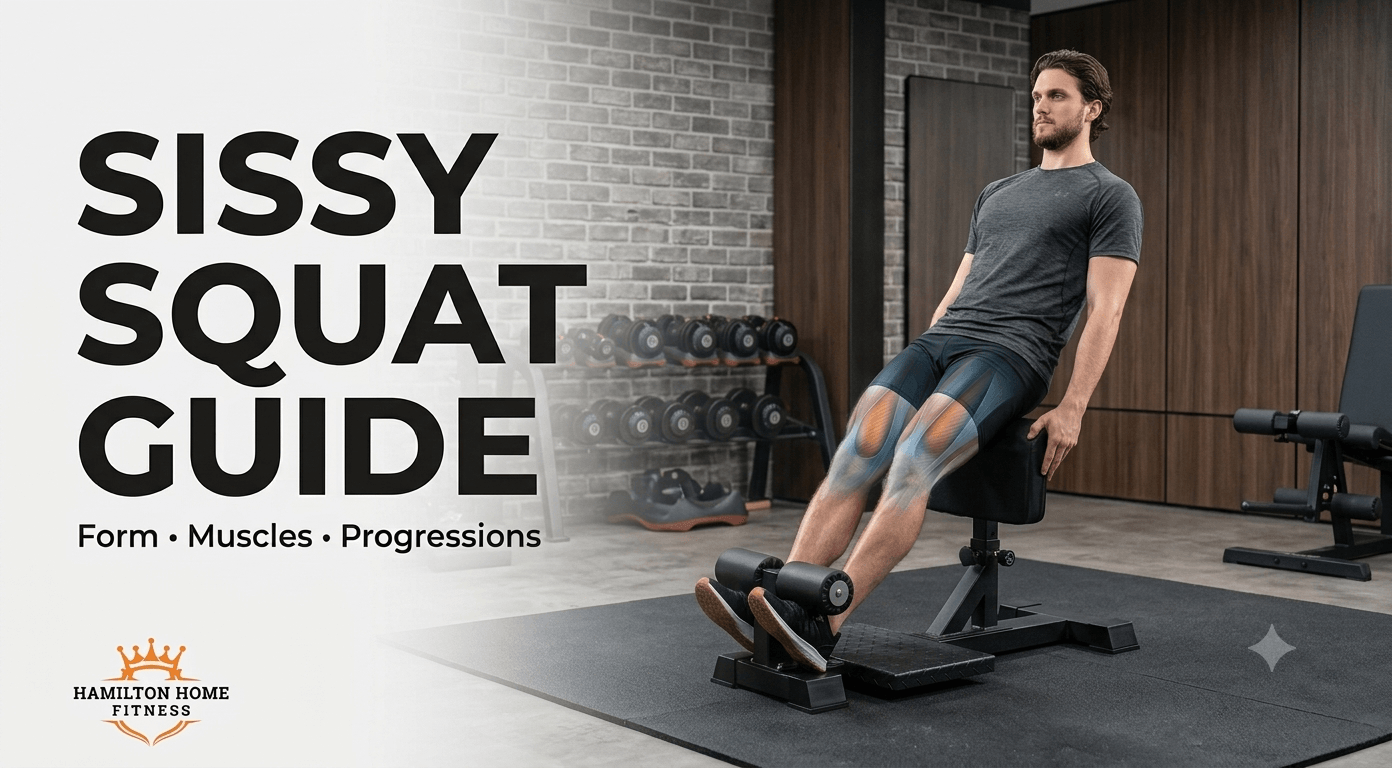
Stand hip-width, hands light on a rack upright or a wall. Let your heels rise as your knees travel forward, hold your hips locked in extension so your torso and thighs stay in one straight line, and lower under control to the depth your knee tolerates today. Drive back up through the balls of your feet.
Working top to bottom:
Feet. Hip-width, toes forward. Heels come off the floor—that's the movement working, not a fault. A plate or a low step under your heels shortens the range and makes early attempts easier.
Knees. They travel forward over your toes. That's the whole point here, and it's the opposite of what you've been told everywhere else.
Hips. Hold them extended—glutes squeezed, hips pushed slightly forward. This is the cue everything else depends on. Hip extension just means your hip joint stays open rather than folding.
Torso. It leans back as a unit with your thighs, not independently.
Hands. A light touch on something solid for balance. Touch, not pull.
The self-check: from the side, your knees, hips, and shoulders should form one straight line the whole way down. The moment your hips fold, you're doing a different exercise.
Mistakes That Make Knees Hurt
Most knee complaints from sissy squats trace back to three errors.
Dropping instead of lowering. Gravity does the descent, and your knee catches you at the bottom. Fix: control the way down over three seconds. Slow is the exercise, not a beginner's setting.
Knees caving inward. Your knees drift toward each other under load. Fix: Keep them tracking in line with your toes, and stop the set when they stop tracking.
Folding at the hips to reach depth. You get lower, but your quads give up the position. Fix: stop at the depth you can hold with a straight hip line.
Sharp knee pain is a stop signal. Muscle soreness the next day is fine. Joint pain during the set is not something to train through.
The Sissy Squat Progression Ladder
Start with a supported partial range, add depth before you add load, and only add weight once you can hold controlled full-range reps with no next-day knee soreness. Each rung earns the next through control, not calendar time.
The five rungs:
Supported partial range—hands on a rack, lower a quarter of the way, hold the straight hip line
Reverse Nordic or kneeling quad extension—same stretch from the floor, far less deep-flexion load
Unsupported partial range—same depth, hands off
Full range—as low as your straight hip line holds
Loaded—a plate or dumbbell added
Most lifters spend weeks on the first two rungs, not days.
Before you touch weight, slow the descent. The eccentric—the lowering phase—carries most of the stimulus, so a three-second lower is progression by itself.
When to Add Weight
Add weight when full-range reps stay controlled and your knees feel normal the following day.
You'll see "work up to twenty bodyweight reps" repeated everywhere. Treat it as a coaching convention, not a research finding.
Two loading tools, and they aren't interchangeable. A plate held out in front shifts your center of mass forward and makes the ascent easier—that's assistance. A pair of dumbbells held at your chest just adds load and covers you for years.
Does a Sissy Squat Bench Help?
No, you don't need one—and it does more than make the movement easier. A fixed foot and calf restraint removes the balance demand, which is genuinely useful. But it also makes it easy to fold at the hips and cut the range short, and that reduces the rectus femoris stretch the exercise exists for.
It's worth owning if balance is the thing stopping you: if you can't hold the bottom position steady, if you train in an apartment with nothing solid to hold, or if you want the same foot placement every rep.
It's not worth much if you can already hold a straight hip line unsupported. You'd be paying to remove a problem you don't have.
If you want one, the York Barbell Sissy Squat is $220 and the lowest-priced sissy squat unit we stock—low-footprint, multiple adjustment points, ships at 56 lbs. Wider options sit in our compact squat machines for home gyms.
One instruction makes a bench worth the money: keep your hips locked in extension. Let them fold, and you've bought a shallower exercise.
Sissy Squat vs. Leg Extension
Both isolate the quads by extending the knee without extending the hip—which is why both reach the rectus femoris that squats leave underworked. The sissy squat lengthens it further because your hip stays extended. It's also much harder to load precisely. No published study has compared the two head-to-head for muscle growth.
Sissy squat | Leg extension | |
Rectus femoris stretch | Greater—hip stays extended | Less—hip is flexed when seated. |
Balance demand. | High | None |
Adding load | Awkward, coarse jumps | Precise, repeatable |
Load at deep knee flexion | High | Adjustable, generally lower |
Footprint | Minimal | Full machine |
Price tier | Low | Mid- |
That caveat in the direct answer matters more than the table. The case for the sissy squat over the machine is reasoning from the stretch position, not a trial result. It's a good argument. It isn't proof, and anyone telling you otherwise is filling a gap in the evidence with confidence.
The practical split: the sissy squat wins on cost, footprint, and stretch. The machine wins on precise progression and on being far kinder to a knee that dislikes deep flexion.
If that second column describes you, browse leg extension machines. The Body-Solid GLCE365B is $690 and handles leg extension and leg curl in one frame, with 8-inch rollers adjusting up, down, and side to side on a 2" × 3" steel frame.
FAQ
How many sissy squats should a beginner do?
Two to three sets of five to eight controlled partial-range reps, twice a week, at the end of a leg session when your knees are warm. Build reps first, then depth, then load.
Can sissy squats build big quads?
They build the rectus femoris that squats leave underworked—a real gap in most lifters' quad development. They won't build the whole quad alone. The three vastus heads still respond best to loaded squatting and pressing.
What can I do instead of a sissy squat?
The reverse Nordic curl and the kneeling quad extension hit the same stretched position from the floor, with less balance demand and less deep-flexion load. Good substitutes if the checklist above ruled you out, and good stepping stones if it didn't.
Should you do sissy squats before or after squats?
After. Put them at the end of your leg session so your knees are warm and your main lifts aren't compromised by pre-fatigued quads.
Final Thought
The sissy squat isn't a miracle or a knee-wrecker. Which one it becomes for you depends on what your knees already tolerate and how patiently you climb the ladder.
Start at the rung that matches where you are today—for most people that's the supported partial range, not the full movement. Add a bench only if balance is genuinely what's holding you back.