

Introduction
Choosing a sauna comes down to four decisions most buying guides never mention: heat type, heater watts, wood, and where it will actually sit—spare room, backyard, garage, or spa floor. Pick the wrong type, and you'll dread every session; skip the electrical math, and the surprise is a 240V circuit quote after the crate is already in your driveway.
This home sauna buying guide settles each one in order: type, size, and watts; placement (garage included); cedar versus hemlock; an honest read of the research; and the real install budget—plus a cold plunge pairing if recovery is the goal. Every step points to models currently listed between $2,099 and $18,999, so the specs and prices you'll compare are real.
Traditional, Infrared, or Hybrid: Pick a Type
Traditional saunas heat the air to roughly 160–195°F with a stove and stones; infrared cabins warm your body directly at 120–150°F; hybrids put both systems in one cabin. None of the three is "better"—they suit different heat tolerances, wiring situations, and session goals.
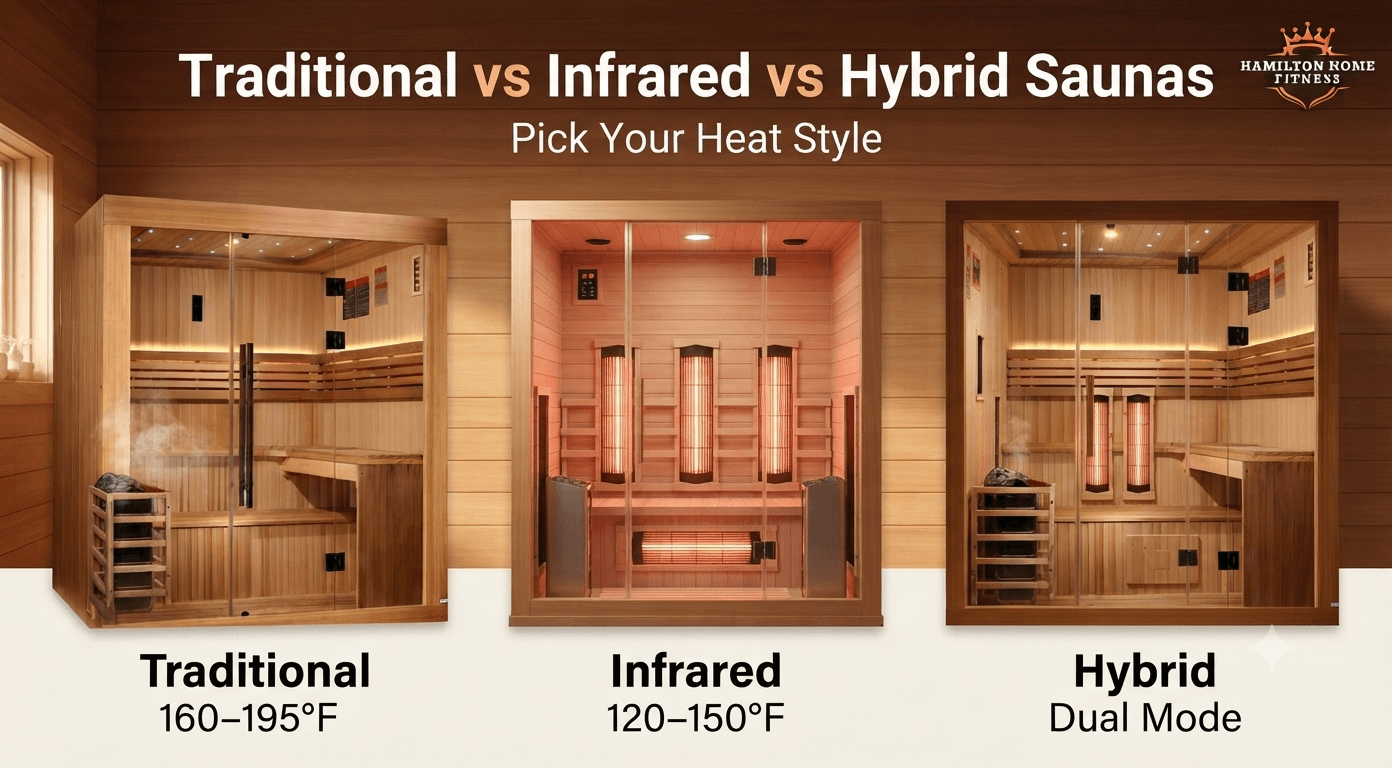
Traditional | Infrared | Hybrid | |
Temperature | ~160–195°F | ~120–150°F | Either, by mode |
Heat-up time | 30–40 minutes | Minimal—panels warm you, not the air first | It depends on mode used |
Humidity control | Adjustable — water over stones | None; fully dry | Both options |
Typical power | Dedicated 240V circuit | Standard 120V outlet on small cabins | 240V typical — confirm on the spec sheet |
Feel | Intense, enveloping, steam on demand | Gentler warmth, deep sweat | Your choice, per session |
Best fit | Heat purists | Lower heat tolerance, easier wiring | Split households |
Traditional Finnish Heat and Löyly
A traditional Finnish sauna heats the air with an electric or wood-burning stove and lets you control humidity by pouring water over hot stones. That burst of steam is called "löyly"—the wave of humid heat that rolls off the stones and makes the room feel instantly hotter without touching a dial. A typical evening runs like this: switch on the electric sauna heater, give the stones their 30–40 minute preheat, settle in near 175°F, and ladle water whenever you want the intensity to climb. If that ritual sounds like the point rather than the chore, this is your type.
Far, Near, and Full-Spectrum Infrared
Far infrared heats your body directly at lower air temperatures, near infrared targets the skin surface, and full-spectrum cabins combine far, mid, and near emitters in one unit. Far infrared does the heavy lifting in most cabins—it drives a deep sweat while the air stays comfortable. Near infrared works shallowly, at skin level. Mid sits between the two. Because the heat is gentler, sessions run longer without the urge to bolt for the door. One buying note: Low EMF, Ultra Low, and Near Zero EMF labels on carbon-panel cabins are manufacturer designations—treat them as comparison tiers between models, not certified guarantees.
Hybrid Cabins: Stove Plus Panels
A hybrid sauna puts a traditional stove and full-spectrum infrared panels in the same cabin, so households split between both heat styles don't have to choose. The indoor hybrid with a Harvia stove and full-spectrum panels currently listed at $9,999 seats three and switches modes by session—löyly on Saturday and a gentle 40-minute infrared sit on Monday. Hybrids cost more than either single type, so they're worth considering only when two regular users genuinely want different heat.
Golden Designs Lines at a Glance
Most models in this guide come from three related lines in the Golden Designs sauna collection: Dynamic, Maxxus, and the GDI series. Dynamic covers value-priced far infrared cabins, mostly in Canadian hemlock, starting at $2,099. Maxxus adds near-zero EMF panels and space-saving corner layouts in the low $3,000s. The GDI series runs widest—PureTech full-spectrum cabins with Himalayan salt bars, plus traditional, barrel, and outdoor builds, reaching $18,999.
How Many People, Watts, and Square Feet?
Size a sauna with two rules before you fall for any model: plan roughly two feet of bench width per seated adult—six feet if anyone wants to lie down—and for traditional cabins, start from about 1 kW of heater power per 45 cubic feet of volume. Both are planning rules; the listed dimensions and heater rating on each spec sheet are the final word.
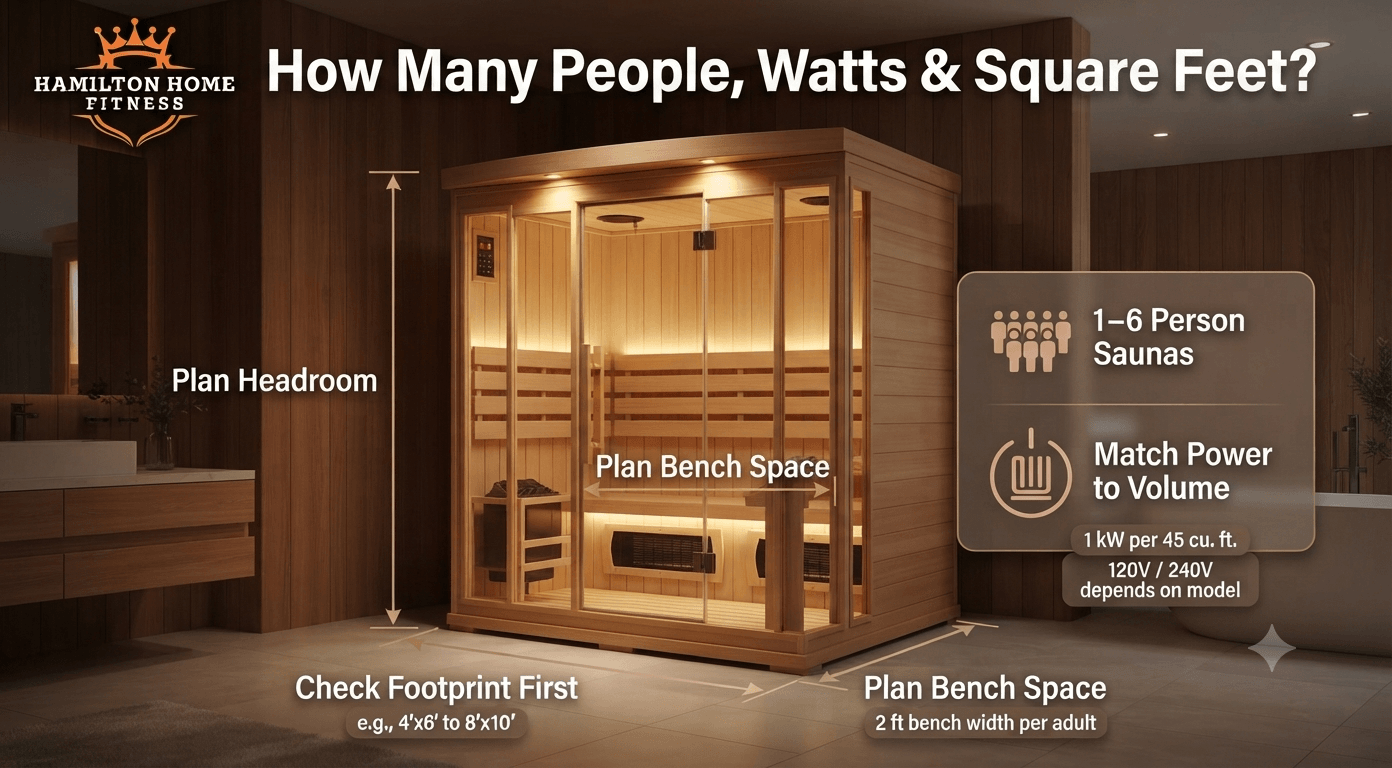
Capacity | Planning footprint (typical) | Power to expect |
1-person | roughly 3' × 3' corner | Infrared: standard 120V outlet on most models |
2-person | roughly 4' × 4' | Infrared: 120V common — confirm per listing |
3–4 people | roughly 5' × 5' to 6' × 6' | Larger full-spectrum cabins may need a dedicated circuit; traditional ones always do. |
5–6 people | roughly 7' wide and up | Dedicated 240V circuit; higher-kW heater on traditional builds |
Cabin Sizes From 1 to 6 People
A rated 2-person cabin fits two seated adults touching shoulders; buy one size above the number of regular users if comfort matters. Rated capacity counts bench inches, not elbow room. A one-person or two-person cabin suits a solo daily user or a couple taking turns. Three- and four-person cabins give two people space to actually relax, and corner layouts recover floor area in tight rooms. For a family sauna or shared sessions, a six-person traditional sauna — currently listed at $9,999 — spreads seating across a two-tier bench, which also gives heat-sensitive users a cooler lower row. Want to lie flat? The bench length, not the rated capacity, decides that.
Heater kW: Match Power to Volume
For traditional saunas, start from roughly 1 kW of heater power per 45 cubic feet of cabin volume, then confirm the exact figure on the model's spec sheet. The math takes one line: a 6' × 5' × 7' cabin is 210 cubic feet, and 210 ÷ 45 ≈ 4.7—so shop the 6 kW class, not the 4.5. Infrared sizing works differently: it's about emitter coverage, not air volume. Panels should surround you from knees to neck—back, sides, and ideally front—with total wattage rising alongside cabin size. An underpowered cabin announces itself fast: 45-minute heat-ups and a temperature that stalls below the set point on cold mornings.
Footprint, Height, and Clearances
Measure four things before ordering: floor footprint, ceiling height, door swing path, and the clearance the manual requires around walls and the heater.
Floor footprint. Tape the cabin's listed base dimensions on the floor and stand inside the outline.
Ceiling height. Compare the listed cabin height against your ceiling—basement soffits and garage door tracks are the usual ambush.
Door swing. Glass doors need a clear arc, and corner units change which direction that arc opens.
Wall and heater clearance. The manual's required gaps aren't suggestions; they protect both heat circulation and the wall behind the stove.
One more inch to respect: assembly space. Panels arrive flat on a freight pallet, and you'll need room to walk each one in and turn it.
Indoor, Outdoor, or Garage Placement?
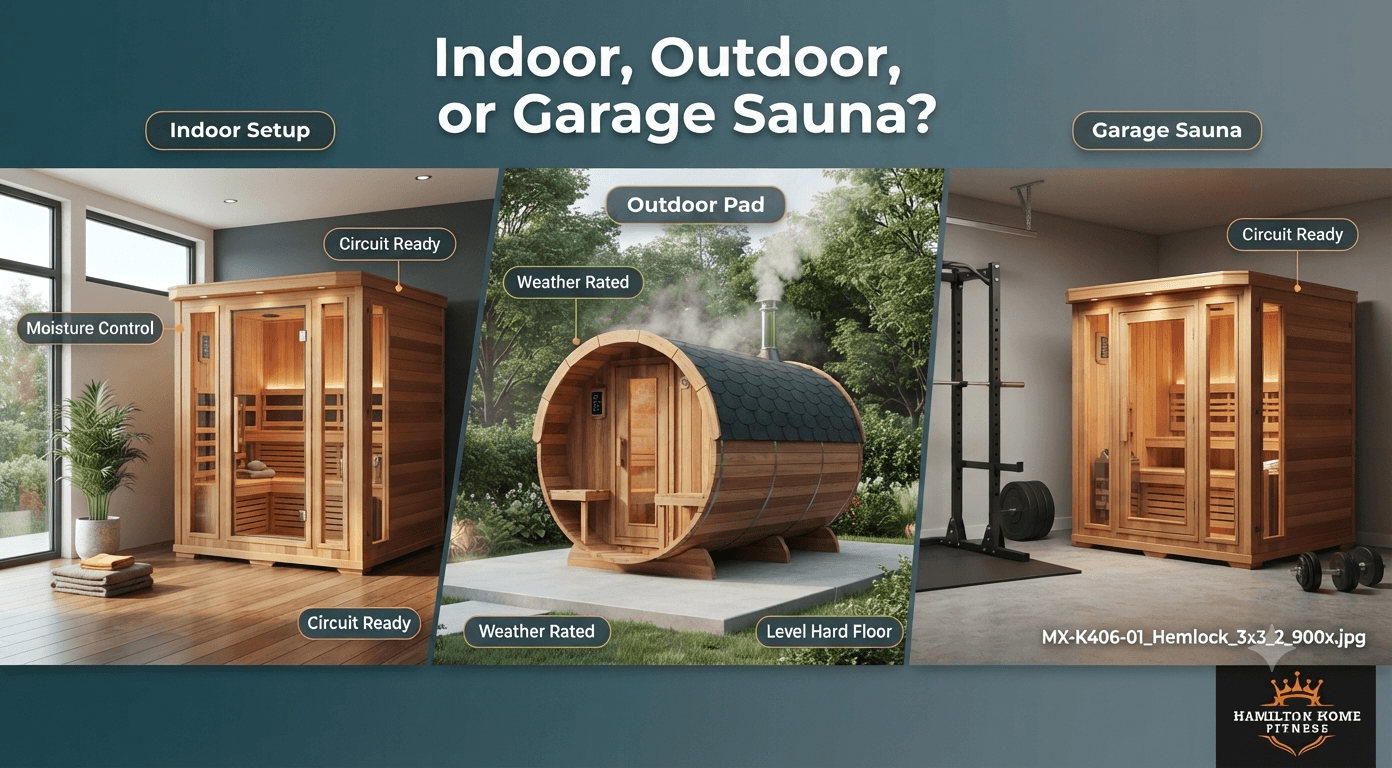
Most buyers can put a sauna indoors, outdoors, or in a garage—the cabin itself rarely rules anything out. What decides the spot are three things: circuit capacity where the sauna will sit; how that space handles moisture; and what the unit stands on. Solve those three and the location argument usually settles itself.
Indoor and Basement Requirements
Indoors, an infrared cabin needs little more than a level hard floor and the right outlet; a traditional sauna adds humidity, so the room needs air movement and moisture-tolerant surfaces.
That difference makes infrared the low-drama indoor sauna installation. A spare bedroom works as delivered—level floor, outlet within reach, and done. A basement sauna suits infrared even better: cool ambient air around a warm, dry cabin and no steam soaking into anything stored nearby.
Traditional cabins ask more of the room. Every ladle of Loyle ends up as humidity somewhere, so the space needs airflow and surfaces that shrug off moisture—one reason a bathroom placement outperforms a carpet-and-drywall guest room. Plan the dedicated circuit run while choosing the room; the install section covers the wiring itself.
Outdoor Pads, Roofs, and Barrels
An outdoor sauna needs a level, load-bearing pad—concrete or compacted gravel—and a weather-rated roof; barrel designs shed rain naturally and heat efficiently thanks to their curved volume.
The pad comes first. Pour a concrete pad or compact a gravel one, check it with a level, and match the model's base requirements before the freight truck arrives. Skip this step, and every door and joint sits slightly out of square from day one. Then handle weather: roof shingles or an equivalent rated top, plus a seasonal check on the weather sealing around doors and trim.
Barrels solve part of this by shape—the curve leaves no flat roof to pond water and less air overhead to heat. A four-person barrel sauna like the Zurich, currently $8,999 with a bronze-tinted privacy window, shows the format at family size. And retire the claim that infrared belongs indoors only: an outdoor-rated hybrid cabin—the Nora, currently $18,999—carries full-spectrum hybrid heating rated for outdoor or indoor placement, which settles the four-season question.
Garage Saunas in a Tennessee Climate
Yes—a garage takes a sauna well if you run a dedicated circuit, keep the manual's clearance from walls and stored items, and manage moisture from traditional steam. Circuit first: the panel is usually steps away, keeping the wiring run short. Clearance second: the manual's gaps apply to shelving and parked cars, not just drywall. Moisture, third: infrared produces almost none; traditional steam needs an exit.
Tennessee makes a useful stress test. Summer garages here already sit humid, and, lo and behold, on top of that, will find every cool surface—so leave a ventilation gap around the cabin and crack the garage door for a few minutes after sessions to clear the condensation. Winters are mild enough that preheat times barely move; the fight the northern garages lose.
For a garage gym owner, the empty bay beside the rack is prime placement: finish the last set, and the sauna sits ten steps away. The checklist travels with nationwide delivery, too—drier states sweat condensation less, and colder ones watch preheat more.
Cedar vs Hemlock: Which Wood Lasts?
Canadian hemlock and western red cedar are the two woods that matter for most buyers—hemlock for light color, low aroma, and lower cost indoors; and cedar for natural rot and insect resistance outdoors. Placement picks the wood more than taste does.

Choose hemlock if… | Choose cedar if… |
The sauna lives indoors | The sauna lives outside in the weather |
Anyone in the house is scent-sensitive | You want the classic sauna aroma |
Budget matters—same cabin, lower price | Outdoor longevity justifies the premium |
You'll also see basswood and aspen—pale, low-scent hardwoods often chosen where allergies rule the room—and occasionally eucalyptus on select builds. None of them changes the core decision: indoors favors mild woods, outdoors favors natural weather resistance.
Canadian Hemlock: Cost and Comfort
Canadian hemlock is the practical indoor choice: light-colored, nearly scent-free, stable under heat cycling, and cheaper than cedar. The blonde boards keep a small cabin feeling bright instead of cave-like, and the scent is a faint, clean wood note that fades into the background—the reason scent-sensitive users land here without a second thought.
Stability is the quieter virtue. Dimensional stability simply means the boards hold their shape through hundreds of heat-up and cool-down cycles instead of warping or opening gaps—exactly the stress an indoor cabin repeats every session. Reforested Canadian hemlock is the standard build wood across most indoor infrared cabins in this guide's price band; a Canadian hemlock far infrared sauna from the Maxxus line, currently $3,299, is typical of the breed—hemlock walls, benches, and trim in one mid-$3,000s package. Kept indoors, it ages evenly and holds its pale tone for years.
Red Cedar: Aroma and Weather
Western red cedar earns its premium outdoors: its natural oils resist rot and insects, and it holds up to weather that would punish hemlock. Those oils are the whole story—a built-in preservative that lets a backyard cabin face rain and humidity without chemical treatment. Fresh cedar runs rich reddish-brown with dramatic grain; left unsealed outside, it weathers slowly toward a silvered gray that many owners like more than the original.
The honest downside sits in your nose. Cedar's aroma is the selling point and the dealbreaker in the same breath—in a hot, closed room, it is strong, and a minority of users find it overwhelming rather than nostalgic. Smell cedar in person before committing if you're unsure. And know when the premium is wasted: in a fully indoor placement, hemlock does the same job for less, so save cedar's cost for the cabin that actually meets the weather.
What Sauna Research Really Shows
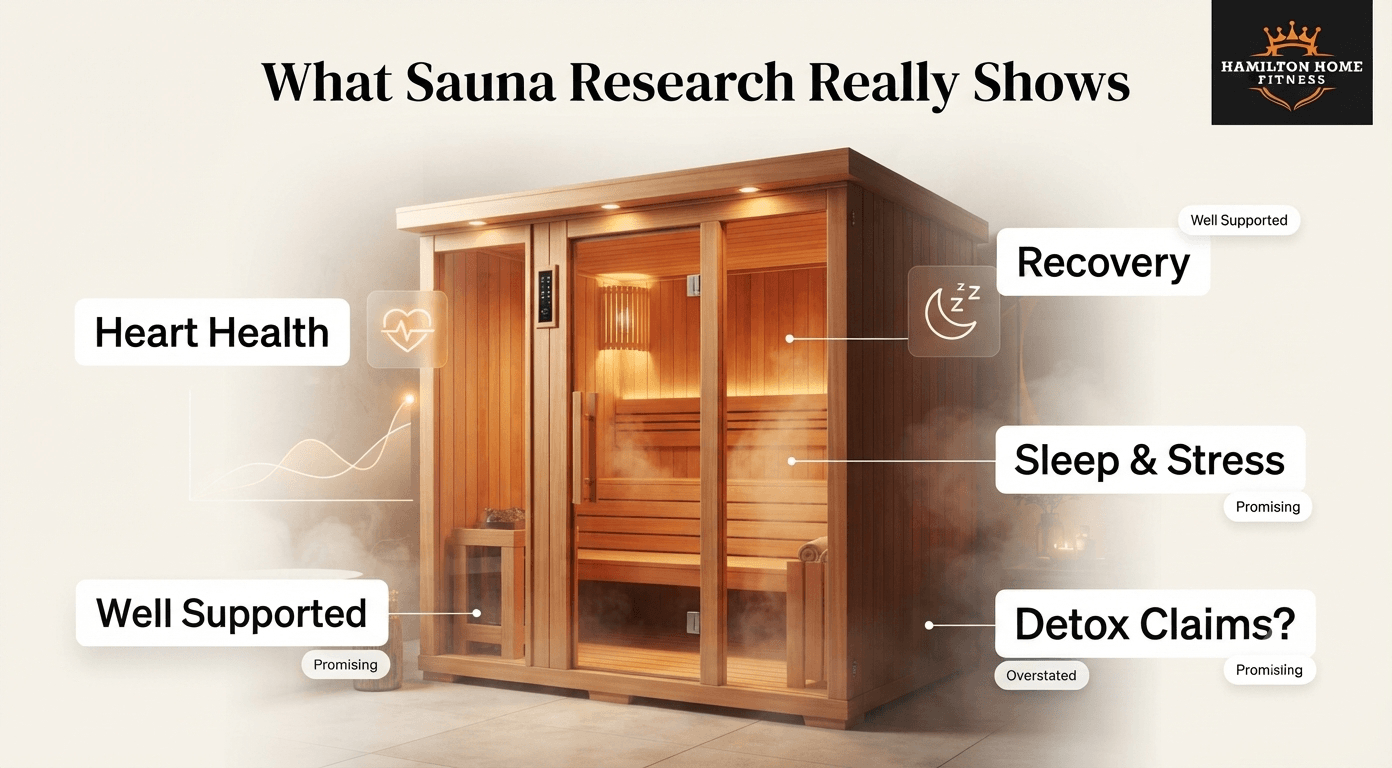
The strongest sauna evidence is observational: long-running Finnish cohort research associating frequent traditional sauna use with roughly half the cardiovascular deaths of once-weekly use across two decades of follow-up. That's an association, not proof — and it studied traditional heat, not infrared. To keep this section honest, every claim below carries one of three labels: well supported, promising but thin, or overstated.
Heart and Longevity Findings
In long-term Finnish cohort research, men using a traditional sauna four to seven times weekly showed markedly fewer cardiovascular deaths than once-weekly users across roughly twenty years of follow-up. The caveat comes first, not last: this is an observational cohort, so it shows association versus causation—men who sauna almost daily may differ from once-a-week users in ways no statistical adjustment fully removes.
With that stated, the pattern itself is unusually consistent. The study tracked more than two thousand middle-aged Finnish men, grouped by habit: once weekly, two to three times, or four to seven times. Risk fell as frequency rose — a dose-response pattern. Sudden cardiac death occurred in about ten percent of the once-weekly group versus five percent of the most frequent users. All-cause mortality followed the same slope. The same research program, led by cardiologist Jari Laukkanen, later linked frequent bathing to lower rates of high blood pressure, stroke, and dementia. Proposed mechanisms are plausible: heart rate during a hot session climbs to a range comparable to moderate exercise, and repeated heat stress triggers heat shock proteins—the cell-level repair response to heat.
Verdict: well supported as an association for traditional sauna and cardiovascular health. One transfer warning—infrared's evidence base is younger and built on small trials, so borrowing these mortality numbers to sell an infrared cabin overstates what anyone has shown.
Recovery, Sleep, and Stress
Regular heat exposure supports recovery mainly through increased circulation, heat acclimation, and the relaxation response — useful effects, though smaller and less studied than the cardiovascular findings. Picture the realistic version: a master athlete finishes a heavy lower-body day, sits in the heat that evening, and steps out with looser muscles, a calmer nervous system, and an earlier drift into sleep. None of that is imaginary; all of it is hard to measure precisely.
The physiology behind the scenario: a session ends with a shift toward the parasympathetic state—the nervous system's rest-and-recover mode—which is why biohackers who track HRV (heart rate variability, a recovery marker) often log sauna evenings favorably and why shorter sleep latency and lower perceived stress are the most commonly reported effects. The sturdiest claim in this cluster is hot weather acclimation: endurance athletes have long used post-training heat to prepare for racing in hot conditions, and the adaptation logic is well grounded. Heat also slots cleanly into a wider recovery stack—easy days, sleep discipline, and vibration therapy equipment for pre-training prep—rather than replacing any of it.
Verdict: promising but thin, with acclimation the best-grounded piece. Buy expecting better session-to-session recovery, not a measurable performance guarantee.
Detox Claims: The Honest Read
Sweating feels cleansing, but your liver and kidneys do the detox work; buy a sauna for recovery, relaxation, and heat benefits—not toxin removal. Sweat composition is mostly water and electrolytes like sodium, with only trace amounts of anything else. Sweating buckets does not multiply those traces into a meaningful cleanse, and no amount of session time outsources what liver and kidney function already handle continuously.
The buyer's mistake is paying a premium for the word. "Detox" survives in sauna marketing because the post-session feeling is genuinely great and easy to mislabel. If a listing leans hardest on detox claims, treat that as a signal about the marketing, not the machine. Verdict: overstated—the weakest common claim in the category, sold by the industry and unsupported at anything beyond trace levels.
How Long and How Often to Sit
Most users build toward 10–20 minutes per traditional session and 20–30 minutes in the gentler heat of an infrared cabin, with hydration before and after. The decision rule: shorter and hotter, or longer and milder—let the sauna type set the clock, not toughness. Beginners start at five to ten minutes and add time across weeks; leaving early because you feel dizzy or off is the protocol working, not failing.
Frequency follows the evidence: the Finnish benefits tracked regular use—several sessions weekly—so consistency beats occasional marathon sits. Ranges are the honest answer here; a false-precision number would just be decoration. One safety note, stated plainly: if you have a heart condition, are pregnant, or take blood pressure medication, talk with your physician before starting regular sessions.
Install Plan: Power, Air, and Floors
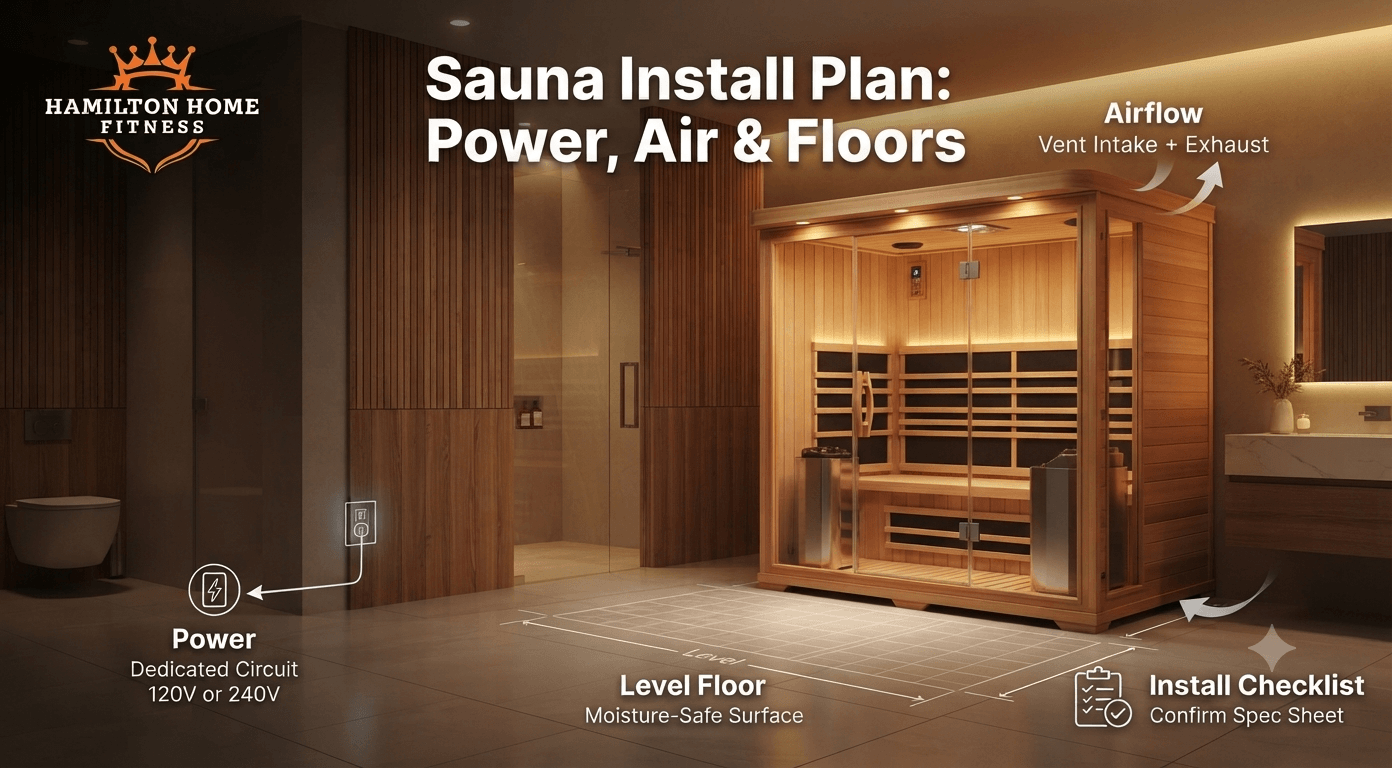
Budget three things before the sauna itself: the circuit, the airflow, and the floor. Many small infrared cabins run on a standard 120V outlet, while traditional heaters typically need a dedicated 240V circuit sized to the heater — and every cabin needs a level, moisture-appropriate surface under it. Answer those three for your exact spot, and the install turns from an unknown cost into a short checklist.
Sauna class | Typical power planning |
1–2 person infrared | Standard 120V outlet on most models |
3+ person / full spectrum | Dedicated circuit common; some models 240V |
Traditional, any size | Dedicated 240V circuit sized to heater kW |
Hybrid | Dedicated 240V typical |
Plan with this table; order with the listing. Final voltage and amperage come from each model's spec sheet, nowhere else.
120V vs 240V: Amps and Circuits
Small infrared cabins often plug into a standard 120V outlet, while traditional electric heaters typically require a dedicated 240V circuit—the exact amperage depends on the heater's kW rating on its spec sheet. A dedicated circuit means the sauna shares its breaker with nothing else. Breaker sizing scales with the heater: more kW, higher amperage, with 30-amp and 40-amp circuits being the common classes behind traditional home stoves. GFCI protection — a breaker or outlet that cuts power instantly at the first electrical fault — is standard practice around heat and moisture, and your electrician will confirm what local code requires.
Bring the licensed electrician three questions and you'll get a real quote instead of a shrug: Does my panel have capacity for a new dedicated circuit? How long is the run from the panel to the sauna's spot? What does code here require for this install? Panel capacity and run distance are the cost drivers—the sauna itself barely moves the number.
Ventilation and Moisture Basics
Traditional saunas breathe: a low intake vent near the heater and a higher exhaust vent keep air fresh and heat even, while infrared cabins need only modest airflow because they produce no steam.
The loop is simple. The intake vent sits low, close to the stove, feeding fresh air into the heater's draft. The exhaust vent sits higher on the opposite side, letting spent air leave. Outdoor cabins sometimes route this through a roof vent instead. Infrared owners can relax—cracking the door between sessions covers it.
Two symptoms tell you the loop is broken. Air that turns stuffy and drowsy mid-session points to a blocked or furniture-covered intake. Condensation streaking the surrounding room's walls means moisture is escaping faster than the space can shed it—open the exhaust fully and air the room after sessions before it becomes a drywall problem.
Floors, Drains, and Delivery Day
A level, hard, water-tolerant floor covers most home installs; floor drains matter mainly for commercial rooms, and your real delivery-day job is a clear path for a heavy freight pallet.
Floor. Concrete, tile, or vinyl plank all work. The carpet fails twice—it can't sit level under load, and it holds moisture.
Drain. A sauna floor drain earns its plumbing in commercial rooms that get hosed down daily. At home, a towel handles the löyly splash; skip the drain unless one already exists.
Delivery. The crate arrives by freight as a curbside pallet weighing several hundred pounds. Walk the path first—gate widths, door frames, stair turns—and book a second set of hands for the day. Uncrate as close to the final spot as possible, and confirm your delivery level and return window in the freight shipping and returns terms before ordering. Ask about white glove options if curbside won't work for your site.
Pair Your Sauna With a Cold Plunge
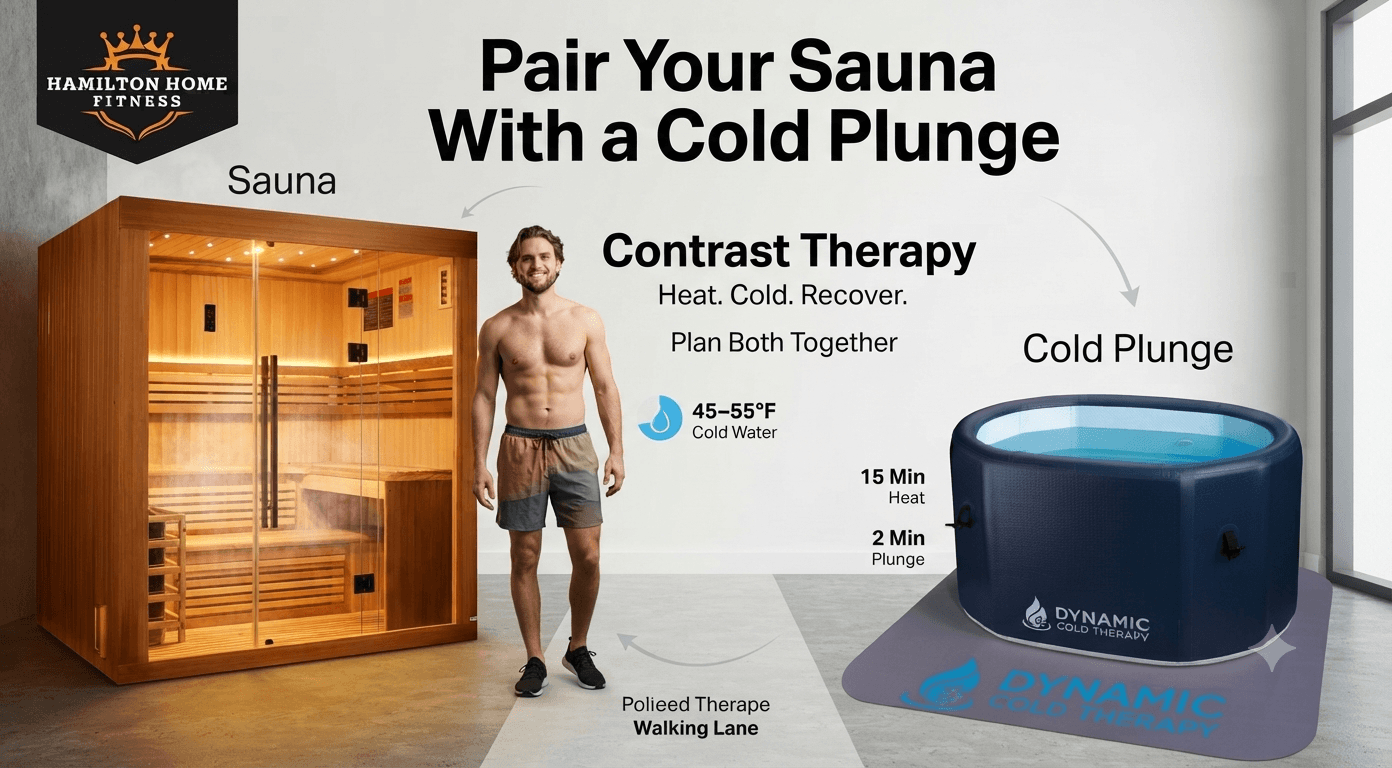
Contrast therapy alternates heat exposure with cold immersion—sauna, plunge, rest, repeat. Athletes run the cycle for perceived recovery and the jolt of alertness that follows the cold, and there's a practical reason to plan both units together: one electrician visit instead of two.
Why Contrast Therapy Helps
Alternating sauna heat with a cold plunge drives large swings in circulation and alertness; many athletes report faster perceived recovery, though the research base here is younger than the sauna cardiovascular work.
Here's the cycle in practice. A lifter finishes an evening session, sits 15 minutes in the heat, then steps into 45–55°F water for two minutes. Vessels that opened wide in the heat clamp down in the cold; cold-water immersion also triggers a norepinephrine response—the alertness chemical behind that wide-awake, almost euphoric exit. Rest for a few minutes, run the round once or twice more, and you're done.
What the hot-cold contrast reliably delivers is how you feel: looser, calmer, and sharper, commonly reported as faster recovery between hard days. What it hasn't earned yet is the word "proven"—so buy the pairing for the experience and the perceived recovery, and treat any bigger claim as marketing running ahead of the evidence.
Space and Power for Both Units
Plan the pair as one project: map both footprints, confirm the plunge chiller's outlet needs alongside the sauna circuit, and choose flooring that tolerates drips between stations.
Footprints together. Tape out the recovery corner layout as one zone—a cabin, a tub, and a walking lane between them wide enough for a dripping person.
Power together. A plunge chiller typically wants a standard outlet; the question is the combined circuit load. Tell your electrician both units are coming so the sauna circuit and the chiller outlet are landed in one visit.
Floor between. The sauna side stays dry; the two steps out of the tub never do. Concrete or tile handles the drip zone—add a mat, not carpet.
On the equipment side, Hamilton Home Fitness carries dedicated plunge brands, including Plunge Zero and Fire Cold Plunge, for buyers who want a chilled, filtered tub running daily. For a low-commitment start, an inflatable cold plunge tub—currently $799, tub only, so you supply the ice or add a chiller later—proves the habit before you commit full-plunge money to it.
Saunas for Hotels, Gyms, and Spas
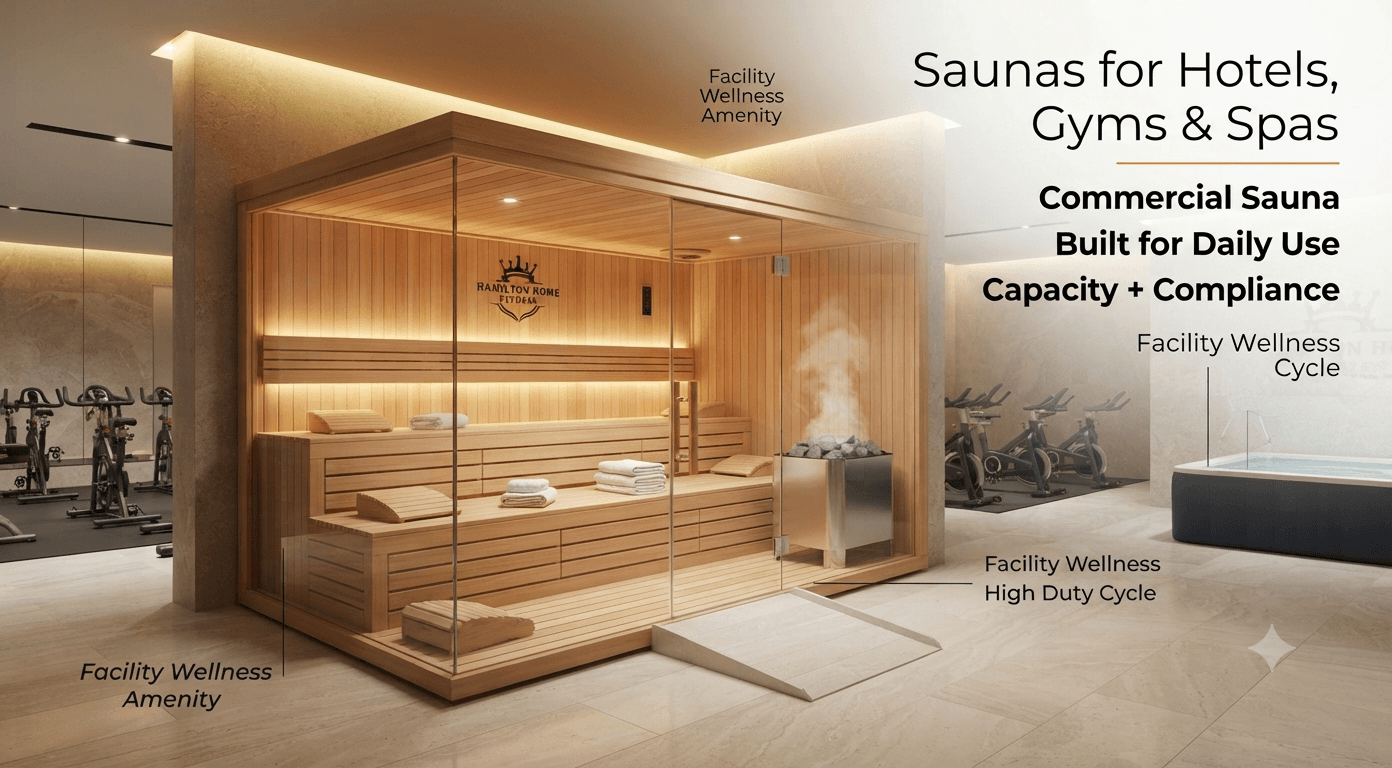
Facility saunas differ from home units in three ways: duty cycle under all-day use, capacity and bench layout for strangers sharing space, and code obligations—accessible entry included. A sauna enters the same procurement lane as the rest of your commercial fitness equipment and facility solutions: judged on workload, throughput, and compliance, not brochure adjectives.
Commercial Duty and Capacity
A hotel or gym sauna runs hot for eight to twelve hours a day, so heater duty rating, bench capacity, and a maintenance schedule matter more than any spec that sells home units.
Duty cycle is the filter that clears the shortlist fastest. A home cabin heats for an evening; a hotel spa sauna holds temperature from the first swim to the last checkout. So put the questions to the spec sheet before the price. What is the heater rated for in continuous operation? How serviceable are the panels or stones? And how fast do replacement parts ship? The decision rule is blunt—if a vendor can't answer duty rating and service interval in one email, you're looking at a home unit wearing commercial paint.
Capacity follows the guest's math. Unrelated users need space strangers can share, which points commercial shortlists toward the collection's five- and six-person traditional builds: two-tier benches give guests a temperature choice, and a straight bench run seats more bodies per foot than a cramped L. Then put the maintenance schedule in writing before opening day—a daily wipe-down, a scheduled deep clean, stone inspection on traditional heaters, and a service log housekeeping actually signs. A gym sauna that smells like a locker room by month three is a maintenance failure, not an equipment one; the same rhythm keeps a multifamily amenity worth its line on the lease.
ADA Entry and Access Planning
Accessible sauna planning starts at the door: a wide, clear entry; a low or ramped threshold; and a bench a guest can transfer onto without assistance.
Clear entry. Plan for the door to meet wheelchair standards—a 32-inch clear opening is the common baseline, measured with the door open, not by the frame.
Threshold. Keep it low or ramp it; accessible ramps run a gentle 1:12 slope, one inch of rise per foot of run.
Transfer bench. Set one bench section near wheelchair seat height—roughly 17 to 19 inches—with clear floor space beside it for the chair.
Grab points. Mount supports that stay grippable in heat; bare metal near a stove burns the hand it's meant to help.
These are planning criteria, not a compliance sign-off—run final dimensions past the facility's code consultant before the purchase order, since sauna ADA compliance details vary by jurisdiction and building type. What the criteria buy you is real: most properties in the SERP-visible market skip accessible heat entirely, so the facility that plans ADA sauna entry from day one owns a differentiator competitors can't retrofit cheaply.
Amenity ROI: What to Model
Model a sauna amenity with four cost inputs—unit, electrical, energy, and maintenance—against the revenue and retention levers your property already tracks; any vendor quoting a universal payback number is guessing.
The cost side takes an afternoon: the unit price, the electrician's quote for the dedicated circuit, energy per session hour from the heater's kW and your utility rate, and the maintenance schedule priced into labor. The value side belongs to numbers you already report. A hotel models the nightly-rate story, review scores, and spa bookings. A multifamily wellness amenity models renewal rates and amenity fees. A gym or corporate wellness program models retention, per-session pricing, and recovery package tiers.
Utilization is the multiplier that decides the whole sheet — a sauna in the daily flow amortizes itself across every metric above, while a locked room depreciates in silence. So build the model from your own tracked numbers, and treat any universal ROI figure as a sales line, not an input. When your sheet says yes, book a gym design consultation to lock footprint, circuit, and ventilation before procurement—the three items that stall commercial installs when they're solved last.
FAQ
Do saunas burn calories?
Yes, modestly. Heat elevates your heart rate, but without muscle work the burn lands closer to a slow walk than a workout—treat calories as a side effect of recovery, never the reason to buy it.
How much does a home sauna cost?
Current listings in this guide's collection run from $2,099 for a two-person far infrared cabin to $18,999 for an outdoor-rated hybrid, with traditional cabins and barrels mostly between $7,000 and $10,000. Prices change — each product page shows the current figure.
How much electricity does a sauna use?
Skip the fake averages and run the formula: heater kW × hours per session (preheat included) × your local rate per kWh. Example: a 6 kW traditional heater running 1.5 total hours at $0.15/kWh costs about $1.35 per session—swap in your own heater rating and utility rate.
How long do home saunas last?
A well-maintained cabin commonly serves for many years; the wood structure typically outlasts the electronics. Heaters and infrared panels are the wear items, so the honest durability check is each model's listed warranty terms for heaters, panels, and cabins—not a universal lifespan claim.
Final Thoughts
You now own the full decision path: pick the heat type your body actually enjoys; size the cabin and heater to the space; settle placement—spare room, backyard pad, or garage bay—and let that placement choose the wood. Set expectations by what the research supports rather than what the marketing promises, price the circuit and floor before the crate ships, and add the cold plunge once the sauna habit is real, not before.
Every model referenced along the way is live in the collection, so comparing specs is one click deep. And if the last open question is wiring, venting, or footprint, contact Hamilton Home Fitness before you order—the Tennessee-based team ships nationwide and will pressure-test your plan so delivery day holds zero surprises.