Introduction
Three rack types, one garage, and a four-figure decision sitting in front of you—picking between a power rack, a half rack, and a squat stand is the most consequential strength purchase you'll make for your home gym.
The stakes are real. You lift heavy, you lift alone, and your square footage isn't unlimited.
This guide compares all three across the four factors that actually decide the call: footprint, safety, attachments, and price—then gives you a clean decision framework built around your ceiling height, floor space, and lifting style.
By the end, you'll know exactly which rack fits your gym and why.
Quick Answer: Which Rack Fits Your Gym?
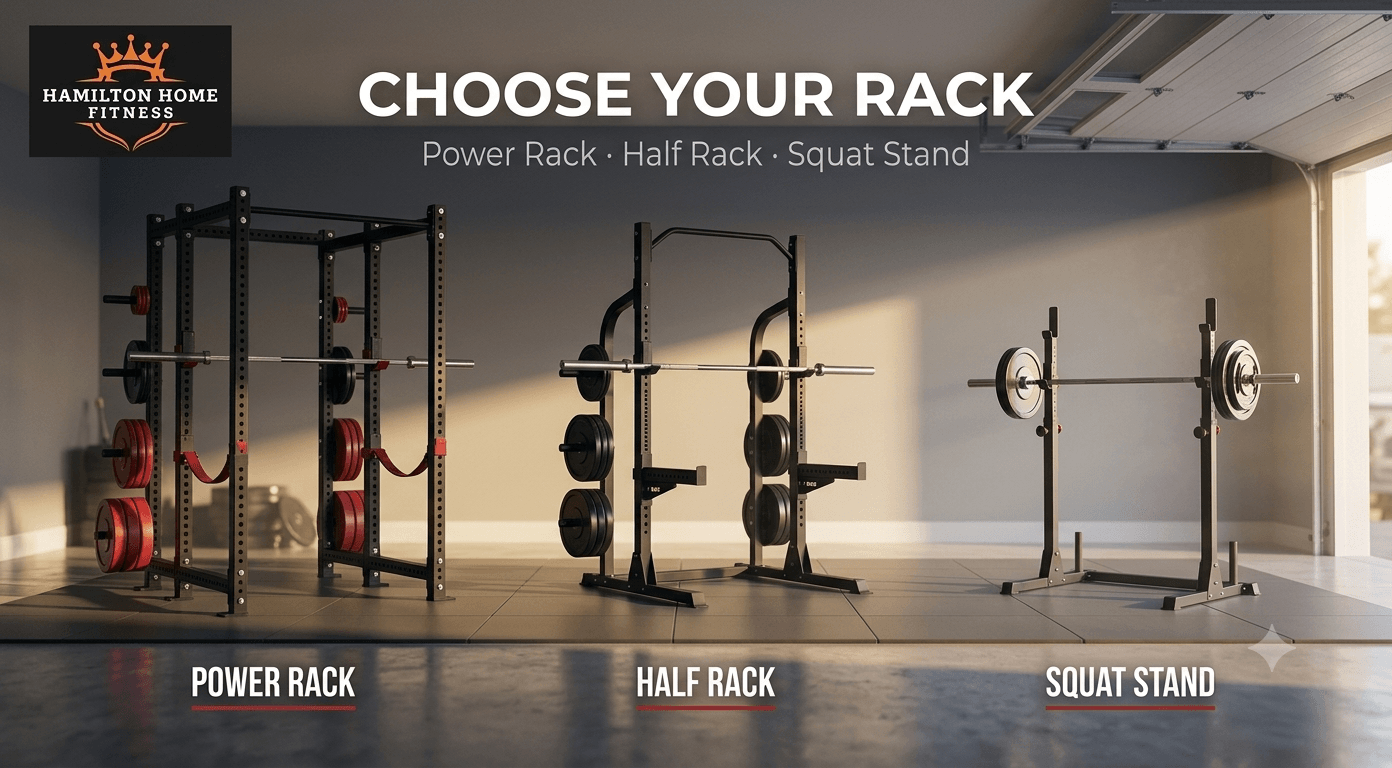
A power rack is the safest choice for solo heavy lifting; a half rack saves floor space without giving up most of that safety; and a squat stand fits the smallest footprint and lowest budget—but only suits lifters who don't need full safeties.
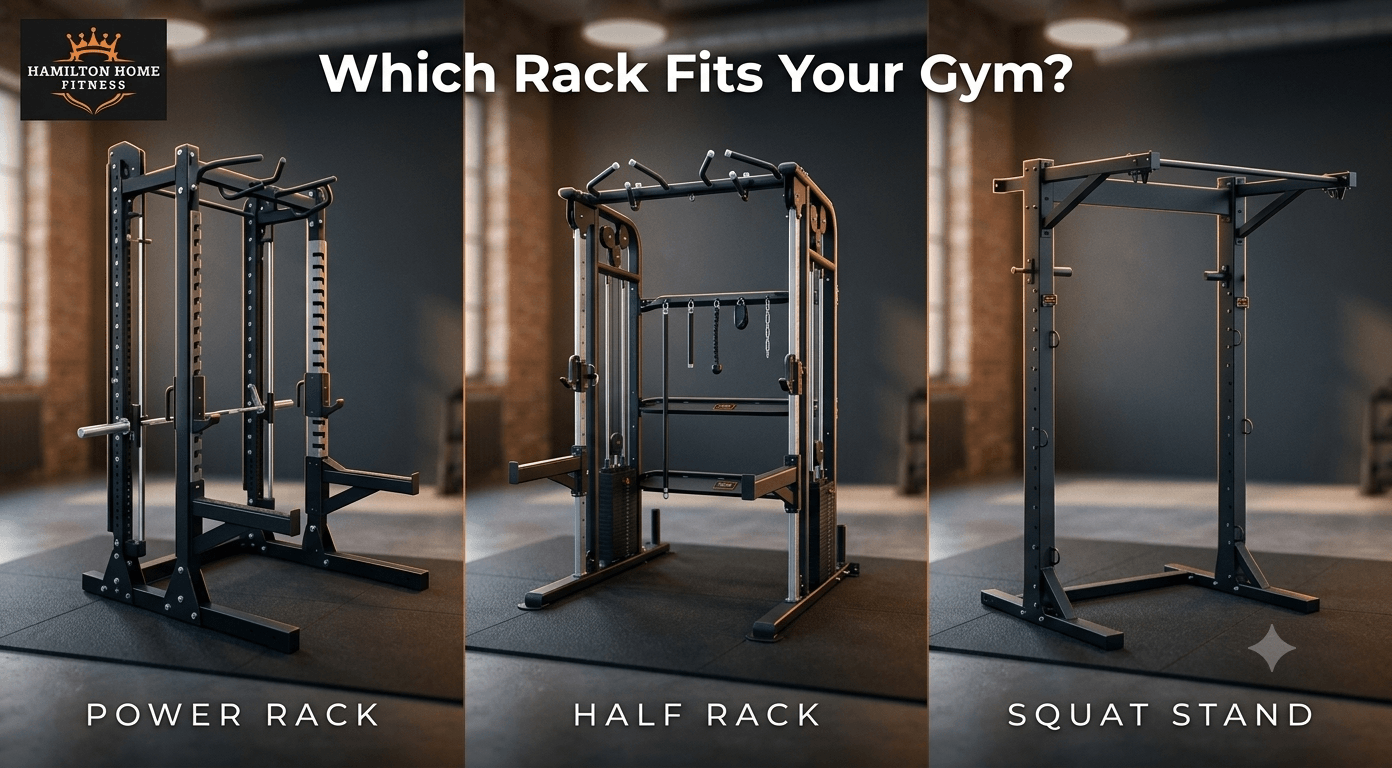
Rack Type | Best For | Trade-Off |
Power Rack | Solo heavy lifters, full attachment expansion, and max safety margin | Largest footprint, highest price |
Half Rack | Limited-depth garages, walk-in access, spotter-arm safety | Less rear support than a cage |
Squat Stand | Tight spaces, low ceilings, lower budgets | Limited safeties, fewer attachments |
If you train heavy and alone, default to a power rack. If your garage is shallow but otherwise workable, a half rack is the strongest middle-ground pick. Choose a squat stand only when ceiling, floor space, or budget rules out the other two options.
What Each Rack Is and How It's Built
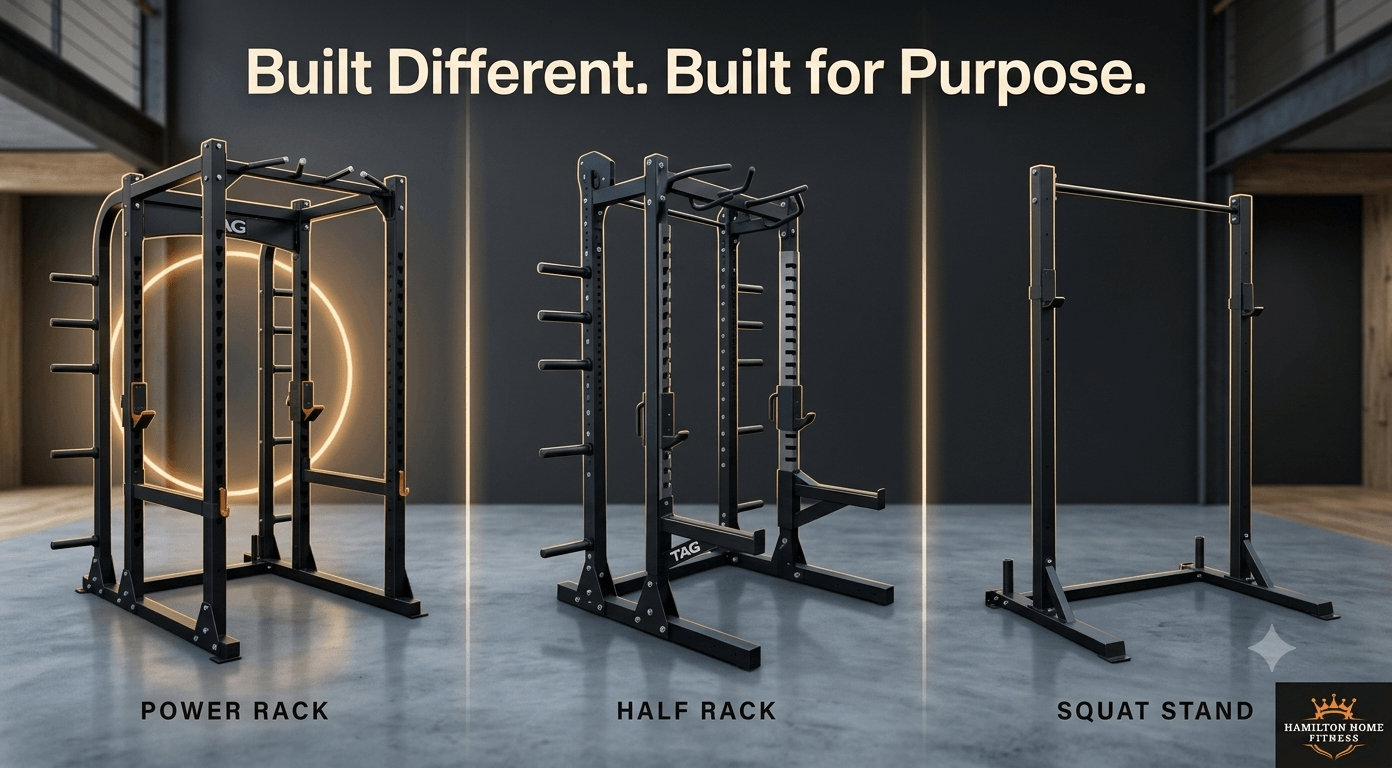
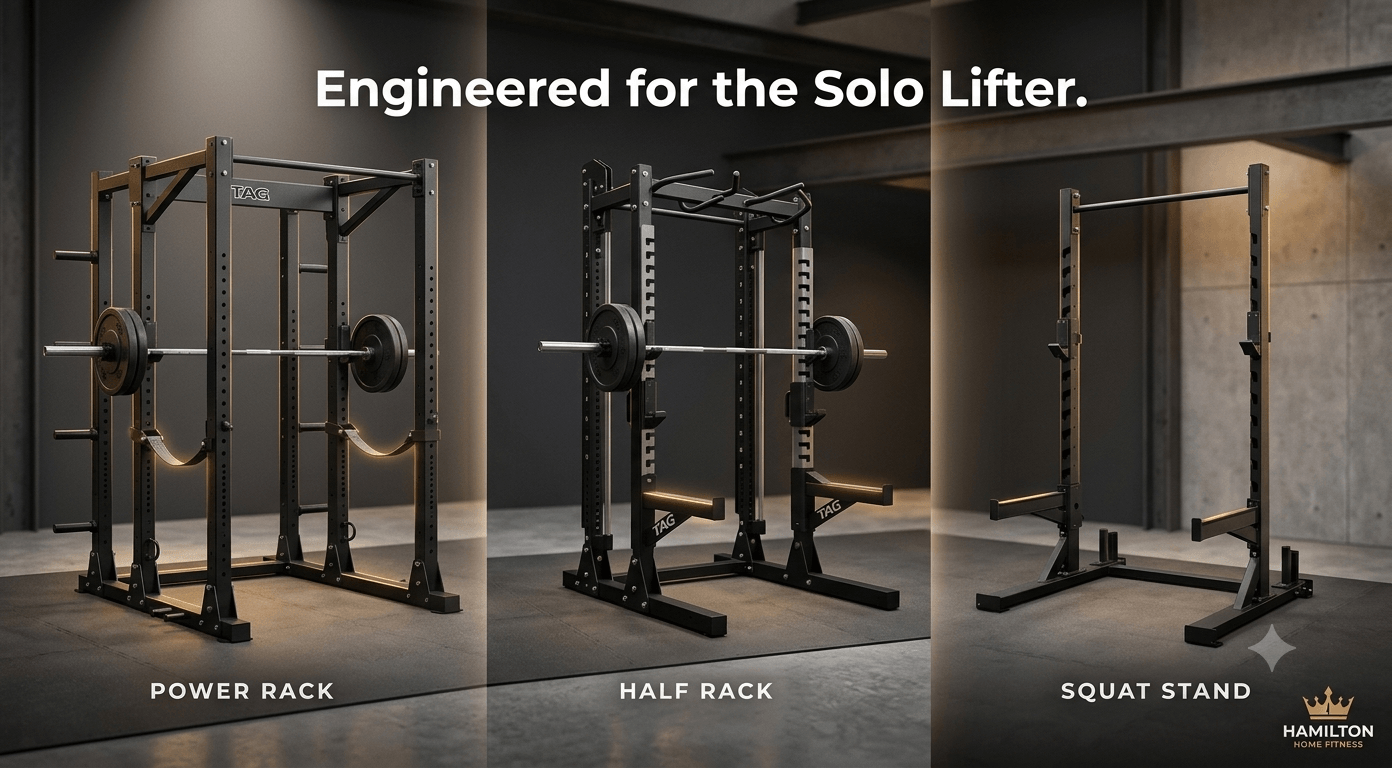
A power rack and a power cage are the same product. A half rack is a shorter four-post variant where lifting happens outside the frame. A squat stand is a two-upright frame with no enclosed safety system.
Power Rack (Power Cage)
A power rack — also called a power cage — is a four-post steel frame the lifter trains inside, with safety arms or straps running between the front and back uprights.
Typical specs: 3x3" uprights, 11-gauge steel, 80–93 inches tall, with adjustable J-cups and full-length safety pins, straps, or pin-pipe combos. The four-post layout is what makes the cage the safety benchmark—a missed lift has nothing to do but land on the safeties.
Half Rack
A half rack uses two front uprights and two shorter rear uprights for stability and plate storage, but the lifter trains in front of the rack rather than inside it.
The rear posts add base width and rigidity without the full depth of a cage, which is why half racks fit shallower garages while still supporting spotter arms, pull-up bars, and most rack attachments. A current example of the form factor is the BodyKore G701 Half Rack.
Squat Stand
A squat stand is two uprights—either independent or joined by a base—used to rack a barbell for squats and presses, with no enclosed safety system.
Some commercial-grade stands accept bolt-on spotter arms, but stability and tipping resistance vary by model. Independent uprights save the most floor space; connected-base designs trade a slightly larger footprint for noticeably better stability.
Is a Power Rack the Same as a Power Cage?
"Yes—'power rack" and "power cage" refer to the same four-post enclosed frame, and the terms are used interchangeably across brands.
Watch for one source of confusion: "half cage" is sometimes used informally for a half rack, which is not a power cage. If a listing says "half cage," check whether the lifter trains inside the frame (cage) or in front of it (half rack) before buying.
Head-to-Head Comparison
Power racks lead with safety and attachments. Half racks win the footprint-to-capability ratio. Squat stands lead in price and portability.
Criterion | Power Rack | Half Rack | Squat Stand |
Footprint | ~4x4 to 5x5 ft. | ~4x4 ft, shallower depth | ~3x3 to 4x4 ft. |
Safety | Full-length pins, straps, or pin-pipe | Spotter arms, rated 600–1,000+ lbs | Minimal or none; some accept spotter arms. |
Attachments | Largest ecosystem (cables, landmines, dip bars, and lat towers). | Most of the same, but with fewer rear-mount options. * | Limited to basic add-ons |
Weight Capacity | 1,000–2,000+ lbs rated | 1,000–1,500 lbs rated | 500–1,000 lbs rated |
Typical Price | $900–$5,000+ | $700–$3,500 | $250–$900 |
*See rack accessories and attachments for compatible add-ons across rack types.
Two practical notes. First, footprint numbers exclude bar overhang and walk-in clearance—add 7 feet of bar width and 2–3 feet of walk-in space when planning your floor. Second, attachment compatibility depends on upright size (2x3" vs. 3x3") and hole pattern, not just rack type—confirm both before buying an accessory.
Safety for Solo Lifters
For solo heavy lifting, a power rack with safety pins or straps offers the highest margin for error. A half rack with properly rated spotter arms is generally safe within its rated limits. A squat stand without long, secure spotter arms should not be used to bail heavy back squats or bench presses.
Safety note: A failed barbell lift can cause serious injury or death. The rack's safety system is not optional equipment — it is the equipment. Build your purchase decision around it.
Power Rack Safety Features
Inside a power rack, safety pins, pin-pipe combos, or nylon straps span the full depth of the cage and catch a failed bar from any angle.
A missed bench press settles on the safeties without the lifter rolling the bar off their chest. A failed squat sets the bar down behind the heels, in front of the toes, or anywhere in between—all of it is caught. Pair the rack with a matching weight bench that fits inside the cage, set the safeties roughly one inch below the bottom of your press, and the solo bench-press risk drops sharply.
Half Rack Safety with Spotter Arms
Half rack spotter arms catch a failed bar at the front of the rack and are typically rated for 600–1,000+ lbs, but because the bar is caught at one end of the arm only, a misgrooved squat can still slip forward off the arms.
Set spotter arms 1–2 inches below the lowest point of your lift. Confirm the manufacturer's load rating before loading near your max. Long arms (15+ inches) and a rear plate-storage base both reduce tipping risk and improve real-world safety.
Squat Stand Risks for Solo Lifters
Most squat stands have either no safety system or short bolt-on spotter arms, and many stands without a connected base can tip if a loaded bar lands off-center on a spotter arm.
Some commercial-grade stands accept long, rated spotter arms and offer real protection — but most consumer squat stands do not. Verify the spotter-arm load rating, the upright dimension (3x3" is sturdier than 2x2"), and base stability before trusting a stand under a heavy solo bench or back squat. When in doubt, train at submaximal loads only.
Footprint and Ceiling Clearance
A typical power rack needs about 48–60 inches of depth and 48–53 inches of width. A half rack needs roughly half the depth. A squat stand can fit in 30–48 square inches. Pull-ups require at least 12 inches of ceiling clearance above the bar.
Three measurements decide whether a rack will physically fit your space. Floor depth controls whether you can walk the bar out and clear the rear uprights on a squat. Floor width controls whether the bar plus collars fit between obstacles on either side—plan for 7 feet of bar overhang on standard Olympic barbells. Ceiling height controls everything overhead.
Measure floor-to-ceiling, subtract the rack height, and subtract another 12 inches for safe pull-up clearance above the bar. If the remainder is negative, the rack is too tall for the space.
Squat Stand and Short Rack Options for Low Ceilings
If your ceiling is under 84 inches, an 80-inch short power rack or a squat stand with a built-in pull-up bar is usually the only viable option for full overhead-press and pull-up range of motion.
Standard residential garages run 84–96 inches from floor to ceiling. Anything below that range rules out 90-inch and 93-inch racks immediately. For finished basements with exposed joists or ductwork, wall-mount rig setups and short squat stands often fit where freestanding power racks cannot.
Decision rule: measure the lowest point of your ceiling—joists, lights, or garage door tracks—not the average height. The rack has to clear the lowest obstacle, not the highest.
Steel Gauge, Uprights, and Capacity
For most serious home lifters, a rack with 11-gauge or 12-gauge steel, 2x3 or 3x3 inch uprights, and a manufacturer-rated capacity of at least 1,000 lbs is the right minimum baseline.
Three specs decide how stiff and how strong a rack actually are.
Steel gauge measures wall thickness, and the rating is inverted—lower numbers mean thicker steel. 11-gauge (about 1/8 inch thick) is the home gym sweet spot for serious lifting. A 12-gauge is acceptable for moderate loads. 14-gauge is budget-tier and noticeably flexes under heavy compound work. 7-gauge appears on full-commercial racks and is overkill for most garages.
Upright size is the cross section of the vertical posts. 3"x3" uprights are the most rigid and accept the widest attachment ecosystem. A 2"x3" is a reasonable middle ground. A 2x2 is the lightest-duty option, fine for light lifters but more prone to flex. Hole spacing also matters — 1-inch (Westside) spacing through the bench-press zone lets you set safeties exactly under the bar, while 2-inch spacing elsewhere keeps J-cup placement quick.
Weight capacity is the manufacturer's static rating. Take your heaviest planned lift, add 50%, and then add another 25% for dynamic loading from the bar drop onto safeties. For most home lifts, that lands at 800–1,200 lbs of required capacity. Powerlifters and commercial setups should look for 1,500 lbs or more.
Capacity ratings vary in how honestly they're tested—brands authorized through reputable dealers like Body-Solid strength gear publish specs that hold up in real use, while no-name budget racks often inflate the number.
How to Choose for Your Garage Gym
Pick the rack that matches your three biggest constraints: ceiling height, floor square footage, and whether you lift heavy things alone. Add attachment plans last, not first.
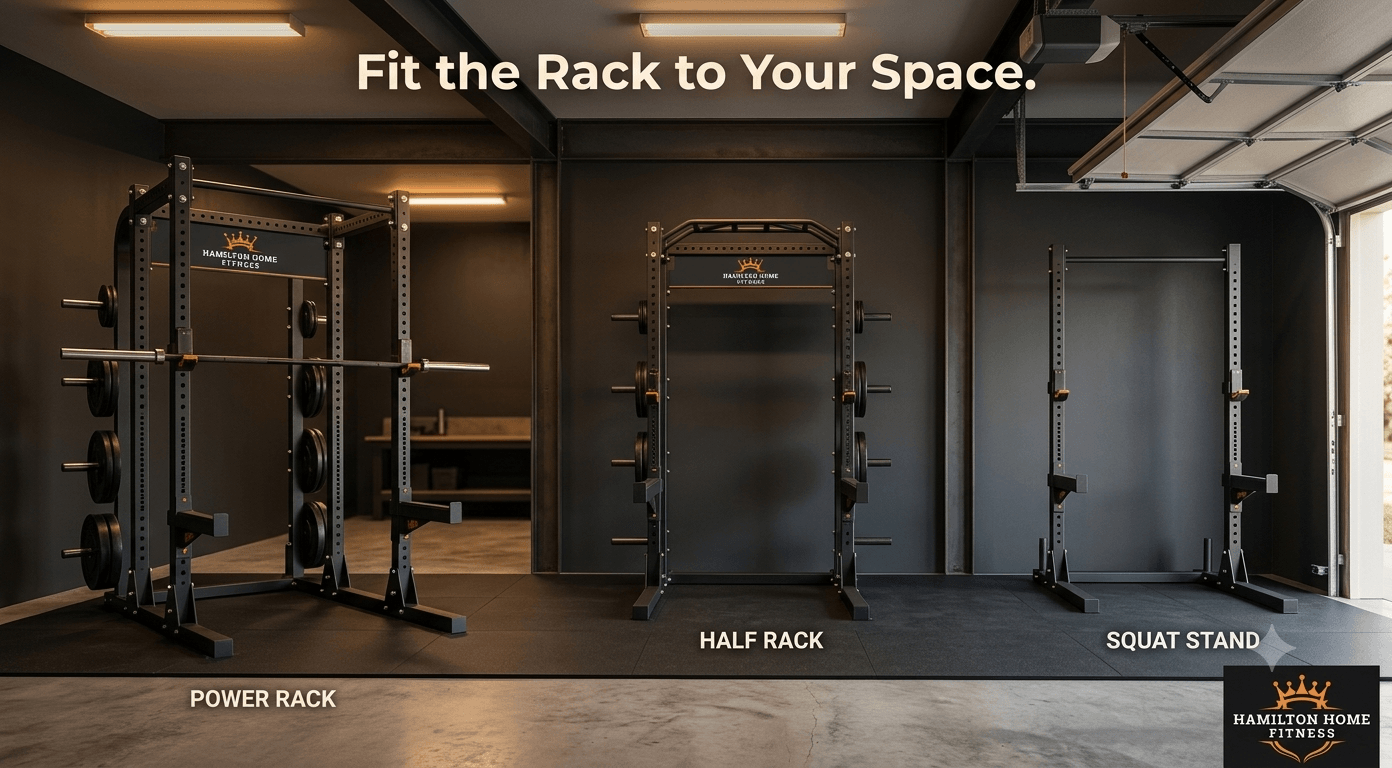
Most rack buyers reverse this order—they fall in love with cable systems and lat towers before checking whether a 90-inch rack will even fit under their garage door tracks. Lock the physical and safety constraints first, then expand into the attachment ecosystem your rack supports.
If your measurements land in an awkward middle zone—a shallow garage with a high ceiling or a tall basement with a structural post in the wrong place—book a free gym design consultation, and the Hamilton Home Fitness team will match a rack to your exact ceiling height and floor plan.
When a Power Rack Is the Right Call
Choose a power rack when you have at least 8x8 feet of floor space, an 84-inch or taller ceiling, can lift heavy alone, and want a long expansion path for attachments.
Scenario: a 9-foot ceiling, a dedicated garage bay, a solo lifter pushing past 1.5x bodyweight back squats. A full cage with pin-pipe safeties earns its footprint here—the safety margin under max-effort lifts is the entire reason to buy this category.
When a Half Rack Hits the Sweet Spot
Choose a half rack when floor depth is limited, you want full safety arms and plate storage, and you prefer walk-in access for setup and re-racking.
Scenario: a 7.5x10 foot garage bay where a car still parks at night or a basement corner with one short wall. A half rack delivers roughly 90% of a power rack's capability in roughly half the depth — and walk-in access makes daily training noticeably faster.
When a squat stand is the honest pick
Choose a squat stand when ceiling height, floor space, or budget rules out everything bigger and your training is limited to squats, presses, and basic accessory work—not solo max-effort benching.
Olympic lifters dumping the bar forward, lifters training submaximal loads, or buyers staging a starter setup for later upgrades are all valid use cases. Browse the squat rack subcategory to see current options sized for tight spaces and low ceilings.
Brand Tiers and What to Expect
Residential racks generally run $400–$900. Light commercial racks run $900–$2,000. Full commercial racks run $2,000–$5,000+. Build quality, steel gauge, and warranty scale roughly with price.
Residential tier ($400–$900). Expect 12-gauge or 14-gauge steel, 2"x2" or 2"x3" uprights, and rated capacities around 500–1,000 lbs. Best for general fitness lifters, beginners, and submaximal training. Brands like Sunny Health and Fitness, Apollo, and York Barbell fit this range and serve buyers who don't need full-commercial overbuild.
Light commercial tier ($900–$2,000). Expect 11-gauge steel, 2"x3" or 3"x3" uprights, capacities of 1,000–1,500 lbs., and a wider attachment ecosystem. This is the sweet spot for serious home lifters and small studios. Tag Fitness rack lineup, Body-Solid Pro ClubLine (SPR500, SPR1000), and BodyKore half racks live here. For buyers building out a complete setup, rack and package bundles combine the rack with matched benches and weights at a packaged price.
Full commercial tier ($2,000–$5,000+). Expect 11-gauge or 7-gauge steel, 3x3" uprights, 1,500–2,000+ lb capacities, deep attachment trees, and structural warranties built for daily use by multiple lifters. Hoist, Legend Fitness, Watson Gym Equipment, Hudson Steel, and Umax Strength sit in this range and are the standard for commercial fitness equipment in gyms, clubs, and corporate wellness facilities.
The honest middle-ground recommendation for most serious home lifters: light commercial. The jump from residential to light commercial is the largest real-world quality gain. The jump from light commercial to full commercial is mostly about daily multi-user durability—useful for a gym, often overkill for a garage.
FAQ
What is the real footprint difference between a power rack, half rack, and squat stand?
A power rack typically needs 4x4 to 5x5 feet of floor space. A half rack needs roughly 4x4 feet with shallower depth. A squat stand fits in 3x3 to 4x4 feet. Add 7 feet for bar overhang and 12+ inches of ceiling clearance above the pull-up bar in all three cases.
Can a half rack safely catch a failed back squat without spotter arms?
No. A half rack relies entirely on attached spotter arms or a pin-pipe safety system to catch a failed lift. Without them, the bar has nothing to land on. Never bail a heavy squat on a half rack that has no safeties installed.
Which rack type supports the most attachments such as dip bars, landmines, and cable systems?
Power racks support the largest attachment ecosystem because four uprights and consistent hole spacing give the most mounting points. Half racks support most of the same accessories with fewer rear-mount options. Squat stands support the fewest, usually limited to J-cups, basic spotter arms, and a pull-up bar.
What weight capacity should I look for in a home gym power rack?
Most serious home lifters are well served by a manufacturer-rated capacity of at least 1,000 lbs. Take your heaviest planned lift, add 50%, then add another 25% for dynamic loading. Powerlifters and commercial setups should look for 1,500 lbs or more.
Do I need to bolt down a power rack or half rack?
Most home setups do not require bolting if the rack is heavy, used within rated limits, and not subjected to kipping or aggressive bar drops. Commercial facilities often bolt for liability and policy reasons. Check your specific rack's manufacturer guidance before skipping anchors.
What ceiling height do I need for pull-ups on each rack type?
Plan for at least 12 inches of clearance above the highest pull-up bar position. An 80-inch rack typically fits under a 7-foot ceiling. A 90-inch power rack usually needs 8 feet or more. Measure the lowest point of your ceiling — not the average — including joists, lights, and garage door tracks.
Can you do pull-ups on a half rack?
Yes. Most half-racks include an integrated pull-up bar across the top crossmember, often available in multi-grip, fat-grip, or neutral-grip variants. Confirm the bar height fits your ceiling clearance before buying.
Are squat stands safe for solo lifters?
Squat stands are safe for technique work and moderate loads but are not the right choice for solo maximum-effort bench press or back squats unless the stand accepts long, rated spotter arms. Verify the spotter-arm load rating and base stability before trusting a stand under heavy solo lifts.
Final Thought
Lock the constraints first: ceiling height, floor space, and whether you lift heavy things alone. Attachments come last. Get those three right, and the rack type chooses itself.
When you're ready to match a specific model to your gym, browse the full Power Racks & Cages collection at Hamilton Home Fitness or reach out to the team for a personalized recommendation based on your exact measurements.
Hamilton Home Fitness is a Tennessee-based authorized dealer for Tag Fitness, Body-Solid, BodyKore, Hoist, York Barbell, Legend Fitness, Watson Gym Equipment, and other renowned strength brands, with nationwide shipping across the USA. This guide is written to help buyers choose the right rack category before selecting a specific product.