Introduction
If you've looked into whole-body vibration, you've seen the big promises: stronger muscles, denser bones, faster fat loss, smoother skin—all from standing on a buzzing platform. Some of that holds up. A lot of it is oversold.
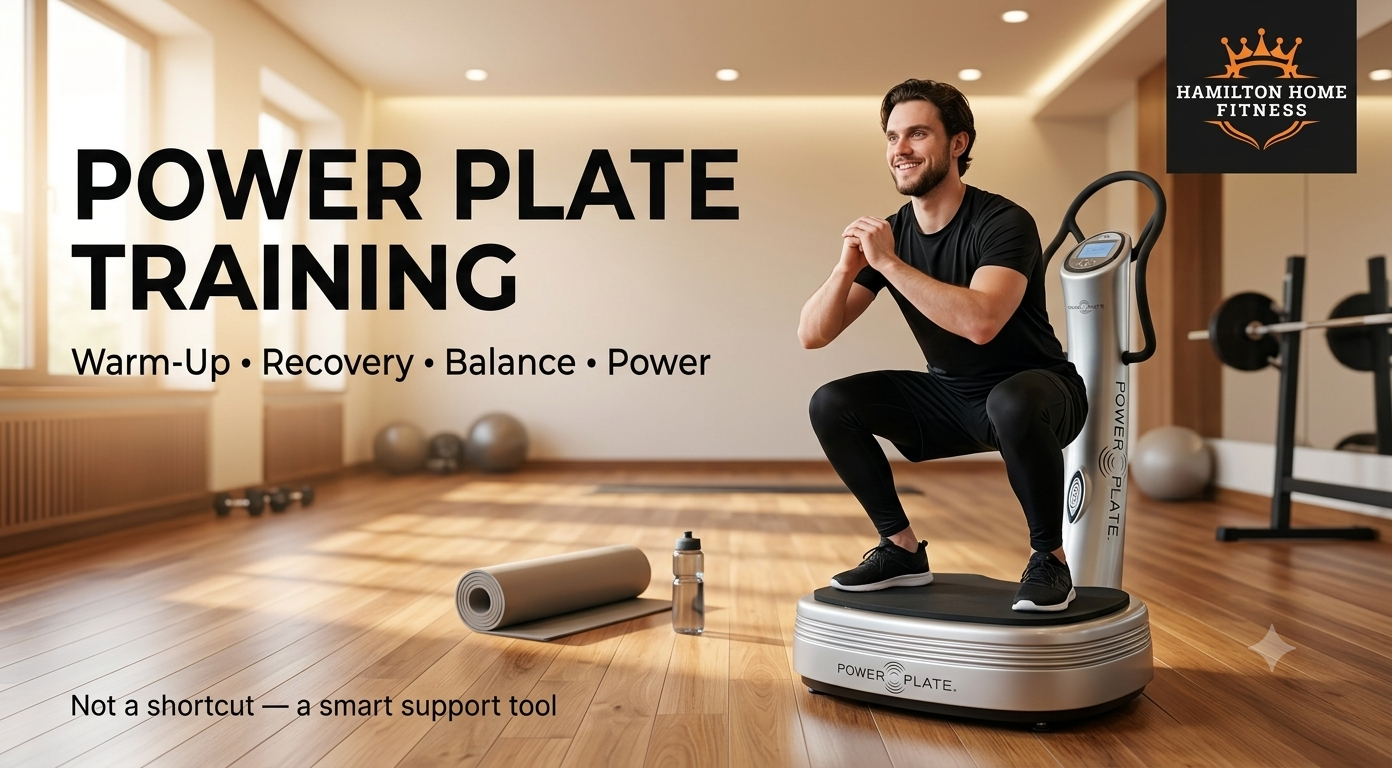
Here's the straight version. Vibration training helps with a handful of specific things—warming up, recovery, muscle activation and power, balance for older adults, and modest bone support for certain groups. It does little for fat loss, and even less for cellulite, whatever the ads claim.
This whole body vibration training guide maps where a Power Plate earns its place and where it doesn't. You'll get how it works, how often and how long to use it, who should skip it, and which settings match which goal.
And if you're weighing an actual unit, the residential and commercial models compared at the end show which one fits your space, your goals, and your budget.
How whole-body vibration works
Whole body vibration training means standing, holding a position, or doing simple moves on a platform that vibrates many times per second. The vibration makes your muscles contract and relax rapidly through a reflex response, which is why a few minutes can feel like real work.
That reflex is the whole point. When the platform moves underneath you, your body senses tiny shifts in balance and fires the muscles to correct them—fast and without you thinking about it. The faster the platform moves, the more often those corrections happen.
Not all platforms move the same way. Better units use tri-planar movement, meaning the surface shifts in three directions — up and down, side to side, and front to back — instead of just bouncing vertically. Power Plate's Precision The wave system is built around this, tuning the motion so the vibration feels smooth rather than jarring.
The idea isn't new. Vibration as a training tool grew out of space-program research decades ago, when scientists looked for ways to fight the muscle and bone loss that comes with long stretches in low gravity. It moved from there into clinics, gyms, and now homes.
Frequency, amplitude, and G-force
Three numbers describe any vibration plate: frequency, amplitude, and the resulting G-force.
Frequency is how many times the platform vibrates per second, measured in hertz (Hz). Most training happens somewhere in the range of about 25 to 50 Hz. Higher frequency means faster, more frequent muscle corrections.
Amplitude is how far the platform actually moves on each cycle — a small shift versus a larger one. Low amplitude is gentler; high amplitude raises the intensity.
G-force is what those two produce together: the load your body feels from the motion. Turn up frequency or amplitude and the G-force climbs, which is why the same plate can feel light during a warm-up and demanding during a strength set.
The takeaway for reading a spec sheet: frequency and amplitude are the two dials, and G-force is the result. You don't need to memorize numbers—you just need to know that more of either means more intensity and that starting low is the safe move.
What WBV does for strength and power
Vibration training can build strength, and it shows its sharpest edge with explosive power. The rapid platform movement pulls in fast-twitch muscle fibers — the ones built for quick, forceful effort — that ordinary lifting doesn't always reach as directly. Treat it as a strong supplement for activation and power, not a swap for heavy progressive lifting.
Here's where it earns its place for a lifter. Spend two minutes on the platform before a heavy squat or deadlift, and you prime your nervous system. Your muscles wake up and recruit more fibers, so the first working set feels crisp instead of sluggish. It's a warm-up that does more than raise your body temperature.
The research broadly supports this. Across studies, vibration training has produced strength gains in the same range as standard resistance work, and for explosive power it has sometimes edged ahead. That points to its real value: reaching the fast, powerful fibers that are hard to fully switch on with slow, controlled lifting alone.
The limit matters just as much. If you're chasing muscle size or a bigger one-rep max, vibration won't stand in for progressive overload—the steady climb in weight that drives real growth. A vibrating platform doesn't load a muscle the way a loaded barbell does. Use it to prime your lifts and sharpen your power, and keep heavy, progressive training as the engine.
Vibration for warm-up and recovery
Vibration is most useful at the edges of a workout. A few minutes before training raises muscle activation and mobility, so you walk into your first set already primed. After training, gentle low-frequency vibration can ease soreness and keep blood moving — and you can foam roll or stretch right on the platform for a deeper effect.
Treat the warm-up as a fast on-ramp. Step on at a low setting and run through easy movements—bodyweight squats, hip circles, and calf raises—for three to five minutes. The vibration switches your muscles on and loosens stiff joints, which matters most on early mornings or cold days when your body is slow to cooperate.
Recovery uses a different dial. Where a warm-up leans toward higher frequency to fire you up, recovery wants the opposite: lower frequency, gentler motion, and relaxed positions instead of working ones. Stand or rest on the platform after a hard session, or place a foam roller on it and let the vibration drive deeper into tight calves, quads, and hamstrings.
Be honest about what's happening underneath. The short-term lift you feel comes mostly from increased blood flow — vibration nudges circulation, which can take the edge off soreness and leave the area feeling looser. That's a real, useful effect. It is not a detox, and it won't flush anything from your system, whatever the marketing says.
If recovery is a real priority, vibration pairs well with heat. Many serious recovery setups add a sauna, and the Golden Designs infrared saunas carried at Hamilton Home Fitness give you a heat-based option to round out a post-training routine alongside a vibration platform.
Does WBV improve bone density?
The evidence here is mixed and depends heavily on who's using it. Some studies suggest whole body vibration may help maintain or modestly support bone mineral density, with the clearest signals in postmenopausal women and people who already have low bone mass. View it as possible support alongside medical care—not a treatment for osteoporosis.
Start with the plain-language terms. Bone mineral density measures how strong and dense your bones are. Osteopenia means that density has slipped below normal but not severely. Osteoporosis is the more advanced stage, where bones turn fragile and break more easily. Both grow more common with age, and the risk rises sharply for women after menopause.
The reasoning behind vibration is simple. Loading a bone signals it to hold or build density, and the rapid muscle contractions on a platform place a gentle, repeated load on the skeleton. For postmenopausal women and master athletes watching for age-related bone loss, that makes it an appealing low-impact option to explore.
But the findings don't line up neatly. Some trials show small gains or slowed loss; others show little change at all. Results shift with the group studied, the settings used, and how long people trained. The honest read: vibration may offer modest help for some people, and the effect is far from guaranteed.
So set expectations carefully. Vibration training is not a cure for osteoporosis, and it won't replace the medication, nutrition, or weight-bearing exercise a doctor may recommend. If you have a bone-density diagnosis or you're at risk, talk with your physician before you start—they can tell you whether it's safe for you and how it fits the rest of your plan.
WBV for seniors and fall prevention
For many older adults, vibration training is a low-impact way to work on balance, leg strength, and proprioception—the three things that most affect fall risk. It's generally well tolerated when it's supervised and started gently. But it isn't right for everyone, so a clinician's input matters before the first session.
The fall-risk piece is what makes this worth attention. Most falls trace back to some mix of weak legs, poor balance, and a dulled sense of body position. Vibration can work all three at once without the joint stress of heavier exercise, which suits people who find traditional strength work hard on their knees or hips.
That sense of body position has a name: proprioception. It's how your body knows where your feet and limbs are without you looking. It fades with age, and when it slips, a small stumble becomes a fall. Training on a slightly unstable, moving surface gives that sense steady, low-grade practice.
Keep the approach simple and safe. A supported standing position — feet on the platform, hands resting on a rail or a sturdy chair — is often enough to start. Begin at a low setting, keep sessions short, and build only as steadiness improves. The goal is controlled, confident practice, never a test of how much the body can take.
This is also where supervision earns its keep. A physical therapist or trainer can set the right starting point and watch form, especially for someone managing a health condition or recovering from one. If that describes you or a parent, a quick check with a professional comes first. For readers building out a recovery-minded setup, the rehab and recovery equipment at Hamilton Home Fitness covers tools suited to senior, post-op, and clinical goals.
How often, how long, what frequency
Most people do better with short, frequent sessions than long ones. A common starting point is a few minutes per session, two to three times a week for strength or recovery goals, with gentler sessions used a bit more often for mobility or circulation. Begin at low settings and build up only as your body adapts.
The right dose depends on your goal, and the three uses pull in different directions. A warm-up is brief and light—just enough to switch the muscles on. Strength work is short but more intense, and it needs recovery days between sessions. Recovery and mobility work stays gentle, and you can do it more often without much risk.
Here's a conservative starting framework to work from:
Goal | Frequency setting | Session length | How often |
Warm-up / activation | Moderate (about 25–35 Hz) | 3–5 minutes | Before training, as needed |
Strength & power | Higher (about 30–40 Hz) | 10–15 minutes | 2–3x per week, with rest days |
Recovery | Lower (about 10–20 Hz) | 5–10 minutes | After hard sessions or as needed |
Balance & mobility | Low (about 5–15 Hz) | 5–10 minutes | Most days, kept gentle |
A few honest caveats on those numbers. Machines vary, and many home units use preset programs or numbered levels instead of raw hertz, so treat these as general ranges, not exact rules. Whatever your goal, start at the lowest comfortable setting and short durations, then add time or intensity slowly.
One rule holds across every goal: more is not better. Longer or harder sessions don't speed up results, and strength work in particular needs rest days for the muscles to adapt. If you feel beaten up rather than primed, you've overdone it—scale back.
Who should not use a vibration plate
Vibration training isn't for everyone. Some people should avoid it outright, and others should get a doctor's clearance before standing on a plate. When in doubt, ask a qualified professional first — a few minutes of caution is worth it.
The list below covers the situations where vibration training calls for medical clearance or avoidance:
Pregnancy—avoid whole-body vibration unless a doctor specifically approves it.
Recent surgery — wait until you're cleared, especially after bone, joint, or abdominal procedures.
Blood clots or a history of them, including deep vein thrombosis—vibration is not advised.
A pacemaker or implanted cardiac device — check with your cardiologist before use.
For certain eye conditions, such as a recent retinal issue, get an ophthalmologist's guidance.
Acute joint, disc, or back problems — hold off until the flare settles and you're cleared.
Gallstones or kidney stones — confirm with your doctor before starting.
Severe osteoporosis or recent fractures — only under medical and professional supervision.
This isn't a complete list, and your situation may not fit neatly into one line of it. If you live with any ongoing medical condition, are managing a recent injury, or simply aren't sure, talk with your physician before you begin. They can tell you whether vibration training is safe for you and how to start without risk.
Residential vs commercial Power Plate
The difference comes down to build, capacity, and how much use the unit is made of. Lighter home models suit one person training daily in a smaller space. Heavier commercial-grade platforms are built for constant use in studios, clinics, and shared gyms. Choose by how many people will use it, how often, and whether you need facility-level durability and support.
Think of it as matching the machine to the load it will carry — not the load you'll lift, but the demand placed on the unit itself. A platform used by one person a few times a week lives an easy life. The same platform in a busy studio handles dozens of sessions a day, and that changes what it needs to be.
Price tracks that gap. Residential Power Plate models generally run from around $2,300 to $3,700, while commercial-grade units climb well past $10,000. The jump pays for heavier construction, higher load capacity, and the durability and support a facility depends on. For a single user, that extra spend usually buys more machine than the goal requires.
Best home and entry options
For home and individual use, lighter Power Plate models cover most needs. They're compact enough for a spare room or garage gym and built for one person training regularly rather than a crowd cycling through all day.
The Power Plate Personal sits at the entry point, around $2,295. It's a sensible pick for a home user who wants vibration for warm-ups, recovery, and balance without paying for a studio-grade build. For most individuals starting out, it's enough machine to meet the goal.
Step up to the Power Plate MOVE at roughly $3,720, and you get a more capable home platform—a strong fit for a serious lifter or master athlete who'll use it often and wants a bit more behind the motion. It comes in black, titanium, and red, so it can match a home setup. If you find yourself planning multi-user or all-day use, that's the signal to size up to a commercial model instead.
Commercial and studio options
For shared and high-volume use, commercial-grade Power Plate models are built to keep up. They carry heavier construction and higher load capacity, and they're meant to run session after session without wearing down—the baseline a studio, clinic, or gym actually needs.
The Pro5, around $12,995, is the workhorse here: a commercial-grade platform suited to studios, rehab clinics, multifamily gyms, and hotel fitness rooms where many people train on the same unit. The my8 sits in a similar premium tier for facilities wanting that level of build. For a single home user, this is more than the goal calls for; for a busy facility, it's the durability that makes the purchase pay off.
Buying for a facility also brings support that matters. Hamilton Home Fitness ships nationwide from Tennessee and offers white-glove delivery and installation, demos, financing, and commercial and fleet pricing for multi-site setups. If you're outfitting a space rather than a single room, book a gym design consult to plan the layout and the right mix of equipment from the start.
FAQ
Do Power Plates actually work?
Yes — for specific things. Vibration training genuinely helps with warm-up, muscle activation, explosive power, recovery, balance, and modest bone support for some groups. It's oversold for fat loss and cellulite. Used for the right goal, it works; treated as a do-everything machine, it disappoints.
Are Power Plates good for weight loss?
Mostly no. Standing on a vibrating platform burns few calories on its own, and any small effect only shows up alongside a proper diet and regular exercise. It can support an active routine, but it is not a fat-loss device—don't buy one expecting the pounds to drop.
Is there real research behind whole-body vibration?
Yes, decades of it, though quality and results vary by use case. The strongest practical support is for strength and power, recovery, and balance. Bone-density effects are mixed and depend on the group studied. So the research is real, but it backs some uses far more firmly than others.
Do vibration plates help circulation and lymphatic flow?
Vibration can briefly raise blood flow, which may support circulation in the short term and leave worked areas feeling looser. Claims about lymphatic "drainage" or detox are weak and overstated. Take the short-term circulation boost as real, and treat the bigger detox promises with caution.
Final Thought
You came in wanting the honest version, and now you have it. You can tell where vibration training actually earns its place—warming up, recovery, muscle activation and power, balance for older adults, and modest bone support for certain people—and where it doesn't, like fat loss and cellulite. You know how to start, how often to train, who should hold off, and which tier fits your needs.
Here's the one line to keep: a Power Plate is a strong supporting tool, not a shortcut and not a fat-loss fix. Use it for the goals it genuinely serves; pair it with real training and recovery, and it will pull its weight.
If you're ready to choose, compare the full lineup side by side and match a model to your space, your goals, and your budget. See the full Power Plate collection at Hamilton Home Fitness—residential models for home and individual use and commercial-grade platforms for studios and clinics, all shipped nationwide from Tennessee.