Introduction
OxeFit's smart strength machines are marketed as "AI-driven training." Mechanically, that means four things: motorized cables, eccentric overload, isokinetic mode, and real-time force-profile data — none of which exist on a plate-loaded or pin-stack functional trainer. Before you spend $8,600 or more on an XS1 Peak or XP1, it's worth knowing exactly what those four things change about how you lift. This guide breaks each one down, then puts XS1 Peak and XP1 against a Hoist H-8 and a Tonal so you can decide with real numbers instead of marketing language.
What OxeFit Does That Trainers Can't
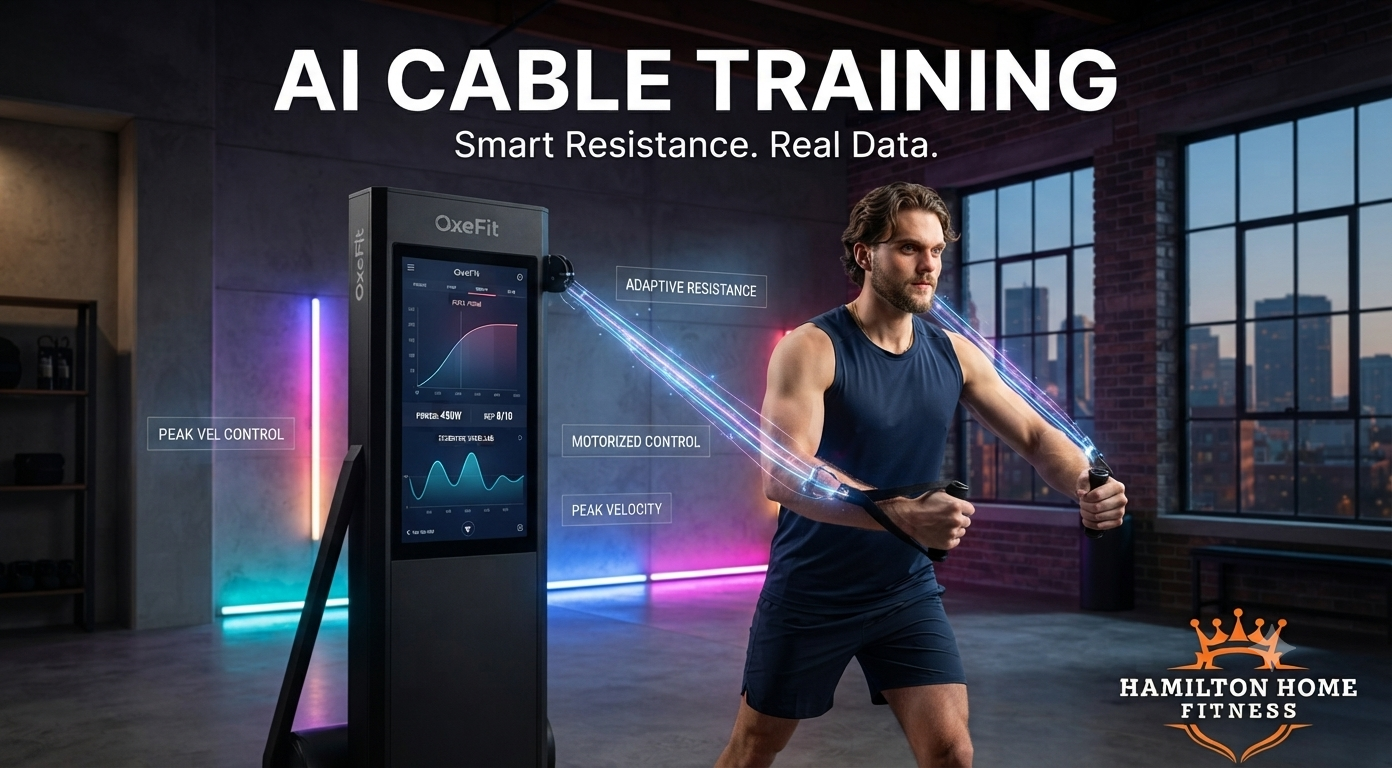
A traditional functional trainer holds one resistance level until you change the pin or swap a plate. OxeFit's cables are driven by motors, not gravity, so the machine can shift resistance mid-rep — heavier on the way down, lighter on the way up, or matched to how fast you're moving. That's the real difference, not the screen.
This is what people mean by a digital weight stack: instead of steel plates you rack and unrack, a motor generates electronic resistance, and you set the amount on a screen instead of a pin. The cable isn't under tension the whole time, either. You load it right before a set and unload it right after, the same way you'd rack a barbell — a button does the work instead of your hands.
A traditional trainer, however well it's built, has no idea how hard you're pulling or how fast the bar is moving. It just holds a weight in place. OxeFit's cables sit on load cells and motion sensors that read power, speed, and side-to-side balance on every rep, then hand that data back to you on the screen. One system measures your effort. The other just resists it.
None of this makes a mechanical trainer obsolete. If you already know you want a plate-loaded cable station and nothing else, commercial functional trainers do that job well, at a fraction of the price and with no subscription attached. OxeFit earns its premium for a different reader — someone who wants the resistance itself to adapt in real time, which is what the rest of this guide covers.
How Motorized Cables Change Your Lift
OxeFit's cables carry no tension until you load them from the screen, and once loaded, the resistance itself can shift mid-rep — heavier as you slow down, lighter as you speed up. That's accommodating resistance: a fixed weight stack can only hold a number you picked in advance.
A set looks like this in practice: pick your exercise and weight, hit load, and the motor sends that electronic resistance through the cable in an instant. Grip the handle or bar and work through your reps while the tension holds. When the set's done, lower the cable back to the deck or rack and hit unload — the same rhythm as racking a barbell, just handled by a button instead of your hands.
That load-unload cycle matters most when you're training alone. There's no plate stack to drop and no pin to lose mid-set. The cable only pulls when you tell it to, and it lets go the same way.
Why Digital Weight Feels Different From Iron
Digital weight doesn't behave like a barbell, because gravity isn't doing the work — the motor is. OxeFit's own documentation says as much: the same number will likely feel heavier on the cable than a free weight, since there's no leverage or momentum to lean on the way there is with iron. A motor-driven cable holds the resistance you set through the entire range of motion, so there's nowhere to hide.
Eccentric Overload and Isokinetic Mode
Eccentric overload means the lowering half of a lift carries more resistance than the lifting half — a training approach linked to greater strength and muscle gains than matching the load in both directions. Isokinetic mode works differently: it holds your speed constant and adjusts resistance to match it, rather than locking you into one fixed weight.
Both are impossible on a plate-loaded machine, because a stack of steel can only apply one number in one direction. Here's what each one actually does for your training.
What Eccentric Overload Trains
The lowering half of a lift is where your muscles can handle the most load — eccentric overload is built around that. Every rep has two halves: the concentric phase, where you lift or push against resistance, and the eccentric phase, where you lower or return under control. Your muscles can handle more weight eccentrically than concentrically, so a load that challenges you on the way up is often too light on the way down.
Eccentric overload closes that gap by adding resistance specifically to the lowering phase — a heavier squat descent than ascent, for example. That extra load creates more of the muscle damage that drives hypertrophy, and training research on accentuated eccentric loading has repeatedly shown it builds strength faster than matched loading in both directions. On the XS1 Peak and XP1, both the rack and deck cable connections apply this automatically once you select the mode — no plate changes, no spotter.
Isokinetic Mode vs. Fixed Weight
In isokinetic mode, the machine holds your speed constant and adjusts resistance to match it — a fixed weight stack can't do that. A traditional trainer's resistance stays the same whether you move fast or slow; isokinetic mode tracks your speed and raises or lowers the load in real time to keep it steady.
That's the force profile showing up on-screen — a live picture of effort across the whole rep, the same idea behind the velocity-based training coaches have used with barbells and sensors for years, just built into the cable itself.
XS1 Peak vs. XP1: Which Fits Your Space
XS1 Peak fits a home or boutique-studio footprint — 45.5" wide by 80" deep unfolded, about 300 lbs. XP1 is a full commercial platform, 92" by 70" by 88", built to handle 400 lbs of resistance and steady multi-user traffic. The right one depends on who's using it and how often, not just what fits on your floor.
XS1 Peak | XP1 | |
Footprint (unfolded) | 45.5" W × 80" D × 81.5" H | 92" L × 70" W × 88" H |
Max resistance | 140 lb rack / 250 lb deck | 400 lb |
Unit weight | ~300 lb | — |
Best fit | Home, boutique studio | Clinic, commercial facility |
Screen | Touchscreen | 43" touchscreen |
XS1 Peak: Best Fit for Home Use
XS1 Peak is built for a home gym or a small studio floor, not a full commercial facility. It needs a dedicated 6' by 8.5' setup space plus 4 inches of clearance behind the unit, and the deck folds up to 21.5 inches deep when you're not training — enough to tuck against a wall in a spare room or garage corner.
That folding deck is the trade-off for the smaller footprint: you get a full strength and cardio system in a home-sized space, but you're working with 140 lbs from the rack connections and 250 lbs from the deck, not a stack you can load past that. For most home lifters, that's plenty of headroom — who outgrows it is covered further down.
OxeFit XS1 Peak is designed for buyers who need a full home setup without dedicating an entire room to it.
XP1: Built for Commercial Use
XP1 trades home-scale footprint for commercial-grade resistance and multi-user durability. At 92 inches long and 70 inches wide, it's not a machine you tuck into a spare bedroom — it's built for a dedicated training room, and the dual 24-by-40-inch force plates and 43-inch touchscreen are sized for a facility, not a living room.
That extra size buys real capability: 400 lbs of resistance, and a bar and bench with adjustable height ranges built to suit different users back to back, plus enough durability for daily multi-client use. For a rehab or performance-training setting, XP1's force-plate data gives clinicians and coaches the kind of objective output that used to require separate testing equipment — worth pairing with dedicated rehab and recovery equipment if you're building out a full clinical space.
Footprint, Ceiling, and Power
Both models need a dedicated, climate-controlled space with a standard grounded outlet and strong WiFi — XP1 simply needs more of it.
Space: XS1 Peak needs 6' × 8.5' minimum; XP1's 92" × 70" footprint needs a full dedicated room, not a corner.
Power: Both run on a standard 120V, three-prong grounded outlet — no special wiring, but don't rely on an extension cord rated under 12A.
Network: Both need a strong, continuous WiFi connection, ideally 5GHz — the system won't run reliably on a weak signal or through a WiFi extender.
Climate: Both must be installed indoors, in a climate-controlled room — the electronics aren't rated for a garage that swings hot or cold.
If you're outfitting a commercial floor around either machine, it's also worth planning the room for recovery, not just training — infrared sauna recovery setups are a natural pairing alongside a strength platform in a facility built for client-facing programs.
Can You Build Muscle on a Cable Machine
Yes, for most lifters. Eccentric overload and accommodating resistance are real training methods with research behind them, not marketing terms — the mechanism covered above genuinely drives strength and muscle gains. But there's a ceiling on how much load OxeFit can apply, and it's lower than what a serious lifter can move with iron.
XS1 Peak tops out at 140 lbs from the rack and 250 lbs from the deck. XP1 goes further, to 400 lbs. For most strength and hypertrophy goals — building muscle, improving general strength, training a full range of motion — that's more than enough resistance, especially with eccentric overload adding effective load beyond the number on the screen.
The exception is a lifter already working near or above those numbers on compound lifts. A 300 lb squatter isn't going to find more room to grow on an XS1 Peak's 250 lb deck connection, no matter how the resistance curve is shaped. That's a hard resistance ceiling, not a training problem to solve around.
Who OxeFit Isn't Ideal For
If you're already pushing heavy compound lifts near or past 250 lb, or you simply prefer the feel of a barbell, OxeFit will feel limiting, not liberating.
That's true for advanced powerlifters and serious bodybuilders training near their limits, and it's just as true for anyone who simply likes the feel of a real bar in their hands. Digital resistance is engineered and consistent; a barbell has momentum, stabilizer demands, and a learning curve some lifters train for on purpose. Neither is wrong — but if that's what you're after, a traditional plate-loaded functional trainer or a straightforward rack and free weights will serve you better than paying a premium for AI features you won't use.
OxeFit vs. Tonal vs. a Functional Trainer
Tonal wins on wall-mounted footprint and camera-based form coaching. A Hoist H-8 wins on resistance ceiling and cost, with no subscription attached. OxeFit wins on training-mode variety and force-plate data. Which one actually wins for you depends on what you're optimizing for.
XS1 Peak | Tonal 2 | Hoist H-8 | |
Resistance type | Motorized digital cable | Electromagnetic, wall-mounted | Mechanical plate stack |
Max resistance | 140 lb rack / 250 lb deck | 250 lb total (125 lb/arm) | 300 lb standard, 400 lb upgraded |
Install | Professional install required | Professional wall-mount required | Assembly only — no power or network needed |
Subscription | Required | $59.95/mo required | None |
Price | $8,600 | ~$4,295 MSRP | $7,999 |
OxeFit vs. Tonal
Tonal wins on wall-mounted footprint and camera-based form coaching; OxeFit wins on cardio-mode variety and force-plate data. Tonal mounts flat to a wall and needs about seven square feet of open floor in front of it — nowhere near XS1 Peak's 6' by 8.5' footprint. Its built-in camera reads your form and delivers real-time coaching cues, which OxeFit doesn't replicate the same way.
But Tonal caps out at 250 lbs total and trains strength only. There's no rowing, no ski simulation, no Digital Pilates, and nothing reading balance or asymmetry the way a force plate does. XS1 Peak's deck connections and cardio modes give it a range Tonal doesn't attempt to match.
Pick Tonal if wall space and camera coaching matter more than variety. Pick OxeFit if you want strength, cardio, and biomechanical data in one footprint and have the floor space to spare.
OxeFit vs. the Hoist H-8
A Hoist H-8 costs less, needs no subscription, and out-resists the XS1 Peak — what it can't do is change resistance mid-rep or track force output. At $7,999, it undercuts XS1 Peak's $8,600 sticker price while offering more raw weight: two 150 lb Silent Steel stacks standard, upgradable to 400 lbs total, rated to handle 450 lbs. It's fully mechanical — no motors, no WiFi, nothing to update.
What it can't do is the whole point of this guide. The resistance is fixed the moment you set the pin. No eccentric overload, no isokinetic mode, no mid-rep adjustment, no force-profile data landing on a screen. You get more weight for less money and no recurring bill; you give up everything that makes OxeFit "AI-driven" in the first place.
For a lifter who wants pure resistance and has no use for adaptive load or training data, the Hoist H-8 Functional Trainer is a genuine alternative — not a downgrade, just a different set of trade-offs.
FAQ
How much does an OxeFit XS1 Peak or XP1 cost?
XS1 Peak is $8,600 and XP1 is $42,600 through Hamilton Home Fitness. Commercial equipment pricing changes, so confirm the current figure on the product page before you buy.
Does OxeFit replace free weights entirely?
No. OxeFit replaces a cable station and a weight stack — not a barbell, dumbbells, or the stability work free weights train. Most serious lifters run it alongside free weights, not instead of them.
Is OxeFit good for athletes and sport-specific training?
Yes, for velocity-based and rotational training. The sport-simulation cardio modes and force-plate data support explosive, rotational work well, making OxeFit a strong supplement to sport-specific conditioning rather than a replacement for it.
Does the XS1 Peak require a subscription?
Yes. XS1 Peak requires an initial membership, billed monthly, to unlock its full exercise and class library. Factor that recurring cost in before comparing its sticker price against a subscription-free machine like the Hoist H-8.
Final Thought
The real question this guide answers isn't whether OxeFit is "better" than a traditional functional trainer — it's whether changing resistance and real training data are worth paying for. A Hoist H-8 gives you more raw weight for less money and no subscription. XS1 Peak and XP1 give you resistance that adapts mid-rep and data a plate stack can't produce. Neither is the wrong answer; they're just answering different questions.
If you're chasing sport-specific power, coaching clients who need objective data, or building a rehab and recovery setup, that adaptive resistance is doing real work. If you just want more iron for less money, it isn't.
Once you know which side of that line you're on, browse the OxeFit collection to compare current XS1 Peak and XP1 specs and pricing directly.