Authorized:











Hudson Steel New Yorker
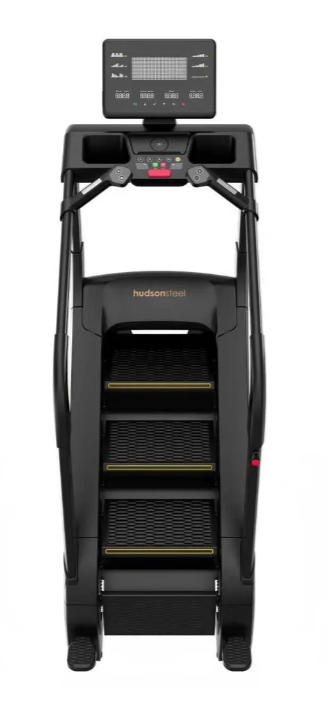
Hudson Steel New Yorker Stair Climber Machine for Sale
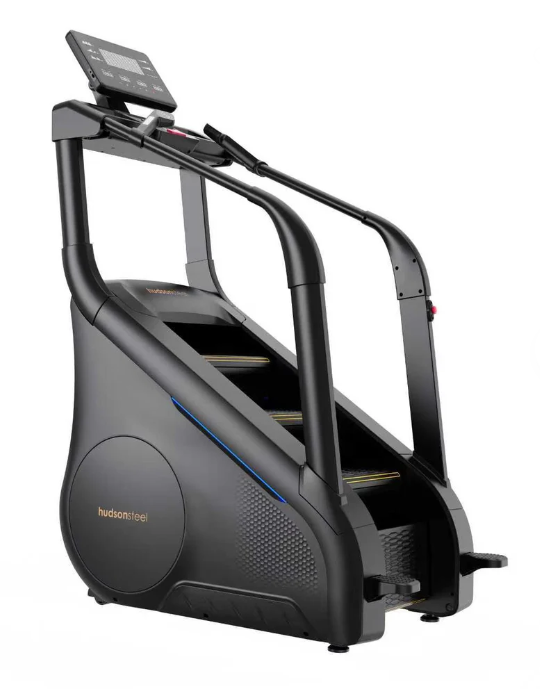
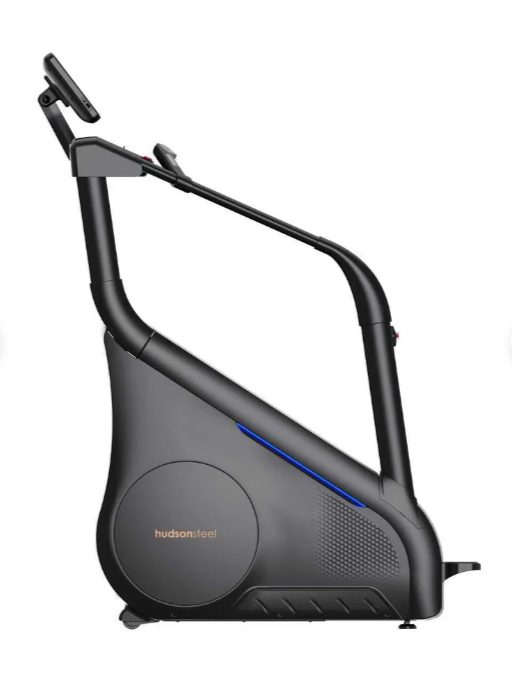
The Hudson Steel New Yorker is a revolving-staircase stair climber sold by Hamilton Home Fitness for home gyms and light commercial rooms. It turns a continuous set of moving steps under magnetic resistance, loading the glutes, quads, hamstrings, and calves through a real climbing stride rather than a pedal motion.
- Steps—7 total, 3 effective stages
- Step rate—20–164 steps per minute
- Resistance—dual EMS electromagnetic
- Max user weight—397 lb
- User height range—4'11"–6'11"
- Assembled size—57.9" x 28.2" x 75.4"
Is This a Stepper or a Real Stair Climb?
This is a real climb. The staircase moves under you, and you keep lifting your feet, which is a different job from a two-pedal stepper, where your feet stay planted on a platform that travels up and down.
What does "3 effective climbing steps" mean? The sheet splits the count two ways: seven steps in total, three of them effective climbing stages. The effective number describes the climb you actually take. The total describes the loop that keeps delivering it.
That distinction matters more than the headline step count when you are choosing between machines. A climb feels natural or cramped based on how many steps you get under your foot, not how many steps circle the frame. It is worth checking that number on every one of the stair climbers on our commercial floor before you settle on a model.
How the Pace and Resistance Work
Pace is set in levels, and resistance comes from dual EMS electromagnetic control rather than friction pads. Nothing rubs, so there is no pad to glaze or replace as the hours build up.
Can beginners and advanced climbers share one machine? Yes. There are 25 levels; the lowest sits at the bottom of the published step-rate range, and each level up adds five steps per minute. Small increments mean a returning beginner and a conditioned athlete can use the same machine without one of them jumping past a usable setting.
A built-in manual handbrake sits alongside the electronic system, so you can hold the staircase without reaching for the console. If you are still weighing machine styles rather than models, our stair climber buying guide works through the trade-offs first.
Key Features
✅ A real revolving climb, not a pedal stepper
✅ Magnetic resistance runs without friction wear
✅ Handrail keys change pace mid-climb
✅ Assisted step-up pedals ease the mount
✅ Wide console stays readable while you climb
✅ Grip sensors read heart rate without a strap.
✅ Color-coded light shows status at a glance
✅ Sweat-resistant surfaces survive hard sessions.
✅ Auto-lock holds the stairs when nobody is on.
✅ Optional wireless charging tops up a phone
✅ One person can wheel it into position.
✅ Cast-iron drive parts built for daily volume
✅ Upright footprint suits a spare room or garage
Can You Get On It Comfortably?
Check two things before you order: your height against the machine's published window and how high the first step sits. The first step is 15.0" off the floor. That is a genuine lift, and it is the number most listings leave out of the highlights.
Hudson Steel answers it with hardware. Two auxiliary pedals come included at 4.9" x 3.9" each, fixed 8.7" from the ground, and they break that first climb into two smaller moves. Hudson Steel also describes the control panel as simple enough for seniors and newcomers, and the panel is genuinely the easy part. The mount is the part to test.
Foot placement has its own figure here. Alongside the platform size, the sheet publishes a usable contact width of "9.1"—the measurement that decides how much of your foot lands on a step rather than over its edge. Almost no spec sheet in this category separates the two.
Decision rule: if stepping onto a low bench is already awkward for the main user, treat the auxiliary pedals as part of the routine rather than a backup, or look at a compact commercial stepper instead.
Add the New Yorker to your cart, or call 423.458.2453, and we will check the height of the window against your room before anything ships. Hudson Steel machines are quoted and invoiced privately, so a short call costs you nothing.
Full Specifications
Every published figure for the New Yorker sits below, grouped so you can find the one you need.
Build and Steps
- Model—CS201ES
- Stair incline—35°
- Step height—6.9"
- Step platform—17.3" x 9.8"
- Handrail finish—spray paint
- Surface—water-resistant, sweat-wicking
Drive and Resistance
- System—EMS with 10.24" flywheel
- Drive system—belt drive
- Braking—electronic brake
- Manual handbrake—built in
- Pulley—cast iron, 13.90" x 1.02"
Console and Safety
- Display—15.6" adjustable LED
- Heart rate—hand-grip sensors
- Quick keys—start/stop and speed
- Phone holder—optional wireless charging
- External charging—optional wireless or wired
- Status light—four-color indicator
- Safety system—light sensor, no-load auto-lock
- Emergency stop—button and pressure switch
Weight and Freight
- Net weight—311 lb
- Gross weight—353 lb
- Crate size—49.2" x 30.5" x 49.2"
- Transport wheels—2.56" x 1.57" x 0.40"
Warranty: Light Commercial and Residential
- Frame—10 years
- Brake—5 years
- Parts—5 years
- Labor—1 year
- Wear items—6 months
New Yorker vs. Spirit CSC880
These two sit closest together on our floor, and the gap between them is commercial, not mechanical. The Spirit Fitness CSC880 is the other seven-step climber in this price band.
Hudson Steel New Yorker
- Price—$5,999.00
- Freight—quoted separately
- Ordering—private invoice brand
Spirit Fitness CSC880
- Price—$5,499.00
- Freight—free on Spirit units
- Ordering—standard cart checkout
Read those two freight lines together with the prices, because the $500 gap narrows once shipping is costed. The reason to pay the difference is capacity: the Spirit unit is rated to 330 lb, so if anyone using the machine sits near that figure, the New Yorker's higher rating is what you are buying. Fitting out a whole room? Our commercial cardio equipment lineup covers the rest of the floor.
Who It Suits, Who Should Skip It
Fit here is about the body and the building, not the budget. The honest split looks like this.
Buy It If
- You want real stairs, not pedal travel
- Your room is a garage, basement, or spare room
- A heavier climber uses it regularly
- It serves a studio, hotel, or department
- You value a strap-free heart rate readout
Skip It If
- The main user cannot manage a high first step
- Your height sits outside the published window
- You need a fold-away machine between sessions
- Free freight is a condition of the purchase
- You want a touchscreen with streaming classes
Hudson Steel positions the New Yorker for fat loss and lower-body conditioning, and stair climbing does load large muscle groups hard. Results still track consistency rather than the machine, and anyone managing a knee, hip, or heart condition should clear a new cardio routine with their doctor first. If a climber turns out to be the wrong shape for your room, our wider cardio equipment range covers treadmills, bikes, and rowers.
Delivery, Setup, and Ordering
This machine arrives by freight on a pallet, and the crate is narrower than a standard 32-inch interior door in every direction, so the delivery path is rarely the obstacle. The weight is. Plan who is moving it and where it lands before the truck arrives.
Does the New Yorker need a special outlet? It takes an AC supply in the 110V–220V band, so a standard household circuit covers it in the US. Position the machine within reach of an outlet rather than running an extension cord across the floor.
Hudson Steel describes the New Yorker as an integrated one-piece structure that needs no complex assembly. The crate is smaller than the finished machine in every dimension, so expect a final setup where the unit will live rather than a fully built delivery. Our shipping and returns terms set out what freight includes, and facilities placing several units can book a gym design session with us instead.
New Yorker Buyer Questions
Can I use the New Yorker at home and in a facility?
Yes. Its coverage is written to span both settings, which is unusual at this level. A home-only warranty would lapse the moment the machine went into a studio or a department gym, so the dual scope is worth checking against where you plan to install it.
Is it quiet enough for an apartment?
Hudson Steel describes it as ultra-quiet in use, and magnetic resistance has no friction pad to squeal. The harder apartment question is logistics: a crated freight delivery of this weight up a shared stairwell is the real blocker, not noise.
How does the wireless charging work?
It is listed as an option rather than standard equipment on both the phone holder and the external charging feed. Confirm the configuration you want when you request your invoice so the machine ships as expected.
What maintenance should I plan for?
Hudson Steel calls it a low-maintenance design, and the published sheet does not include a service schedule. Ask us for the manufacturer's maintenance guidance before your first month of use, and keep the step surfaces clear of grit.
How many people can train on it in a day?
No duty-cycle figure is published for this model. The warranty tiers are the honest signal of the use the manufacturer expects, so match them against your actual traffic before you commit a busy floor to one unit.
Is the step rate motor-driven or self-paced?
The sheet specifies a belt drive with an electronic brake and does not publish a motor rating. If that detail decides your purchase, ask us to confirm it with Hudson Steel in writing before you order rather than assuming either answer.
Order the New Yorker.
Measure your ceiling, check your height against the window, then buy the machine that still climbs in ten years. Hamilton Home Fitness is an authorized dealer for more than 40 brands and ships to all 50 states from Tennessee, so one call gets you a freight quote and a straight answer on fit.
IN-STORE SPECIAL
Secure Payments

© HAMILTON HOME FITNESS. All Rights Reserved.
