
Introduction
If you lift or train hard four to six days a week and want in-home cold water immersion for recovery, the hard part isn't the plunging—it's choosing the right setup without undersizing it or overspending. You're weighing tub size, chiller wattage, running cost, and water sanitation all at once and probably wondering whether cold after lifting will blunt your gains.
This guide takes each decision in turn — sizing the tub to your body, matching chiller power to your space and climate, keeping the water clean, planning the install, and pricing the true cost — so you can match a plunge to your routine and goals, then decide whether to add a sauna for contrast therapy. Where it's useful, we'll point to authorized cold plunge and sauna options from Hamilton Home Fitness, shipped nationwide from Tennessee.
Is a home cold plunge worth it?
A home cold plunge is worth it for recovery, sleep, and stress resilience—with one timing caveat if maximizing muscle growth is your top goal. For most lifters and hybrid athletes who train hard and want to recover faster, it earns its place. The exception is narrow and easy to work around, and we'll cover it below.
Recovery, sleep, and stress benefits
Cold water immersion can reduce muscle soreness and perceived fatigue after hard training and may support sleep and stress resilience. In recovery research, the effect on next-day soreness is meaningful rather than dramatic — enough to help you train again sooner, not enough to erase a brutal session. Cold exposure also drives a sharp, short-lived rise in norepinephrine, which is part of why a plunge leaves you alert and clear-headed, and many people report easier wind-down and better sleep when they keep it earlier in the day. Treat these as reliable, modest wins, not miracle claims. If you're building out a wider recovery setup, it's worth seeing how a plunge fits alongside recovery and rehab equipment.
Will cold plunging blunt muscle growth?
Cold water immersion right after lifting can blunt muscle growth signaling, so separate cold exposure from hypertrophy-focused sessions. The simplest rule: keep aggressive cold roughly four to six hours away from any session where size is the goal, or schedule it on rest days, before training, or during in-season blocks when recovery matters more than building new muscle. The effect shows up most in studies that plunge immediately after lifting; strength gains are less consistently affected than muscle size. So you don't have to choose between cold and gains—you just have to time it. A plunge used this way supports recovery without working against your training.
What Size Cold Plunge Do You Need?
Match the tub's interior length to your height for the immersion depth you want, and size up if more than one person will use it. Size is the variable people get wrong most often, because a tub that looks big in photos can still leave your knees or shoulders out of the water. Decide first how you want to sit, then check the numbers against your body and your floor space.
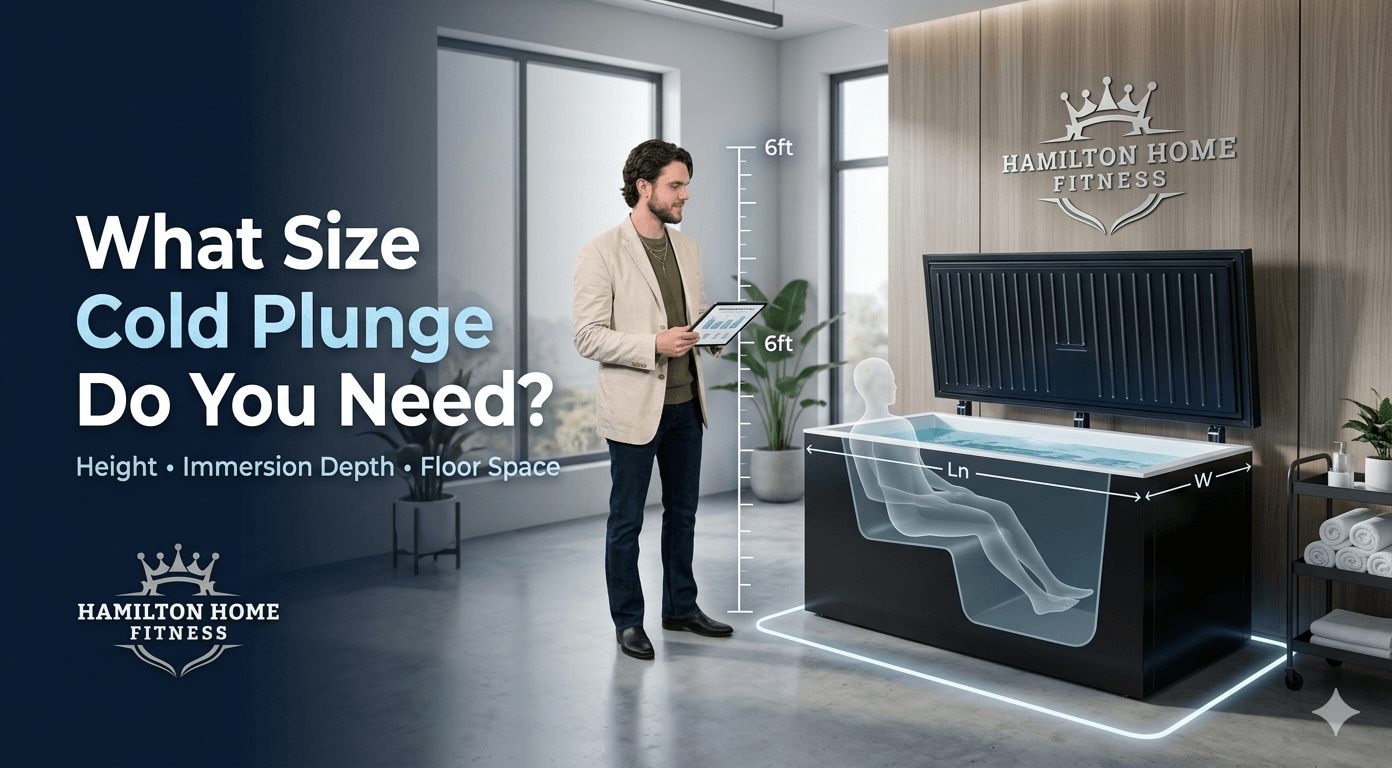
Sizing by height and immersion depth
For shoulders-under immersion, choose an interior length close to your seated or reclined body length; taller users need longer or deeper tubs. Reclined, laydown-style tubs give the most coverage but take the most floor space, while vertical and seated designs keep you upright and save room—at the cost of full-body submersion. Many full-size laydown tubs are built to fit users up to roughly 6'8", but always read the listed interior dimensions rather than the outer footprint since insulation and walls eat into usable space. If you're between two sizes, go larger—it's far easier to plunge into a slightly roomy tub than to fold into a tight one, and it leaves headroom if a partner or training buddy uses it too. Check the stated weight capacity for the same reason.
Tub materials and formats
Cold plunges come as stainless steel, acrylic, fiberglass, wood barrel, or inflatable—each trading off durability, insulation, footprint, and price. Stainless steel and acrylic or fiberglass shells are the most durable and hold temperature well, especially with double-wall or foam insulation, which directly lowers how hard your chiller has to work. Wood barrels look great and suit outdoor settings but demand more upkeep, while inflatable tubs are the cheapest, most portable entry point and the easiest to set aside, at the cost of insulation and longevity. Pick the material for where it will live and how often you'll use it: a permanent indoor or covered outdoor spot rewards an insulated hard shell, while a try-before-you-commit setup leans inflatable. To see how these formats and sizes play out in real tubs, browse the Plunge Zero cold plunge tubs.
Chiller Power: Wattage, HP & Climate
Chiller power should match your water volume and the heat load of your space — a hot, uninsulated garage needs more horsepower and better insulation than a cool basement. The job of the chiller isn't just to reach a cold temperature once; it's to hold that temperature against everything trying to warm the water back up. Two tubs of the same size can need very different chillers depending on where they sit.
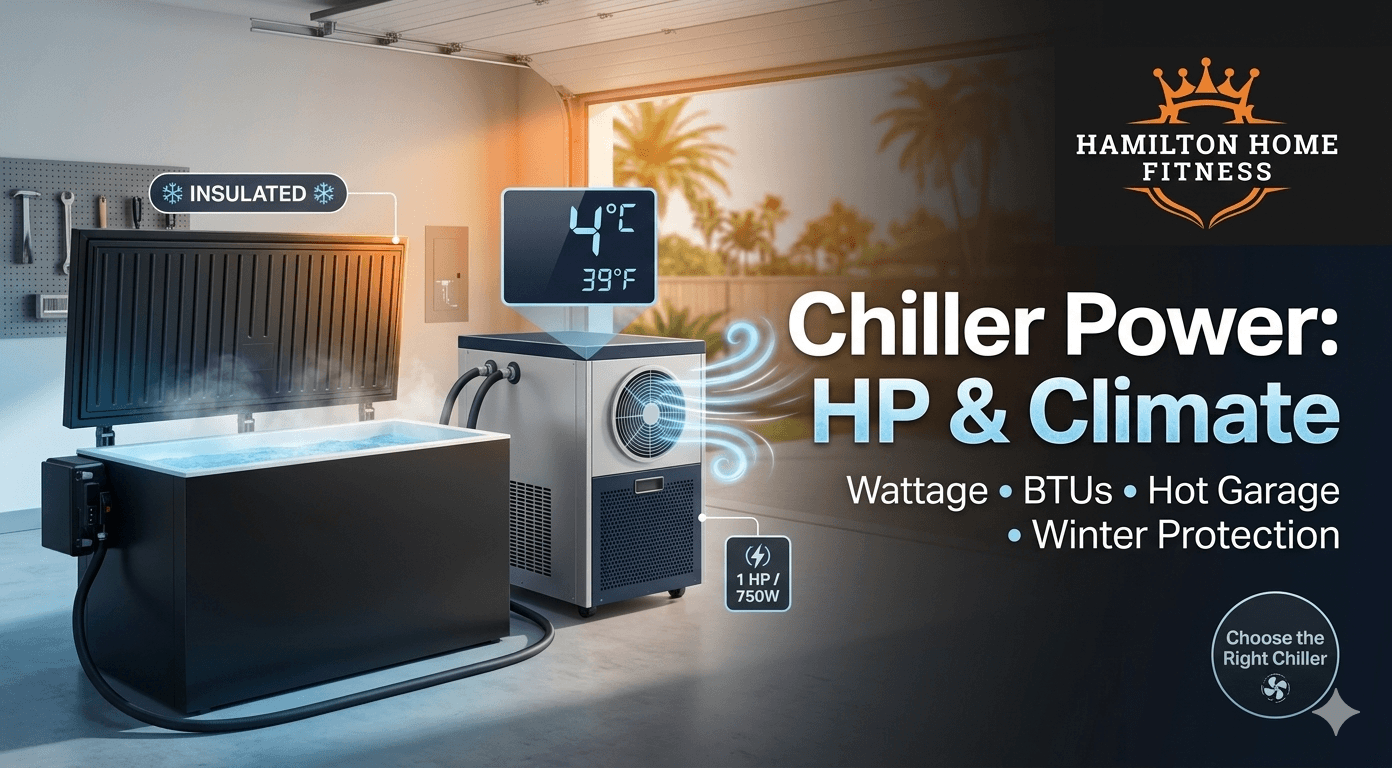
Sizing a chiller for a hot garage
In a hot Tennessee garage that can pass 90–100°F in summer, a chiller works far harder, so favor more horsepower, heavy insulation, and an insulated cover. As a rough decision rule, a small, well-insulated tub can be served by a quarter- to half-horsepower unit, a half-horsepower chiller is the common standard for most home tubs, and larger tubs, hot climates, or anyone who wants fast cooldowns should look at one to one-and-a-half horsepower. Horsepower is only a proxy, though—what actually matters is cooling capacity in BTUs and the efficiency of the compressor and refrigerant (you'll see R134a, R290 propane, and R410a on spec sheets). Insulation changes the math more than most buyers expect: a double-wall, foam-insulated tub with a tight cover holds cold so well that it lets a smaller chiller keep up, while an uninsulated tub in direct sun can overwhelm a unit that would be fine indoors. Keep the chiller shaded and well-ventilated, and your space and ambient heat will drive the choice as much as tub size does. If you're unsure what your garage or climate demands, it's worth getting a climate-matched recommendation from the team before you buy.
Outdoor use, winter, and freezing
Yes, you can run a cold plunge outdoors in winter, but you need freeze protection or an all-in-one unit rated for sub-freezing ambient temperatures. The risk in deep cold isn't the plunge water itself—it's the lines, pump, and chiller, which can freeze and crack if the system idles in subfreezing weather. An insulated cover and continuous circulation help, and some all-in-one units are winterized to keep working well below freezing; a few are rated for extremes on both ends, holding temperature in summer heat and tolerating sub-zero winters. In genuinely harsh climates, look for built-in freeze protection or an antifreeze loop rather than improvising. If hard freezes are rare where you live, the requirements are lighter, but plan for your coldest realistic night, not your average one.
Monthly electricity cost
Most home cold plunges add roughly $8–$20 per month in electricity, more in hot climates or with poor insulation. The chiller doesn't run constantly—like a refrigerator, it cycles on to cool and off once it hits temperature, so your bill tracks how often it has to fight heat gain. That's why insulation pays you back twice: a well-insulated tub with a tight lid cuts compressor runtime, which lowers both your cost and the wear on the unit. You can trim further by running it on a timer or schedule and keeping the cover on between sessions. Expect the higher end of that range during a Tennessee summer and the lower end in a cool, shaded, or indoor space.
Temperature & Time: Evidence-Based Use
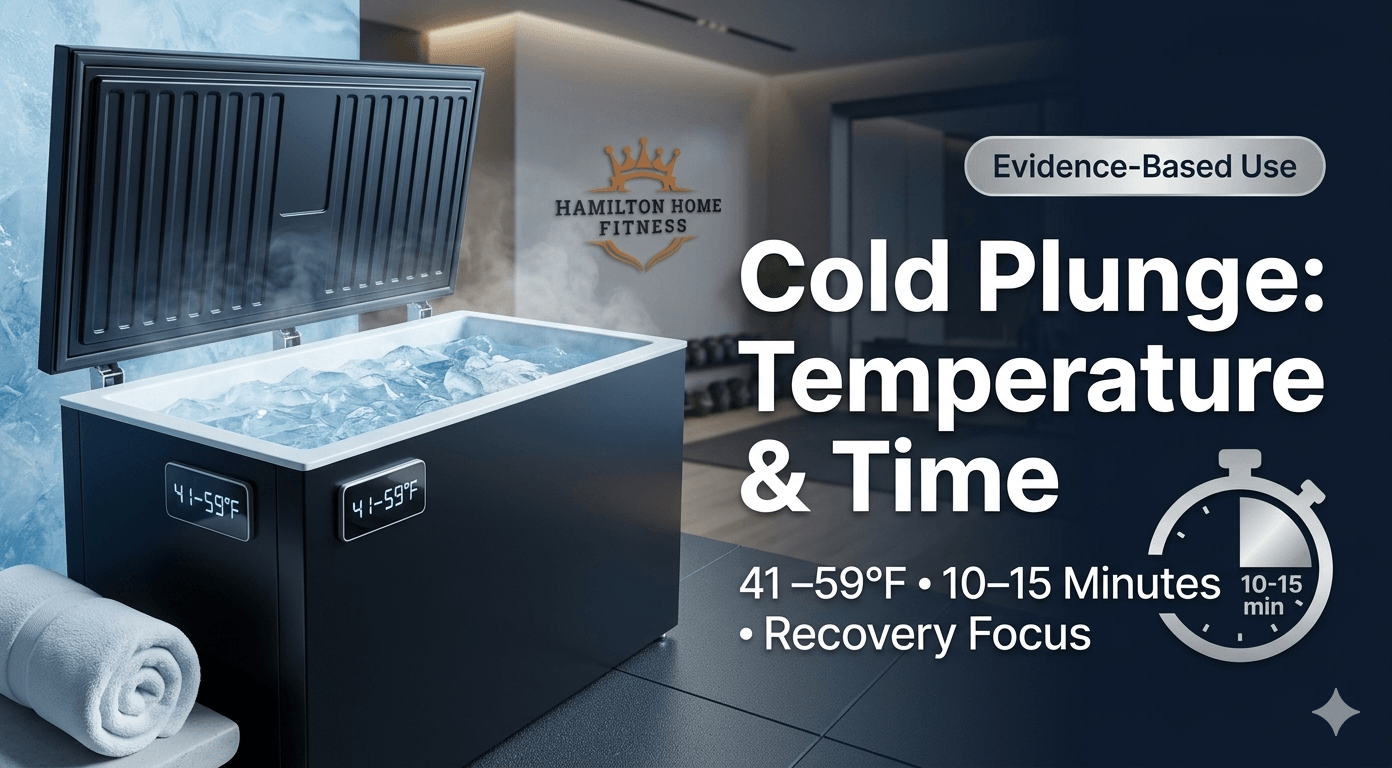
Research-backed recovery protocols often use about 10–15 minutes in cold water, while shorter "cold-shock" sessions are mainly for mental resilience and alertness. Those are two different goals with two different doses, and conflating them is where most advice goes wrong. Decide what you're after first, then set temperature and time to match it.
Evidence-based temperature range
For recovery, studies commonly use water around 41–59°F; colder water is not automatically better and is harder to tolerate. Within that band, the research splits by goal: a network meta-analysis of recovery protocols found moderately cold water near 52–59°F most effective for easing muscle soreness, while colder water around 41–50°F did more for neuromuscular markers like jump performance and for clearing muscle-damage markers. Going colder than that — into the high 30s — feels intense and is popular for the cold-shock effect, but it doesn't reliably buy you more recovery, and it shortens how long you can stay in safely. A practical starting point is the low 50s°F, then adjust toward your tolerance and your goal rather than chasing the lowest number on the dial. Keep in mind these are population averages with real variation between people, so treat them as a tested range, not a precise prescription.
How long to stay in
Recovery studies often use 10–15 minutes, while popular 2–5 minute plunges are aimed more at alertness, mood, and habit than at maximal recovery. As a simple rule: if the goal is recovery from a hard session, lean toward the longer end at a moderate temperature; if the goal is the mental jolt and the discipline of a daily cold habit, a short plunge in colder water does the job. Very brief dips of under two minutes tend to be the least effective for recovery, so don't expect a 60-second splash to undo a brutal training block. Some people frame the practice around a few minutes of total cold exposure spread across the week, which is a reasonable habit anchor, but it's a popularized guideline rather than a hard law. Whatever you choose, build up gradually—tolerance is trainable, and pushing into long exposures at very cold temperatures before you're ready trades little extra benefit for real discomfort and risk.
Filtration vs Sanitation: Clean Water
A filter removes particles while ozone or UV kills microbes — you need both, plus basic water chemistry, to keep water clean. These are two separate jobs that often get lumped together, and skipping either one is how plunge water turns cloudy or unsafe. Get the combination right and you can go weeks between water changes instead of days.

Micron filters and what they do
A micron cartridge filter traps hair, skin, and debris; lower micron ratings catch finer particles but clog faster. Most cold plunges use a cartridge in the 20–50 micron range, which is the practical sweet spot—fine enough to keep the water clear and coarse enough that it doesn't choke off circulation. Plan to rinse or replace it on a schedule; with daily use, that's roughly every three to four weeks, sooner if several people share the tub or come in after sweaty training. The filter only handles physical debris, though. It does nothing about bacteria, which is the sanitation system's job.
Ozone vs UV (and a safety note)
Ozone oxidizes the whole body of water, while UV-C only treats water passing through its chamber; neither leaves a lasting residual. That distinction matters: ozone, produced by a generator and injected into the water line, attacks bacteria and organic waste throughout the tub and is the method many cold plunge brands favor, while UV-C damages microbes only as water flows past the lamp and does little to break down sweat or oils. Because neither leaves a protective residual the way chlorine does, contamination can persist between circulation cycles—so for shared or family use, add a low chlorine or bromine residual rather than relying on ozone or UV alone. One real safety point: ozone is a respiratory irritant and can accumulate in poorly ventilated spaces like a closed basement or a windowless room, so ventilate any ozone system indoors. UV adds nothing to the air, which makes it the easier choice for tightly enclosed installs.
Water changes and chemistry
With good filtration and sanitation, many owners stretch water changes to several weeks while monitoring pH and alkalinity. Keeping pH and total alkalinity in a normal range protects both your skin and the chiller's components, and checking them takes seconds with basic test strips. Hard water can leave scale over time, so factor your fill-water quality into how often you drain. The cleaner you keep the water through filtration and sanitation, the longer you can wait between full changes — but when clarity drops or chemistry drifts and won't correct, drain and refill rather than dosing endlessly.
Indoor vs Outdoor Setup & Install
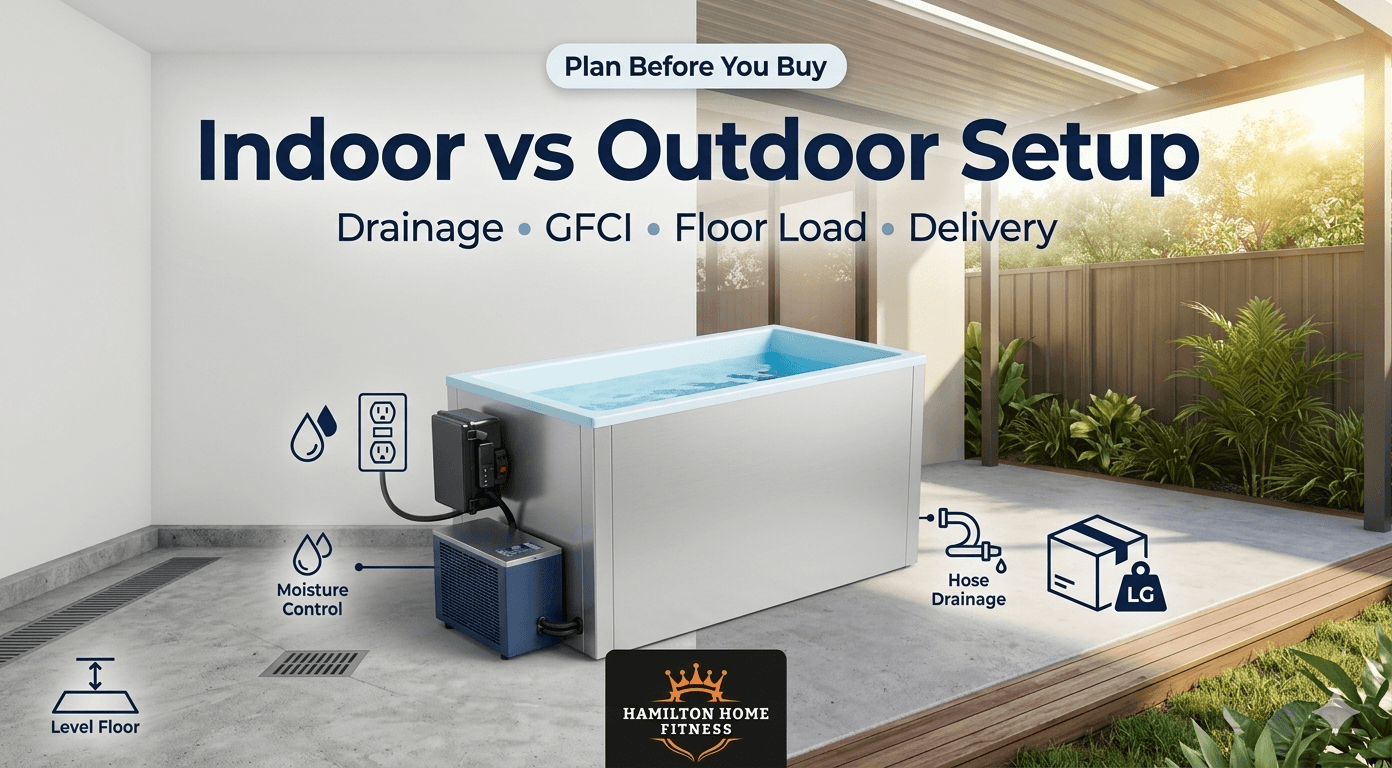
Choose placement by space, drainage, electrical access, and floor load — then plan a GFCI circuit and freight delivery. The install decisions are easy to overlook when you're focused on the tub itself, but they determine whether the plunge is safe, legal, and actually usable in your space. Sort them before you buy, not after the freight truck arrives.
Placement, drainage, floor load
A filled cold plunge can weigh 800–1,200 lbs, so place it on level, supported flooring with a drainage and moisture plan. On a slab garage or a ground-level concrete pad, that weight is rarely an issue; on an upper floor or an older structure, confirm the floor can carry it before committing. Level matters too—an out-of-level tub stresses the shell and throws off water coverage. Plan how you'll drain it, whether to a floor drain, a sump, or a hose run to the yard, and for indoor spots, add moisture management so humidity from an open tub doesn't damage the room. Basements and garages both work well when drainage and airflow are handled. If you're not sure your space will accommodate the tub, weight, and clearances, you can book a home gym design consultation to plan it properly.
Electrical, GFCI, and delivery
Most plunges run on a standard 120V, 15–20 amp GFCI outlet; larger systems may need a 220V circuit. A GFCI is non-negotiable around water, and the outlet should sit within reach of the chiller — typically within about 25 feet — on a circuit that isn't already loaded with other appliances. Confirm the specific amperage and voltage your unit needs before installation, since a higher-powered chiller or all-in-one may call for a dedicated circuit or a sub-panel. These units are heavy and ship by freight, so check whether delivery is curbside or white-glove and plan a clear path to the install spot. You can review the shipping and freight delivery details so there are no surprises on delivery day.
All-in-One vs Chiller vs DIY Cost
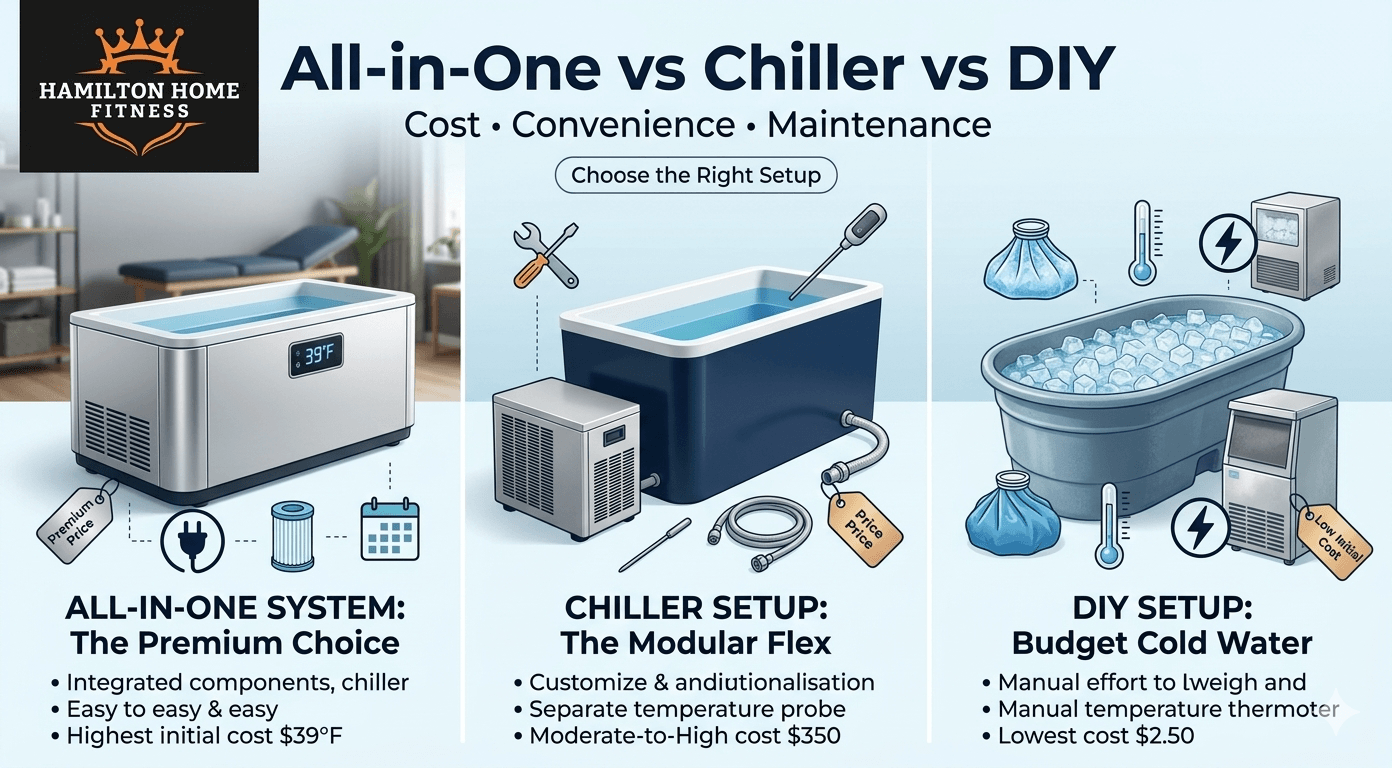
An all-in-one is simplest and most reliable; a separate chiller is most flexible; and DIY is cheapest upfront but often costlier and fussier over time. All three deliver cold water; what differs is how much money, maintenance, and tinkering each demands over the years you'll own it. Match the path to how you actually live, not to the lowest sticker price.
True cost of ownership
The total cost is the upfront price plus electricity, filters, sanitizer, and water—and a chiller usually beats buying ice within months of regular use. A DIY build—a stock tank or chest freezer conversion—starts cheap, but the ongoing cost and hassle add up: bagged ice for a single icy session can run a surprising amount, and ice-based setups give you no real temperature control. A purpose-built tub with a chiller or an all-in-one removes that recurring ice cost; for daily use, the chiller typically pays for itself versus ice within several months, while occasional users may stay cheaper on ice through the first year. Quality complete systems generally span a wide range from a few thousand dollars into the tens of thousands, so set your budget against frequency: the more often you plunge, the faster the all-in-one or chiller wins on cost and convenience. Beyond ice or electricity, budget a little for filters, sanitizer, and the occasional water change.
Which setup fits which buyer
If you'll plunge daily and want zero fuss, an all-in-one is usually the strongest fit; occasional users can start cheaper. An all-in-one builds the compressor, filtration, and sanitation into the tub, so there's no external chiller to plumb, fewer leak points, and a plug-and-play setup—ideal for someone who wants it ready every morning without thinking about it. A separate chiller suits buyers who want to pair a specific tub with a specific cooling unit or upgrade pieces over time. DIY fits the budget-first tinkerer who doesn't mind manual cooling and maintenance. For a daily-use, low-maintenance option that fits most home setups, look at the all-in-one Fire Cold Plunge.
Should You Add a Sauna for Contrast?
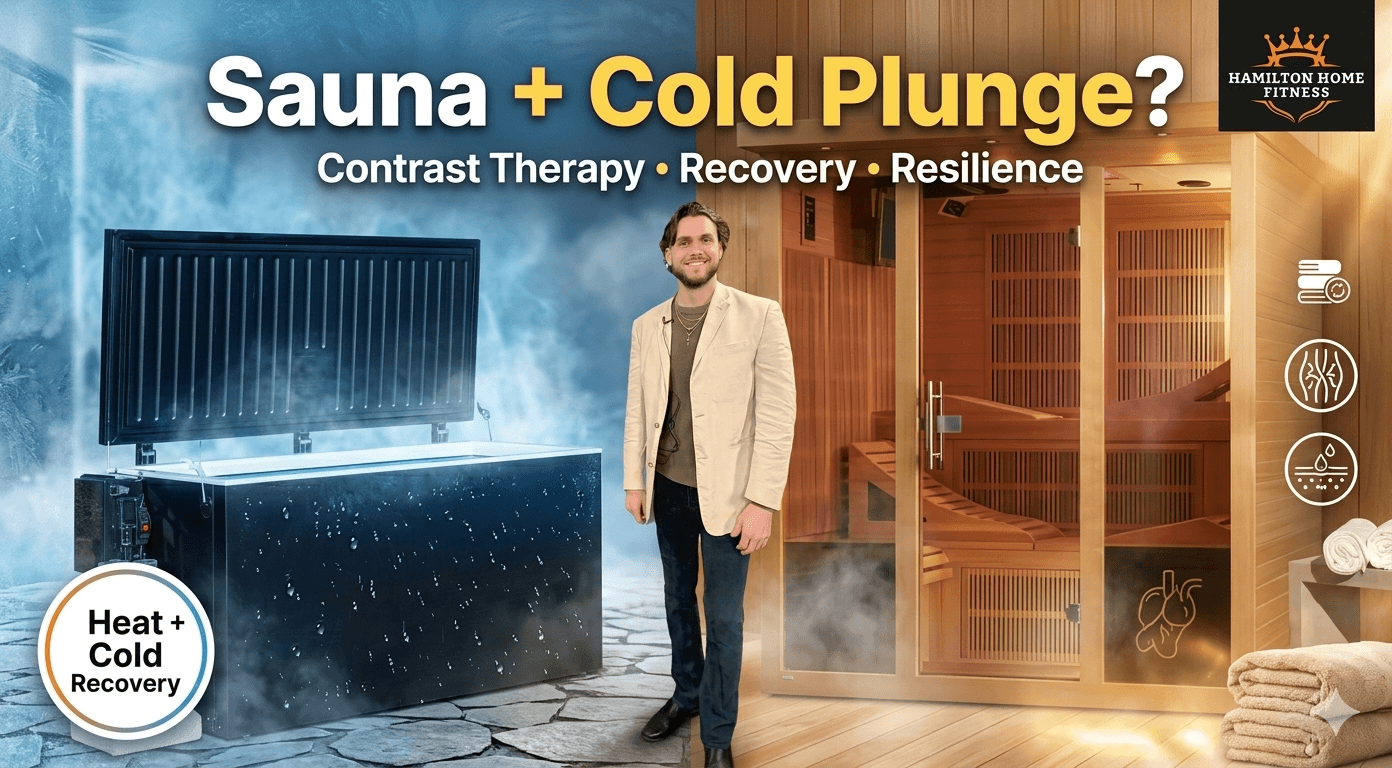
Contrast therapy is well-supported for recovery and resilience, so add a sauna if you'll use both consistently and have the space and budget. A sauna isn't required to get value from a cold plunge, but pairing heat with cold opens up a recovery practice that cold alone can't, and for many athletes it's the upgrade that makes the whole setup feel complete. The deciding factors are honest ones: will you actually use both, and do you have the room and money for them?
Contrast therapy and the evidence
Alternating heat and cold creates a vascular pumping effect, and sauna use carries strong cardiovascular associations—though much of that data is observational. The mechanism is intuitive: heat opens blood vessels, cold constricts them, and cycling between the two repeatedly works your circulation like a pump that helps move blood and clear metabolic waste. The cold side has the better recovery evidence for soreness and perceived recovery, while the sauna side carries some of the strongest longevity-style data of any recovery tool, with large studies linking frequent sauna use to better cardiovascular outcomes. The important caveat: those sauna findings come from observational cohorts, which show association, not proven cause—so treat contrast therapy as a well-studied, promising practice rather than a guaranteed result.
A simple home contrast protocol
A common approach is a few rounds of sauna heat followed by a short cold plunge—and if hypertrophy is the goal, keep aggressive cold away from your lifting window. A practical starting structure is several minutes in the sauna, then a short cold plunge, repeated for two or three rounds, adjusting heat, cold, and duration to your tolerance. Whether you finish on cold or heat is largely preference; finishing cold leaves you alert, and finishing warm leaves you relaxed for sleep. The one rule that carries over from earlier: on days you're training for size, space the cold from your lifting session so it doesn't blunt growth—the sauna doesn't share that concern. Hydrate well, never push through real distress, and check with a doctor first if you have cardiovascular conditions or are pregnant. If contrast therapy appeals, you can view the Golden Designs infrared saunas for a pairing.
Final Thoughts
You now have what you need to choose well: Size the tub to your body; match chiller power to your hottest realistic ambient temperature; set up clean water and a safe install; weigh the true cost of each path; and decide whether a sauna earns its place. The takeaway is simple—buy the system you'll actually use every day, size the chiller for your worst-case heat rather than your average, and time cold around your training so it speeds recovery without working against your goals.
When you're ready to move from research to a real setup, Hamilton Home Fitness carries authorized cold plunge lines and, if contrast therapy appeals, Golden Designs saunas—shipped nationwide from Tennessee with freight and white-glove options. The single best next step is to contact the team for a climate-matched recommendation so your tub and chiller are sized right for your space the first time.