Introduction
A trap bar can look “standard” and still change your numbers, your form feel, and even your confidence. If you’ve ever asked, “How much does a trap bar weigh?” you’re not alone—most lifters assume every hex bar is the same, then wonder why their logbook doesn’t match a friend’s or a gym’s posted PR board.
At Hamilton Home Fitness, we see this most when people swap between bars: one feels easier off the floor, another feels steadier in the rack, and the total load quietly changes. We also see collars and clamps get counted by accident, which makes progress tracking messy for coaches, home gym owners, and rehab-focused clients who need consistency.
In this guide, you’ll get a clear way to confirm your bar’s unloaded weight and understand why designs differ—open vs. closed frames, handle setups, sleeves, and added features. You’ll leave with a simple “check-and-log” habit: verify the bar once (spec sheet or a quick scale test), write it on the bar or in your app, and train with numbers you can trust. If you’re buying, you’ll also learn how bar weight connects to your space, plates, and goals—so the “right” trap bar fits you from day one.
Trap bar weight: what’s normal?
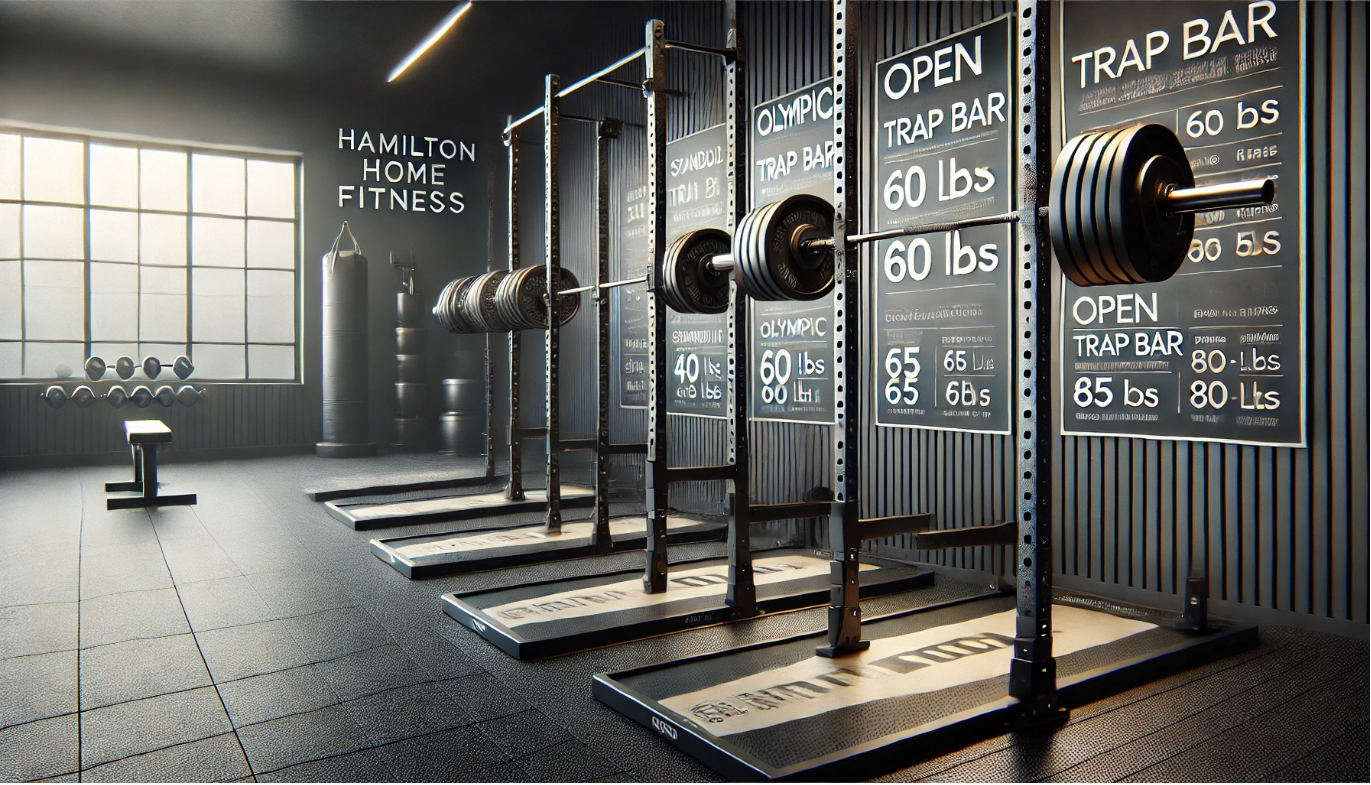
Most trap bars weigh about 40–70 lb, but the only “standard trap bar weight” that matters is the unloaded weight of your exact model for accurate training logs.
Most are 40–70 lb
Most trap bars land in the 40–70 lb range because brands balance strength, stability, and usability differently across designs like closed hex bars, open trap bars, and rackable trap bars. If you’re comparing lifts across gyms or bars, treat this range as a starting point—not a guarantee.
Real examples: 47 vs 60 lb
It’s common to see one trap bar listed around 47 lb and another around 60 lb, and that gap can change your “total load” even when the plates are identical. The fastest proof is simple: weigh the unloaded bar once, then label it.
A quick reality check example:
- If you load 45s per side, a 60 lb bar totals 150 lb.
- The same plates on a 47 lb bar totals 137 lb.
That 13 lb difference is why lifters sometimes feel like progress “stalled” when they actually just changed equipment.
Does weight include collars?
Trap bar weight usually means the bar only, not collars, clamps, chains, or bands. To keep tracking clean, use one rule:
- Log bar and plates every time.
- Only add collars if you always use the same pair and want “all-in” precision.
Why do trap bars vary in weight?
Trap bars vary in weight because design choices change how much steel is used and where it’s placed, which affects stability, rack compatibility, and how the bar feels under load.
Frame size and steel thickness
Heavier trap bars usually have more steel in the frame—either through thicker tubing, larger overall dimensions, or extra reinforcement. In practical terms, a compact closed hex bar built for easy storage can come in lighter, while a longer rackable trap bar often adds material to span a rack safely and resist flex. When we help customers compare models, this is the first “tell”: if the frame looks longer, wider, or more reinforced at stress points, the unloaded weight typically climbs.
Sleeves, handles, and extras
Hardware adds weight fast. Longer loadable sleeves mean more steel and sometimes sturdier sleeve assemblies. Dual-handle setups can add material in the handle mounts, and some specialty designs include convenience features like a built-in jack or added bracing to keep the bar stable while loading plates. A quick proof test you can do at home: pick up two trap bars by the same point on the frame—if one feels front-heavy, it often has heavier sleeves or reinforced ends.
Open vs rackable designs
Open trap bars and rackable trap bars solve different problems, so the weight can swing either way. Open designs may remove part of the rear frame for easier entry and lunges, while rackable designs often prioritize stiffness and rack reach. The takeaway is simple: don’t assume “open is lighter” or “rackable is heavier”—confirm the unloaded bar weight for the exact model you train on, then log consistently.
Open vs closed: weight differences
Open vs. closed trap bar weight can differ by more than 10 pounds, so the only reliable way to compare is to check the unloaded bar weight for each model before you compare lifts.
Open trap bars can be lighter
Some open trap bars are built to stay maneuverable, with a trimmed frame that makes step-in and carry movements easier. In real gyms, we’ve seen open-frame bars listed around the high 40s to low 50s in pounds, which can be a big deal for newer lifters, rehab clients, or anyone tracking smaller jumps. If you’re doing higher reps or conditioning work, a lighter starting point can also reduce fatigue before the plates even matter.
Closed/rackable bars trend heavier
Many closed hex bars, and especially rackable trap bars, tend to sit closer to the 60 lb neighborhood because they often use longer, sturdier geometry and extra reinforcement to feel stable when you pull heavy. When customers test both styles side by side, they usually describe the heavier bar as “more planted” on the floor and “less twitchy” when loading plates—useful traits if you train hard and want a consistent setup.
What this changes in training
The practical impact is your math and your comparisons. If you switch bars and keep the same plates, your total load changes instantly, and your PRs can look better or worse for reasons that have nothing to do with strength. Our simple coaching rule is: treat the trap bar like part of the prescription. Write the bar type and unloaded weight in your log (for example, “open bar” or “rackable bar”), and don’t compare PRs across different bars unless you adjust for the bar’s actual weight.
Does trap bar weight matter?
Trap bar weight matters most because it changes your total load and your progress tracking, not because a heavier trap bar automatically makes it a “better” bar.
It matters for load math
If you care about honest PRs, you need one simple habit: always count the unloaded trap bar weight. Total load is the bar plus plates on both sides, and the bar can swing the result by 10–20 lb between models. In coaching settings, this is one of the most common “silent errors” we see—two athletes load the same plates, but they’re pulling different totals because one used an open trap bar and the other grabbed a rackable bar. The fix is easy: verify the bar once (spec sheet or scale), then write it in your training app and on a small label near the handle.
Heavier isn’t always better
A heavier trap bar can signal more steel, longer sleeves, or extra reinforcement, which may feel steadier for heavy deadlifts. But “better” depends on your space and your goals. If you’re training in a tight home gym, moving the bar often, or doing carries and lunges, a lighter open-frame design can be the smarter choice. If you’re pulling heavy and want rack compatibility, a sturdier rackable trap bar might make setup safer and more repeatable. The best bar is the one you can use consistently and track accurately.
Quick buying checklist
Before you commit, match the bar to your real constraints:
- Confirm the unloaded bar weight and log it for comparisons
- Choose open vs closed based on movement needs and space
- Check handle height options for comfort and range of motion
- Make sure sleeve length fits your plates and loading style
At Hamilton Home Fitness, we guide buyers to the simplest win: pick a bar you’ll use weekly, then keep your numbers clean from day one.
Final Thought
The best answer to “how much does a trap bar weigh?” is the one you can verify and repeat. Trap bars vary because of real build differences—open vs. closed frames, rackable length, tubing thickness, sleeves, and features like dual handles—so guessing turns your training log into noise.
If you want a simple, experience-backed rule, use this: confirm the unloaded trap bar weight once, label it, and log the bar and plates the same way every session. That one habit makes PRs honest, programming cleaner, and comparisons fair—especially if you train across multiple gyms or share equipment with family, clients, or teammates.
When you’re choosing a trap bar for a home gym or facility, don’t chase “heavier is better.” Chase the right fit: the design that matches your space, your plates, your rack setup, and how you actually train.
If you want a quick, no-pressure recommendation, Hamilton Home Fitness can help you compare trap bar styles and specs so you pick the right bar the first time and train with confidence.