Introduction
A used commercial rack or treadmill can cost a third of what you'd pay new — or hide repairs and safety risks that wipe out every dollar of the savings. Whether you're building a garage gym, opening a CrossFit box, or refreshing a small hotel or apartment facility, the skill that separates a real deal from an expensive mistake is knowing how to inspect each piece before you pay.
It matters now because gym liquidations, hotel refresh sell-offs, and dealer-refurbished inventory are everywhere, yet conditions vary sharply, and the labels "used," "refurbished," and "remanufactured" aren't standardized, so they tell you little on their own.
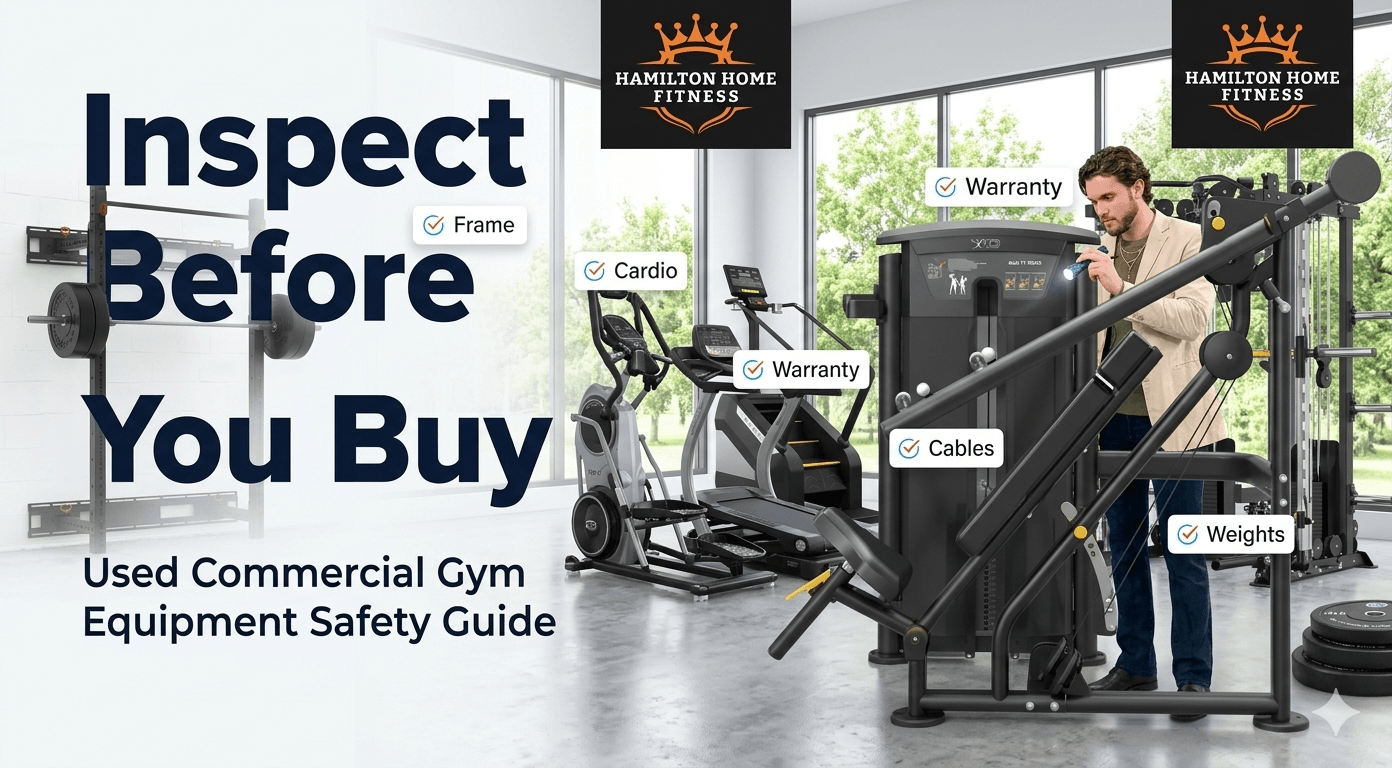
This guide gives you a used commercial gym equipment inspection method you can run on the spot: what to check on racks and benches, treadmills and cardio, cable machines, and free weights, plus how to tell a smart buy from a walk-away.
And where the math doesn't work or the right unit isn't available or used, buying new or sourcing from a vetted dealer is the smarter call—we'll cover that too.
Used vs. Refurbished: What You're Buying
The words "used," "refurbished," and "remanufactured" aren't standardized in the fitness industry, so the label tells you little. What actually matters is what was inspected, what was replaced, and what's warranted.
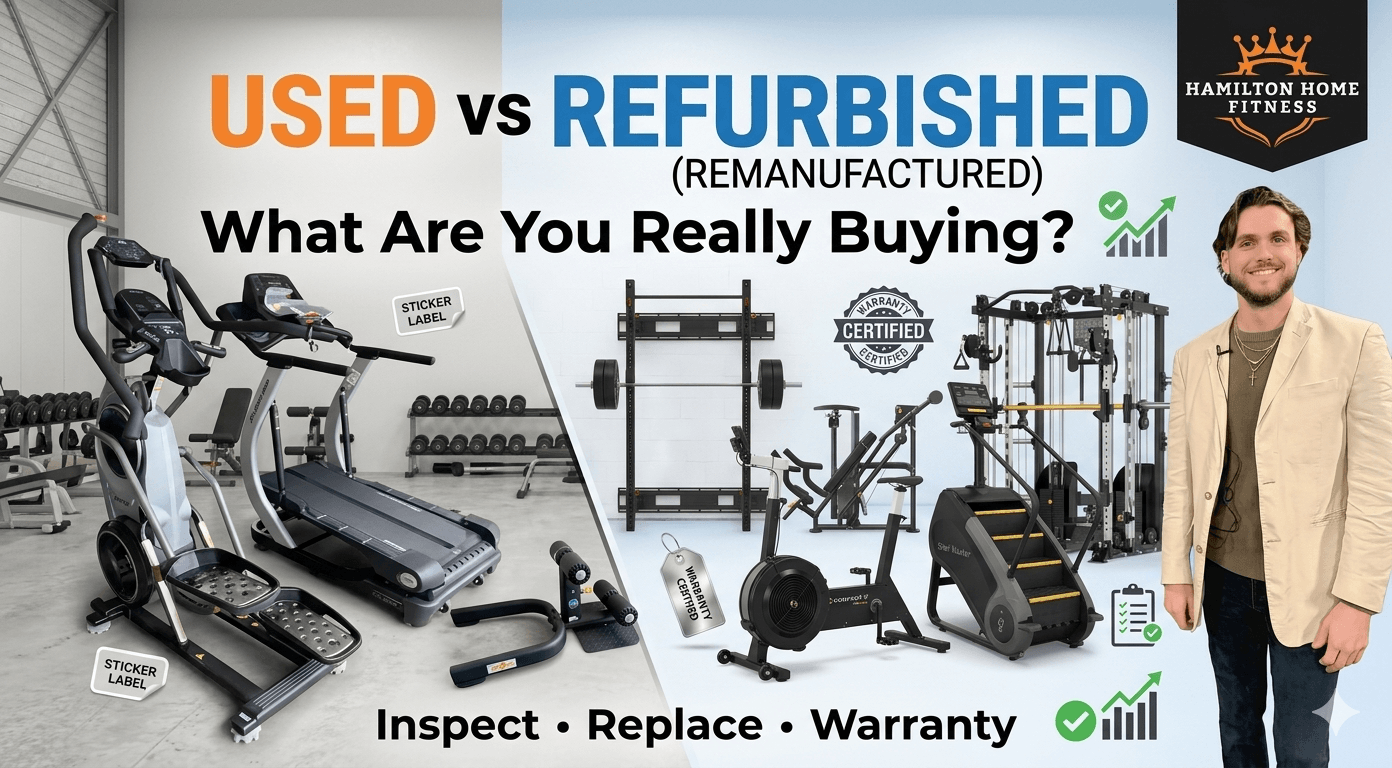
In practice, the terms tend to mean three different things. "Used" usually means as-is—wiped down and resold with its full history (and its hidden wear) intact. "Refurbished" generally means cleaned, inspected, lubricated, and given minor repairs and adjustments. "Remanufactured" is the deepest level: the machine is stripped down, repainted, and has high-wear parts like belts, bearings, and cables replaced, often anything past roughly 25% wear. The price you should pay — and the inspection effort you need — shifts with each.
Prices and depreciation
Used commercial equipment typically sells for roughly 30–60% of new, and certified refurbished units often save 30–50% or more—but cardio loses value faster than strength.
That gap exists because strength gear (racks, benches, and plate-loaded machines) is mostly steel with little to fail, so quality commercial brands often hold around 25–45% of original retail even after five to ten years of use. Cardio is the opposite: motors, boards, and consoles age and get discontinued, so treadmills, ellipticals, and bikes depreciate fastest and carry the most repair risk. Prices also swing with location and season, so treat any single asking price as a starting point, not a fixed value. For the wider new-versus-used decision across your whole setup, our commercial gym equipment buying guide goes deeper than this inspection-focused guide.
Safe buys vs. risky buys
Simple, rebuildable items are usually safe to buy used. Electronics-heavy cardio and worn cable systems carry the most hidden risk.
Racks, benches, dumbbells, barbells, and plates are low-risk: there's little to hide, and most wear is cosmetic or cheap to fix. Plate-loaded strength machines are usually safe too, since they have no electronics. The caution list is cardio with high logged hours; cable and selectorized machines with worn cables or bushings; and anything with a discontinued console or motor controller, where a single part failure can cost more than you saved. As a rule of thumb: the more moving parts and electronics a machine has, the harder you inspect it before you commit.
Frame, Welds, Rust & Pads
Check the frame before anything else. Surface rust and torn pads are fixable, but structural pitting, cracked welds, or a fatigued frame makes any machine a walk-away no matter how good the price looks—the frame is the one part you usually can't repair affordably.
Surface rust vs. structural pitting
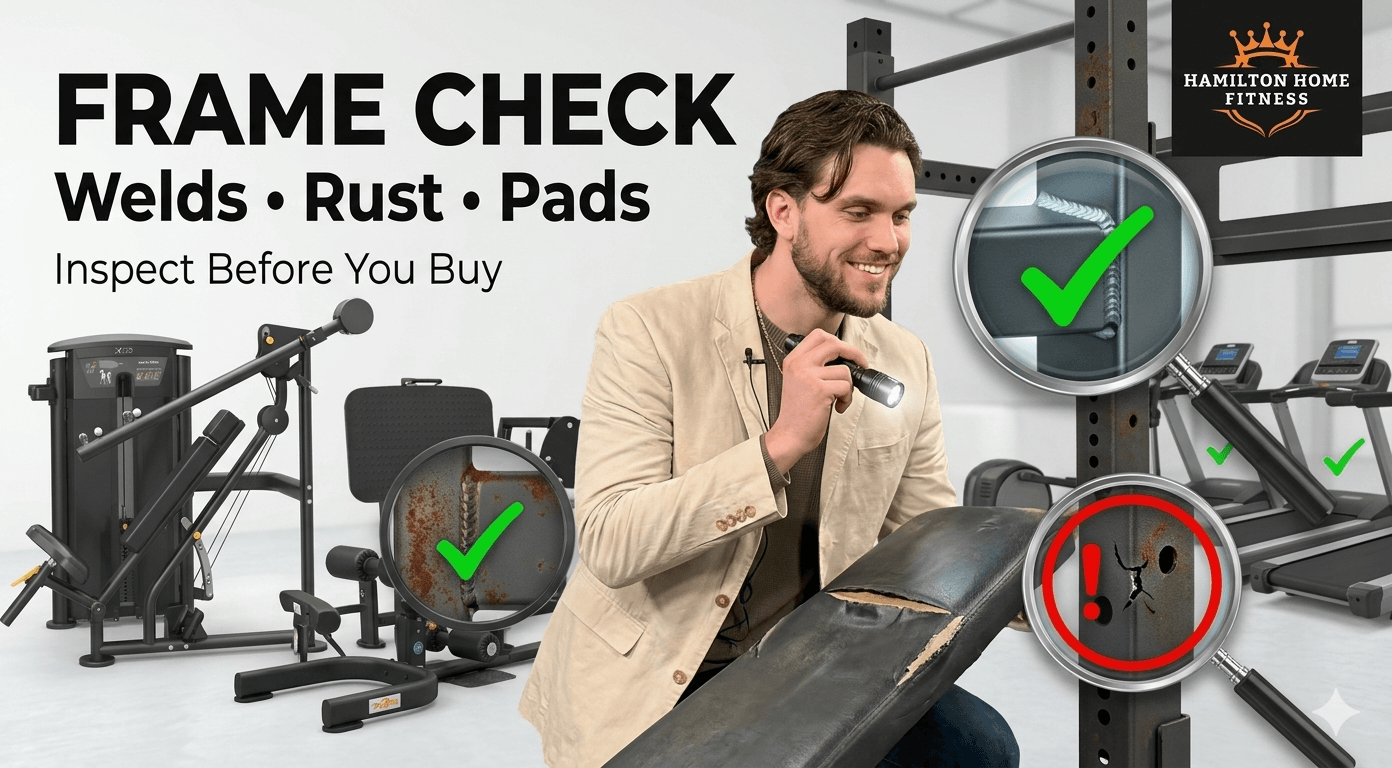
Light surface rust wipes back and is purely cosmetic. If you can flake metal off with a fingernail or a screwdriver tip, the structural integrity is gone.
The test is depth. A film of orange on uprights, plates, or hardware cleans up and means nothing for safety. Deep pitting that has eaten into the steel — flaking, crumbling, or leaving rough craters — means the metal can no longer be trusted under load. Keep in mind that powder coat protects only the outer surface, so corrosion can hide inside the tubing where moisture got in, especially at chips around bar catches and impact points. Look there, not just at the clean faces.
Weld cracks and frame fatigue
Inspect the welds at the base and uprights with a bright flashlight. Hairline cracks show up as thin, dark threads running through the paint, and thick, messy welds that don't match the factory's clean, even beads signal a prior failure or a backyard repair.
Welds and joints are where fatigue shows first because that's where stress concentrates. On a multi-station or stack machine, run the plates through their full travel: if they bind or rub the guide rods, the frame is likely twisted from a rough move. Check the feet and floor bolts too—elongated or warped bolt holes mean the unit was poorly anchored and stressed in its last home. Any crack at a stress point can fail catastrophically under a heavy lift, so treat one as a walk-away rather than a negotiating point.
Racks, benches and pads
A used rack or bench should sit dead stable with no wobble, with undamaged J-cups and safeties and bolt holes that haven't elongated from poor anchoring.
Push and rock the unit before you load it: a full rack, half rack, or Smith should feel planted, with straight uprights and adjustment holes that aren't warped from over-tightened bolts. On benches, check the pivots and the FID adjustment ladder for play or bent steel. Torn vinyl and exposed foam look bad and are unhygienic, but reupholstery is cheap — don't reject a structurally sound bench over a pad you can replace. If you're not sure what a solid commercial-grade frame should feel like, Hamilton's power racks and cages give a useful baseline to compare a used unit against.
Inspecting Used Treadmills & Cardio
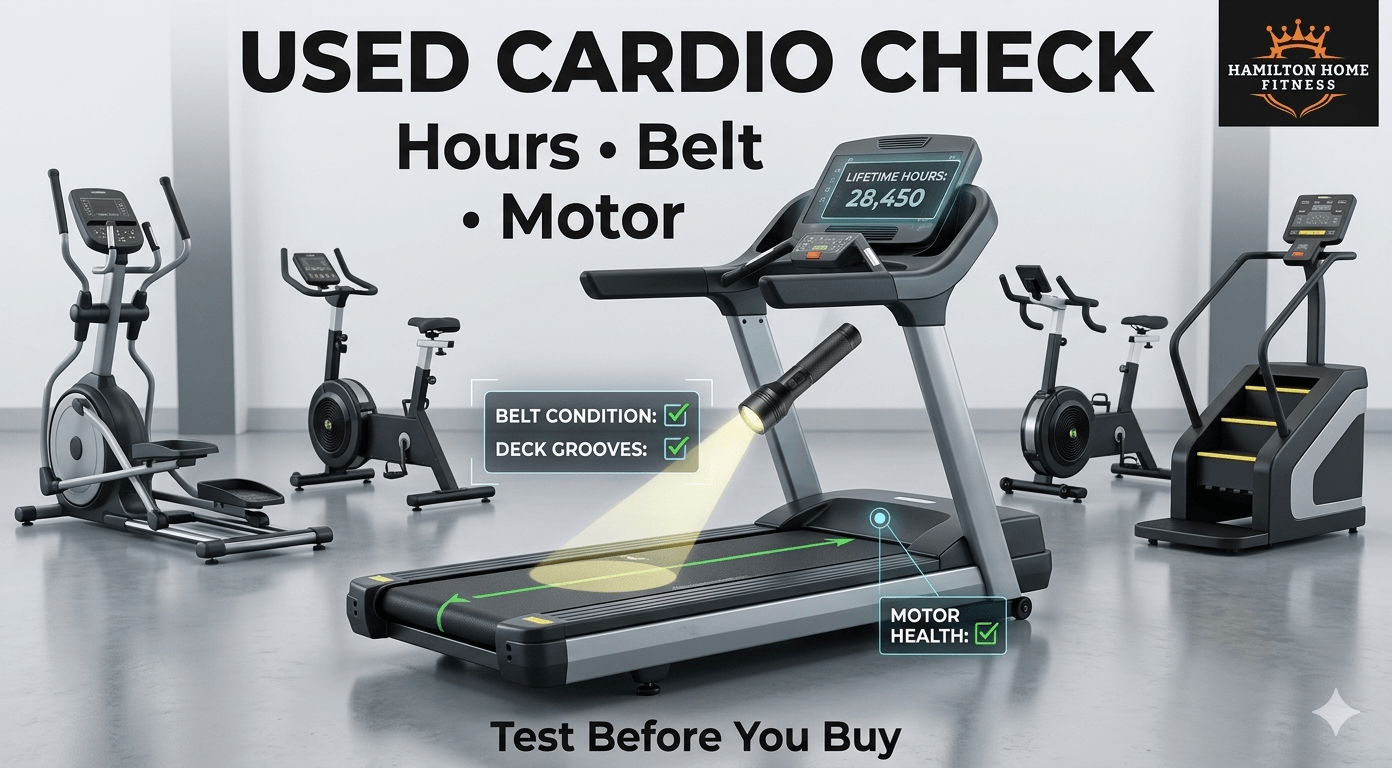
Cardio is where used buying gets risky. Always power the unit on, run it, and listen before you judge its condition by looks—and read its lifetime hours, because a clean exterior can sit on a worn-out machine.
Treadmill motor, deck and belt
Run the belt at a moderate and then a faster speed. It should move smoothly with no slipping, hesitation, surging, or burning smell, and the deck underneath should feel flat with no grooves, pits, or exposed wood.
Then check the belt itself. A good belt has a consistent ridged feel across its width; spots that feel slick and smooth are worn, and black streaks on the underside mean the bottom layer has worn through—both can quietly cook the electronics if ignored. Inspect the diagonal seam for fingers that are pulling apart, and confirm the belt lifts only a couple of inches off the deck, not loose enough to slip. The motor matters too: commercial machines usually run sturdier AC motors, while the DC motors common on lighter units have carbon brushes that wear out. Always unplug before lifting any motor cover, and for a high-value treadmill, a technician's amp-draw test against the manufacturer's service spec is the surest read on motor health. If you want a sense of what current commercial cardio should run like, Hamilton's commercial cardio machines make a useful reference point.
Reading the hour and mileage count
A treadmill's age means little. Pull its lifetime hours or miles from the console — often through a hidden key sequence in the service menu — to see the real wear.
This single number changes everything. A three-year-old treadmill pulled from a boutique studio might have a few hundred hours on it, while a one-year-old unit from a 24-hour club can carry many thousands, since commercial machines often run eight to fourteen hours a day. A low-hour hotel-refresh treadmill can be a genuine bargain; a high-hour club unit at the same price is not. Value the machine on the life it has left, not the year it was built or how clean it looks.
Ellipticals, bikes and rowers
For ellipticals, bikes, and rowers, move through the full range under your own power: listen for grinding or clicking bearings, confirm resistance engages and adjusts smoothly, and check that chains, flywheels, and dampers are intact.
On an elliptical, work the strides and watch the ramp and pedal arms for wobble or knocking that points to worn bearings. On spin, air, recumbent, and upright bikes, spin the flywheel and run the resistance knob or magnetic brake through its range—it should change smoothly with no slipping or dead spots. Rowers are simpler: check the chain or belt for wear and the damper and flywheel for smooth, quiet pull, and make sure the performance monitor powers on and reads. For rowers specifically, Concept2 rowers are a common, easy-to-service benchmark to compare a used unit against.
Testing Cables, Pulleys & Stacks
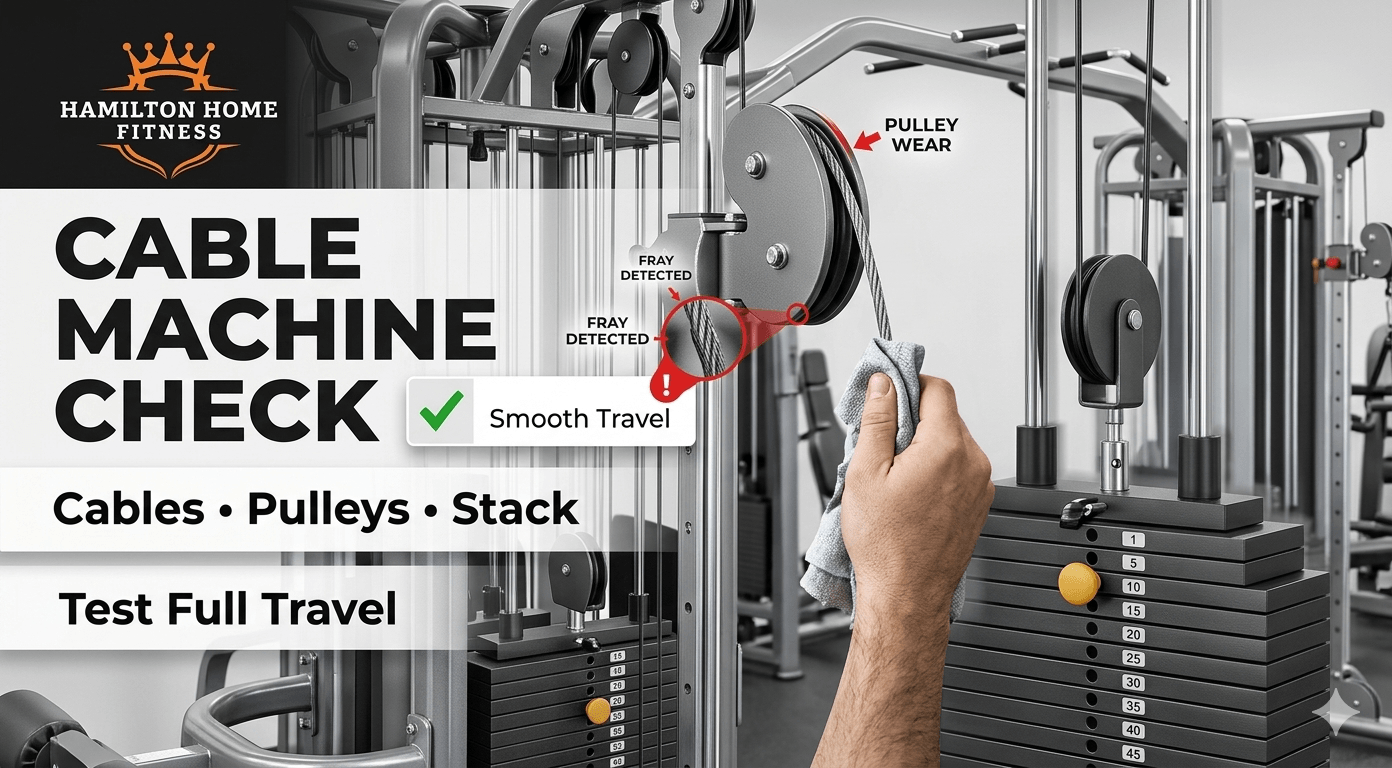
Run every weight on the stack through its full travel. The cables should be smooth and intact, the pulleys quiet, and the stack should glide without sticking or chattering—cable failure is a direct injury risk, so this section earns a careful check.
Cable fray, kinks and pulley wear
Run a rag along the length of each cable to catch frays, kinks, or nicks in the coating. Any break in the nylon can let the steel core inside start to corrode and weaken, so even a small tear matters.
Don't judge a cable by the parts you can see at eye level—pull it through its travel and feel the whole run, including where it wraps the pulleys and enters the frame. Frays, a bent kink that won't straighten, or a flattened section are all reasons to plan on replacing the cable. While the stack is moving, listen to the pulleys: they should spin freely and silently. Grinding, squealing, or a wheel that hops in its groove points to worn pulley bearings or a cam that's no longer tracking cleanly. These are among the cheapest parts to replace but the most dangerous to ignore.
Weight stack and bushing test
Lift each plate through its full range. Smooth, quiet travel is good; sticking or chatter means worn guide-rod bushings—and before you commit, confirm the selector pins and all attachments are present.
Go plate by plate rather than testing one weight, because wear often shows only at certain points on the guide rods. A stack that drags, knocks, or shudders usually needs new bushings, which is a routine fix; a stack that binds hard or sits crooked can signal a bent rod or tweaked frame, which is not. Check that the weight pins are there and lock in cleanly and that the handles, bars, and ankle straps the machine needs haven't gone missing—sourcing odd attachments later can cost more and take longer than expected. This applies to both selectorized and plate-loaded stations: the plates should move freely, seat squarely, and never rub.
Checking Used Free Weights
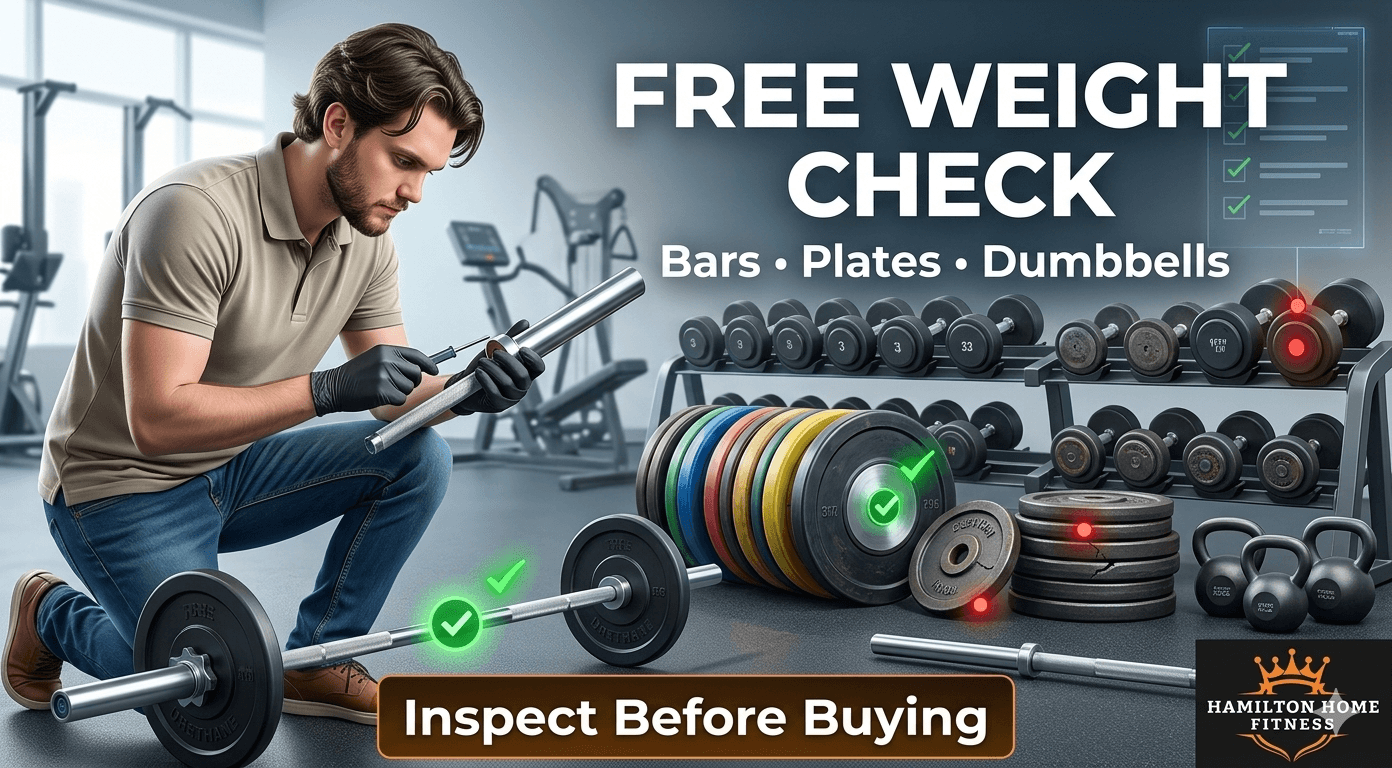
Free weights are the safest used category, but they still reward a quick look. Check barbells for bends and spin, plates for cracks and accurate weight, and dumbbells for loose or cracked heads before you buy in bulk.
Barbells: spin, whip and bend
Roll the bar on a flat surface to spot a bend, then spin the sleeves. They should rotate freely and fairly evenly, while a visible wobble as it rolls or heavy rust through the knurling is a pass.
A straight shaft is the non-negotiable part; a bent bar can't be trusted and isn't worth saving. Some up-and-down play in the sleeves is normal even on good bars and just makes noise when dropped on bumpers, so don't reject a bar for that alone. What you're checking is that the sleeves still spin (seized sleeves strain the wrists on cleans and snatches) and that the knurling and finish aren't rusted to the point of tearing skin or hiding pitting. Light surface rust cleans up; deep rust does not.
Bumper plates and iron plates
On bumpers, check that the steel insert is bonded tight to the rubber with no splitting around the hub and no warping. On iron plates, surface rust is fine — cracks are not.
The most common bumper failure is the center insert working loose or the rubber splitting where it meets the steel, so press and inspect around the hub. Warped or deformed plates (often the thin 10-pounders, especially if they were stored flat under load) won't sit flush and should be passed over. It's also worth spot-checking weight accuracy: cheaper or older plates can run several percent off their stamped weight, which quietly throws off every load you calculate. Iron plates are simpler—clean off light rust, but reject any plate with a crack.
Dumbbells and kettlebells
Check dumbbell heads for movement or cracks, handles for rust or worn coating, and any adjustable sets for a mechanism that locks cleanly.
Grab each head and try to twist it: on welded or riveted dumbbells, a head that shifts means the bond is failing and the weight is on its way out. Look the handles over for cracks, deep rust, or worn rubber and urethane coatings, and on hex or round fixed sets make sure the knurling still gives grip. For adjustable dumbbells and kettlebells, cycle the selector or adjustment a few times — it should engage and lock with no slop, since a mechanism that doesn't hold is a dropped-weight risk. When used free weights don't pass these checks, Hamilton's free weight range is a straightforward new baseline to fall back on.
Warranty, Delivery & Where to Buy
Where you buy sets your risk. Dealer-refurbished is the lowest-risk path and comes with a warranty. Auctions and private listings are sold as-is with none, and freight can add real cost to either one.
Where gyms sell used equipment
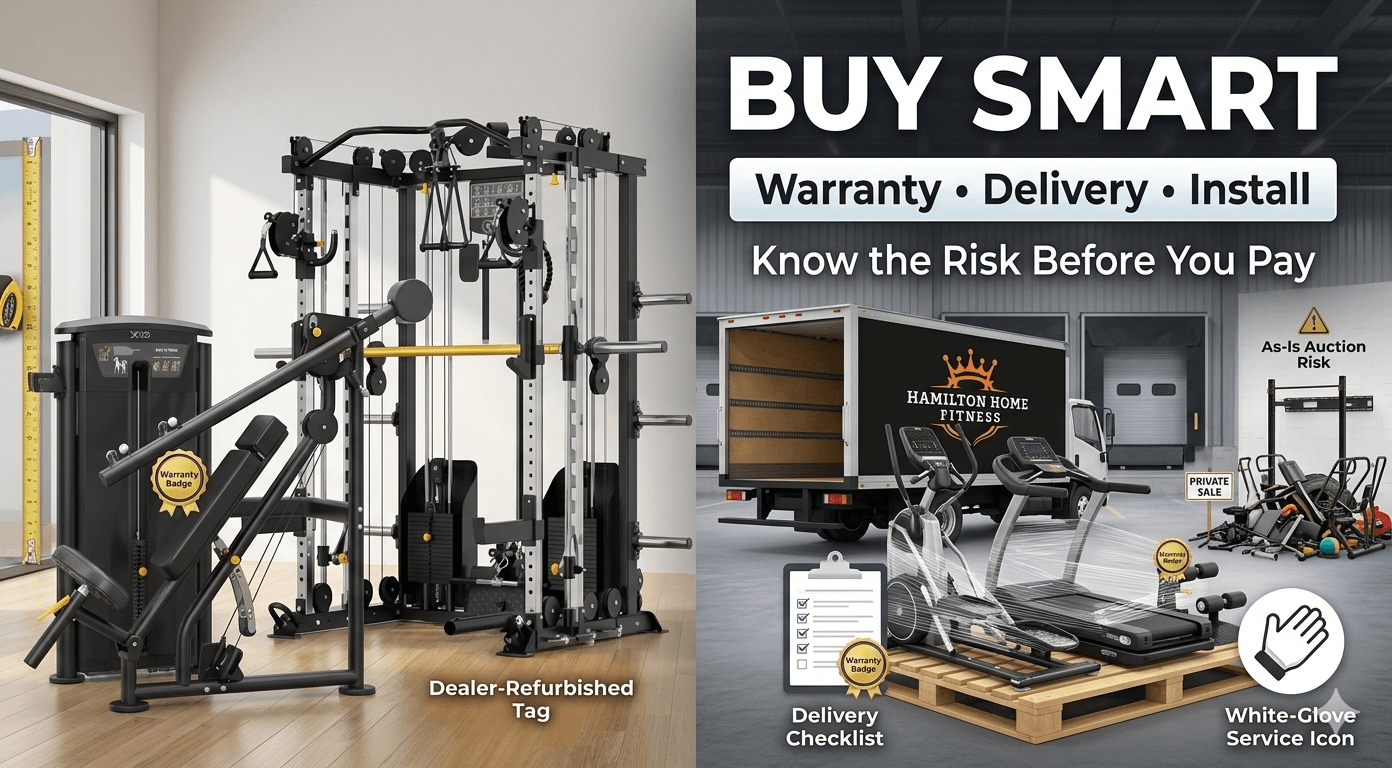
Commercial gear comes from gym liquidations, hotel and multifamily refreshes, corporate and university surplus, lease returns, and dealer trade-ins. The more vetted the channel, the lower your risk.
Each channel trades price against certainty. Refurbishing dealers cost the most but inspect, repair, and stand behind the unit—the easiest path if you'd rather not gamble. Closure auctions and bulk liquidations are cheaper but almost always sold as-is, with condition based on the seller's photos, and you are responsible for dismantling and freight. Private listings on marketplaces can be the lowest price of all, but you're the only inspection the machine gets. Hotel and apartment refresh units are worth seeking out because they're often low-hour. Match the channel to how much risk you can absorb: the cheaper and more as-is the source, the harder you run every check in this guide. When you'd rather skip the gamble, Hamilton's used fitness equipment is inspected and restored before it sells.
Warranty and service support
Factory commercial warranties usually cover only the original buyer and don't transfer, so private used gear typically has none left. Reputable dealers issue their own coverage instead — often 90 days to a year, with extensions available.
This is the part buyers most often get wrong. A machine that shipped with an impressive manufacturer warranty almost never carries that protection to a second owner, and transfer, where it exists at all, depends entirely on the maker's terms. So on an as-is auction or private buy, assume you own every future repair. A dealer-backed warranty changes the math: it puts parts, labor, and a service path behind the unit, which is worth folding into the price you're willing to pay. Third-party and extended contracts exist too, though they commonly exclude consumables like grips, pads, and upholstery—read what's actually covered before you count on it.
Freight, white glove, and install
Heavy commercial units ship by LTL freight, so confirm whether you're getting curbside or white-glove delivery and measure your path of travel before you commit.
Freight is the cost buyers forget until it surprises them. Curbside delivery drops a pallet at the end of your driveway and leaves the rest—moving, assembly, and packaging removal—to you; white glove brings it inside, sets it up, and hauls the debris for more money. Decide which you're paying for up front. Then measure the real route the equipment has to travel: doorways, hallways, turns, elevators, and ceiling height. A power rack or treadmill that won't fit through the door is a logistics problem no inspection catches. Hamilton's shipping and delivery options spell out how this works so there are no surprises on delivery day.
When to Buy New Instead
Buy new when the used unit needs major parts, has no warranty path, isn't available in the spec you need, or anchors a member-facing space where downtime costs more than the savings.
Used wins on simple, sound, rebuildable gear at the right price. It stops making sense the moment the math turns. Run a quick check against four triggers:
The first is repair cost. If the inspection turns up a worn belt and deck, a tired motor, a discontinued console, or cables and bushings due for replacement, add those parts and the labor and freight to the asking price—once that total nears new, the discount is gone and you've bought someone else's problem.
The second is warranty. If the unit is as-is with no coverage and no service path, you're self-insuring every future failure. On a high-use machine, that risk often outweighs the upfront saving.
The third is availability and spec. If you can't find the model, capacity, or finish you need used, or you need a matched set for a facility floor, chasing the right used pieces can cost more time and money than buying new.
The fourth is a role. Where equipment is the centerpiece of the member or resident experience—a CrossFit affiliate's rigs, a hotel or multifamily fitness room, or a paid studio—downtime damages the experience, so reliability and a clean warranty are worth paying for. Save used for secondary zones, overflow, and home setups.
When those triggers point to new, new commercial equipment gives you full warranty coverage and current parts support. And if you're outfitting a whole facility rather than buying piece by piece, a gym design consultation helps you match the right mix of new and used to your space and budget.
FAQ
How long do commercial treadmills last?
Roughly 10–20 years or many thousands of hours when well maintained—but lifespan depends on logged hours and upkeep, not age. Read the console hours before you judge a used unit, since a low-hour machine can outlast a newer one that ran all day in a busy club.
How much does a used commercial cable machine cost?
Commonly a few hundred dollars up to about $2,500 used, depending on the brand, condition, and whether it's a single or dual weight stack. Now, the same machines run from several thousand dollars to $7,500 or more, which is where the used appeal comes from.
Can you buy used hotel gym equipment?
Yes—hotel refresh sell-offs are a common source, and the units are often low-hour because they see lighter use than club equipment. Still inspect for condition as you would any used machine, and confirm no warranty is assumed since these are typically sold as-is.
Is refurbished gym equipment safe?
It can be when a reputable dealer has inspected it, replaced worn parts, and backs it with a warranty. Raw "as-is" used carries more risk because nothing was repaired or guaranteed. The safety difference is in the work done and the coverage offered, not the label.
Should I have a used machine inspected by a technician?
For higher-value cardio and cable machines, yes — a qualified technician inspection or load test is worth the cost. It catches motor, electronic, and structural wear a visual check can miss, and on an expensive unit, that protection easily pays for itself.
Do used commercial machines meet ASTM safety standards?
Standards like ASTM in the US and EN 957 in Europe certify how equipment is designed and built when new, not its condition after years of use. A machine that once met a standard isn't automatically safe today, which is exactly why hands-on inspection still matters on any used unit.
Final Thoughts
A careful inspection turns used commercial equipment from a gamble into a confident decision. You now have a method you can run on the spot—judging frame integrity, cardio wear, cable safety, and free-weight condition—and clear rules for when a used unit is a smart buy versus when new is the smarter spend.
The pattern holds across every category: simple, structurally sound gear at the right price is where used wins, while high-hour cardio, worn cables, no warranty, or a member-facing role is where new earns its premium. Inspect first, price in the repairs and freight, and let the machine's real condition—not its looks or its model year—make the call.
When you want help finding inspected units, sourcing a specific machine, or deciding between used and new for your space, contact the Hamilton Home Fitness team.