Introduction
If you're opening or refreshing an outpatient rehab clinic, your equipment has to serve post-surgical, cardiac, neurological, and geriatric patients—safely, accessibly, and within a real budget. Most checklists hand you a flat list, but the decisions that matter come later: what to buy in each category for your caseload, how to keep every station ADA-accessible, and how to source it all without stitching together a dozen vendors. At buildout the capital is already committed, so the wrong cardio or layout becomes a safety and access problem you've paid for.
This physical therapy clinic equipment guide covers the core categories; how to choose within each for your patient mix; an ADA-aware layout; the warranty and service reality of clinical-use equipment; and honest cost ranges—built around sourcing the full kit from one commercial partner, Hamilton Home Fitness, so you can scope a complete buildout instead of chasing parts.
Core PT clinic equipment list
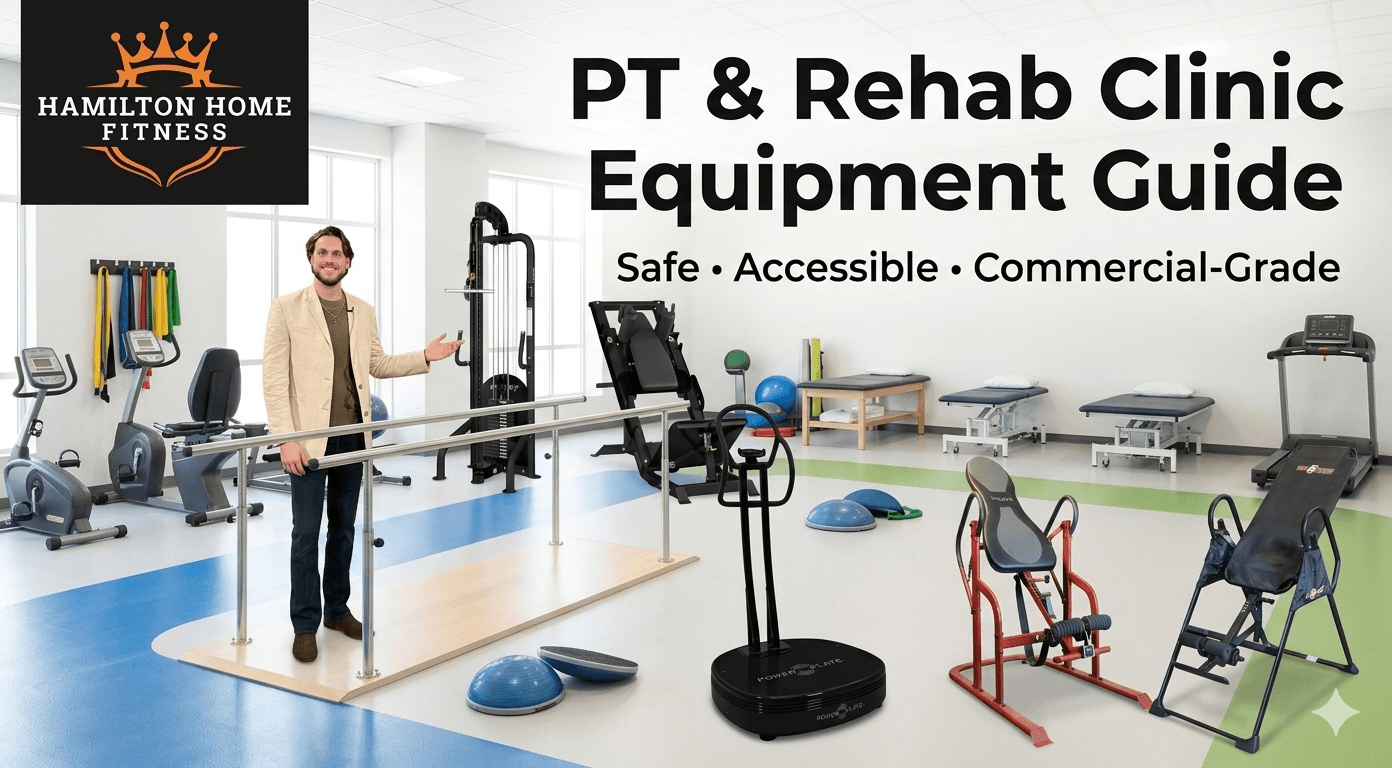
Every outpatient PT clinic needs six core categories before you specialize: low-impact cardio, scalable strength and functional trainers, balance and mobility tools, treatment and mat/hi-lo tables, gait training and parallel bars, and supporting accessories. Get these in place and you can treat most caseloads; everything after is tuning for your patient mix.
Use this as your starting rehab clinic equipment list:
Low-impact cardio — recumbent steppers, step-through recumbent bikes, upper-body ergometers, and low-step-on treadmills for warm-ups and conditioning.
Strength and functional trainers—a dual-adjustable pulley or cable column plus a seated or iso-lateral leg press for graded loading.
Balance and mobility tools — balance pads, BOSU, wobble boards, foam rollers, bands, and light dumbbells.
Treatment and tables—treatment plinths, mat tables, and a high-low table for transfers and hands-on work.
Gait and parallel bars — adjustable parallel bars and gait-training space for ambulation and fall recovery.
Accessories — mirrors, mats, medicine balls, ankle weights, and storage to keep the floor usable.
You can browse equipment organized this way through Hamilton Home Fitness's rehab equipment categories. The next sections cover how to choose within each, starting with the cardio decisions that carry the most patient-safety weight.
Low-impact cardio for rehab
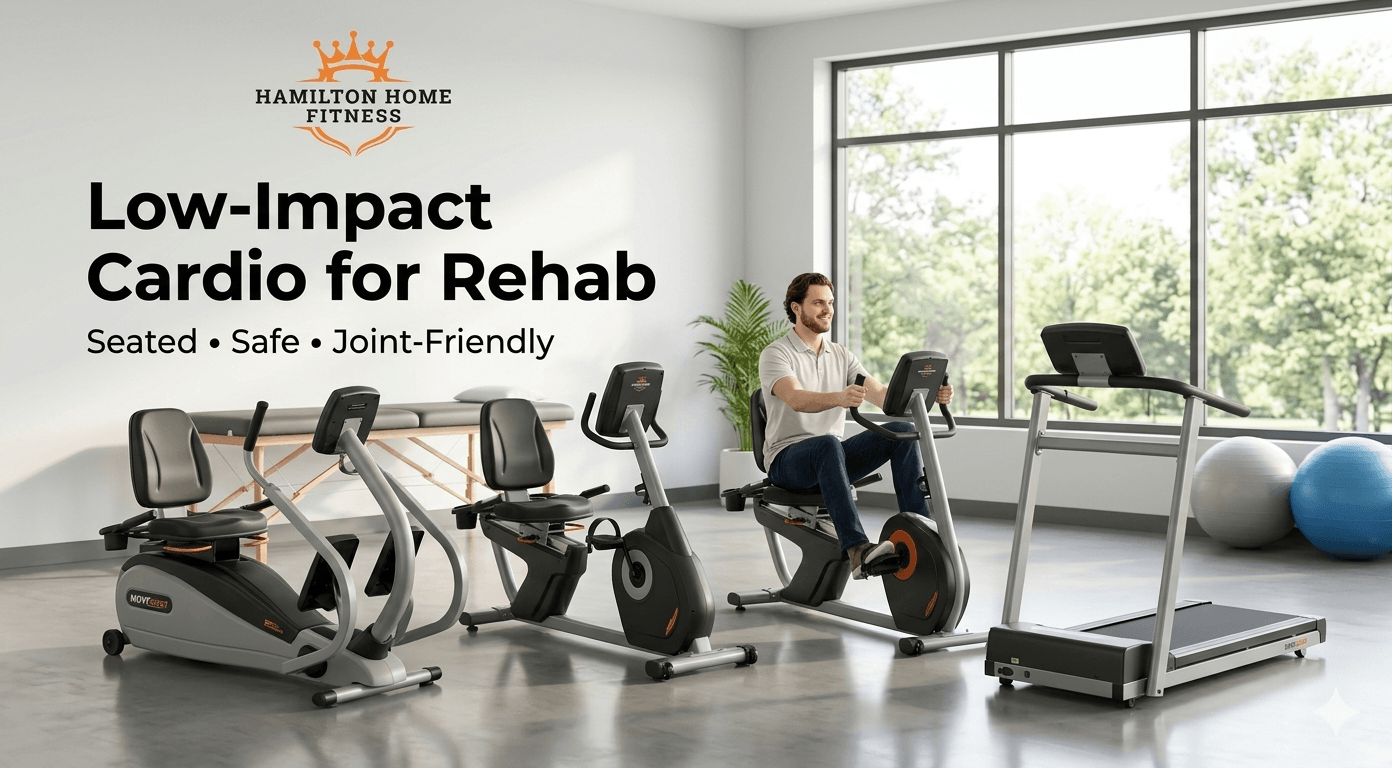
The safest rehab cardio is seated, low-entry, and joint-friendly—recumbent steppers, step-through recumbent bikes, upper-body ergometers, and low-step-on treadmills. Choose by patient population, and set intensity to recognized clinical guidance such as AACVPR and ACSM rather than a fixed in-house protocol.
Recumbent stepper vs recumbent bike
A recumbent stepper drives both arms and legs in a seated position; a recumbent bike isolates the legs—the choice depends on whether the patient needs total-body or lower-body work. A recumbent cross trainer (total-body trainer) uses contralateral arm-and-leg motion, so a patient can lean on a stronger side and still get a full cardiovascular and light-strength session. A recumbent bike is simpler and lower-skill, which suits steady lower-limb conditioning and early knee or hip work.
Both should have a step-through frame and low starting force, and better models add a swivel seat for safe transfers. Check weight capacity if you treat bariatric patients. You can view current options in the rehab cardio machines category.
Cardio for cardiac and pulmonary rehab
Cardiac and pulmonary rehab favor seated machines with low starting resistance, easy transfers, and steady, monitoring-friendly pacing. Post-MI and COPD patients need cardio they can begin gently and stop safely, and a swivel-seat transfer lowers fall risk for deconditioned or unsteady patients.
Pace work to perceived exertion (RPE/Borg) under your clinical protocol and the relevant AACVPR or ACSM guidance—the equipment supports the program; it doesn't replace clinical judgment. Step-through recumbent bikes and low-step-on treadmills are readily available; clinical recumbent steppers and upper-body ergometers are usually best specced through a consultation so you match the model to your caseload and budget.
What a NuStep-style trainer does
A NuStep-style recumbent cross trainer gives a seated, low-impact, total-body cardio and strengthening workout used across PT, cardiac, neurologic, and geriatric rehab. Its low step-through and 360-degree swivel seat make transfers safe for wheelchair users and unsteady patients, and the synchronized arm-and-leg motion lets a patient compensate with a stronger side—which is why it appears in stroke recovery, joint-replacement therapy, and active-aging programs.
It's the category reference point when you want one machine that covers the widest range of abilities. If you want a recumbent stepper specced for your clinic, scope it through a buildout consultation alongside the rest of your cardio mix.
Functional trainers and cable columns
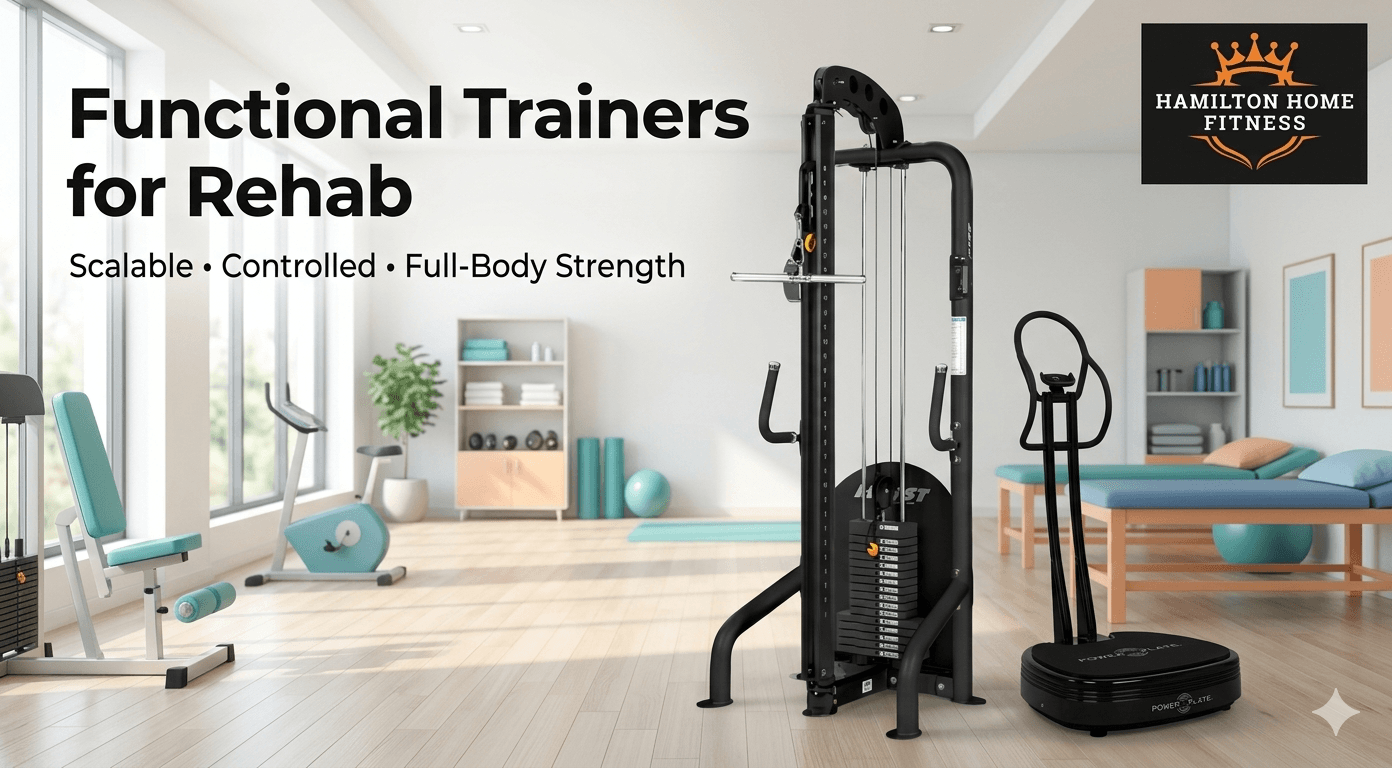
For scalable, full-body rehab strength, choose a dual-adjustable pulley or cable column for the widest progression range—from light, assisted patterns to fully loaded—and add a seated or iso-lateral leg press for controlled lower-body work. One cable system covers most upper- and lower-body rehab loading without crowding your floor.
Cable column vs functional trainer
A cable column is a single adjustable stack; a functional trainer pairs two, enabling bilateral and offset patterns at light, repeatable loads. The dual setup matters in rehab because you can train each side independently, run scapular and rotator-cuff drills at very low resistance, and progress lat pulldowns and low rows on the same frame.
Look for many height positions on each column so you can match a patient's range of motion and smooth low-end resistance so the first loaded reps aren't a jump. You can see clinic-suitable options in the commercial functional trainers category.
Building rehab progressions
One functional trainer can carry a patient from assisted, light-band work to fully loaded patterns without swapping machines. Start with mini-bands or the lightest cable setting for early range and motor control, then add load and unilateral patterns as strength and tolerance return — all on the same station.
That continuity is what makes a cable system efficient for a clinic: more capability per square foot, fewer machines to maintain, and a clear path from early rehab to return-to-function.
Balance and mobility tools
Every modern PT clinic needs a small-equipment kit for proprioception, gait, and mobility: balance pads, a BOSU, wobble or balance boards, foam rollers, resistance bands, light dumbbells, and medicine balls. These are low-cost, high-use items that show up in nearly every treatment plan.
Group them by purpose:
Proprioception and stability—balance pads, BOSU, wobble, and balance boards for ankle, knee, and post-injury control work.
Fall prevention and gait-balance tools paired with parallel bars and open floor space for unsteady neuro and geriatric patients.
Mobility and soft tissue—foam rollers, lacrosse or peanut rollers, and bands for range of motion and self-release.
Light loading — mini-bands, light dumbbells, ankle weights, and medicine balls for early strengthening and dynamic warm-ups.
Buy these in multiples and a range of resistances so several patients can train at once. They're best sourced as part of a full clinic kit rather than piecemeal—a buildout consultation can fold them in alongside your cardio and strength stations so nothing gets missed.
Planning an ADA-accessible layout
Under the 2010 ADA Standards (Sections 206, 236, and 1004), at least one of each type of machine must have clear floor space positioned for transfer or wheelchair use, and that equipment must sit on an accessible route. "Type" is defined by the muscle group or kind of cardio, so one accessible cardio machine, one accessible cable station, and one accessible leg machine—each reachable—are the baseline to design around.
A few practical points that follow from the standard:
Clear floor space can be positioned for a side transfer (next to the seat) or centered on the controls, depending on how the machine is used. Adjacent spaces are allowed to overlap or be shared between two machines, which saves room.
Accessible routes must connect the entrance, accessible stations, and treatment areas with enough width and turning space for a wheelchair to move and reposition.
Transfer-friendly equipment—step-through frames, swivel seats, and low step-on heights—makes the accessible stations genuinely usable, not just compliant on paper.
Source these requirements from the U.S. Access Board and ADA.gov, which publish the official standards. One important limit: this is design guidance, not a compliance guarantee. Confirm your specific floor plan with a licensed architect or ADA specialist before you build, since dimensions, routes, and local requirements vary by site.
Equipment by patient population
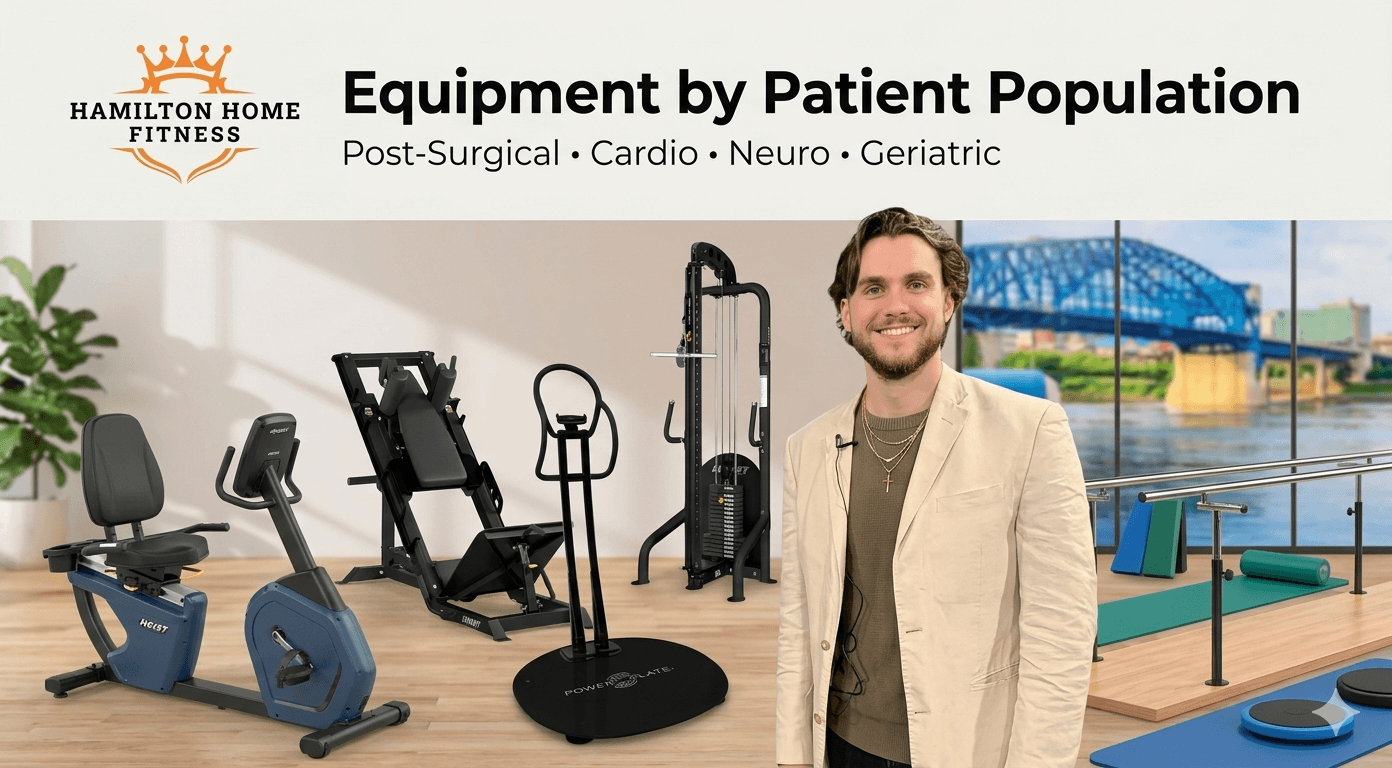
Equip by caseload, not by a generic list. Post-surgical patients need controlled loading and safe transfers; cardiac and pulmonary patients need seated, low-impact cardio; neurologic and geriatric patients need stability, gait, and fall-prevention tools. Map your purchase to the patients actually walking through your door.
Post-surgical: knee, hip, shoulder
Post-op knees and hips need controlled, seated lower-body loading; shoulders need light cable and band progressions. After a total knee or hip replacement or an ACL reconstruction, a seated leg press lets you load the joint through a safe, supported range and dial resistance precisely as tolerance returns. Pair it with a recumbent bike for early range of motion and gait practice as patients progress.
For rotator-cuff repairs and frozen shoulder, the cable column carries the work—scapular drills and external rotation patterns at very low resistance, scaled up over time. You can match these needs to seated leg press options for the lower-body side of the bay.
Cardiac and pulmonary rehab
Cardiac and pulmonary bays run best on step-through recumbent bikes and seated cardio with easy on- and off-ramps. Post-MI and COPD patients need to start gently, stay within a monitored intensity, and transfer without strain—so a low step-through frame and a swivel seat do real safety work here, not just comfort.
Keep these stations close to where you monitor patients, and choose machines with low starting resistance so the first minutes are manageable. Spirit step-through recumbent bikes are a confirmed option for this population.
Neurologic and geriatric rehab
Neuro and geriatric caseloads center on balance, gait, and fall-prevention tools plus accessible seated cardio. These are your highest-fall-risk patients, so the kit leans toward stability and ambulation:
Parallel bars for supported gait training and ambulation practice.
Balance pads, BOSU, and boards for graded proprioception and standing-balance work.
Recumbent steppers or step-through bikes for safe, total-body conditioning from a seated start.
Open, uncluttered floor space for gait, transfers, and supervised fall recovery.
Stroke survivors and vestibular patients benefit from the total-body, compensate-with-your-stronger-side design of a recumbent cross trainer, which keeps cardio accessible even with significant one-sided weakness.
Commercial build, warranty and service
Yes, PT clinics rely on commercial-grade equipment—clinical duty cycles destroy consumer gear, so the durability and support behind a machine matter as much as the machine itself. A treadmill or cable station that runs all day, every day, under patients of every size and ability is a different purchase than a home unit, and buying down to a consumer spec usually costs more in downtime and replacement.
What to expect, and what to prioritize:
Commercial frame and parts coverage — clinical-use warranties on the frame and mechanical components, not residential terms. Confirm the coverage on each model before you buy.
Available service plans — a path for preventive maintenance and repairs so a down machine doesn't sideline a treatment bay.
Freight and white-glove delivery—heavy clinical equipment needs proper freight, and room-of-choice or white-glove installation spares your staff the setup.
Look for a supplier that documents this support rather than leaving it vague. Hoist, for example, is a brand that spells out its commercial warranties and service options — you can review the Hoist warranty and service support details as a benchmark for what "clinical-grade" should include. Treat warranty and service as part of the purchase decision, not an afterthought.
What it costs to equip a clinic
Equipping an outpatient clinic commonly runs $30k–$200k inside a total startup of roughly $100k–$500k depending on size and specialty. Commercial cardio typically lands around $3k–$7k per unit and treatment tables around $500–$2k each, with modalities adding more. Treat equipment as a phased investment—start with the core stations and expand as caseload grows—and get exact numbers from a quote rather than a sticker.
A rough way to tier it:
Essential floor—one or two cardio machines, a functional trainer, a leg press, treatment and mat tables, and a balance/mobility kit.
Full clinic—multiple cardio types for different populations, added strength stations, parallel bars, and a hi-lo table.
Specialized — population-specific cardio (recumbent steppers, upper-body ergometers) and extra capacity for higher patient volume.
You can see representative commercial cardio equipment pricing to ground your budget, then request a private quote for your exact build. Clinics adding contrast therapy can also fold in optional recovery suites: saunas and cold plunge—useful for sports medicine and athletic recovery programs, though not a core clinical requirement.
FAQ
Should a PT clinic buy or lease its equipment?
Buying suits, durable big-ticket items you'll use for years; leasing preserves cash and suits fast-changing or high-maintenance gear. Many clinics blend both—purchasing core cardio and strength stations while leasing items they may upgrade sooner.
How long does commercial rehab equipment last?
Commercial-grade cardio and strength typically run for many years under clinical use with routine maintenance. Plan a maintenance and replacement cadence from day one, since lifespan—not the sticker price—drives the true cost of ownership.
How much floor space does each equipment station need?
Plan for the machine's footprint plus clear floor space for transfer or wheelchair use, and account for accessible routes between stations. Layout determines both patient throughput and ADA accessibility, so map it before you buy.
Final Thought
A well-equipped outpatient clinic is built by patient population and accessibility, not by copying a generic list. Choose safe low-impact cardio, scalable functional strength, real balance and mobility tools, and an ADA-aware layout—then buy commercial-grade with service behind it. The takeaway is simple: match equipment to your patients and your space first, and price follows from there.
When you're ready to turn this kit into one accessible build-out, book a clinic gym design consultation with Hamilton Home Fitness—a multi-brand commercial source that can spec your cardio, strength, balance, and optional recovery from a single quote.