Introduction
Choosing gym gear can feel confusing. A functional trainer with a Smith machine mixes a guided Smith bar and a cable-based functional trainer into one frame. It promises safety for solo lifts, many exercise options, and smart space use. But which setup best fits your goals: a hybrid, a power rack, or free weights?
This guide from Hamilton Home Fitness gives clear answers. We explain what a hybrid does, who benefits, and the trade-offs you should know. You will find simple rules for programming, safety tips, space and cost checks, and buying advice. We also walk you through demos, setup, and long-term care so you avoid common mistakes.
Read the fast verdict to decide quickly. Then dive into full sections that cover comparisons, workouts, features, models, and local buying help. Every section answers real questions lifters and gym owners ask. By the end, you will know if a functional trainer with a Smith machine fits your home gym, studio, or commercial space—and how to choose one that works for you. We share buying tips, common pitfalls, and a simple checklist so you get the right machine the first time. We also show how to fit the machine in any room and save money.
Hybrid: Functional Trainer + Smith
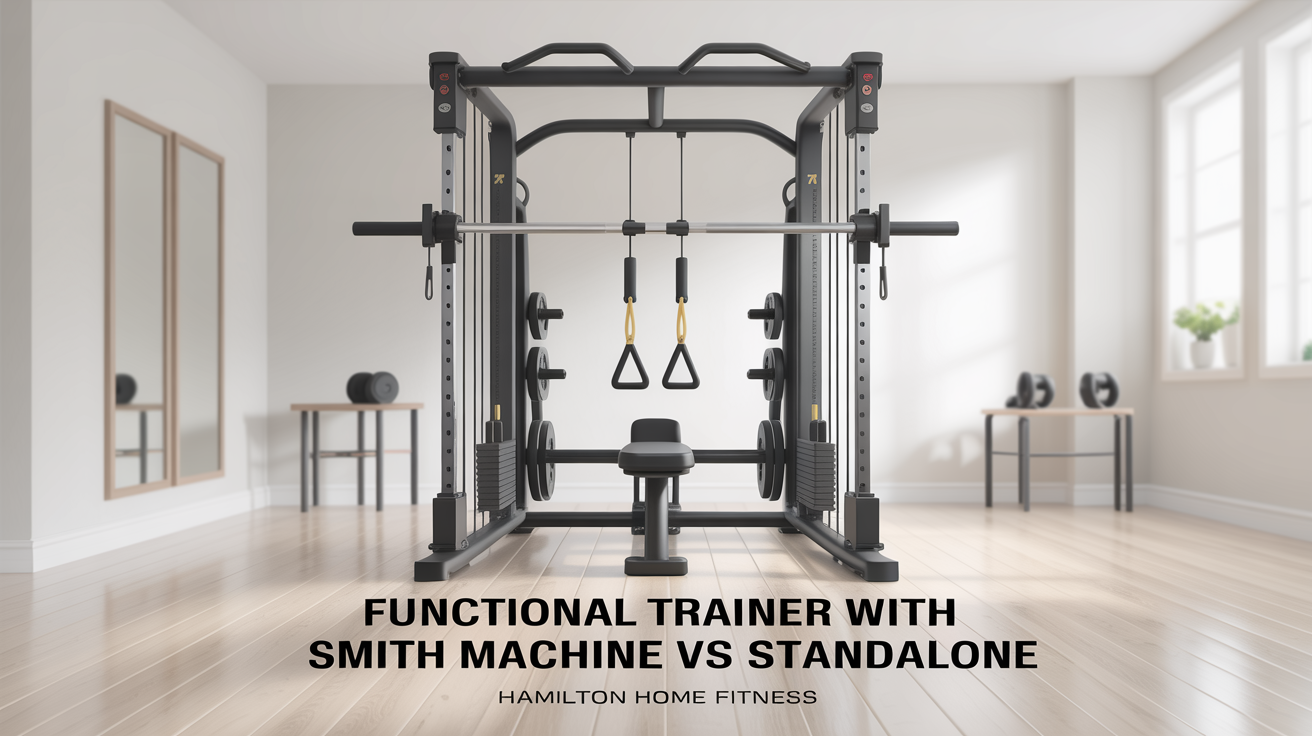
A hybrid unit blends a guided Smith bar and a cable-based functional trainer into one frame. It gives you both guided bar work and freestyle cable moves. This makes it a true all-in-one station for many goals.
What it is and key parts
A hybrid has a Smith bar on rails, twin pulley columns, and one or two weight stacks. It often adds an adjustable bench, pull-up bar, and multiple attachment points. Common attachments include handles, a lat bar, ankle straps, and landmine adapters.
Who benefits and use cases
Beginners and solo lifters get safe, guided lifts without a spotter. Home gym owners save space by replacing several machines. Small studios and boutique gyms use hybrids for circuits and group classes. Rehab clients and older adults benefit from controlled motion and cable rehab options.
Pros and cons at a glance
Pros:
- Saves floor space by combining stations.
- Safer for solo heavy sets thanks to guided bar locks.
- Wide exercise range with cables and bar work.
Cons:
- Less natural bar path than a free barbell for some lifts.
- Usually pricier than a single dedicated machine.
- Not ideal for true Olympic lifting or max free-weight work.
A hybrid is a smart middle ground. It trades some free-bar freedom for safety and variety. If you want one machine that handles strength, function, and rehab, a hybrid often fits the bill.
Hybrid vs Standalone Equipment
Choosing between hybrid and standalone gear depends on goals, space, and training style. Below are the core trade-offs to help you decide quickly and clearly.
Hybrid vs free weights
Free weights give the most natural bar path and prime stabilizer muscles. They are best for heavy squats, deadlifts, and Olympic lifts. Hybrids trade some freedom for guided safety. The Smith bar helps solo lifters push heavier without a spotter. Cables add constant tension and smooth resistance. If you want raw, unrestricted strength work, keep a free bar. If you need safety, variety, and accessory work in one footprint, a hybrid wins.
Hybrid vs power rack
Power racks are the gold standard for heavy barbell training and max lifts. They let you use full ranges and custom rigs like monolifts. Hybrids give you a guided bar plus cable options in a single frame. That makes them better for circuit training, personal training studios, and multi-user spaces. For pure strength athletes, a rack is essential. For studios and home gyms that need multi-functionality, a hybrid is often more practical.
Space, cost, and ROI
Hybrids typically cost more than one rack but less than buying a rack plus a full cable station. They save floor space by replacing multiple machines. For commercial buyers, a hybrid can raise utilization and reduce maintenance. Home buyers get value from fewer purchases and faster workouts. Consider used commercial deals and modular systems to cut costs. Measure your room height, footprint, and budget before buying. For a tailored fit, Hamilton Home Fitness can help match models to your space and goals.
Workouts, Programming & Results
A hybrid unit handles many goals. You can train for strength, size, function, or rehab. Use the Smith bar for heavy, controlled lifts and the cables for steady tension and single-side work. Mix both every week for balanced results.
Exercises you can do
Smith bar moves: squats, bench press, incline press, split squats, and upright rows.
Cable moves: cable crossovers, single-arm rows, face pulls, triceps pushdowns, and woodchoppers.
Combos and function: landmine presses, cable-assisted pull-ups, single-leg cable lunges, and banded Smith bar lockouts.
You can run circuits, HIIT flows, rehab sets, and full strength blocks all on one frame.
Programming for strength
Use the Smith for heavy, low-rep work (3–6 reps) to drive strength safely. Follow with cable accessory work (6–12 reps) for hypertrophy and joint health.
Plan blocks: 3–6 week strength phases, then 4–6 week hypertrophy phases.
Sample split: heavy lower (Smith squats), heavy upper (Smith bench), and accessory day (cables and single-leg work). Rest 48–72 hours on heavy lifts. Track load, reps, and range of motion to ensure progress.
Safety and biomechanics tips
The Smith bar follows a fixed path. Adjust foot position to mimic a natural bar path for squats and presses. Use cables to train stabilizer muscles and full range of motion.
Set safety stops and use lock points on the Smith for unspotted sets. Warm up with light cable rows and band work. Keep knees soft on squats and retract the shoulder blades on presses.
For rehab or seniors, use low loads and higher reps with cables to rebuild control and mobility. If unsure, get a coach to check form before increasing weight.
Buy, Fit, Cost, and Maintenance
Buying a hybrid needs a plan. Think size, installation, budget, and long-term care. Measure first. Test before you buy. Check service and warranty. Below are clear steps to make the right buy and keep the machine working for years.
Sizing, installation & demo
Measure room length, width, and ceiling height. Add 2–3 ft of clearance for Smith travel and cable arcs. Check doorways, stair access, and garage clearance for delivery. Ask for a demo. Press, squat, and run cable moves in a showroom. Try different foot positions on the Smith. Choose white-glove delivery or pro installation for heavy commercial units.
Top models and alternatives
Compare three tiers: budget, mid-range, and commercial. Key specs: Smith bar type (counterbalanced or not), weight stack size, pulley count, and warranty. Alternatives: a power rack + cable trainer, modular systems that grow, or used commercial hybrids. Match the model to your goals: Heavy bar work favors a rack; variety and safety favor hybrids.
Warranty, service, upkeep
Check frame, parts, and cable warranties. Ask if dealers stock spare parts in the US and offer local service in Tennessee. Inspect cables and pulleys yearly. Lubricate Smith guide rods and tighten bolts quarterly. Replace frayed cables immediately. Keep a service log with dates, parts, and costs. For peace of mind, ask dealers about on-site maintenance plans and parts availability—that saves downtime and extends machine life.
Hamilton Home Fitness can help you demo models, arrange installation, and set up a maintenance plan that fits your space and budget.
Final Thought
A functional trainer with a Smith machine is a smart, space-saving choice for many lifters. It blends guided bar work and cable training. That mix gives safety, variety, and fast workouts for home gyms, studios, and rehab use.
This hybrid is not perfect for every goal. If you chase raw free-bar power or Olympic lifts, keep a power rack and barbell as your base. But if you want safe solo lifting, broad exercise options, and fewer machines in your room, the hybrid often wins. Choose the setup that fits your training plan, space, and budget—not the hardest sell.
At Hamilton Home Fitness, we match buyers to the right models, help arrange demos, and handle delivery and service across Tennessee and nationwide. Try a demo, use our buyer checklist, or ask for a custom quote. We’ll help you pick a machine that lasts, fits your goals, and makes every workout count.