Introduction
If you already own a rack, a bench, and free weights, a functional trainer is the piece that adds smooth cable work — rows, face pulls, lateral raises, triceps, woodchops, and rehab — to the setup you've built, whether that's a home gym or a facility.
The problem is that most trainers look nearly identical on paper, while the specs that decide the purchase — cable ratio, stack range, pulley spacing, attachments, and fit — are easy to misread, so it's easy to overpay or buy a machine that won't fit your space or keep up as you get stronger.
This guide shows you how to read those specs and match a trainer to your space and goals, then where Hoist and Body-Solid fit within our premium home workout machines.
The 6 specs that decide your purchase
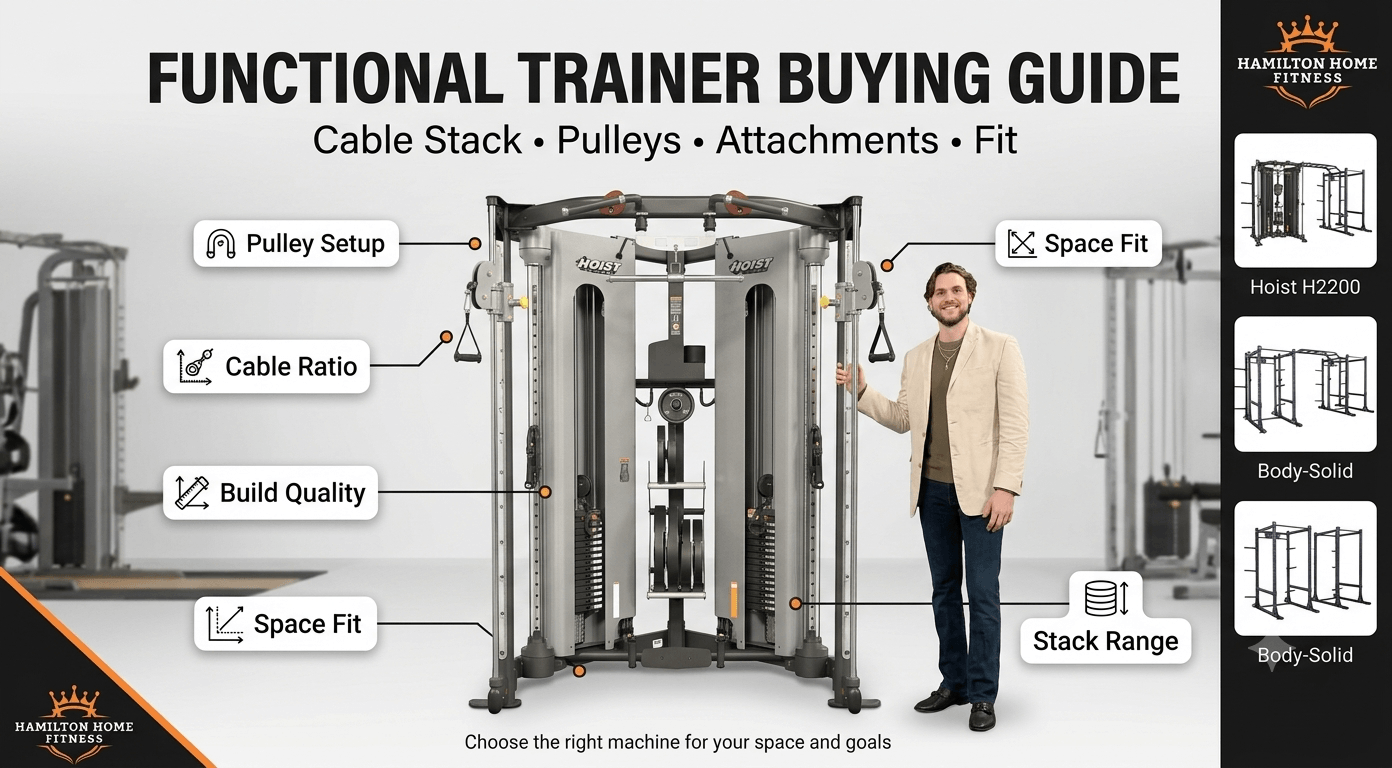
The six things that actually decide a functional trainer are cable ratio, stack range, pulley spacing, pulley height and range of motion, included attachments, and fit—footprint, ceiling, and build. Get these right, and the rest is detail.
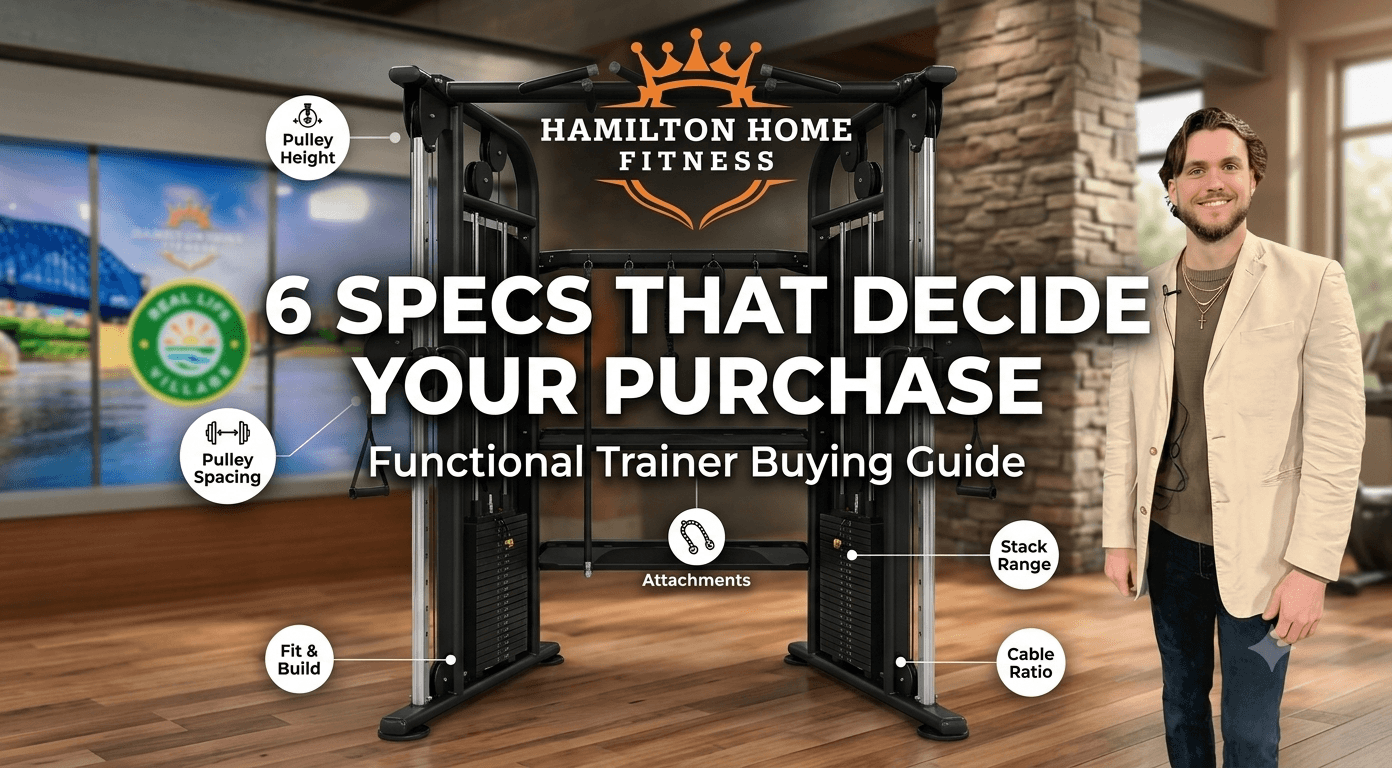
Cable ratio sets how much of the stack you feel at the handle. A 1:1 gives the full weight; a 2:1 gives about half with double the cable travel.
Stack range is the resistance you can actually use, after ratio—not the number printed on the plates.
Pulley spacing is how far apart the columns sit, which decides how well wide moves like chest flys and crossovers feel.
Pulley height and ROM come from how many height positions the column offers and how far the cable travels.
Attachments are the handles and bars included in the box versus the ones you'll buy later.
Fit is whether the machine clears your ceiling, fits your floor, and is built to last in your setting.
The rest of this guide takes each one in turn.
Cable ratio: 1:1 vs 2:1 vs 4:1
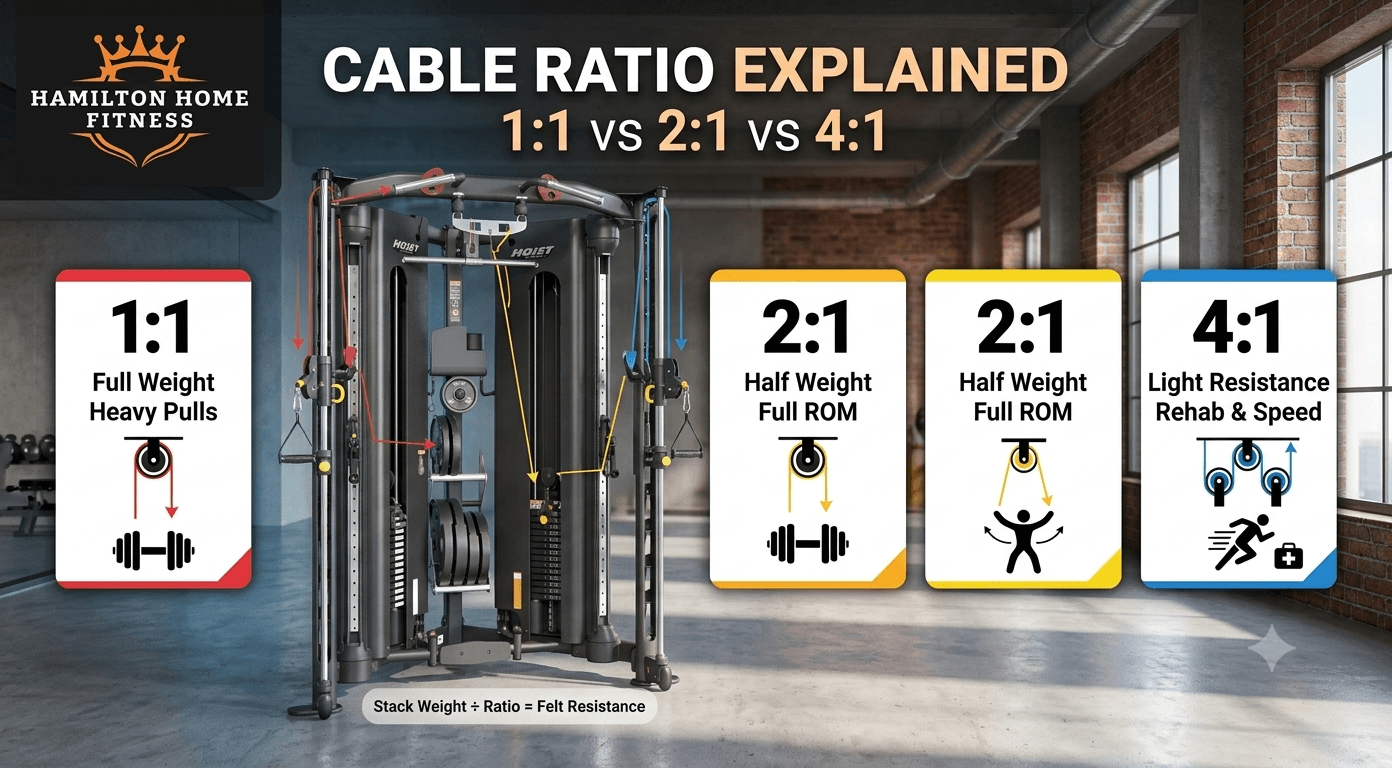
Cable ratio decides how much of the stack you actually feel. A 1:1 gives you the full weight with shorter cable travel, a 2:1 gives about half the weight with double the travel, and a 4:1 is lighter still. To estimate the resistance at the handle, divide the stack weight by the ratio.
Ratio | Felt resistance from a 200 lb stack | Cable travel | Best for |
1:1 | ~200 lb | Shortest | Heavy pulldowns and rows, max strength |
2:1 | ~100 lb | About double | Full-ROM functional work, flies, chops, general training |
4:1 | ~50 lb | About quadruple | Light, long-range speed and rehab work |
This is why stack weight alone never tells the whole story: the same 200 lb stack feels completely different depending on the ratio.
What a 2:1 ratio means
On a 2:1 trainer, a 200 lb stack delivers about 100 lb at the handle, and the cable travels twice as far. Some brands print this as "2:1" or "split weight cabling," others as ""1/2:1"—both describe the same setup, where the mechanical advantage halves the load and lengthens the range.
The practical upshot: a "160 lb stack" on a 2:1 trainer gives you roughly 80 lb of resistance, not 160. The trade-off works in your favor for most training—you get longer cable travel for a full range of motion, finer half-plate increments for dialing in resistance, and a lower starting weight that suits lighter movements.
When 1:1 is the better pick
Choose a 1:1, or a dedicated 1:1 lat and low-row station, if your priority is heavy pulldowns and rows. With a 1:1 system, the weight you select is the weight you pull, so you can keep loading for progressive overload without running out of stack.
The simple rule: heavy pulling favors 1:1, while range of motion and finer increments favor 2:1. You don't always have to choose—many trainers pair 2:1 adjustable columns with a 1:1 dedicated pulldown or row stack, giving you both in one machine.
Weight stack range by training goal
Most home users are well served by dual 150–200 lb stacks on a 2:1 trainer—that's roughly 75–100 lb of felt resistance per side, enough for the large majority of cable work. The stack you need depends on your goal and the ratio, not the number printed on the plates.
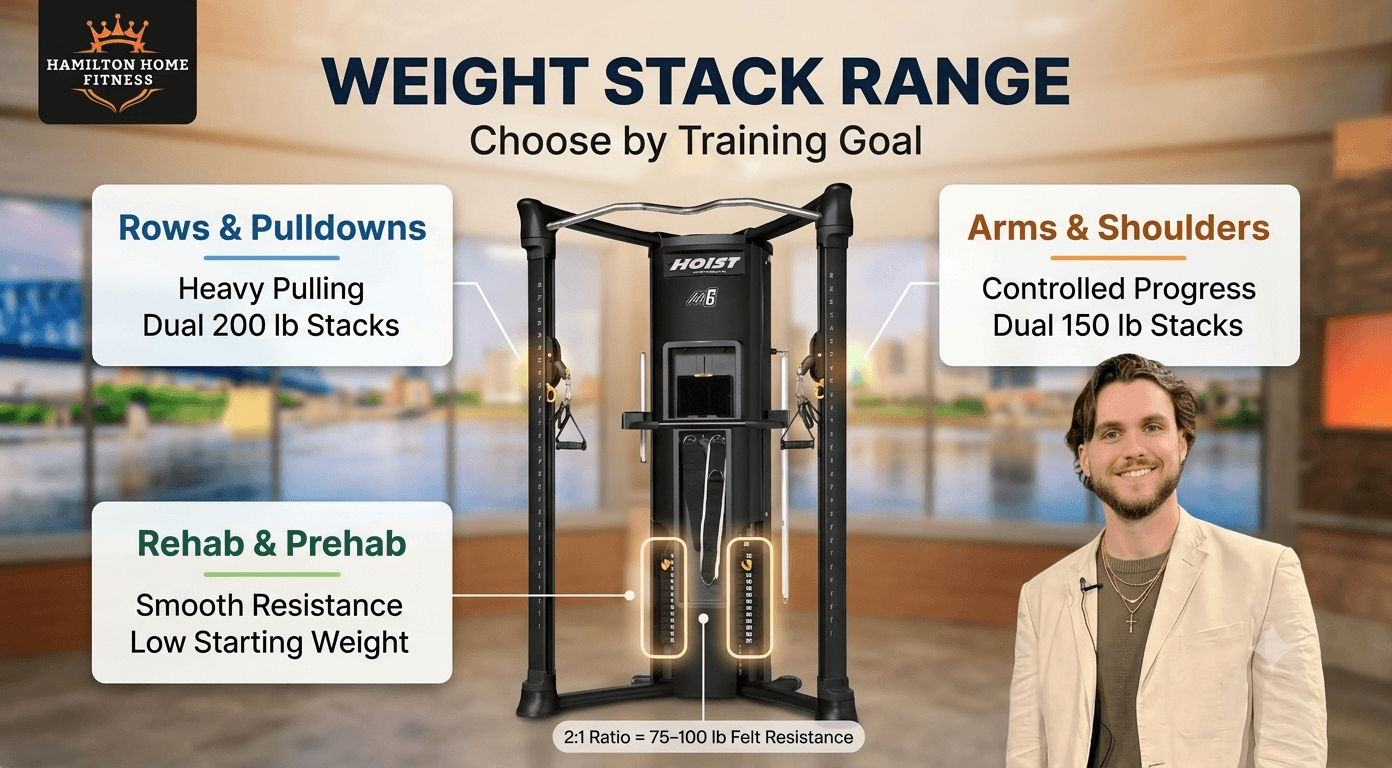
Match the range to what you train:
Rows and pulldowns: This is where you'll want the most weight. On a 2:1 trainer, lean toward dual 200 lb stacks (or upgradable ones) so heavy pulling doesn't top out; if max-effort back work is the priority, a dedicated 1:1 station is the stronger answer.
Triceps, curls, and lateral raises: Lighter by nature. Dual 150 lb stacks on a 2:1 system give plenty of usable load, and the smaller half-plate increments make it easy to progress these smaller movements.
Rehab and prehab: Here, low and finely adjustable resistance matters more than a big number. A 2:1 (or higher) ratio with a low starting weight and smooth feel suits controlled, joint-friendly work — useful for shoulder health, posture, and recovery. Pair this with the rest of your rehab and recovery equipment for a complete corrective setup.
Two stack-related details are worth weighing. Dual stacks let each arm work independently and let two people train at once, which is the standard on true functional trainers. And upgradable stacks are cheap insurance: buying a trainer that accepts a stack increase later means the machine can grow as you get stronger, rather than capping your progress.
Note on rehab and recovery work: a functional trainer can support gentle, low-load movement, but it isn't a substitute for professional care—anyone training around an injury should follow guidance from a physical therapist or qualified clinician.
Pulley spacing, height, and ROM
Buyers often blur three separate things. Pulley spacing is how far apart the two columns sit, which decides how well wide moves like chest flys and crossovers feel. Pulley height is how many positions the cable can lock into along the column. And range of motion comes mostly from cable travel — how far the cable pays out per rep. Wide spacing favors big-arc movements; narrow spacing handles chops, presses, and single-arm work; and more height positions plus longer travel mean a more usable range.
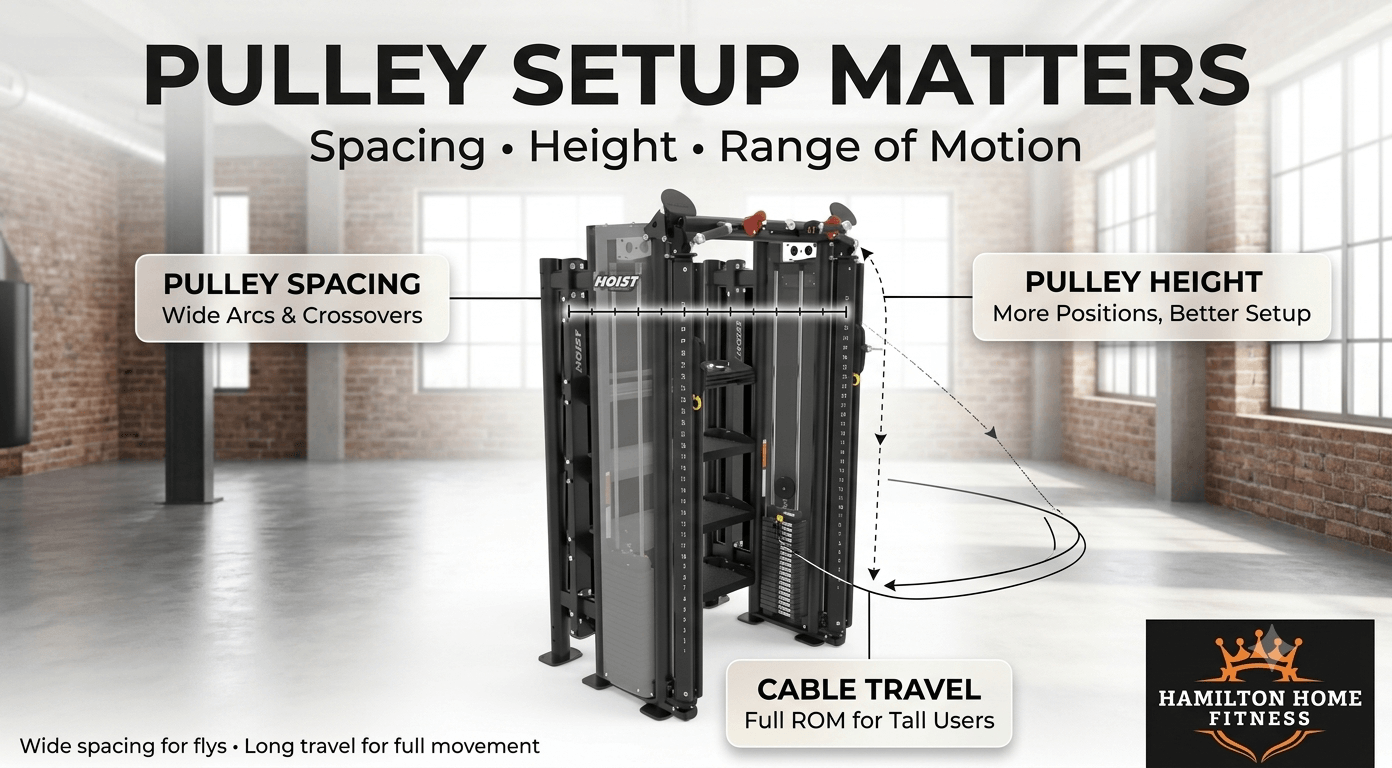
Here's how the setup maps to the movement:
Wide-arc work (chest flys, full crossovers): rewards wide column spacing.
Rotational and core work (woodchops, Pallof presses): fine on narrow spacing.
Pulling and pressing (rows, presses, single-arm work): unaffected by spacing.
Full-range and overhead movements: depend on long cable travel and high pulley positions.
Spacing for crossovers and chops
Wide-stance crossover machines suit big-arc flys; a narrower dual-column trainer covers most cable work in less space. A true cable crossover spreads its columns wide—often ten feet or more—to create room for sweeping fly and crossover arcs, which is why it specializes in that one feel.
A standard dual-column functional trainer sits much narrower and trades a little of that wide-fly arc for a far smaller footprint. For woodchops, Pallof presses, single-arm rows, face pulls, and lateral raises, the narrower spacing makes no practical difference. Many trainers also use swivel arms that pivot the pulley outward, widening your effective angles without widening the machine. Unless wide-chest flies are a top priority, the compact trainer is usually the better fit for home and most facility spaces.
Cable travel and your height
Taller lifters and full-ROM movements need long cable travel and many height positions. A short cable can "bottom "out"—the weight stack reaches the top and the cable stops paying out before you've finished the rep, cutting your range right where you want a full stretch.
This is felt most by taller users and on long pulls like high-to-low chops, overhead triceps, and full-extension presses. Two specs protect you here: generous cable travel and a high number of pulley height positions, which let you set the start point precisely for each movement. Check both against your height before buying rather than assuming the machine will accommodate your full range.
Attachments a good trainer includes
A quality functional trainer should include the core handles and bars you'll use every session, not force you to buy them separately. Before comparing prices, check what's actually in the box—included attachments are real value, and a low sticker price can hide a short list.
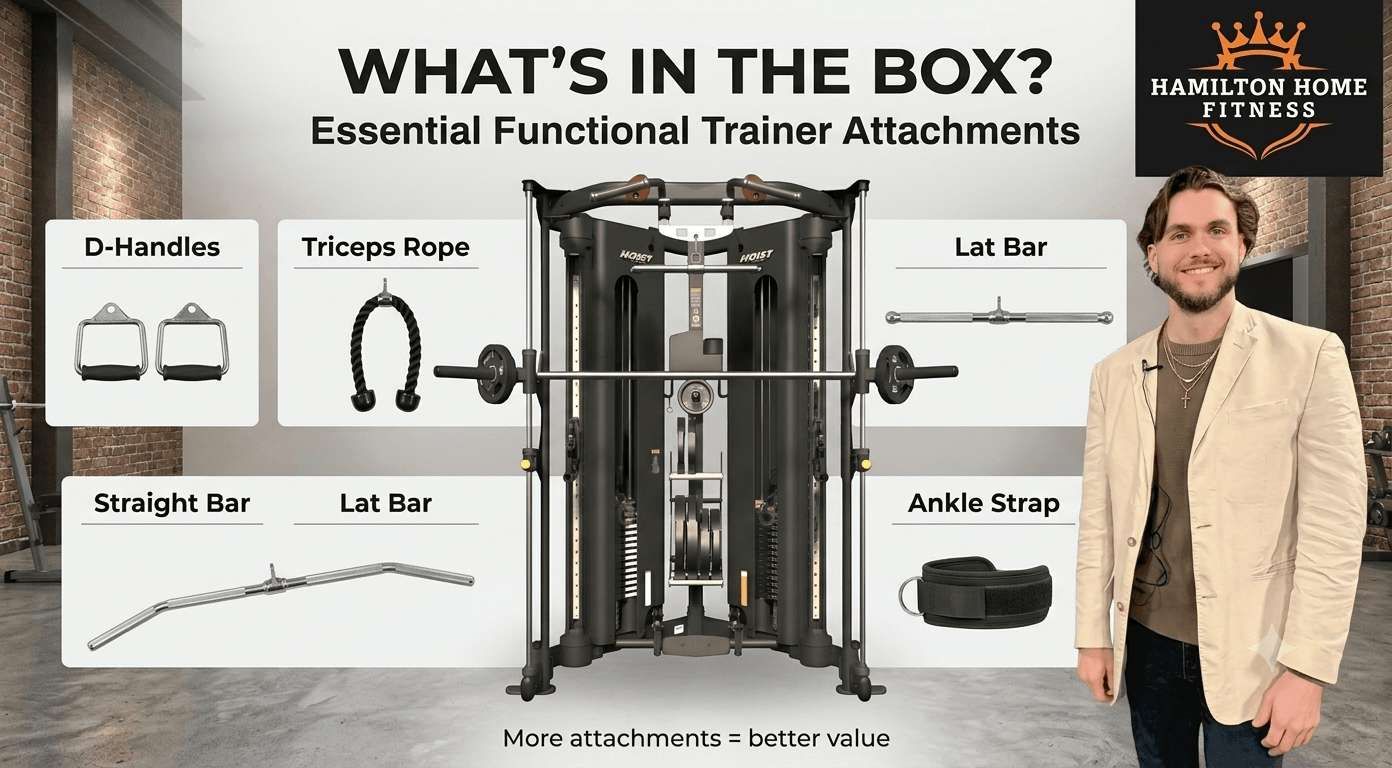
Look for these essentials to come standard:
Single D-handles (a pair): the workhorses for rows, presses, curls, lateral raises, and most single-arm work.
A rope or triceps rope: for pushdowns, face pulls, and hammer curls.
A straight bar: for pushdowns, curls, and upright rows.
A lat bar or long bar: for pulldowns and movements that use both pulleys at once.
An ankle strap: for kickbacks, hip work, and lower-body cable training.
These are common upgrades you can add later rather than deal-breakers:
An EZ or curl bar for more wrist-friendly curls and pushdowns.
A MAG-style handle for a stronger, more comfortable pulling grip.
A multi-exercise bar or specialty grips for variety.
An accessory rack to keep handles organized on the machine.
The takeaway when comparing two trainers: count the included attachments in the price. A unit that ships with the five essentials is often better value than a cheaper one that leaves you buying handles piece by piece.
Footprint, ceiling, and build quality
Before anything else, confirm the machine physically fits and is built to last. Most freestanding trainers need roughly five to seven feet of width and an eight-foot (or taller) ceiling once you add overhead clearance, and the frame gauge, pulley type, and cable construction are what separate club-grade units from entry models.
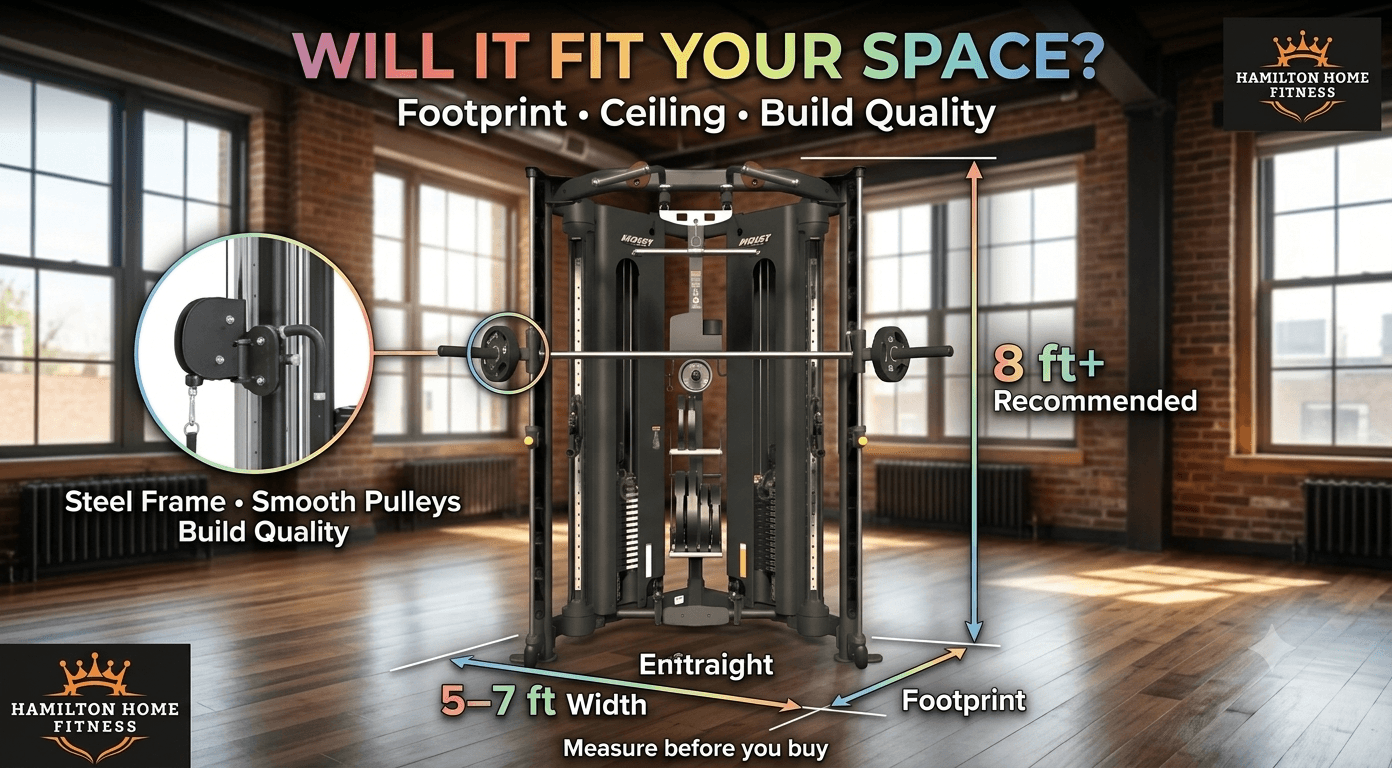
Space and ceiling you need
Add about 12 to 18 inches above the machine's height for safe overhead moves—a roughly 80-inch unit wants about 94 to 98 inches of ceiling. A true eight-foot (96-inch) ceiling is workable for many trainers but tight for taller ones, so measure before you buy rather than after.
Plan the floor space the same way: most trainers want five to seven feet of width, around three to four feet of depth, and two to three feet of clearance behind and to the sides so cables and your arms move freely. If your room is tight, a compact, walk-through, or corner-style unit like the compact Hoist Mi6 fits a smaller footprint without giving up full pulley adjustability.
Frame, pulleys, and cables
Look for heavy-gauge steel, sealed-bearing aluminum pulleys, and coated aircraft-grade cable. These three details do the quiet work of keeping the machine stable, smooth, and quiet for years.
Check each one:
Frame: Heavier-gauge steel (commonly 11-gauge, with 7-gauge on the most robust commercial frames) resists flex and wobble under load. Thin tubing is the first sign of a budget build.
Pulleys: sealed-bearing aluminum pulleys give the smooth, consistent glide that defines a good cable feel; cheaper plastic pulleys wear faster and feel notchy.
Cable: Coated aircraft-grade steel cable, often rated well above the stack weight, holds up to daily use and resists fraying.
Warranty: home vs commercial
Residential use often carries lifetime frame coverage, while light-commercial and full-commercial settings get tiered terms. The same machine can be warrantied differently depending on where it's used, so the warranty needs to match your setting.
A typical pattern looks like this:
Residential (home use only): frequently a lifetime frame or structural warranty, with shorter terms on parts, cables, and upholstery.
Light commercial (hotels, apartments, studios, fire and police stations — settings without paid memberships): strong but capped terms, often several years on the frame and moving parts.
Full commercial (membership gyms, high-traffic floors): the shortest tiers, reflecting heavy daily use.
When comparing units, read the warranty for your environment, and confirm what's covered—frame, parts, labor, bearings, and cables are often listed separately rather than under one number.
Dedicated trainer vs rack cable add-on
If you mainly want occasional cable work and already own a sturdy rack, a rack-mounted cable add-on can be enough. If you want full dual-cable versatility and a smooth, consistent feel, a dedicated functional trainer is the stronger long-term choice. The decision comes down to how much cable training you'll really do and how good your existing rack is.
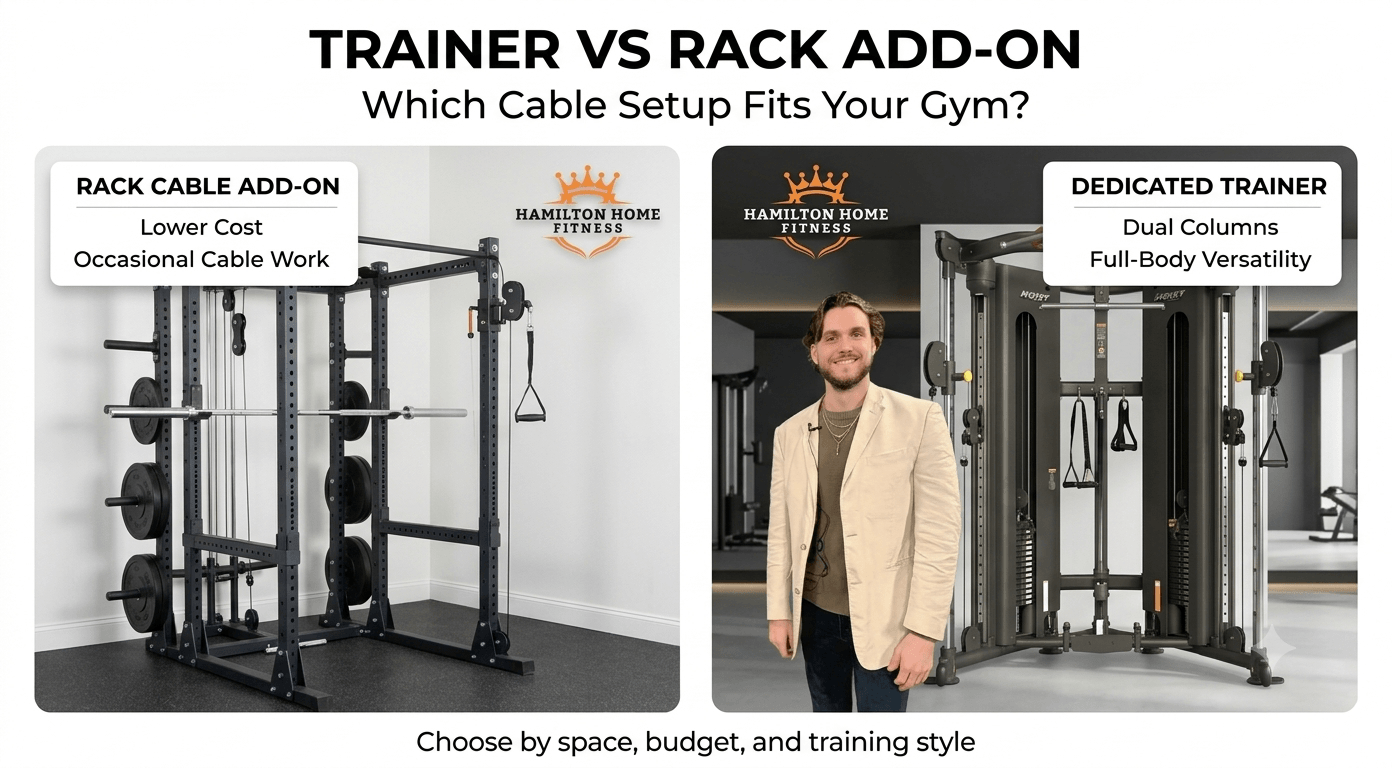
Rack cable add-on | Dedicated functional trainer | |
Best for | Occasional cable work on a rack you already own | Frequent, full-body cable training |
Cable setup | Often a single pulley or stack | Two independent adjustable columns |
Feel | Varies with rack quality and pulley | Engineered for smooth, consistent glide |
Cost & space | Lower cost, no extra footprint | Higher cost, needs its own space |
When a rack cable add-on works
A rack cable add-on suits lifters who already have a solid rack and want light, occasional cable work. If your rack is heavy-gauge and well-anchored, bolting on a pulley or a plate-loaded cable column is a low-cost way to add pushdowns, face pulls, and the occasional row without buying a second machine.
The limits are worth knowing before you commit. Add-ons often give you one pulley or one stack rather than two independent columns, so you lose true dual-cable movements and simultaneous two-arm work. Feel depends heavily on the rack and pulley quality, and the ratio and cable travel may be fixed rather than optimized for range of motion. If your rack is light-duty, skip the add-on — the unit needs to be rock-solid under load. You can see what a suitable frame looks like among our power racks and cages.
Is it worth it vs. free weights?
A functional trainer complements free weights rather than replacing them—it adds constant-tension, joint-friendly variety to a setup you already own. The cable keeps tension on the muscle through the whole range, which free weights can't do at every angle, and it makes movements like face pulls, chops, and cable lateral raises far easier to load well.
Picture the typical case: you already have a rack, a barbell, and dumbbells for your heavy compound work. Adding cables fills the gaps — rows and pulldowns without a partner, controlled prehab and shoulder work, rotational core training, and high-rep isolation that's gentle on the joints. It won't replace barbell squats, presses, or deadlifts, and it isn't meant to. Think of it as the versatility layer on top of your free weights, not a substitute for them.
Home vs commercial use
Home and light-commercial settings—apartments, studios, and hotels—need different durability and warranty tiers than a full commercial floor. The machine that's ideal in a spare bedroom isn't automatically right for a facility seeing dozens of users a day, so match the grade to the environment.
Map your setting to the build you need:
Home and garage: a residential-grade trainer with a quiet stack and a compact footprint is usually plenty.
Light commercial (multifamily, hotel, corporate wellness, small studio, rehab clinic): step up to heavier framing and a light-commercial warranty for shared, all-day use.
Full commercial (membership gyms, athletic facilities): prioritize the heaviest frames, commercial warranties, and serviceability.
If you're outfitting a shared or facility space, our commercial functional trainers are built for that traffic, with the framing and warranty terms those settings demand.
Matching Hoist and Body-Solid to you
Hoist suits buyers prioritizing smooth feel, integrated stations, and club-grade build; Body-Solid suits buyers who want proven, durable cable training at a lower entry price. Both are sound choices—the right one depends on your budget, space, and how much you value a premium feel.
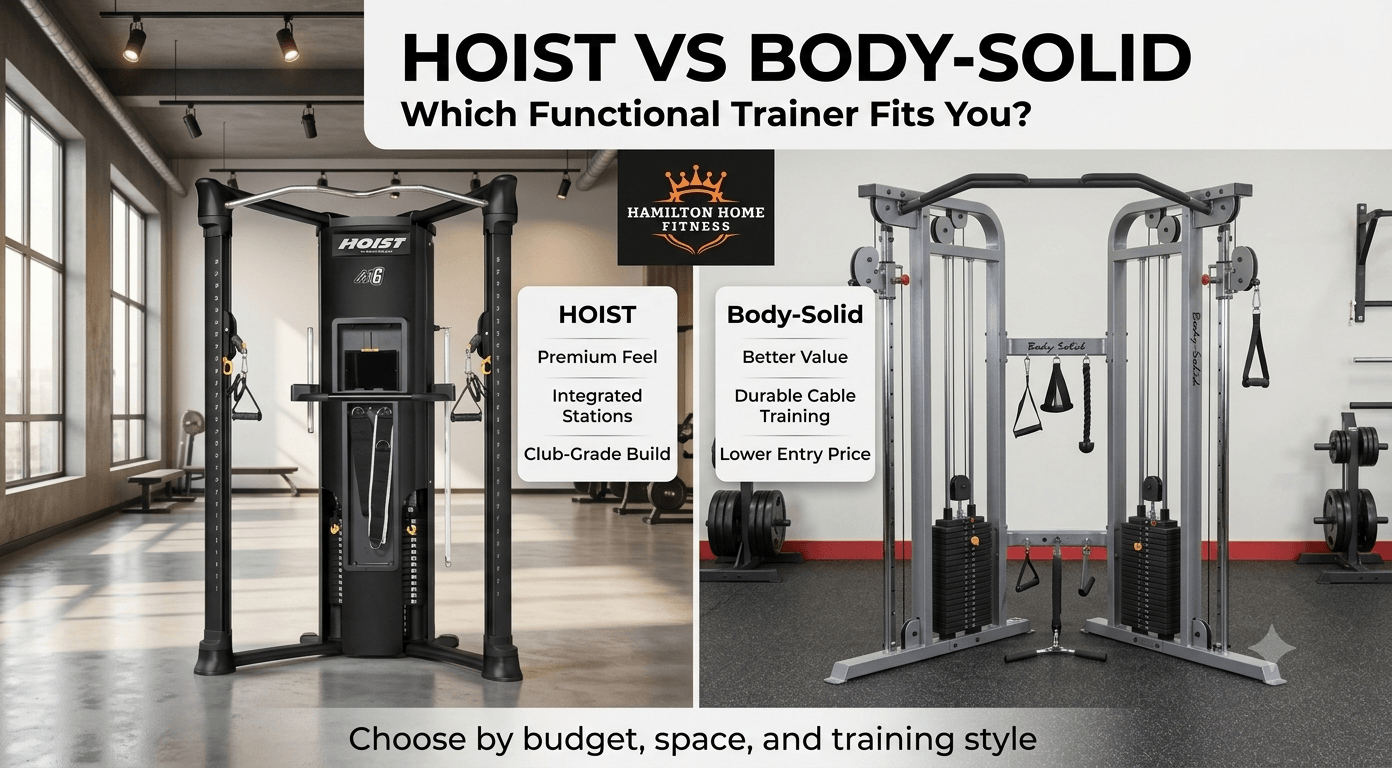
Hoist (H-8, Mi6) | Body-Solid (GDCC series) | |
Cable ratio | 2:1 split-weight cabling | 2:1 (listed as "1/2:1") |
Stacks | Dual 150 lb, upgradeable to 200 | Dual 160 lb. optional upgrades |
Footprint | Corner (H-8) or compact walk-through (Mi6) | Wider crossover-style frame |
Build | Club-grade, Silent Steel stacks | 11-gauge frame, aircraft cable |
Pricing & shipping | Private invoice / freight quote | Lower entry price, ships free |
The Hoist H-8 and Mi6
The Hoist H-8 is a corner 2:1 unit with an integrated Smith machine, lat pulldown, and low row; the Mi6 is its compact, walk-through sibling. The H-8 is the all-in-one choice when you want cable training plus guided barbell work and dedicated back stations in a single corner footprint, with 28 pulley positions per column and long cable travel for full range of motion.
The Mi6 strips that down to the dual-cable essentials in a smaller, walk-through frame—a strong fit when space is tight but you still want Hoist's smooth feel and adjustability. Both run the same 2:1 split-weight system, so the choice is really about whether you need the H-8's integrated stations or the Mi6's compact footprint. You can view the flagship at the Hoist H-8 functional trainer.
Body-Solid as a value option
Body-Solid's GDCC trainers offer dual stacks and an 11-gauge frame at a lower entry price, and they ship free. They run the same effective 2:1 feel, use aircraft-grade cable rated well above the stack, and offer around 20 height positions per column—durable, well-proven cable training without the premium-tier cost.
For many home and light-commercial buyers, that's the sweet spot: commercial-grade construction and free shipping at a price that leaves room in the budget. If you want a credible, value-minded machine that still holds up to daily use, explore Body-Solid.
Why Hoist costs more
Hoist costs more for its club-grade build, smooth Silent Steel feel, and integrated stations, and it's sold through private invoice rather than public pricing. The premium buy offers quieter, glass-smooth stacks; heavier construction; and features like the integrated Smith machine and dedicated back stations—the kind of machine built to hold up on a commercial floor for years.
Viewed as cost of ownership rather than sticker price, durability and resale value change the math, especially for facilities. Because Hoist uses private-invoice pricing, you request a quote rather than seeing a public price online. See the full lineup and request pricing at the Hoist range.
FAQ
Do functional trainers arrive fully assembled?
Usually not. Most ships are by freight, partly assembled, and full assembly or white-glove installation is often available as an add-on. For machines that can weigh 600 to 900 pounds, professional installation is worth it—these aren't quick living room builds.
Is a 2:1 trainer strong enough to train heavy?
For most pressing rows and isolation work, yes. A 2:1 trainer with dual 200 lb stacks gives roughly 100 lb of felt resistance per side, which covers the large majority of cable training. For maximum-effort lat pulldowns and heavy rows, choose a larger or upgradable stack or a dedicated 1:1 station built for heavy pulling.
Does Hamilton Home Fitness ship nationwide?
Yes. Hamilton Home Fitness is Tennessee-based and ships across the US by freight. Hoist is handled through private invoice, while Body-Solid and several other brands ship free. For delivery, freight, and returns details, see our shipping and returns details.
Final Thought
Once you can read cable ratio, stack range, pulley spacing, attachments, and fit, choosing between a hoist, a Body-Solid, or a rack add-on stops being a guess and becomes a clear decision based on your space and goals. The specs that look intimidating on a product page are the same ones that tell you exactly which machine will keep up with your training for years.
The smartest next step is to match the machine to the room before you buy. Book a gym design consultation, and our Tennessee-based team will help you size the right trainer to your space, goals, and budget—and put together a quote, whether you're outfitting a home gym or a full facility.