Introduction
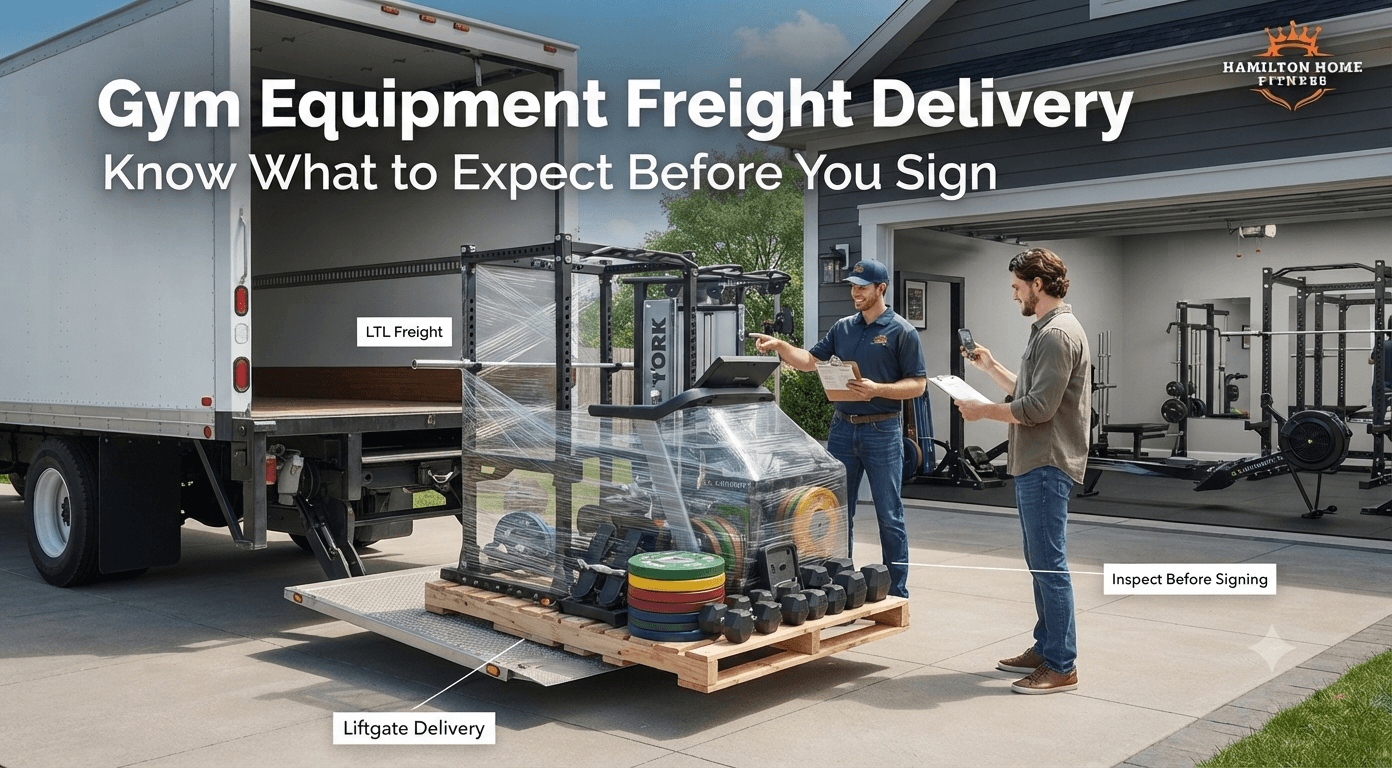
An 18-wheeler is about to pull up to your house with your new power rack — or your treadmill, or a pallet of weight plates — and you've never taken a freight delivery before. What do you check? What are you actually signing? And who pays if it shows up crushed?
This gym equipment freight shipping guide answers all three. You'll learn the four ways heavy equipment gets delivered, what to inspect before you sign, and exactly what to do if your order arrives damaged.
First-time home-gym buyer or facility manager taking a multi-pallet order — the process is the same, and far less stressful once you know the steps. Most deliveries go fine. The ones that don't are usually lost at the curb, in the moment before someone signs the paperwork without really looking.
We'll finish with the easy part: which brands ship free, and how to choose the right delivery option at checkout.
Freight vs. Parcel: Why Gym Gear Ships LTL
Yes — most heavy gym equipment ships by freight, not parcel. Freight, called LTL (less-than-truckload), means your order rides a shared truck on a pallet or in a crate. It's used because the equipment is too big or heavy for standard carriers like UPS, FedEx, or USPS. Parcel handles only the lighter, smaller items.
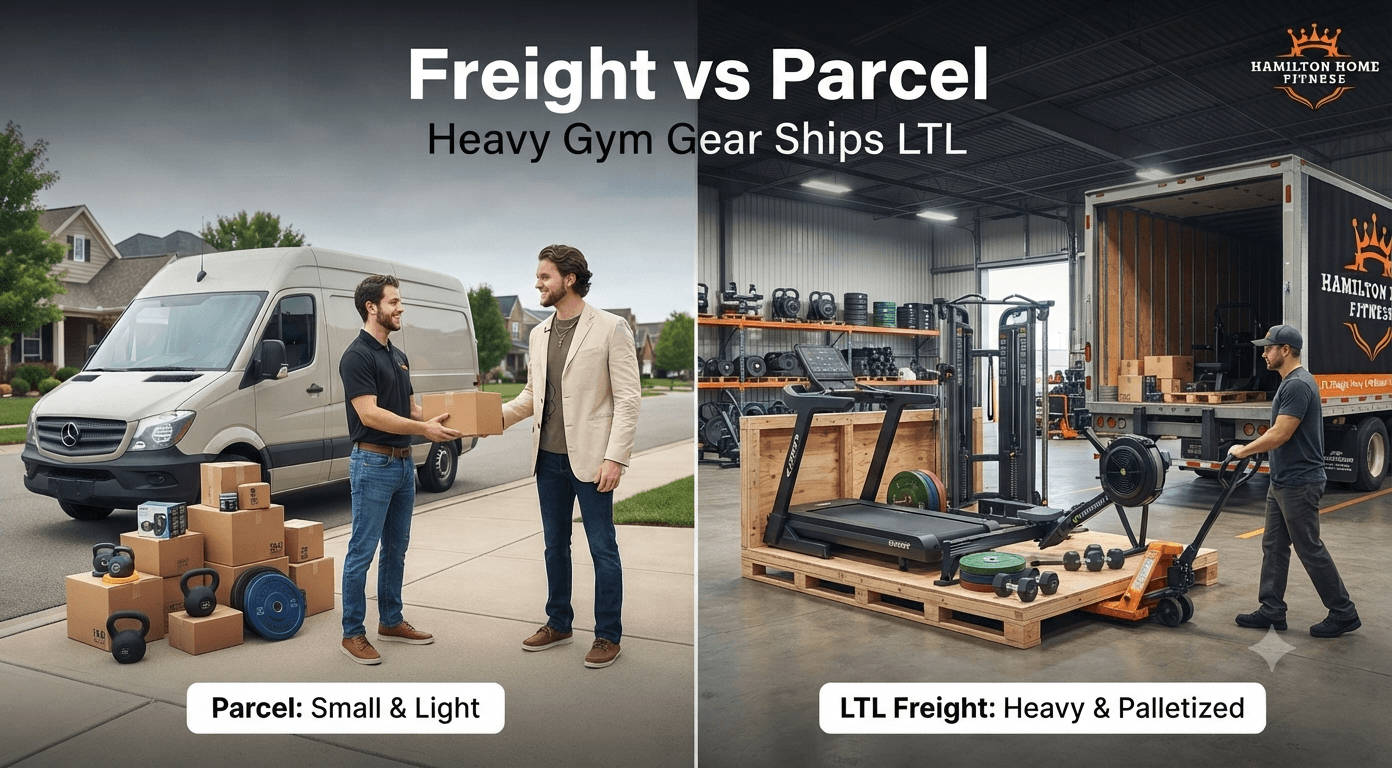
The split comes down to size and weight. Parcel carriers are built for boxes a person can lift and a van can drop at your door. Once an item gets too heavy or bulky for that, it moves to a freight truck instead.
Gym equipment crosses that line fast. A treadmill can top 300 pounds boxed. A functional trainer can run past 600. Even without one giant machine, a full order of plates or dumbbells stacks up to hundreds of pounds — so it palletizes too.
"LTL" just means your pallet shares trailer space with other shipments instead of filling a whole truck. That keeps the cost down, but it's why freight moves differently than a parcel drop-off — a difference the rest of this guide walks you through.
The 4 Ways Heavy Gym Gear Gets Delivered
Heavy gym equipment arrives one of four ways. Curbside drops the pallet at your curb. Liftgate lowers it safely to the ground for you. Threshold brings it just inside your door. White glove carries it to the room, assembles it, and hauls the packaging away. Each level does more than the last — and costs more, too.
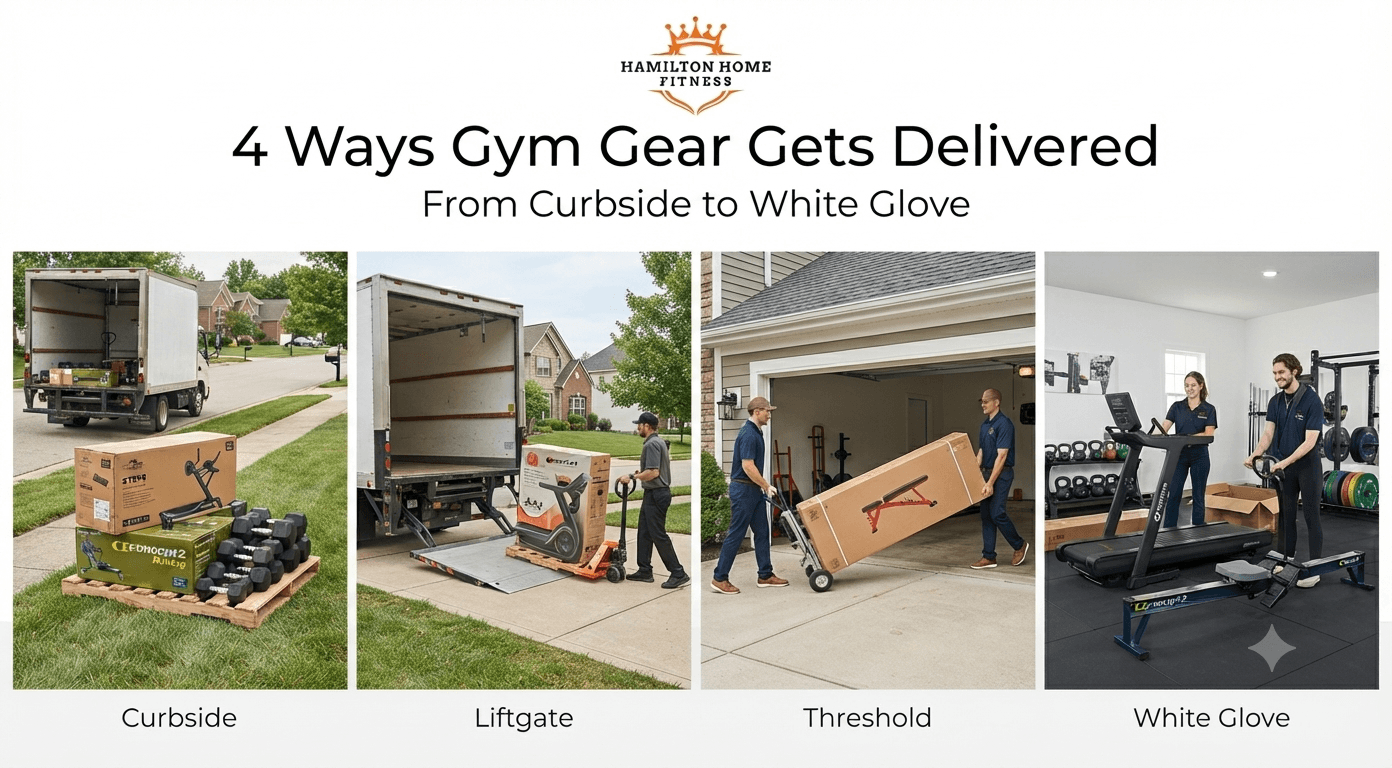
Knowing which is which saves you from a stranded pallet or a fee you didn't expect. Here's how they compare:
Delivery type | What's included | Who it's for | When to skip it |
Curbside | Driver brings the pallet to your curb or driveway; unloading and moving it are on you | Buyers with helpers on hand and a way to get it inside | If you can't unload from truck height or have no one to help lift |
Liftgate | A hydraulic platform lowers the pallet from the truck safely to the ground | Homes and sites with no loading dock or forklift | If you have a dock or forklift to unload the truck yourself |
Threshold | The item is carried just inside your door or garage — no farther | Buyers who want it out of the weather but can handle setup | If you need it in a specific room or fully assembled |
White glove | Carried to the room of your choice, assembled, and all packaging removed | Anyone who wants it set up and ready with zero lifting | If you're happy to assemble it yourself and want to save the cost |
By default, most heavy gym equipment ships curbside, and many orders include a liftgate so you're not wrestling a pallet off the back of a truck. Threshold and white glove are upgrades you choose when you want the equipment brought in — or set up — for you.
Which Gym Equipment Ships on a Pallet?
Large machines and heavy bulk orders ship freight; small accessories ship parcel. A power rack, smith machine, treadmill, rower, or functional trainer almost always arrives on a pallet. So does a heavy order of plates or dumbbells — even without one giant item — because the combined weight crosses the limit parcel carriers can handle.
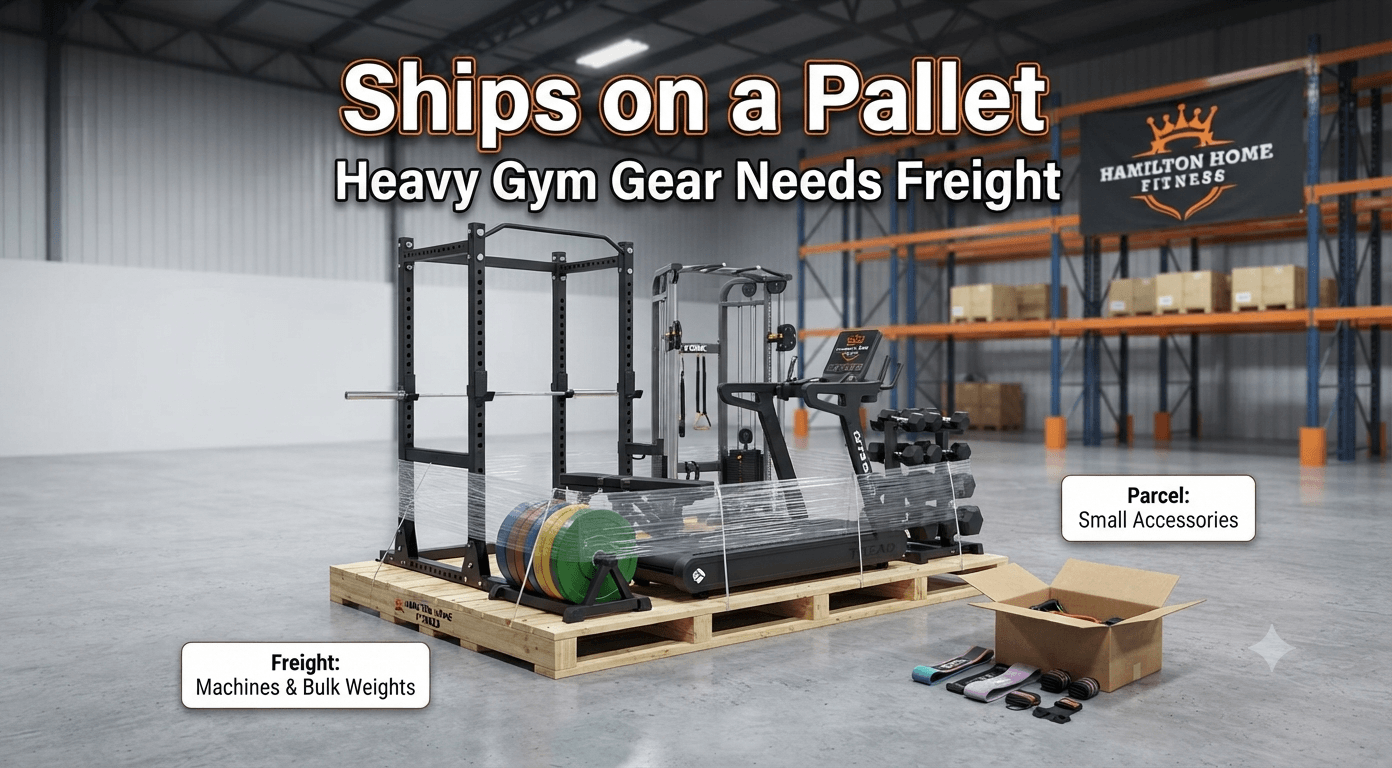
Here's how the most common orders break down, so you know what to expect for yours:
Item | How it ships |
Power rack, half rack, or smith machine | Freight — palletized |
Treadmill, elliptical, exercise bike, or stair climber | Freight — palletized |
Rower or functional trainer | Freight — palletized |
Plate-loaded or selectorized machines | Freight — palletized |
Sauna or cold plunge | Freight — usually crated |
Heavy orders of plates, dumbbells, or kettlebells | Freight — palletized by total weight |
Small accessories — bands, straps, grips, gloves | Parcel — UPS, FedEx, or USPS |
The pattern is simple. Anything with a heavy steel frame ships palletized because there's no other safe way to move it — power racks and cages, smith machines, plate-loaded stations. The same goes for large cardio equipment such as treadmills, which are heavier and bulkier than they look once boxed. Saunas and cold plunges ship freight too, usually crated to protect the shell or panels in transit.
The part that surprises first-time buyers is weight without size. A single kettlebell might ship parcel. But a full set of free weights like plates and dumbbells can total several hundred — sometimes over a thousand — pounds. Parcel carriers cap out well below that, so the whole order moves freight, even when no single piece is large.
Will the Truck Reach My Home or Gym?
Yes, freight delivers to homes — but the driver's job ends at the curb. They won't cross grass, gravel, or slopes, carry items indoors, or go up stairs. If you need it inside, in the basement, or upstairs, plan for a liftgate plus helpers, or upgrade to white glove or professional installation.
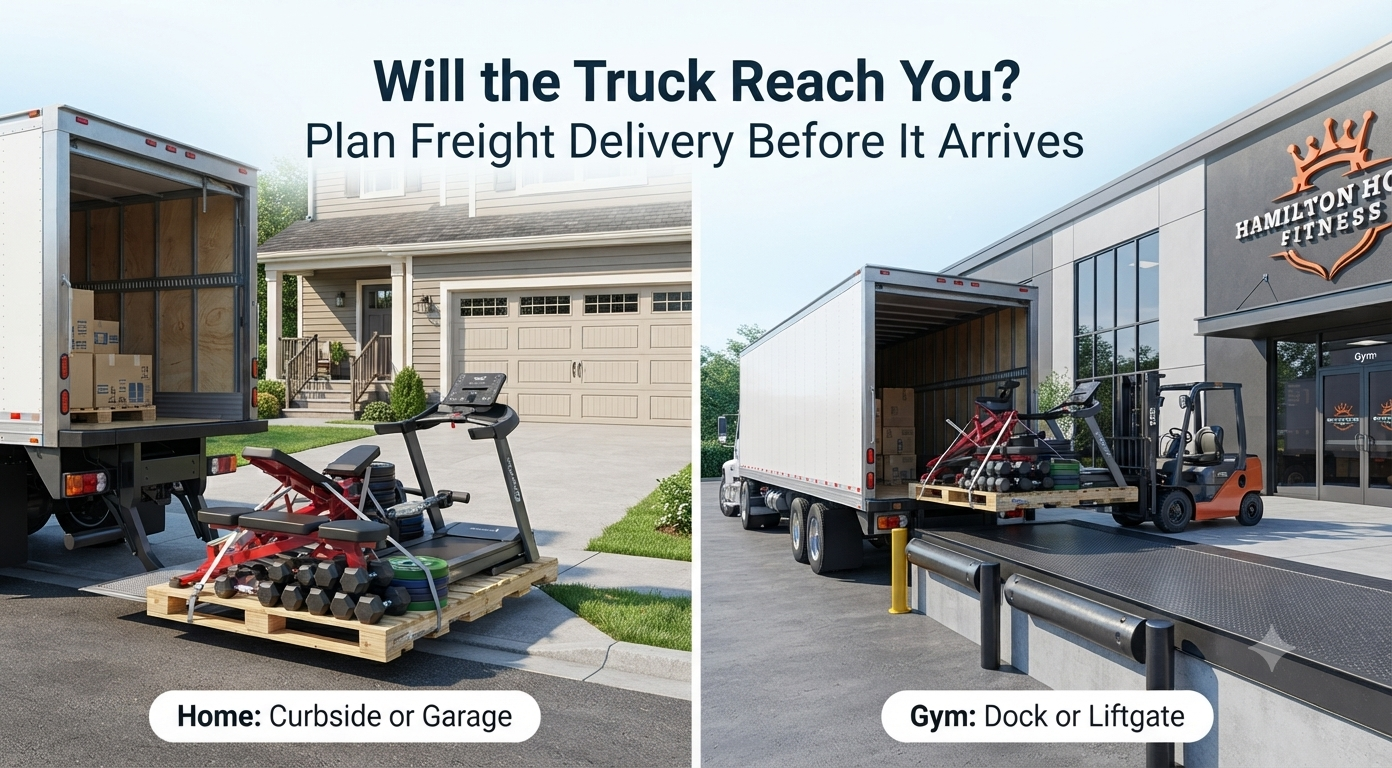
That one rule saves most delivery-day headaches. The truck gets your order to the ground; where it goes from there depends on the service you picked and the layout you're working with.
Home Delivery: Garage, Basement, Stairs
For home delivery, expect the pallet at your driveway or curb — getting it inside is on you unless you upgrade.
A ground-floor garage is the easy case. If the driveway is paved and flat, a liftgate lowers the pallet and you and a helper can roll or carry it a few feet through the garage door. Two able bodies and a hand truck usually handle it.
A basement gym is harder. Once the pallet is at the curb, you're moving heavy boxes down a flight of stairs and around tight turns — often the trickiest part of the whole delivery. Line up help before delivery day, and consider an appliance dolly for anything you'd struggle to grip.
A second-floor apartment or condo is the toughest. Curbside means the lobby or the bottom of the stairwell, not your unit. If there's no elevator, or the piece won't fit in one, that's exactly when threshold or white glove earns its cost — the crew carries it up and, with white glove, into the room and assembled. If you'd rather not haul a 300-pound box up a staircase yourself, pay for the room-of-choice upgrade.
Commercial Delivery and Loading Docks
For gyms and facilities, delivery runs on a scheduled appointment, and a loading dock or forklift changes everything about how it unloads.
With a dock or forklift, unloading is quick. The truck backs in, your team moves the pallets off directly, and you skip the liftgate entirely. This is the smoothest path for a hotel, school, or health club taking a multi-pallet order.
Without a dock, plan like a residential delivery at scale. You'll want a liftgate on the truck and enough staff on-site to move several heavy pallets during the delivery window — not one person trying to receive an entire gym alone.
Either way, book the appointment for a time your team is actually free, and have hands ready when the truck arrives. For larger facility orders, HHF Commercial Fitness can help plan the delivery and installation so a full build-out doesn't land on your staff to sort out at the curb.
How to Inspect and Sign for Freight
Before you sign, inspect the shipment with the driver present. Walk the pallet, check the wrap, corners, and carton count against the paperwork, and open anything that looks hit. If you spot damage, write exactly what's wrong on the delivery paperwork before you sign — that note is what protects your claim.
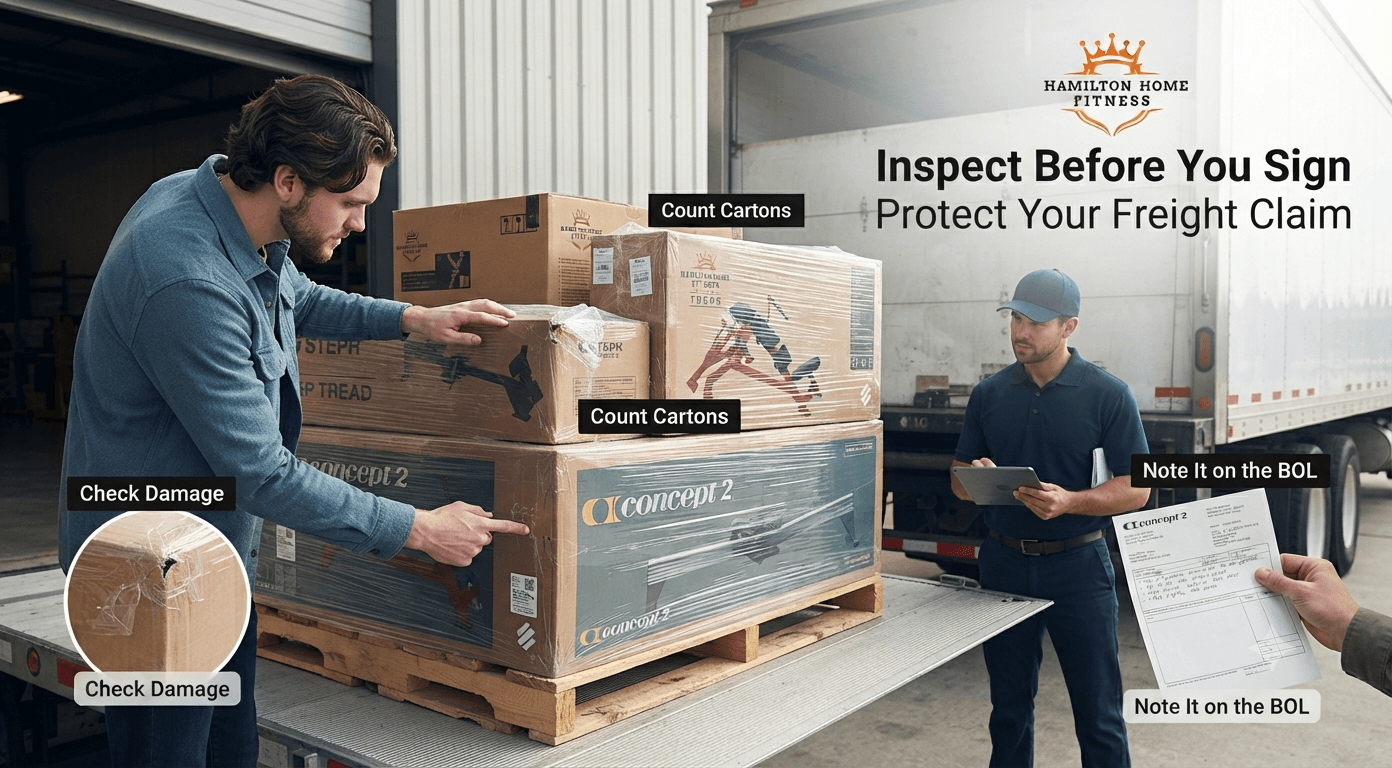
This is the two minutes that decide whether a problem is the carrier's to fix or yours to eat. Don't let the driver rush you, and don't sign first and look later.
What to Check Before You Sign
Do a two-minute walkaround before you sign anything.
The driver will hand you a delivery receipt — often the BOL, short for bill of lading, the document that lists what's on the truck and shifts responsibility to you once you sign it. Treat your signature as the moment the shipment becomes your problem. So look first:
Count the pieces against the number listed on the paperwork. A pallet plus three cartons should be a pallet plus three cartons.
Check the pallet wrap and straps. Torn shrink wrap, cut straps, or a re-wrapped look can signal rough handling.
Scan the corners and edges for crushing, punctures, or forklift holes poked through a box.
Look for stains or water damage on the cardboard, which can point to trouble inside.
Open anything that looks hit while the driver is still there, so you can see the actual product, not just the box.
If everything checks out, sign and enjoy your equipment. If something's off, don't wave the driver away — move to the next step before you sign.
How to Note Damage on the BOL
Vague notes lose claims — write the specific damage, not "subject to inspection."
Here's the trap: a note like "possible damage" or "subject to inspection" has no real weight. It doesn't describe anything, so a carrier can wave it off later. What protects you is a plain, specific description of what you actually see.
Weak note (won't hold up) | Strong note (protects your claim) |
"Subject to inspection" | "Crushed left corner, box torn, dent in frame visible" |
"Possible damage" | "Two boxes water-stained, one carton missing from count" |
Write the specific version on both the driver's copy and yours, before you sign. Then photograph everything — the damage, the packaging, and the pallet — and, if you can, have the driver initial next to your note so there's no dispute about whether it was there at delivery. Keep all of it. Those photos and that annotated paperwork are the backbone of any claim.
What to Do If Your Order Arrives Damaged
If your order arrives damaged or short, don't panic and don't throw anything away. Note the damage on the paperwork, photograph everything, and keep all the packaging. Then contact Hamilton Home Fitness right away. In most cases you accept and document the shipment rather than refuse it — refusing can complicate your claim.
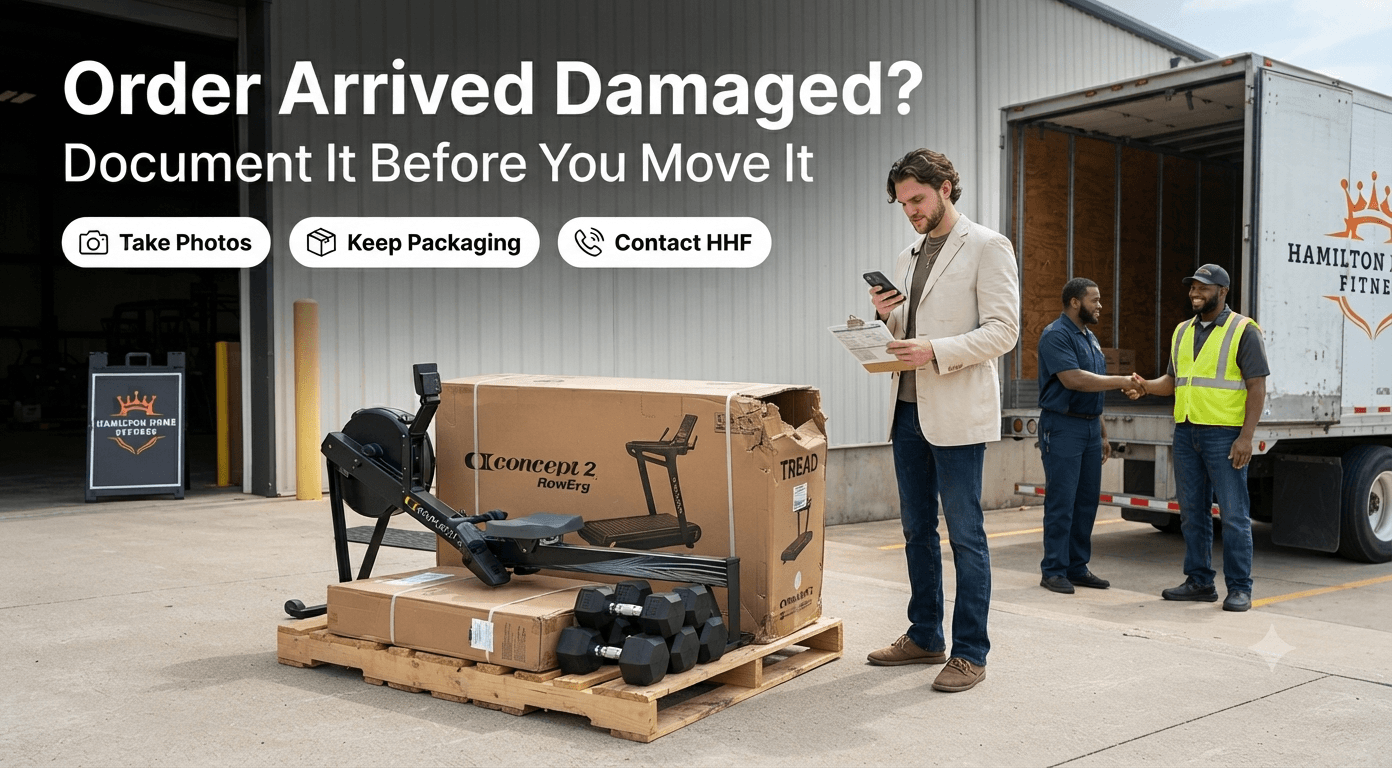
Who ends up responsible depends on where and how the damage happened, which is exactly why documentation matters so much. Solid notes and photos let the problem be sorted out fairly instead of turning into your word against the carrier's. This is general guidance, not legal advice — the specifics of any claim come down to your paperwork and the carrier's terms, so let HHF walk you through it.
The steps are simple, and the order matters:
Note it on the delivery receipt before you sign, in specific terms.
Photograph everything — the damage, the boxes, and the pallet.
Keep all packaging exactly as it arrived. Don't break it down or toss it.
Contact HHF quickly so the claim starts while the trail is fresh.
Visible Damage vs. Hidden Damage
Some damage is obvious at delivery; some hides until you unbox — and the second kind is time-sensitive.
Visible damage is what you catch at the truck: a crushed corner, a torn box, a dented frame. You handle that on the spot by noting it and photographing it before you sign.
Hidden damage — often called concealed damage — is the one that catches people out. The box looks fine, you sign, and days later you unbox a cracked panel or find a carton missing from the order. This is where the clock matters. Reporting a concealed problem is usually a short, carrier-set window, so the moment you find it, stop, photograph it, and contact HHF — don't wait, and don't assume it's too late to check. Keep the original packaging until the claim is settled, because it's often part of how the damage gets verified.
Should You Ever Refuse a Delivery?
Usually, no — accept and document instead of refusing.
It feels natural to reject a damaged shipment and send it back. But refusing often works against you. Once the freight is back in the carrier's hands, you lose control of it, it can pick up more damage in transit, and some claims are harder to win when you're no longer holding the goods.
The better move in almost every case: accept the shipment, note the damage in detail, photograph it, and keep it. That leaves you in control and your claim intact.
The narrow exception is a shipment that arrives clearly destroyed — not scuffed, but wrecked. Even then, don't decide alone at the curb. Note the condition, photograph it, and call HHF first so the right call gets made together, whether that's refusing and reshipping or accepting and filing.
Free Shipping and Choosing Your Delivery
Once you know what to expect, choosing is simple. Hamilton Home Fitness ships free on five brands, and at checkout you pick the delivery level your space needs. For a heavy commercial order or a full room, you can request delivery and professional installation instead of handling it yourself.
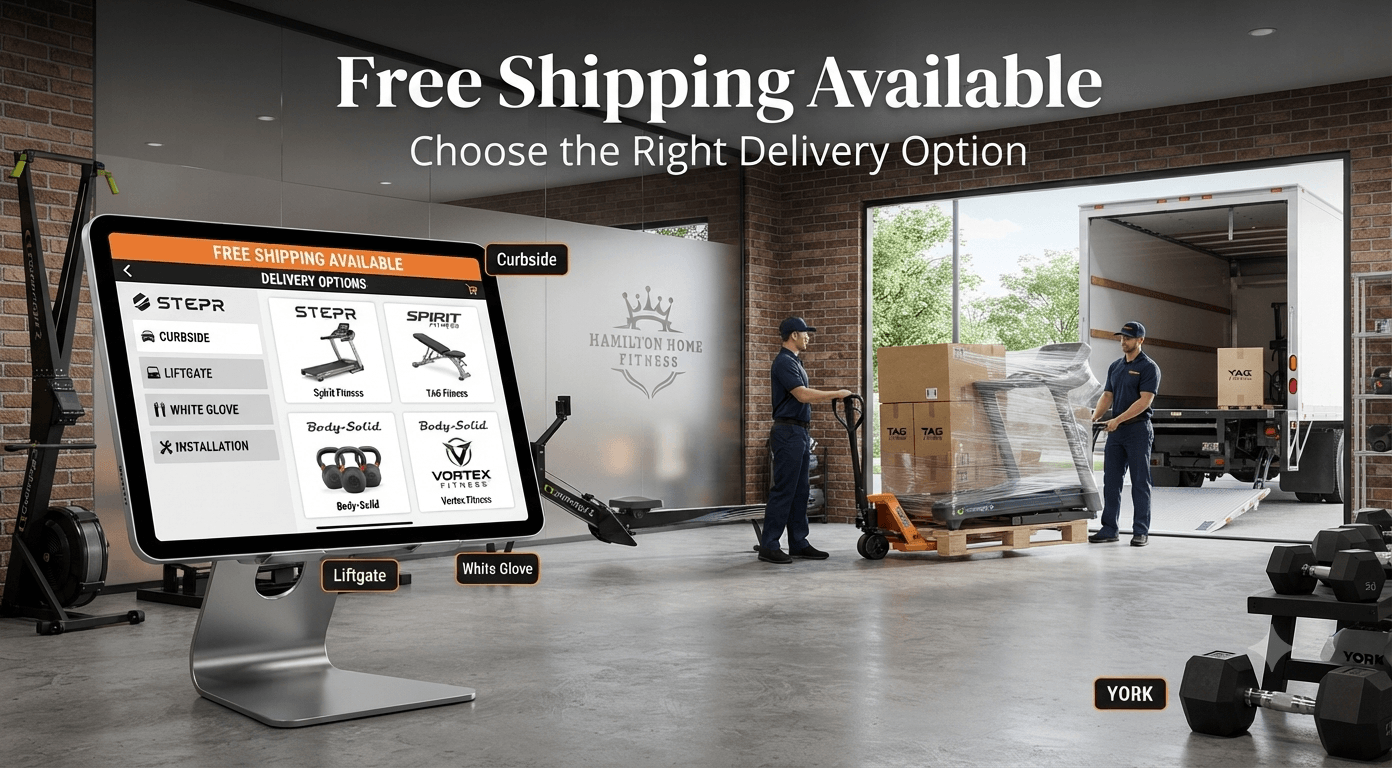
No guesswork, no surprise at the curb — just the right service for your order and your space.
Brands That Ship Free
Free shipping applies to STEPR, Spirit Fitness, TAG Fitness, Body-Solid, and Vortex Fitness.
Each fits a different buyer. Spirit Fitness and Vortex are worth a look if you're outfitting cardio or a full facility. Body-Solid and TAG Fitness suit strength setups, from home racks to commercial floors. STEPR is designed for buyers after a stair climber. If your equipment falls under one of these brands, the freight cost is already handled — one less number to weigh at checkout.
Choosing Delivery at Checkout
Match your delivery choice to your space and the weight of your order.
If you've got helpers and a way to get the pallet inside, curbside with a liftgate is usually enough. If your space is tight — a basement, an upper floor, a narrow entry — threshold or white glove is worth the upgrade to have it carried in. And for a heavy commercial order or a full room build-out, you can book a gym design and installation so the equipment arrives set up and ready, not stacked on pallets for your team to sort out.
Before you commit, it's worth a quick read of the Shipping & Returns policy so you know how returns and refunds work on undamaged equipment. Then pick the option that fits — or reach out for a quote if a big order needs a hand.
FAQ
How long does freight delivery take?
Freight usually takes longer than parcel. Your order needs processing and palletizing before it ships, then moves terminal-to-terminal rather than straight to your door. Once it reaches your local terminal, the carrier calls to schedule a delivery appointment. Transit time depends on your distance from Tennessee and whether the item is in stock. For a firm estimate on your order, check the item's product page or contact Hamilton Home Fitness.
Do I need a liftgate for a treadmill?
Usually yes, if your home has no loading dock. A treadmill is heavy and ships on a pallet, so a liftgate lowers it safely to the ground instead of leaving you to unload from the back of a truck. You'll still need a helper to move it inside.
Which brands ship free at Hamilton Home Fitness?
Free shipping applies to STEPR, Spirit Fitness, TAG Fitness, Body-Solid, and Vortex Fitness.
Final Thought
You now know how heavy gym equipment actually gets to you. You can tell curbside from liftgate from white glove and pick the one your space needs. You know to inspect the pallet and note any damage before you sign — the two minutes that protect your money. And if something arrives damaged, you know to document it, keep it, and call rather than panic.
Freight feels intimidating right up until you know the steps. Now you do — and most deliveries go smoothly for buyers who receive them the right way.
When you're ready, Hamilton Home Fitness ships free on STEPR, Spirit Fitness, TAG Fitness, Body-Solid, and Vortex Fitness, and can deliver and install larger orders so you're not receiving a full gym alone. Pick the delivery option that fits your space at checkout — or reach out for a delivery-and-install quote on a bigger order.