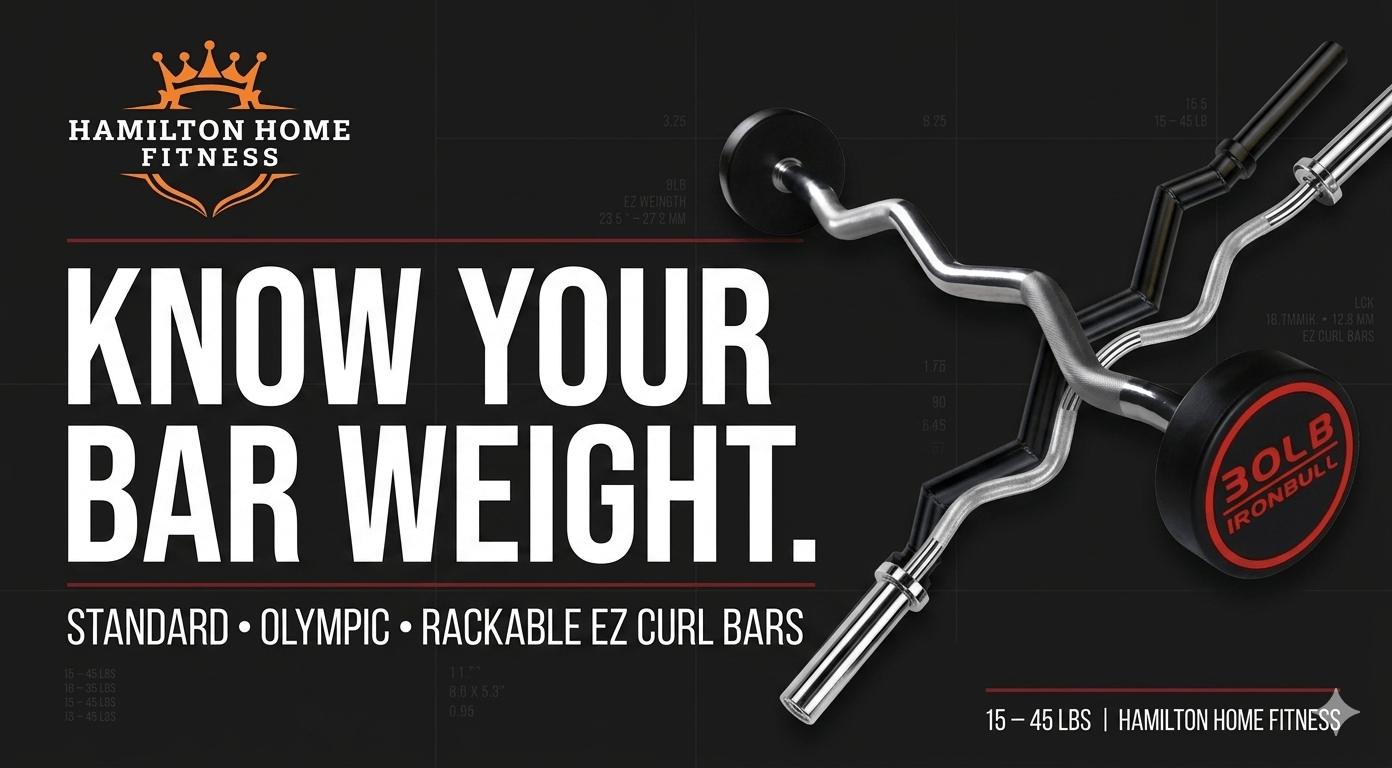
Calculate Total EZ Bar Weight
How do you calculate total weight on an EZ bar?
To calculate total weight on an EZ bar, add the bar weight without plates to the plates on both sides, and include collars only if you know their weight. The clean formula is: Total = bar + left plates + right plates (+ collars).
Here’s a real-life example I use when I’m logging curls and don’t want “math fatigue” to ruin the session:
- Bar: 25 lb
- Plates: 10 lb per side (20 lb total)
- Collars: not counted
Total = 25 + 20 = 45 lb
Quick checklist (so you don’t double-count):
- Confirm the empty ez curl bar weight once
- Count plates on one side, then multiply by 2
- Add collars only if you always use the same pair
Do curl bars come in kilograms (kg)?
Yes—some curl bars are labeled in kg, and plenty of lifters mix units without realizing it. If your bar is marked in kg and your plates are in lb (or vice versa), your log can quietly drift.
A simple conversion you can remember: 1 kg ≈ 2.2 lb. So a 10 kg bar is about 22 lb. If you’re using a curl bar weight in kg, write it that way in your notes—or convert once and stick to one unit so your progress stays honest.
EZ curl bar weight without plates
An EZ curl bar without plates is just the empty bar weight, and that number is your “base” for every curl session. Once you know it, tracking becomes easy—and weirdly satisfying.
Example: If your empty bar is 20 lb and you add 15 lb per side, that’s 20 + 30 = 50 lb total. No guessing, no inflated PRs, just clean data you can build on.
People Also Ask
How much does a curl bar weigh?
Most curl bars fall into a range, not one exact number, because the design and sleeves change the weight. A common home-gym curl bar might be 15–30 lb, but your bar could be different.
How much does an EZ curl bar weigh without plates?
An EZ curl bar without plates is simply the empty bar weight—no plates, no extras. For example, if your EZ bar is 20 lb, that’s your baseline before you add anything.
Is a curl bar 20 pounds or 25 pounds?
It can be either, depending on the model. If your bar is labeled 20 lb, trust that; if it’s unlabeled, 25 lb is also a common option you’ll see in gyms and listings.
Are all curl bars the same weight?
No, and this is where people get tripped up. A short standard bar and an Olympic-style bar can look similar but weigh differently because of sleeve size and build.
How much does an Olympic curl bar weigh?
An Olympic curl bar is usually heavier than a standard one because it’s built for 2-inch plates. Many land around 20–35 lb, but the exact weight depends on the specific bar.
How do I find the weight of my curl bar?
Check the bar for a stamp or label first—end caps and sleeves are the usual spots. If there’s nothing printed, use a bathroom scale method to confirm it instead of guessing.
Do curl bars come in kilograms (kg)?
Yes—some bars are labeled in kg, especially in brands that list specs internationally. If your bar says 10 kg, that’s roughly 22 lb.
How much does a rackable EZ curl bar weigh?
Rackable EZ bars are typically heavier because they’re longer and built to sit on a rack safely. Many are around 25–45 lb, but you should confirm the listed empty weight before buying.
What’s the difference between a curl bar and an EZ bar?
In most gyms, they’re the same thing: an angled-grip bar designed to make curls feel better on wrists and elbows. The “EZ bar” name just shows up more often on product listings.
Does the curl bar weight include collars?
Usually, no—people mean the bar only unless collars are clearly included. If you always use collars, weigh them once (even about 1 lb total can matter for tracking).
How do you calculate total weight on an EZ bar?
Add the bar’s empty weight to both sides of plates, and include collars only if you know their weight. Example: 25 lb bar + (10 lb per side) = 45 lb total.
What is the lightest curl bar for beginners?
The lightest options are usually shorter curl bars or lighter fixed bars, which feel easier to control. If your goal is form and comfort, starting around 15–20 lb can be a smart, confidence-building choice.
Final Thought
Knowing your curl bar weight shouldn’t feel like a guessing game. Once you identify whether you’re using a standard, Olympic, rackable, or fixed EZ bar, everything gets easier—plate loading makes sense, your numbers stay honest, and your progress finally feels real. I’ve seen lifters stall for weeks just because their “20 lb bar” was actually heavier, and they were unknowingly chasing the wrong targets.
Here’s your next step: verify your empty bar weight one time, write it down, and use the same simple total-weight formula every session. If you’re building out a home setup (or upgrading a studio), choose a curl bar that matches your plates, rack, and space—because compatibility saves headaches later.
And if you want gear that feels solid, ships across the U.S., and fits real-world training goals, Hamilton Home Fitness is the place to start. The right bar won’t just make curls smoother—it’ll make consistency easier, and consistency is what changes bodies.