- BODY SOLID
Authorized:











Treadmills

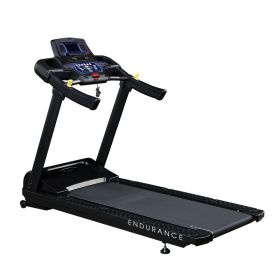
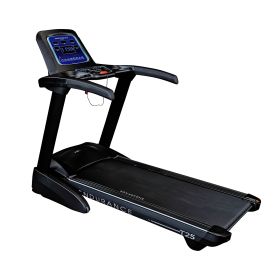
Home gym treadmills take weather, gym crowds, and the commute out of your cardio. This treadmill collection spans folding decks for spare rooms, curved motorless runners for conditioning, and commercial-grade platforms for heavy use, so walkers, runners, and garage-gym athletes can match the machine to how they actually train.
Match your training style to the features that matter most before you compare models.
| Training style | What to prioritize |
|---|---|
| Daily walkers and seniors | Wide cushioned belt, low step-up height |
| Joggers and weekend runners | 12%+ incline |
| Endurance and HIIT athletes | Full incline-decline range, quick speed response |
| Therapy and recovery users | Low start speed, secure handrails, gradual incline |
| CrossFit and conditioning | Curved manual or commercial slat-belt model |
| Small spaces | Folding deck with transport wheels |
| Commercial settings | AC motor and multi-year labor warranty |
If a treadmill is part of a rehab or recovery plan, confirm the program with your clinician first.
How to Choose a Home Gym Treadmill
Four decisions settle most of the choice: the motor, the deck, the incline range, and the fit in your room. Get those four right, and the rest of the spec sheet falls into line.
Budget treadmills tend to break down in the same three places. A weak motor overheats, a thin belt grinds, and a flimsy frame wobbles at speed. If a model skimps on any of the three, keep shopping.
Motor: Continuous Power, Not Peak
Undersizing the motor and every workout shortens its life. How much horsepower do I really need for a home treadmill? Walking asks the least of a motor; mixed jogging calls for 2.5 to 3.0 continuous horsepower (CHP), and daily runners and HIIT users should target 3.0 CHP or higher. Read the continuous rating and skip the peak-HP figure, because continuous duty is the only number that reflects real-world endurance.
Where you train shapes the motor type too. In a basement or spare room, a quality DC motor keeps the noise down. An AC drive handles nonstop, multi-user sessions without thermal cutoffs, the protective shutdowns a motor makes when it runs too hot.
Belt, Deck, and Cushioning
Belt size decides whether a treadmill feels safe at speed. What size treadmill do I need for running at home? A 20" × 60" belt is the runner’s gold standard, and on a steel frame with a runner-grade motor it is the safe minimum for true running.
Cushioning earns its place for taller users, returning runners and anyone training on consecutive days.
Speed, Incline, and Programs
A speed range of 0 to 12 mph covers nearly every home user. Incline adds hill simulation, a higher calorie burn, and lower-impact intensity, and premium models add decline for downhill work. Built-in programs and touchscreen consoles bring variety, but they should back up solid mechanics and never stand in for them.
Motorized, Curved, or Folding?
Pick the type by where and how you train, because each one trades something for something else. These three models show how far the specs spread across our home gym treadmills.
| Spec | BowFlex T9 | STEPR Tread Pro Classic | APE Wood Motorless |
|---|---|---|---|
| Drive | Motorized | 3.5 HP brushless servo motor | None, stride-driven |
| Running surface | 22" W × 60" L | 63" L x 23" W | 55 × 19 inches |
| Top speed | Up to 12 mph | Up to 13.7 mph | Stride only |
| Incline | Up to 15% | Up to 18% | No incline setting |
| Max user weight | 350 lbs | Up to 330 lbs | 265 lbs |
| Warranty | Lifetime frame and drive motor | 10-year frame, 3-year parts, 2-year labor | Manufacturer warranty; terms differ by model |
Motorized treadmills are the default for most home gyms. They hold a set pace, run programmed workouts, and raise the incline for you, which gives you predictable training data and a smooth ride from walking to intervals.
Curved manual treadmills hand the pace to your legs. The belt moves only as fast as you drive it, and with no motor there is nothing to burn out. That self-driven belt makes a curved model a strong treadmill for CrossFit sprints, because you accelerate and stop on your own effort. Browse our curved, motorless treadmills to compare them.
Is a folding treadmill good for a home gym? Yes, for apartments, spare bedrooms, and shared spaces, as long as you skip budget builds with plastic hinges and choose a hydraulic-assist lift for a safe one-handed setup. Choose folding if the room has another job, and choose a rigid frame if the treadmill owns the space, since a fixed frame gives a steadier ride and a longer service life.
Once you know your type, compare models in the lineup by belt size, motor, and warranty.
What to Check on Any Spec Sheet
Run every model on your shortlist through these checks. Even a treadmill with long warranty coverage has to clear the rest of the list.
✅ Multi-zone, shock-absorbing deck
✅ Incline range reaching at least 15%
✅ Steel-welded frame, not a stamped one
✅ User weight capacity: 300 lbs or higher
✅ Clear console with heart rate input
✅ App or wearable connectivity
✅ Lifetime frame and motor warranty
✅ Parts and labor coverage in writing
Commercial-Grade Treadmills for Home
Are commercial treadmills worth it for home use? Yes, when you train daily, share the machine with family or run a small studio. Heavy-duty treadmills carry heavier motors, sturdier frames, and larger belts, and that build usually means fewer service calls and a longer working life.
The STEPR Tread Pro Classic, listed as light-commercial, and the Tread Pro Plus bring that build into a room you can actually fit at home, alongside Spirit Fitness commercial lines. If the machine will see constant use, explore the full commercial treadmill range.
Qualifying STEPR, Spirit Fitness, and Vortex orders ship free, so start with those lines if delivery cost weighs on the decision. The wider collection also covers Sunny Health & Fitness at the entry end, plus APE, Renegade, Apollo, Body-Solid Endurance, and BowFlex.
Space and Setup Before Delivery
Plan the room before you order. How much space does a home treadmill need? The machine’s footprint plus the clearance its owner’s manual sets. Spirit’s CT800 manual, for example, calls for at least 1 m (39 in.) behind the machine and 0.5 m (19.7 in.) on each side.
If you’re setting up a treadmill for garage training or any other room, run these checks before delivery day:
- Tape the footprint and clearance zone on the floor
- Photograph the outlet and its breaker label
- Measure every doorway, stair, and turn on the route
- Confirm the floor is level where the deck will sit
Want a second set of eyes on the layout? Book a gym design, and our team can plan the room around your equipment and traffic flow.
Confirm the circuit, outlet, and clearance in the owner’s manual before your treadmill ships.
Who These Treadmills Suit
It suits you if you:
- Want to walk, jog, and sprint on one machine
- Train before work or after dark at home
- Share one machine across a household
Rethink it if you:
- Want cardio with no footstrike at all
- Need upper-body work in the same session
- Need a machine two people can use at once
If the second list sounds like you, start with a different machine. Our wider cardio equipment range covers ellipticals, exercise bikes, rowing machines, and stair climbers.
Home Treadmill FAQs
Can you keep a treadmill in a garage? Yes, if the garage stays inside the manual’s operating range. Spirit lists an operating temperature of 40 to 120 degrees Fahrenheit and 95% non-condensing humidity for its CT800 and says the machine is not designed for outdoor or high-humidity use. If winter pushes your garage below that range, heat the space or choose another room.
Does a treadmill need a dedicated circuit? Some do, and the manual says which. Spirit’s CT800 manual specifies a nominal 120-volt/15 amp dedicated circuit and warns never to use a GFCI wall outlet, the type of outlet that cuts power when it senses a ground fault. Spirit’s CT850 and CT900 use a 5-20P NEMA power plug, a 20-amp plug that needs a matching outlet.
Can you use an extension cord with a treadmill? Avoid it. The Spirit's CT800 manual says not to use one, and if one is unavoidable, to keep it as short as possible and heavy-duty 16 gauge minimum. Plugging straight into a wall outlet on the right circuit is the safer setup.
Can a treadmill work without electricity? Yes, a motorless one can. The Vortex CVX2500 uses an all-mechanical, non-electric drive, so it keeps running through power interruptions. You trade a powered incline for that independence.
What treadmills do gyms use? Gyms run commercial-rated treadmills built for hours of daily use. Spirit Fitness labels its CT900 Full Commercial and pairs a 5.0 HP AC drive system with a 22” x 62” workout area.
Find Your Treadmill Fit
Shop the lineup and open any model for its full spec sheet before you add it to your cart. If a listing leaves out a figure you need, such as a user weight limit or assembled size, call 423-458-2453 before you order. Hamilton Home Fitness ships home gym treadmills nationwide from Tennessee with insured freight.
- STEPR—premium Tread Pro and Pro Plus models with slat-style ride feel and gym-grade build quality
- Spirit Fitness—quiet, reliable home and light-commercial treadmills with strong warranty backing
- True Fitness—biomechanically engineered running surfaces trusted in elite athletic clubs
- Horizon Fitness—accessible home models with thoughtful console design and proven motors
- Matrix Fitness—full commercial cardio platform for studios, corporate gyms, and multi-family facilities
- Vortex—durable curved manual treadmills built for conditioning, intervals, and sled-style work
Secure Payments